Rejection Sensitive Dysphoria Isn’t You Being Oversensitive. It’s Your Nervous System Misfiring.

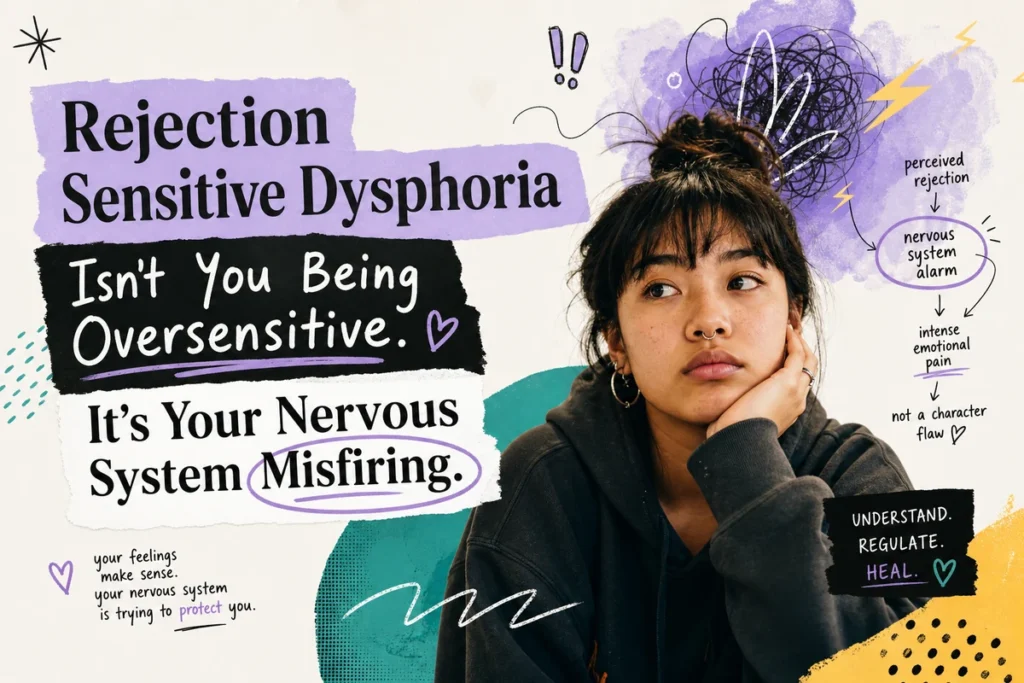
When something tips you into a spiral of shame, fury, or despair because someone’s tone of voice shifted, a message went unanswered, or feedback landed harder than intended, the standard explanation on offer is that you are too sensitive. That you need thicker skin. That you are overreacting to something objectively small. The word “oversensitive”, does a lot of damage when applied to rejection sensitive dysphoria in the context of ADHD, because it frames a neurobiological event as a character defect. What is actually happening is a misfiring in the dopamine and norepinephrine systems that regulate emotional intensity. Your nervous system is not responding disproportionately because you are weak, it is wired to respond this way from years of hypervigilance. It is responding disproportionately because it is wired to, and understanding that distinction changes everything about how you relate to yourself.
What Rejection Sensitive Dysphoria Actually Is
Rejection sensitive dysphoria, or RSD, is the term used to describe the intense, sudden emotional pain that people with ADHD experience in response to perceived or real criticism, rejection, failure, or teasing. The word “dysphoria”, is not accidental. It is borrowed from the Greek for “difficult to bear,”, and that precision matters because this experience sits categorically apart from ordinary disappointment.
RSD is not currently listed as a formal diagnostic criterion in the DSM-5, but it is well-documented in clinical literature and recognized across ADHD research as an expression of the broader emotional dysregulation that characterizes the condition. Faraone et al. (2019, Journal of Child Psychology and Psychiatry) described emotional dysregulation as a primary feature of adult ADHD with significant clinical relevance, noting that it compounds impairment across virtually every major life domain. Research on prevalence puts emotional dysregulation in adults with ADHD somewhere between 30 and 70 percent, depending on criteria, with higher estimates consistently appearing in studies that include adults rather than only children (Shaw et al., 2014).
What makes RSD specifically distinct from general emotional lability is the trigger: perceived relational threat. It is not simply that ADHD brains feel emotions more intensely across the board. It is that the signal of social rejection, real or anticipated, produces a response that is neurologically disproportionate to what the situation objectively warrants. You can be functioning well, then someone reads your message with one word changed and the whole day collapses.
“Rejection sensitivity is a painful and overwhelming experience which often lasts a significant amount of time, between hours and weeks, and can resurface many years later.”, Rowney-Smith et al., 2026, PLOS One
Why It Hits Your Body, Not Just Your Thoughts
One of the most underreported findings about RSD is that it is a full-body experience, not just an emotional or cognitive one. A 2026 qualitative study from Brighton Sussex Medical School, led by Rowney-Smith, Sutton, Quadt, and Eccles and published in PLOS One, recruited adults with ADHD and explored their lived experience of rejection sensitivity through focus-group interviews. Three themes emerged consistently: withdrawal, masking, and bodily sensations. That third theme is the one almost nobody talks about.
Participants described physical responses that were immediate, overwhelming, and physically distinct. One participant described: “it’s like a pinch in your heart, like a very swift, brief, like, like your heart or like your throat closing up… feels like your heart kind of drops maybe a bit.”, Another described the sensation as if “a chair had been taken out from beneath you.”, A third used a striking metaphor about heat hand-warmers, describing “getting warmer inside me… everything inside”, flooding with heat.
These are not metaphors for sadness. They are descriptions of an autonomic nervous system activation: the same cascade that fires during a physical threat. What this tells us is that perceived social rejection is being processed, at least in part, through the same neural threat-detection pathways as physical danger. Your body is not being dramatic. It is responding to what its nervous system has classified as a genuine threat signal.
The anticipation problem: Rowney-Smith et al. (2026) found that participants often experienced more distress from the anticipation of rejection than from actual rejection. The expectation of being turned down or criticized triggered the full emotional and physical response before any rejection had occurred. This is why many people with ADHD pre-emptively withdraw from friendships, job applications, and opportunities entirely. The nervous system fires the alarm before the smoke arrives.
The Dopamine and Norepinephrine Explanation
To understand why rejection lands differently in the ADHD brain, you need to understand two neurotransmitters: dopamine and norepinephrine. These are the same systems that ADHD medications target, which is not a coincidence.
Dopamine plays a central role in emotional salience, specifically in how intensely a stimulus is coded as meaningful or threatening. In neurotypical brains, the prefrontal cortex uses adequate dopamine signaling to apply a kind of proportionality brake: the emotional significance assigned to an event is calibrated against context. In ADHD, this dopamine-mediated calibration is impaired. The emotional volume knob has a different baseline, and the upper range is considerably louder. A critical comment that registers as mild discomfort for most people may register as acute distress for someone with ADHD, not because they have decided to care more but because the neurochemical signal is amplified upstream of any conscious choice.
Norepinephrine adds a second layer. Noradrenergic systems in the prefrontal cortex are central to emotional arousal, vigilance, and the regulation of the stress response. In ADHD, norepinephrine dysregulation has been documented at the level of the alpha-2A adrenergic receptor system, which is one reason non-stimulant medications like guanfacine and atomoxetine, both of which act on noradrenergic pathways, can reduce emotional hyperreactivity in some people with ADHD. When norepinephrine regulation is impaired, the stress and arousal systems tend to stay activated longer after a triggering event. The signal does not decay at the normal rate. This is why an RSD episode can persist for hours or days, long after the original event has passed.
Barkley (2010) framed emotional dysregulation in ADHD as a deficit in inhibitory control: the capacity to pause between feeling an emotion and being governed by it. The prefrontal cortex, already resource-constrained in ADHD, struggles to put a hold on a limbic system that is sounding alarm bells. The result is not that you choose to catastrophize. The result is that the architecture for interrupting that process is slower to engage than it would be in a neurotypical brain.
Why “Oversensitive”, Is the Wrong Frame Entirely
The “oversensitive”, label implies that the calibration is yours to correct by attitude adjustment. It positions the emotional response as a choice, or at least a controllable disposition, rather than a neurological event. This framing is not just inaccurate. It actively compounds the harm, because it adds a second layer of shame on top of an experience that is already distressing.
If you have ADHD and experience RSD, you have almost certainly been told some version of this: you take things too personally, you need to let things go, you are making a big deal out of nothing, or you need to toughen up. Every time you received that message without the neurobiological context, you absorbed it as evidence of a personal failure. The “oversensitive”, label teaches you to distrust your own nervous system rather than understand it.
The problem is not that your emotional responses are excessive. The problem is that the regulatory system that would normally modulate those responses is underperforming. Those are fundamentally different problems with fundamentally different solutions.
Rowney-Smith et al. (2026) identified another consequence of this mislabeling: many participants adopted “a mask of toughness”, to conceal their RSD from others, presenting as nonchalant or unbothered in situations where they were actually experiencing significant internal distress. This masking had its own costs. Consistent concealment left participants feeling dissociated from their own emotional experience, and several disclosed that they had needed therapy specifically to reconnect with their authentic self beneath the mask. When the mask became the expected presentation, others assumed the person was not affected, which led to more criticism, not less, creating a feedback loop the researchers explicitly described as a “vicious circle.”
From lived experience: In research interviews with adults with ADHD, one participant described having “no great understanding of the struggles I was going through and in particular, rejection sensitivity dysphoria”, before gaining the framework to name what was happening. That absence of language for the experience is itself part of the harm. Naming RSD is often the first meaningful step toward managing it.
How RSD Quietly Shapes Entire Life Trajectories
The outward signs of a single RSD episode are visible: the spiral, the shutdown, the overlong message draft you eventually delete. What is less visible is the cumulative structural effect RSD has on the choices you make to avoid ever being in that position again. This is where rejection sensitive dysphoria transitions from an acute emotional experience into a chronic life-shaping force.
Rowney-Smith et al. (2026) found that all participants described withdrawal not just as a response to rejection but as a preventive strategy. They pre-emptively withdrew from friendships, romantic relationships, university coursework, and job applications. Crucially, this withdrawal was triggered not by past rejection but by the anticipated experience of a possible future rejection. The nervous system had modeled the outcome, generated the emotional response in advance, and taken evasive action before any actual event occurred.
The downstream effects of this are significant. People with ADHD who experience RSD are more likely to experience loneliness (Houghton et al., 2020, Journal of Psychopathology and Behavioral Assessment), because the same protective withdrawal that feels necessary in the moment systematically erodes the social connections that buffer against it. Research also identifies bidirectional associations between anxiety and rejection sensitivity in ADHD, with each amplifying the threshold at which the other fires (Romero-Canyas et al., as cited in Rowney-Smith et al., 2026). The protection strategy accelerates the problem it was designed to prevent.
This is also why a complete understanding of RSD has to include more than acute coping. It requires understanding the long-game cost of avoidance: the opportunities not taken, the relationships never started, the version of your life that got quietly edited down to a size small enough that rejection could not find you. RSD does not just hurt. It contracts.
The Complication of Perceived vs. Actual Rejection
One of the most disorienting features of rejection sensitive dysphoria is that it does not require actual rejection to fire. The nervous system response is triggered by perceived rejection, which includes ambiguous signals, neutral messages interpreted as cold, unanswered texts, and the absence of positive feedback in a context where positive feedback was expected.
This creates a serious problem for relationships, at work and in personal life. Because the emotional response to a perceived slight is indistinguishable internally from the response to a real one, the person experiencing RSD is often operating on information that others would not recognize as emotionally significant. Your manager sends a short reply to your proposal. You read terseness as disapproval. Your nervous system fires the alarm. You spend the next several hours in a low-grade state of defensive arousal, convinced something is wrong, while your manager has already moved on entirely.
This gap between the internal experience and external reality is what makes RSD so isolating. You cannot explain it without sounding like you are describing something disproportionate, because by external measure it often is. And the more you have internalized the “oversensitive”, label, the less likely you are to name what is happening at all, which means it continues to run in the background, shaping behavior without anyone in your life understanding why.
Emotional dysregulation is a significant area of symptom expression in ADHD that compounds impairment and, particularly in women, can obscure the diagnosis entirely., Barkley and Murphy, 2010
RSD, Shame, and the Risk of Misdiagnosis
When RSD is severe and frequent, its presentation can overlap with several other conditions: bipolar disorder (rapid mood shifts), borderline personality disorder (rejection sensitivity and emotional dysphoria), and social anxiety disorder (avoidance of evaluation situations). This is clinically important because misdiagnosis leads to treatments that do not address the underlying ADHD neurobiology.
Matthies and Philipsen (2014, Borderline Personality Disorder and Emotion Dysregulation) identified significant clinical overlap between ADHD and borderline personality disorder specifically in the domain of emotional dysregulation, and noted that the co-occurrence of rejection sensitivity across both presentations makes differential diagnosis genuinely complex. For people with ADHD who have been told they have emotional instability or a personality disorder without an ADHD assessment, this is worth raising with a clinician.
The ADHD-anxiety overlap also matters here. Rejection sensitivity elevates baseline anxiety, and anxiety in turn lowers the threshold at which the nervous system flags ambiguous social signals as threatening. The two conditions amplify each other in a way that makes both harder to treat in isolation.
Women with ADHD face an additional layer of risk. Research reviewed by Barkley and Murphy (2010) found that women with ADHD tend to have higher levels of emotional dysregulation overall, and that these traits both complicate the ADHD presentation and, in some cases, cause ADHD to be missed entirely because the presenting concern looks more like a mood disorder than an attention condition. RSD, in this context, becomes one of several ways that ADHD in women gets misread as “just anxiety”, or “just being emotional.”
On treatment: ADHD stimulant medications (methylphenidate and amphetamine formulations) address dopaminergic and noradrenergic signaling and can reduce the intensity of RSD for many people. Non-stimulant options including guanfacine-XR and atomoxetine, which act directly on norepinephrine pathways, have also shown efficacy in reducing emotional hyperreactivity. Medication does not eliminate RSD but can lower baseline reactivity significantly. Any medication decisions should be made with a prescribing clinician.
What Helps: Working With Your Nervous System, Not Against It
The goal is not to stop caring about rejection. That is not achievable and it is not the point. The goal is to introduce enough of a gap between the trigger and the response that your prefrontal cortex can get involved before you have already acted on the initial alarm signal.
Labeling is one of the most evidence-supported techniques for doing this. Research on affect labeling suggests that naming an emotional state engages prefrontal processing and can reduce the intensity of the limbic response. For RSD specifically, this means developing the practice of recognizing the spike early and naming it accurately: “This is an RSD response.”, Not “I am devastated,”, not “something is wrong,”, but specifically: “My nervous system is firing a threat alarm right now and I know why.”, That precision matters because it re-routes the experience from identity-level (“I am being rejected, which means I am not enough”) to a neurological event you can observe from a slight distance.
Behavioral rules set in advance are also more effective than in-the-moment willpower. The ADHD brain, when in the grip of an RSD episode, has reduced access to the executive function needed to make deliberate choices. Decisions made during acute dysphoria tend to be driven by the alarm state rather than reflective judgment. A rule established in a neutral state, like not sending any message until 20 minutes have passed, works as an external constraint that does not require you to out-think the flood in real time.
Understanding the pattern across your own life is perhaps the most important long-term intervention. Identifying the specific triggers, contexts, and relationship patterns that reliably activate RSD gives you advance notice that lets you prepare. Executive function strategies that support planning and follow-through also reduce the chronic low-level failure experiences that feed RSD’s shame component over time, because the fewer situations your brain adds to its “evidence of inadequacy”, file, the lower the baseline reactivity tends to get. RSD does not exist in isolation. It is fed by accumulated shame, and anything that interrupts the shame cycle also reduces the fuel available to RSD.
Removing the Shame Narrative
Here is the core reframe: you are not a person who cannot handle normal human interactions. You are a person with a neurological condition that causes an identifiable, well-documented difference in how your nervous system processes signals of social threat. The intensity of your response is not a reflection of your character, your strength, or your maturity. It is the output of a dopamine and norepinephrine system that is operating outside typical parameters.
Every time you have been accused of being too sensitive, what was actually happening is that your emotional regulation system was doing something measurably different from what most people’s do. The “too”, in “too sensitive”, is a comparison to a neurotypical baseline that you do not share. You were not too sensitive. You were differently neurological, in a way that nobody around you, and possibly you yourself, had the framework to understand.
Rowney-Smith et al. (2026) concluded that rejection sensitivity significantly affects mental wellbeing in people with ADHD, generating anxiousness, despair, and embarrassment, and that the absence of understanding around this experience, both in the people living it and in those around them, is a major driver of those mental health consequences. Understanding RSD is not just intellectually interesting. It is clinically protective. The more clearly you can see what is happening in your nervous system, the less available that experience is as evidence against yourself.
You were never overreacting. Your nervous system was doing exactly what its wiring told it to do. That wiring can be understood, worked with, and in many cases treated. What it cannot be fixed by is trying harder to not feel things. The path forward starts with getting the framing right.
Quick Dopamine Hits:
- When you feel an RSD spike starting, name it out loud or in writing: ‘This is RSD, not evidence.’, That one act of labeling shifts processing from the reactive limbic system toward the prefrontal cortex and can interrupt the feedback loop within seconds.
- Before sending any message written during an RSD episode, set a 20-minute timer and do not hit send until it goes off. Most RSD-driven responses written in that window will need to be rewritten or deleted entirely.
- After a rejection or criticism event, write two lists: what actually happened in factual terms, and what your brain is claiming it means about you. The gap between those two lists is where RSD lives.
Rate this article
Was this a useful hit?