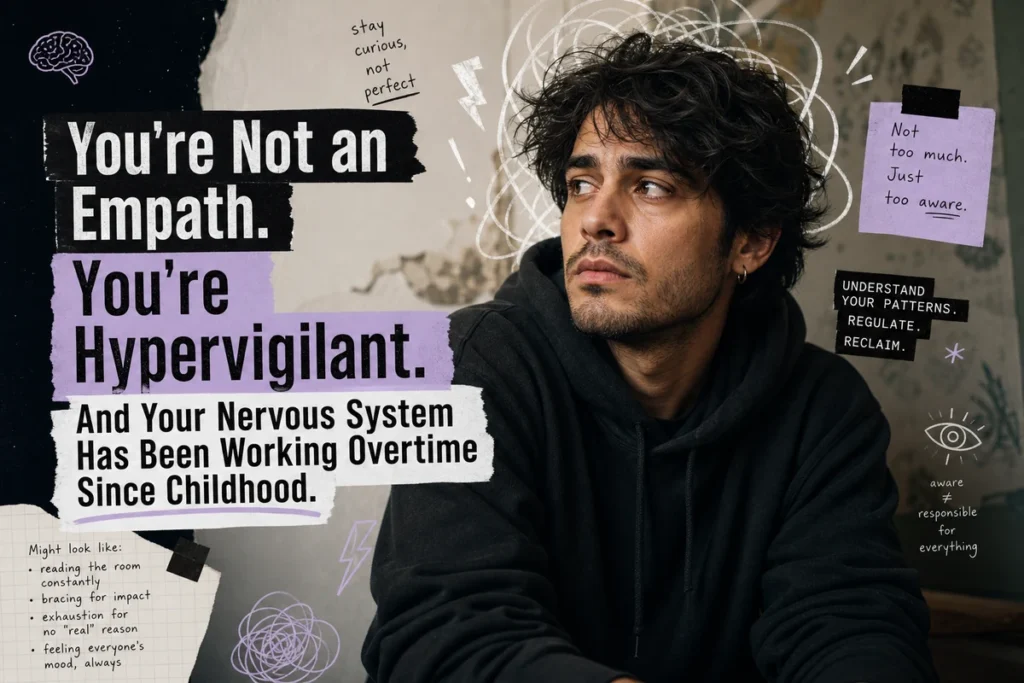
You’re Not an Empath. You’re Hypervigilant. And Your Nervous System Has Been Working Overtime Since Childhood.

If you have ever been described as deeply empathetic, an incredible listener, someone who always knows what people need before they ask, there is a real chance that what people were praising was not a personality trait. It was a nervous system in permanent threat-scan mode. ADHD hyperempathy, the intense, often overwhelming attunement to other people’s emotional states that many women with ADHD report, is not a separate gift layered on top of the diagnosis. It is what the diagnosis looks like when a dysregulated nervous system has been reading social danger signals since childhood, and getting praised for it the whole way through.
What Is ADHD Hyperempathy, and Why Does It Show Up So Strongly in Women?
Hyperempathy in the context of ADHD is not simply feeling a lot. It is the experience of being acutely, often involuntarily tuned to the emotional frequencies of everyone in the room: tracking tone of voice, monitoring facial expressions for micro-shifts, sensing the moment a conversation changes texture. Many women with ADHD describe it as a background process that never fully switches off. They walk into a room and within seconds they have catalogued who seems tense, who is performing cheerfulness, who might be about to say something critical. This is not clairvoyance. It is an overactivated threat-detection system doing exactly what it was trained to do.
The neurological basis for this kind of hypervigilance is real. Research by Chronaki and colleagues, published in the Journal of Child Psychology and Psychiatry, found that children with ADHD showed a pattern of initial hyper-orientation to angry vocal expressions, reflected in amplified early neural responses to hostile tones of voice. The study described this as a rapid, near-automatic orientation to threatening stimuli at early stages of sensory processing. In other words, the ADHD nervous system is not slow to register social threat. It fires fast and registers loudly at the internal level, which is why self-regulation strategies like stimming become essential.
The ADHD nervous system does not ignore social danger signals. It amplifies them at the preattentive level, before conscious thought has a chance to intervene.
This matters enormously for understanding why so many women with ADHD develop what looks to the outside world like exceptional social sensitivity. The nervous system is not being generous. It is being cautious. It is scanning because it learned, early and clearly, that missing a social cue had consequences.
The Fawn Response: What Nobody Told You Was a Coping Mechanism
Most people are familiar with fight or flight as stress responses. Fewer are familiar with the fawn response: the pattern of placating, agreeing, accommodating, and making yourself useful as a way of neutralising perceived social threat. You do not fight the danger. You do not run from it. You manage it, by making the person who represents the danger feel comfortable and satisfied.
For women with ADHD, the fawn response is not a personality quirk. It is a nervous system solution to a specific problem: the problem of having a dysregulated emotional system in a world that punishes women for showing dysregulation. A girl who cannot modulate her emotional responses, who feels things more intensely and recovers more slowly, who is exquisitely sensitive to disapproval, learns quickly that the safest strategy is to prevent the disapproval from happening in the first place. You learn to read the room not because you are naturally empathetic, though you may well be, but because reading the room reduces the probability of the kind of rejection that feels, in the ADHD nervous system, like a physical wound.
The fawn-RSD loop: Rejection sensitive dysphoria (RSD) means the anticipation of rejection can feel as distressing as actual rejection itself. Research by Rowney-Smith and colleagues (2026, PLoS One) found that in people with ADHD, the expectation of rejection caused more distress than the rejection event itself, driving pre-emptive withdrawal and masking behaviours designed to prevent rejection from ever occurring. The fawn response is, in part, a strategy for managing RSD before it activates.
The connection to rejection sensitive dysphoria is direct. RSD, the extreme emotional pain triggered by real or perceived criticism or rejection, is one of the most impairing features of ADHD for many adults, and it is particularly prevalent in women. When you understand that the fawn response is, in large part, a pre-emptive management strategy for RSD, the exhaustion of people-pleasing starts to make neurological sense. You are not being conflict-averse because you are weak. You are running an energy-intensive prevention system because your nervous system has correctly identified that rejection will hurt in ways that most people around you do not experience.
Why Girls With ADHD Learn to Prioritise the Room Over Themselves
The developmental story matters here. A qualitative study by Williams and colleagues (2025), examining how young adults with ADHD reflected on their experiences as girls, produced findings that were consistent and striking: ADHD symptoms in girls were described as socially oriented and internalised, particularly shaped by the social context. Participants described being strongly motivated, often at a preconscious level, by avoiding social rejection and wanting to fit in. Masking and compensatory behaviours were the result, and the social motivation driving them was something the existing diagnostic criteria did not capture at all.
This is the mechanism nobody names clearly enough. Girls with ADHD are not simply hiding their symptoms. They are developing a sophisticated social intelligence system built on acute observation of others, rapid pattern recognition, and constant calibration of their own behaviour to what the social environment requires. This is effortful, skilled, and deeply exhausting. It is also, in many contexts, socially rewarded. The girl who is always attuned, always accommodating, always the one who smooths over awkward moments and remembers what everyone needs, receives praise and positive social feedback. She learns that this is who she is.
By the time she is an adult, the hypervigilance is not a strategy anymore. It is an identity.
From the community: “I was at a social event… and one lady asked me ‘are you masking right now’ and i just straight up answered ‘yes, very much.’ I don’t know why i do it, even in spaces where people actually are more empathetic about it… Im 27 now and i dont know how well im coping, if im coping at all.”, r/ADHD thread
The Neurological Weight of Reading Every Room
Here is what makes this pattern different from simply being socially perceptive. In a neurotypical person, reading social cues is a relatively automatic process that runs without significant cognitive overhead. For a woman with ADHD whose nervous system is in a state of chronic hypervigilance, this process is neither automatic nor low-cost. It is active, ongoing, and competes for the same cognitive resources that executive function depends on.
Slobodin and colleagues (2025, PLoS One) conducted a controlled study specifically examining emotional dysfunction in adult women with ADHD. Their findings showed that ADHD symptoms had an indirect effect on emotional dysregulation via executive function impairments, specifically working memory deficits and difficulties with task-shifting. Emotional dysregulation in women with ADHD was not just a direct result of the condition itself, it was also the downstream product of executive systems that were already under strain. When you are simultaneously managing a socially demanding interaction, suppressing your own emotional responses to appear regulated, and monitoring everyone else’s emotional states for signs of disapproval, you are running multiple demanding processes through circuitry that is already operating at reduced capacity.
The result is not just tiredness after social interactions. It is a particular kind of depletion that many women with ADHD describe as feeling hollowed out: the sense that they have been fully present for everyone else’s emotional reality and have nothing left that belongs to them.
Women with ADHD frequently report greater emotional lability, chronic overwhelm, and relational strain than men with the same diagnosis, and neuroimaging research shows correspondingly more alterations in emotion-related circuits specifically in women.
The Praise That Made It Worse
This is the part that is hardest to untangle, because the feedback loop runs for decades before most women recognise it. The hypervigilance, the people-pleasing, the compulsive social attunement: these are not just tolerated in women and girls. They are actively celebrated. You are the good listener. The one who holds the group together. The person everyone turns to in a crisis, because you already sensed the crisis coming and were quietly managing it before anyone else noticed.
Research on adverse experiences of women with undiagnosed ADHD has documented how gender norms contributed to the masking of symptoms, with participants noting that their struggles did not fit how they were expected to behave as girls, pushing them further toward socially compliant, other-directed presentations. The traits the world rewarded were, in many cases, the compensatory behaviours driven by an unrecognised nervous system condition. The woman who is exhausted by her own empathy is not lacking discipline. She is carrying the weight of a coping mechanism that the people around her keep asking her to lift higher.
This dynamic also helps explain why so many women with ADHD are genuinely shocked by their late-discovery diagnosis. Not because they did not struggle, but because the particular shape of their struggle was socially legible as a virtue. You cannot easily seek help for something that everyone keeps telling you is your best quality.
Why This Isn’t the Same as Emotional Intelligence
There is an important distinction between emotional intelligence, the capacity to identify, understand, and regulate emotions in yourself and others, and the kind of nervous-system hypervigilance that drives ADHD hyperempathy. Emotional intelligence is generally a stable, available resource that improves with practice and reflection. Hypervigilance-driven social attunement is neither stable nor reliably available. It is state-dependent, expensive, and subject to collapse under conditions of stress, fatigue, hormonal fluctuation, or cumulative sensory load.
A woman with ADHD who seems emotionally gifted in a one-on-one conversation on a good day may find that same attunement completely unavailable after a difficult workday, during the premenstrual phase of her cycle, or in a loud, overstimulating environment. This is not inconsistency of character. This is the difference between a cognitive skill and a stress response. One can be developed. The other burns out.
The research on ADHD presentation in girls explicitly notes that symptoms were more pronounced at home compared to school, because the high cognitive and emotional effort of performing socially appropriate behaviour all day depleted the resources needed to maintain the mask in less demanding environments. The family that sees the meltdown is not seeing the real person beneath a facade. They are seeing what happens to a dysregulated nervous system when the performance finally ends.
Skill built on survival: One late-discovery woman and licensed counsellor described the experience precisely: “Years of masking taught me how to read a room quickly. What once felt like survival became clinical intuition. My neurodivergent mind doesn’t settle for one perspective. It automatically looks at situations from multiple angles.” The skill was real. But it was built on survival, not choice.
When People-Pleasing Starts Costing More Than It Returns
For many women, the fawn response and its associated hyperempathy work well enough in adolescence and early adulthood. The cost is manageable when the demands on the system are limited. The problems often emerge as life becomes more complex: a full-time job with unpredictable social demands, a relationship that requires genuine emotional availability rather than performed attunement, children who need a regulated parent, or a body moving into hormonal transitions that destabilise an already-stretched emotional regulation system even further.
ADDitude Magazine has documented how adult women with ADHD often experience the people-pleasing cycle as rooted in fear of rejection and a sense that emotional security is contingent on satisfying others. This is consistent with the RSD research: the fawn response is not irrational. It is a historically accurate prediction about what happens when the nervous system struggles to manage social expectations. The problem is not that it was wrong. The problem is that it was never given an expiry date.
The toll on identity is significant. Research by Hall and colleagues (2026, Behavioral Sciences) found that ADHD symptom severity was directly linked to identity distress, mediated in part through masking behaviours. Higher masking was associated with lower self-esteem and increased feelings of being an impostor in one’s own life. When the coping mechanism that has kept you socially safe since childhood also prevents you from ever being known as you actually are, the question of who you really are becomes genuinely hard to answer.
Masking is not a neutral strategy. Research shows it actively contributes to identity distress: the more you camouflage who you are, the less certain you become of who that is.
The Difference Between Care and Surveillance
One of the most useful reframes for women working through this pattern is learning to distinguish genuine care for others from nervous-system surveillance of others. Genuine care is voluntary, restorative, and boundaried. You attend to someone else’s emotional state because you want to, and you can disengage when you need to. Surveillance is compulsive, draining, and boundaryless. Many women with ADHD find it extremely difficult to stop scanning the room even when they desperately want to, because the nervous system has not received the all-clear signal.
Many women with ADHD find this distinction initially destabilising, because so much of their identity is organised around being caring, attuned people. The recognition that much of what felt like empathy was actually threat management does not diminish the care. It does, however, clarify why the care was never quite enough to feel safe, why the more you gave the more exhausted and invisible you felt, and why successfully managing other people’s emotional states rarely translated into feeling genuinely secure in a relationship.
The executive function angle matters here too. As research on executive function dysfunction makes clear, the ADHD nervous system often has difficulty with emotional regulation at the level of inhibition and cognitive reappraisal. It is not that you care too much. It is that you may lack reliable access to the internal braking system that would let you choose when to attend and when to step back. The hyperempathy is not unlimited generosity. It is incomplete inhibitory control meeting a world that taught you, clearly and early, that the consequences of social miscalibration were severe.
Building a Nervous System That Belongs to You
Recovery from a lifetime of nervous-system hypervigilance is not about becoming less empathetic. It is about building the capacity to choose. The goal is not to stop reading rooms. It is to reach a point where staying or leaving the room is actually a choice, rather than something the nervous system decides on your behalf.
This looks different for each person, but some elements recur consistently. Understanding the origin story matters: when you know that the people-pleasing was a survival strategy built by a nervous system that was never given its actual diagnosis, the self-criticism tends to soften. You were not pathologically anxious about other people. You were a nervous system doing its best work under difficult conditions without adequate support.
Physical regulation tends to come before cognitive reappraisal. The hypervigilance is subcortical, meaning it fires before the thinking brain has a chance to evaluate the threat. Strategies that work at the body level, including reducing sensory load before difficult social interactions, building in recovery time, and learning to recognise the body’s early warning signals, are not optional add-ons. They are the infrastructure without which more cognitive work such as boundary-setting and identity reconstruction will struggle to hold.
And finally: the skills are real. The hyperempathy that developed as a survival mechanism did produce genuine capacities for attunement, pattern recognition, and nuanced social understanding. Those capacities do not disappear when you stop using them as armour. They become available in a different way: as something you can offer rather than something you feel compelled to give.
Women with ADHD have been told for decades that they are too sensitive, too emotional, too much. The research tells a more precise story: they have nervous systems wired for heightened threat detection, trained by years of social feedback, and shaped by a diagnostic system that mistook the coping mechanism for the character. The hyperempathy was never the problem. The problem was never being given the language to understand what it actually was.
Quick Dopamine Hits:
- After your next social event, give yourself 20 unscheduled minutes before opening any messages. No checking whether someone was upset. Just let the nervous system come down before you analyse the room.
- When you catch yourself apologising for something that wasn’t your fault, pause and ask: ‘Am I sorry, or am I managing someone’s emotional state?’ Write the actual answer down, not to fix anything, just to see the pattern.
- Pick one low-stakes interaction this week where you let a small discomfort sit without immediately soothing it. Don’t fix the awkward pause. Don’t rush to make the other person comfortable. Notice what happens in your body when you wait.
Rate this article
Was this a useful hit?