You Are Doing the Work of Three People and Still Not Getting Promoted. Here Is What Is Actually Happening.

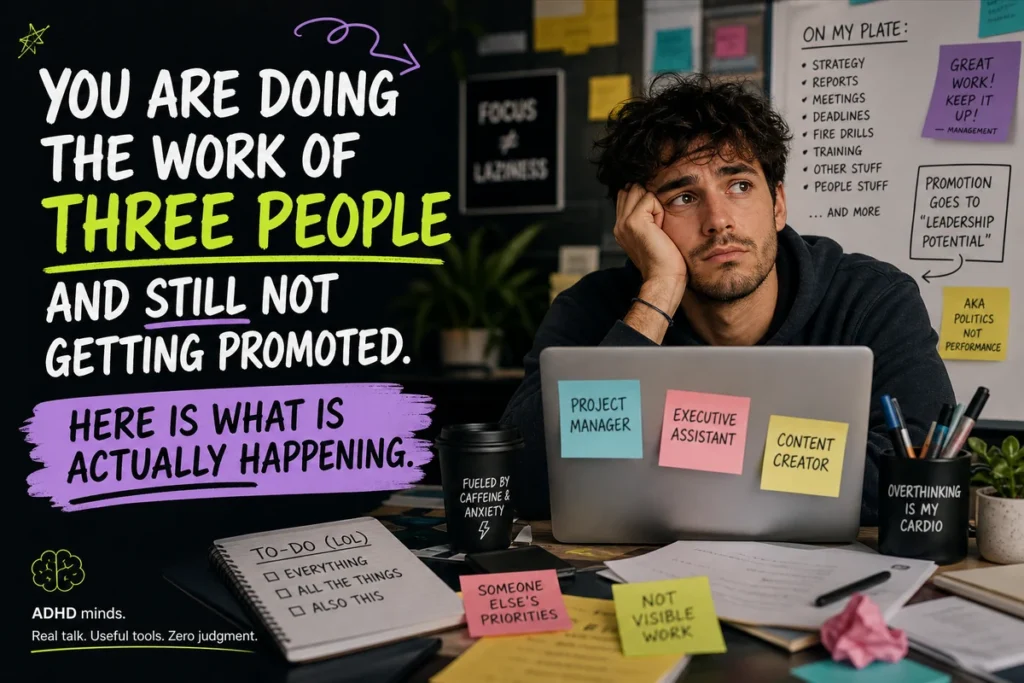
You have delivered the kind of work that makes your manager look good. You have pulled late nights nobody asked for, solved problems that were not technically yours to solve, and produced output that a neurotypical colleague would need two people to replicate. And still, when the promotion conversation comes around, you are told you are “almost there.” You need to “work on your visibility.” You need to demonstrate “leadership presence.” If you have ADHD, this is not a generic career problem. It is a structural one, rooted in the exact way your brain produces work and the exact ways workplaces decide who advances. The gap between ADHD career performance and ADHD career advancement is real, it is documented, and it is almost never explained clearly to the people living inside it.
Why ADHD Produces Brilliant Work That Still Reads as “Not Ready”
Most workplace promotion frameworks are built around a single implied standard: reliable, visible, consistent performance over time. The research on how organisations evaluate leadership potential consistently points to the same cluster of signals: steady output, strong meeting presence, relationship investment, and the ability to manage upward. These signals are assessed continuously, often unconsciously, by managers who are deciding who gets stretched assignments, sponsor relationships, and eventually titles.
The problem is that ADHD produces exactly the wrong signal pattern for this evaluation system, even when the underlying capability is high. Research published in the Journal of Neural Transmission found that adults with ADHD frequently experience work problems related to not meeting their own standards and perceived potential, and that ADHD traits, particularly inattention, are strongly associated with work-related difficulties (Fuermaier et al., 2021). Critically, those same researchers noted that this impairment is less often accompanied by negative formal performance evaluations or job loss. In other words, you are not failing. You are just not looking like you are advancing. That distinction matters enormously for understanding the promotion gap.
Adults with ADHD experience significantly higher levels of job burnout compared to those without ADHD, mediated specifically through executive function deficits in self-management to time and self-organisation, the exact skills that promotion decisions measure most heavily (Turjeman-Levi, Itzchakov, and Engel-Yeger, 2024, AIMS Public Health).
Organisational psychology expert Nancy Doyle has documented that the core executive function complaints for neurodivergent professionals are attention regulation, working memory, organisation, time management, planning, and prioritising (Doyle, 2022). These are not peripheral work skills. They are exactly what separates someone who gets promoted into management from someone who remains a strong individual contributor. When those functions are inconsistent, accessible in hyperfocus states but absent under low-interest conditions, the picture from the outside looks like unreliability rather than neurodivergence.
The Output Illusion: Why Hyperfocus Does Not Build a Promotion Case
Hyperfocus is genuinely impressive. When it locks in, adults with ADHD can produce work that neurotypical peers cannot match in quality or depth. The problem is not the output itself. It is the pattern the output creates.
Promotion decisions are not made based on your three best weeks. They are made based on the perceived signal of what you will do as a manager, a leader, or a person with greater scope. Inconsistency in output, not poor output, just inconsistent output, reads to decision-makers as a reliability risk. A manager watching an ADHD employee sees periods of extraordinary production followed by stretches of missed emails, late deliverables, and visible disengagement. The hyperfocus peaks are noted, but they do not override the anxiety that comes from not knowing when the troughs will arrive.
The consistency trap: Research from the University of New Hampshire found that neurodivergent employees, particularly those with ADHD, are frequently underemployed relative to their actual capabilities, with their inconsistent output pattern interpreted through a neurotypical lens of unreliability rather than neurodivergent output variability (Zindell, 2024). The gap is not competence. It is the readability of that competence to evaluators who are not trained to interpret it.
There is also a timing problem. Hyperfocus tends to activate around novelty, urgency, and personal interest. Routine administrative tasks, status updates, and the small visible maintenance work that signals “I am on top of everything” are exactly the tasks that ADHD brains tend to deprioritise. These tasks carry no dopamine reward and feel pointless when there is genuinely important work to do. But they are the tasks managers see most clearly, because they happen in the small everyday spaces where assessments of reliability get made.
What Workplaces Actually Measure When They Decide Who Advances
Most promotion frameworks measure output formally and political capital informally. The formal part you are probably managing, or at least partially managing. It is the informal part that is often quietly stalling ADHD career advancement.
Workplace social capital, defined as employees’ perceptions of trust, reciprocity, and network interactions with peers and people across hierarchical levels, is deeply linked to promotion. Research on neurodivergent professionals consistently identifies lack of social capital and support as one of the three primary barriers to career progression, alongside executive dysfunction and sensory overload (Doyle, 2022, Zindell, 2024). Social capital at work is built through the interactions that many ADHD brains are most likely to skip: casual hallway conversations, brief check-ins that feel pointless, follow-up emails with no urgent purpose, and lunch meetings that take time that could be spent working.
The professional environment most workplaces reward is one where small talk, confident self-presentation, and relationship investment are not just valued but treated as evidence of leadership ability. People who demonstrate these traits are viewed significantly more favourably by managers and peers, regardless of their output quality (Zindell, 2024). For an ADHD brain that finds low-stakes social performance exhausting and that is already depleted from managing executive function all day, this represents a structural disadvantage that compounds over time.
The neurodivergent professional is often working twice as hard as their neurotypical colleague just to reach baseline performance, and using whatever is left for the actual job. There is frequently nothing remaining for the impression management that promotion requires.
Meeting Presence: The Invisible Test You Are Probably Failing Without Knowing
Why does meeting presence matter so much for ADHD career advancement? Because meetings are where visibility gets created. They are where managers form opinions about who “gets it,” who is engaged, and who would do well with more responsibility. And they are one of the harder environments for ADHD brains to perform in consistently.
Executive function challenges in meetings show up in specific ways: difficulty tracking a conversation while simultaneously formulating a response, losing the thread of what someone said while processing an earlier point, speaking before a complete thought has formed, or going completely quiet because the cognitive load of listening while appearing engaged consumes all available working memory. Research identifies presentation skills and communication in meetings as a distinct and particularly challenging aspect of professional life for adults with ADHD, requiring simultaneous deployment of attention regulation, impulse control, working memory, and social calibration (Doyle, 2022).
What this looks like to a manager is not “this person has ADHD.” It looks like this person seems distracted, does not contribute ideas, or conversely, interrupts frequently and does not build on others’ points. Neither picture says “ready to lead.” And neither picture reflects what that person actually knows or is capable of, because meetings do not measure knowledge. They measure a specific kind of real-time performance that ADHD brains are often structurally disadvantaged at, and that disadvantage is rarely named or accommodated.
The Self-Advocacy Failure Nobody Talks About
Getting promoted requires a form of self-promotion that many adults with ADHD find particularly difficult. Not because ADHD people are falsely modest, but because the timing and execution of effective self-advocacy require exactly the executive functions that ADHD disrupts most: sustained planning over long time horizons, working memory for tracking who knows what you have done, strategic relationship maintenance, and the ability to hold back from impulsive self-disclosure in contexts where it is better to stay quiet.
Research found that ADHD symptom severity significantly predicts both imposter phenomenon and identity distress, mediated through lower self-esteem and higher levels of social camouflaging (Hall, Stuckey, and Berman, 2026, Behavioral Sciences). Adults with ADHD are more likely to systematically underestimate their own competence and to conceal their strengths behind a mask of performed normalcy. The result is a professional who has done genuinely impressive work but who, when the moment comes to make the case for their own advancement, either cannot do it credibly or actively undercuts themselves.
This is compounded by the rejection sensitivity that many ADHD adults experience around performance evaluation. As covered in the RSD at Work article, fear of feedback can cause ADHD professionals to avoid the very conversations, stretch opportunities, and sponsor relationships that build promotion cases. You cannot advocate for yourself if you are managing the emotional threat of being told no. And when that emotional threat feels as intense as clinical research describes, avoidance becomes the path of least pain.
Adults who maintain high occupational performance through compensatory strategies and masking often experience substantial internal suffering, yet their impairment remains invisible within behaviour-based evaluation systems. The achievement is seen, the cost of that achievement is not. (From research examining the diagnostic blind spots created by compensatory masking in adults with ADHD.)
The Burnout Ceiling: When Output Becomes Unsustainable
There is a specific arc that many ADHD professionals follow. In the early stages of a role, novelty activates interest, hyperfocus generates impressive output, and the initial learning curve provides the urgency the ADHD nervous system needs to function. Performance looks strong. The individual may be flagged as a high-potential employee.
Then the role becomes familiar. The novelty wears off. Routine tasks multiply. The structural supports that novelty provided disappear. Output becomes inconsistent. The same person who was a standout six months ago is now getting feedback about reliability, follow-through, and presence. And underneath all of that, the cognitive cost of compensating for ADHD, managing the masking, and maintaining professional performance with a dysregulated executive function system, is quietly building a burnout trajectory that goes unrecognised until it has already derailed the career.
Research from AIMS Public Health found that employees with ADHD report significantly higher burnout levels than those without, with a large effect size (Cohen’s d = 1.13). The specific mechanisms were executive function deficits in self-management to time, which drove physical fatigue, and self-organisation and problem-solving deficits, which drove emotional exhaustion and cognitive weariness (Turjeman-Levi, Itzchakov, and Engel-Yeger, 2024). These are not peripheral wellbeing issues. They are the direct neurological mechanisms behind why the ADHD professional who appears functional on the outside eventually stops performing at any level. Understanding this pattern is covered in more depth in the article on ADHD burnout versus depression, because the two can look identical from the outside and require different responses.
The visibility problem reframed: Organisations often promote the person who appears to be managing well, not the person who is actually producing the most. For ADHD professionals, appearing to manage well is frequently the hardest part of the job. It consumes the very resources needed to do the actual work. The promotion gap is often not a performance gap at all. It is a visibility gap driven by a brain that cannot easily separate the doing from the performing-of-doing.
What Actually Shifts Career Trajectory for ADHD Adults
There is no single fix. But there are specific lever points where targeted change produces disproportionate results, and they are different from the standard “work on your communication” advice most ADHD professionals receive in performance reviews.
The first lever is output signalling. ADHD output is often invisible because it happens in bursts and is not narrated. Neurotypical colleagues who produce steadier, more moderate output make it continuously visible through check-ins, status updates, and casual mentions. The fix is not to produce differently. It is to build a consistent, low-friction habit of translating output into visibility: a brief written update after a productive session, a one-line message to a manager, not a report but a signal. The systems that support this kind of follow-through without relying on working memory are covered in detail at the ADHD Systems pillar.
The second lever is meeting strategy. Trying to perform “engaged neurotypical” across every meeting all day will accelerate burnout before it builds career capital. What is achievable is strategic contribution: identifying one meeting per week where you have the most relevant knowledge, preparing one specific point before the meeting starts, and making that single contribution count. Research on CBT strategies for ADHD professionals supports breaking complex behavioural goals into discrete, achievable sub-steps, which is exactly what structured meeting preparation represents (Solanto, 2011, Ramsay, 2010).
The third lever is deliberate relationship investment. ADHD brains tend to outsource relationship maintenance to whatever happens naturally, which means it largely does not happen. This is not a character flaw. It is the product of an attentional system that struggles to sustain voluntary effort toward tasks with no immediate interest or urgency. The practical response is to schedule it, make it specific, and keep the volume very low. One intentional professional conversation per week, asking one targeted question or following up on something someone mentioned last time, is more than most ADHD professionals are currently doing, and it has compounding effects on the social capital that promotion decisions require.
The fourth lever is addressing what underlies the self-advocacy gap. For many adults with ADHD, this means directly working with the shame and rejection sensitivity that makes self-promotion feel dangerous. Cognitive Behavioral Therapy adapted for ADHD, schema therapy targeting chronic failure beliefs, and social skills training all have empirical support for improving the interpersonal functioning that ADHD disrupts in professional contexts (ADHD in Adulthood: Clinical Presentation, Comorbidities, and Treatment Perspectives, 2024). This is not about changing personality. It is about building specific skills that the ADHD nervous system never had the scaffolding to develop.
The System Is Not Designed for How Your Brain Works
Understanding the ADHD promotion gap does not require concluding that you are broken. It requires understanding that the systems organisations use to identify and reward talent were built around a neurotypical model of consistent, relationship-visible, politically calibrated performance. That model produces many false negatives when applied to neurodivergent adults.
A 2024 study on neurodivergent workplace inclusion synthesised evidence showing that neurodivergent workers are frequently underemployed relative to their capability, that the primary source of this gap is not competence but the mismatch between how work is structured, evaluated, and rewarded, and that the privileging of neurotypical norms in professional culture is the mechanism by which capable neurodivergent employees remain stuck (Zindell, 2024). This is a structural finding, not a personal one. More recent evidence from the EY Global Neuroinclusion Study (2025) reinforces that organisations themselves are beginning to recognise this gap, even if individual managers have not yet caught up.
What changes the career trajectory of adults with ADHD most reliably is not becoming better at appearing neurotypical. It is developing specific targeted strategies for the specific leverage points where ADHD creates the most visible gaps: output narration, meeting contribution, relationship investment, and self-advocacy. Not all at once. Not with a perfect system that collapses in week three. With something small, sustainable, and built around how your brain actually works rather than how you wish it would. The ADHD Career pillar covers the full landscape of workplace accommodations, job fit, and structural changes that support neurodivergent professionals at every stage.
You are not stuck because you are not good enough. You are stuck because you are good in ways the system has not yet learned to measure.
Quick Dopamine Hits:
- After your next high-output day, send one brief, specific update to your manager, two sentences about what you completed and what it means for the project. Not a report. Just signal your output.
- Identify the one meeting per week where you have the most relevant knowledge. Before it starts, write down one thing you plan to say. One specific observation or question. That is your only goal for the meeting.
- Find one person at your level or above whose career trajectory you admire. Ask them one question about how they navigated a specific decision, not generic advice. One targeted conversation a month builds the relationship capital ADHD brains tend to skip.
Rate this article
Was this a useful hit?