RSD at Work: How Rejection Sensitive Dysphoria Is Quietly Reshaping Your Career

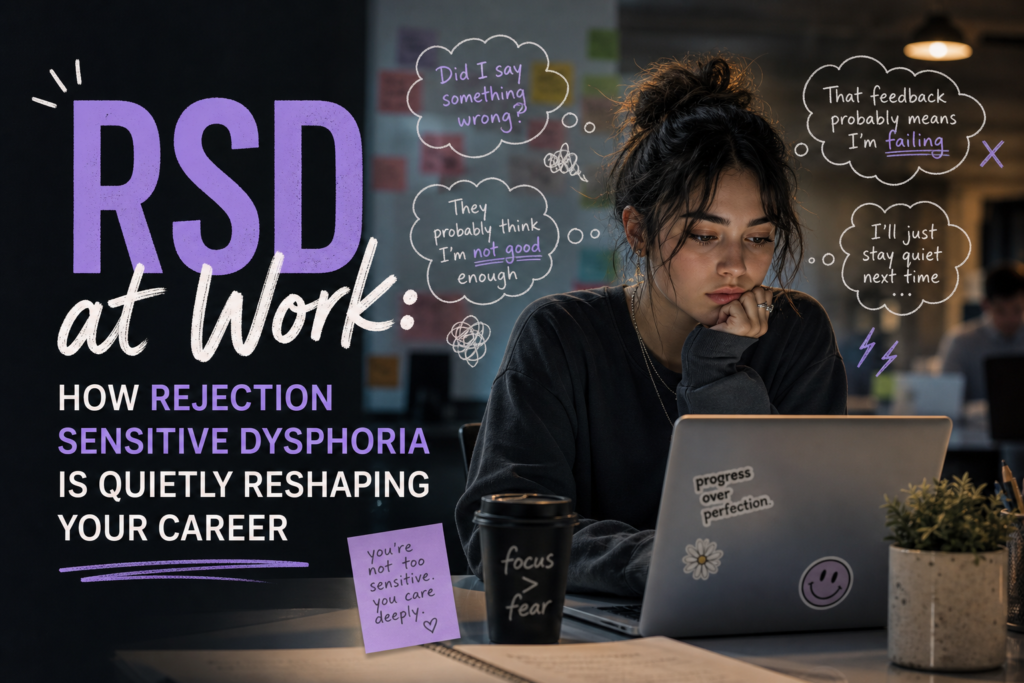
You have probably never told your manager that you are terrified of criticism. You have almost certainly never written “fear of rejection” on a performance review. But if you have ADHD, there is a real chance that rejection sensitive dysphoria, or RSD at work, has been quietly making career decisions on your behalf for years. It shows up as the application you never submitted, the feedback session you avoided rescheduling, the job you left before anyone could tell you that you were not measuring up. It does not look like a disorder from the outside. It looks like choices.
The problem is that most of what gets written about RSD focuses on personal relationships: the text you overanalyzed, the friend who seemed cold, the romantic rejection that floored you for two weeks. The workplace dimension is almost entirely absent from mainstream ADHD content. Which means thousands of neurodivergent adults are watching their careers contract around them and have no framework for understanding why.
What RSD Actually Is, and Why the Workplace Amplifies It
Rejection sensitive dysphoria is not a formal DSM diagnosis, but the clinical description is consistent: it refers to intense, often sudden emotional pain triggered by perceived or anticipated rejection, criticism, or failure. The word “dysphoria” is doing real work here. This is not mild discomfort. Researchers and clinicians describe it as a full-body emotional response that can feel physically painful and can persist for hours, days, or in some cases resurface years later.
A qualitative study from the University of Sussex explored the lived experience of rejection sensitivity in adults with ADHD using focus-group interviews and thematic analysis. Participants described rejection sensitivity as “a painful and overwhelming experience, which often lasts a significant amount of time, between hours and weeks, and can resurface many years later” (Braun and Clarke method, University of Sussex, ER/AR649/1). The three primary themes that emerged were masking, withdrawal, and intense bodily sensations. All three show up in the workplace in ways that are rarely named.
Participants described how withdrawal negatively impacts their relationships and life opportunities, including how they had avoided applying for career opportunities “to avoid rejection.” The fear was not of the actual rejection. It was of the anticipatory experience during the application process itself.
The workplace is a particularly hostile environment for a nervous system primed for RSD. Performance is constantly being evaluated. Hierarchies are explicit. Feedback is institutionalized. You spend eight or more hours a day in a space where your output, your behavior, and your social presentation are all available for judgment. For someone without ADHD, that is a manageable background hum. For someone with RSD, it is an ongoing threat landscape that requires constant monitoring and self-protection strategies, most of which are invisible and exhausting.
The Application You Never Sent
One of the least-discussed ways RSD shapes careers is through pre-rejection: the decision not to try in order to avoid the pain of being turned down. The University of Sussex research found that participants often experienced rejection sensitivity during the application process itself, not when they received an outcome. The anticipation alone was enough to trigger the full emotional response.
This means the cost calculation is completely different for someone with RSD. For a neurotypical person, the calculus of applying for a job is roughly: effort invested versus potential gain, with some manageable disappointment factored in if it does not work out. For someone with RSD, the calculus is: effort invested versus the near-certainty of a distressing emotional event that may last days and that you will be responsible for concealing at work while it happens. The math does not work. Not applying is genuinely the more rational short-term choice given what the experience feels like from the inside.
The result is a career that quietly shrinks. You stay in the role you have because at least there you know where the landmines are. You do not pitch the idea in the meeting because if it gets shot down you will have to sit there feeling like you are dissolving while pretending to take notes. You do not go for the stretch assignment because being visibly bad at something new, in front of colleagues, is not a discomfort to push through. It is a threat your nervous system will fight to avoid.
The stall pattern: Research from the University of Sussex found that ADHD adults with rejection sensitivity commonly avoid career opportunities not after receiving rejection, but in anticipation of it. The emotional pain of imagined criticism is often enough to trigger full withdrawal from the opportunity itself.
Over-Performing as a Defense System
The flip side of withdrawal is hypervigilance through achievement. Not everyone with RSD retreats. Some build elaborate systems designed to make criticism structurally impossible. If your work is perfect, no one can critique it. If you arrive first and leave last, no one can question your commitment. If you have already anticipated every objection in your presentation and addressed it before anyone can raise it, you have neutralized the threat before it arrives.
This looks like high performance from the outside. Managers notice it. It can generate genuine career advancement. It also runs on a completely unsustainable fuel source. The energy required to maintain a zero-criticism perimeter is enormous, and the goal is not excellence. The goal is safety. There is a difference, and the body knows it. What gets called ambition or work ethic in annual reviews is often, at its core, an anxiety management strategy.
The qualitative research on RSD describes masking as a central coping mechanism, one that causes progressive disconnection from authentic emotions and real self-assessment. One participant described it as reaching a point where “you can’t identify if you’re bothered or not, because you lose connection” (University of Sussex focus group data, ER/AR649/1). Translated to a workplace context: you no longer know if you actually care about this project, or if you are performing caring because the alternative, appearing not to care, feels too dangerous to risk.
The masking that protects you from criticism at work also makes it harder to know what you actually want from your career. The two problems are not separate.
Over-performers with RSD are also disproportionately vulnerable to burnout. The combination of ADHD cognitive load, emotional regulation demands, and constant hypervigilance creates a depletion pattern that does not respond well to the standard advice of working smarter rather than harder. The problem is not inefficiency. The problem is that a significant portion of mental bandwidth is being consumed by a threat-monitoring system that never fully switches off.
Rage-Quitting and the Exit Before the Exit
RSD in the workplace does not always look like anxiety. Sometimes it looks like anger. A piece of critical feedback that most people would process in a few minutes can hit someone with RSD as a full emotional crisis: a flooding, all-or-nothing experience where the message received is not “this piece of work needs revision” but “you are fundamentally not good enough and everyone here knows it.” From inside that experience, the reasonable-seeming response is to leave before the situation confirms what already feels true.
This produces what looks like impulsivity from the outside, and what feels, from the inside, like the only sane option. The rage-quit. The sudden resignation after a difficult performance review. The decision to go freelance after a manager’s email lands the wrong way. Research suggests that emotional dysregulation is a core feature of ADHD, not a peripheral symptom, and that the intensity and duration of emotional responses in ADHD adults is significantly elevated compared to neurotypical controls. The challenge is that by the time the emotional flooding subsides and clearer thinking returns, decisions may already have been made and communicated.
There is also a subtler version of this pattern: the slow withdrawal that precedes a formal exit. Months before the resignation letter, the person with RSD has already psychologically left. They stop contributing in meetings where they have previously been told their ideas were off-base. They stop asking questions because questions invite the wrong kind of attention. They start building emotional distance from colleagues and projects as a preemptive insulation against the rejection they expect is coming. By the time they leave, it feels inevitable rather than chosen, because in a meaningful sense the departure happened long before the paperwork.
From the community: “I recently lost the IT job I held for 12 years following two major burnouts… I’m feeling quite lost at the moment and unsure how to move forward.”, r/AuDHD thread
Why Feedback Conversations Feel Like Survival Situations
A routine one-on-one with your manager should not feel like a threat to your continued existence. For many people with RSD, it does. Not because they are catastrophizing irrationally, but because their nervous system is processing the situation through a neurological filter that assigns enormous salience to even mild signals of disapproval.
Russell Barkley’s work on ADHD and emotional regulation has long emphasized that the deficit is not in understanding emotions intellectually but in regulating their intensity and duration. When your manager says “I noticed the report was late,” you may intellectually know this is a minor comment. Your nervous system is not consulting your intellectual knowledge. It is already generating a stress response of the kind most people reserve for significantly more threatening situations.
The behavioral consequence is avoidance. Feedback conversations get rescheduled, then rescheduled again. Annual reviews are dreaded for weeks in advance. Informal check-ins become something to navigate rather than something to use. The person with RSD develops an elaborate set of strategies for surviving these interactions rather than benefiting from them. They may become skilled at deflecting, minimizing, or redirecting. They may over-agree with everything said in order to get out of the room faster. None of this serves their actual professional development.
The University of Sussex research found that some participants deliberately submitted work below their usual standard or submitted it late, specifically to have a ready explanation available if criticized. The rejection was not the feared thing. The unexplained rejection was the feared thing.
This dynamic has a specific structural consequence: people with RSD are often systematically underrepresented in the feedback their managers have about them. Because they avoid feedback conversations, deflect during them, or mask so thoroughly that the manager believes everything is fine, they receive less corrective information over time. Paradoxically, the strategy designed to avoid criticism tends to leave them more exposed to significant performance issues that were never addressed early because no one knew to address them.
Masking at Work and the Identity Cost
Masking in the ADHD context means suppressing or camouflaging neurodivergent traits in order to appear more neurotypical. In the workplace, this often looks like exceptional social performance: appearing engaged in meetings where you are struggling to follow, laughing at the right moments, crafting carefully neutral responses to emails you experienced as deeply painful, performing calm during situations where you are internally dysregulated. The University of Sussex study found that consistent masking causes disconnection from authentic emotions and makes it difficult to distinguish between real and performed reactions to situations.
The workplace demands on masking are particularly high because the professional environment has strong norms about emotional display. You are expected to receive critical feedback without visible distress. You are expected to disagree in meetings without it reading as personal. You are expected to be disappointed about a decision without that disappointment affecting your relationship with the person who made it. All of these are harder for someone with RSD, and the energy cost of continuously performing these norms is significant.
Over time, sustained workplace masking produces a specific kind of professional identity confusion. You have been performing a version of yourself at work for so long that you are no longer sure which parts of your professional identity are genuinely yours and which parts were constructed to keep the RSD threat at bay. This is not a minor inconvenience. For adults who have spent years in careers that were shaped around avoiding rejection rather than pursuing interest, it can represent a significant detachment from what they actually want their working life to look like.
The masking cost: Sustained professional masking does more than drain energy. Research on rejection sensitivity in ADHD cohorts found that long-term masking causes progressive disconnection from authentic emotions, making it harder over time to identify what you actually want, including what you want from your career.
Practical Strategies That Account for How RSD Actually Works
Most workplace advice about handling feedback or building resilience is written for nervous systems that do not have RSD. “View criticism as a growth opportunity” is not actionable for someone whose body is generating a threat response before the manager has finished the sentence. Useful strategies need to work with the RSD architecture, not against it.
The first shift is separating the anticipatory experience from the actual event. Because RSD often hits hardest in the period before a feedback conversation or application, creating a specific ritual for that anticipatory window is more useful than trying to manage the response in the moment. This might mean scheduling feedback conversations for times of day when you are most regulated, building in explicit transition time afterward, or having a physical location associated with recovery rather than trying to walk from a difficult meeting back into a team environment.
The second is developing a personalized criteria system for distinguishing signal from noise in feedback. Not all criticism is equally valid, and one practical way to reduce RSD reactivity to feedback is to have a pre-established framework for evaluating it. Is this person qualified to assess this specific thing? Is this feedback about the work or about a preference? Is there a pattern across multiple sources, or is this a single data point? Having these questions prepared in advance means you have something to do with the information other than feel it, which gives the prefrontal cortex a job during a moment when it would otherwise be overwhelmed.
Third, consider being explicit with trusted colleagues or managers about the fact that you process criticism with significant emotional intensity and need time before you can respond usefully. This does not require an ADHD diagnosis disclosure. It can be framed as a working-style preference: “I process feedback better in writing before we discuss it,” or “I find it helpful to have time to think before responding to performance conversations.” These are legitimate professional preferences that also happen to create structural protection against RSD-driven reactive decisions.
For the application avoidance pattern specifically, the most effective intervention is reducing the stakes of the first step. The fear is about rejection at the end of the process, but the avoidance happens at the beginning. Decoupling the first action from the final outcome, writing your name on the document without committing to submitting it, sending a speculative email without calling it an application, creates an entry point that does not trigger the full anticipatory RSD response.
What Helps at the Neurological Level
It is worth being direct about the neurological dimension here, because understanding the mechanism changes how you relate to the experience. RSD is not a personality flaw or a sign of excessive sensitivity. Research suggests it is linked to the same dopamine and norepinephrine dysregulation that underlies ADHD executive function differences. The emotional flooding is not disproportionate to how the situation feels from the inside. It is proportionate to a nervous system that is generating a significantly elevated signal in response to social threat cues.
Some clinicians, including William Dodson who has written extensively on RSD, note that the condition can respond to specific medications including alpha-2 agonists and, for some people, stimulant medications that also support executive function. This is worth raising directly with a prescribing clinician if RSD is significantly affecting your professional life, rather than assuming that medication only addresses attention.
Therapeutic approaches that specifically address emotional regulation in ADHD, including dialectical behavior therapy adapted for ADHD and certain approaches within cognitive behavioral therapy, have a better evidence base for RSD than general anxiety treatments. The key difference is that effective therapy for RSD needs to address the speed and intensity of the emotional response, not just the cognitive content of the thoughts involved. Standard cognitive restructuring approaches, which ask you to identify and challenge distorted beliefs, often do not work well during active RSD flooding because the cognitive architecture needed for that process is not accessible when the emotional system is fully activated.
The goal is not to feel less. The goal is to build enough structural space between the trigger and the response that a different kind of thinking becomes possible before the decision gets made.
Recognizing the Pattern Is the Work
Most adults who have been living with RSD in the workplace for years have built an entire professional identity around it without knowing that is what they did. The industries they entered, the company sizes they preferred, the roles they took and avoided, the managers they stayed loyal to and the ones they fled, all of these decisions carry the fingerprints of a nervous system that was managing a pain response most people around them could not see.
Recognizing that pattern is not a small thing. It is not a matter of deciding to be more confident or learning to take feedback better. It means looking at your career history and asking, honestly, which choices were made toward something and which were made away from something. It means understanding that the jobs you stayed in too long and the opportunities you never pursued were not evidence of being unmotivated or risk-averse. They were evidence of a nervous system doing exactly what nervous systems do: protecting you from pain using the tools available.
That understanding will not eliminate RSD. But it changes the relationship to it. And changing the relationship, building enough space to recognize the RSD response as a response rather than reality, is where the actual career work begins.
Quick Dopamine Hits:
- Before your next feedback conversation, write down one specific thing you did well on the project. Read it out loud before entering the room. This is not positive thinking, it is giving your nervous system a factual anchor before RSD can flood the narrative.
- When you feel the urge to quit or rage-send an email after perceived criticism, set a 90-minute timer before taking any action. The emotional intensity of RSD typically peaks and begins to drop within that window.
- If you are avoiding a job application, open the document and write only your name and contact details. Save it. You are not committing to applying, you are breaking the freeze. Do nothing else until tomorrow.
Rate this article
Was this a useful hit?