Stop Calling It Drama. What’s Actually Happening Inside Your Brain When RSD Hits.

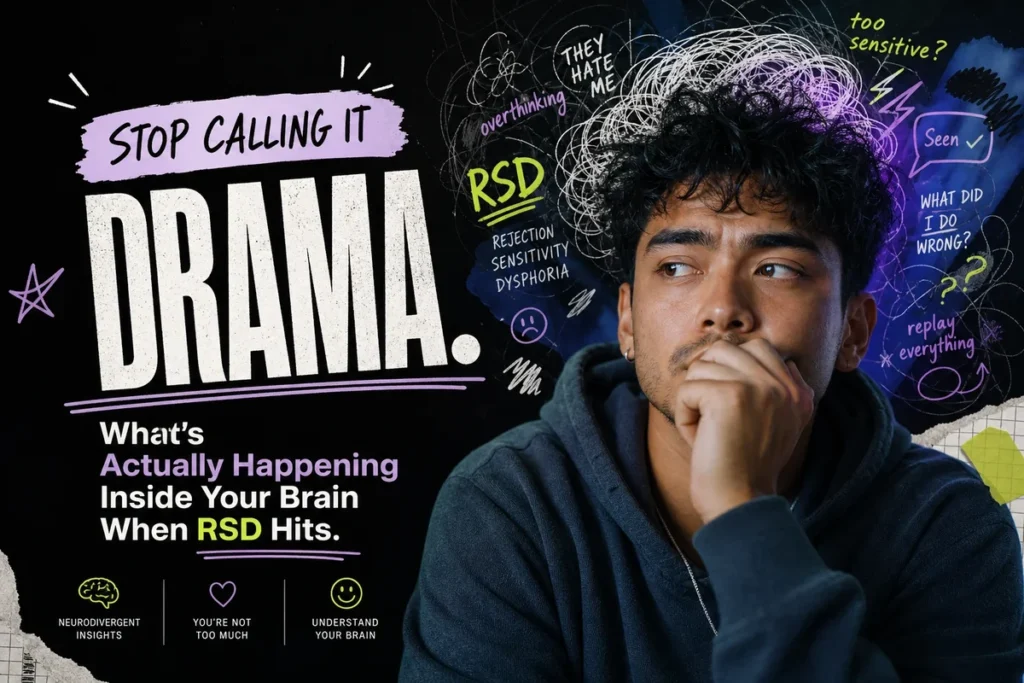
Someone says something. Maybe their tone shifts slightly, or their reply is shorter than usual, or they give feedback that was probably meant constructively. And in the space of about two seconds, your brain converts that signal into something that feels like a verdict on your entire worth as a person. The wave hits before you can think. Your chest tightens, your thoughts accelerate, and somewhere underneath the flood of feeling, a familiar voice says: here you go again. Being dramatic. Too sensitive. As always. That second layer, the shame on top of the pain, is where rejection sensitive dysphoria in ADHD does its most lasting damage. And it is not drama. It is a neurological feedback loop running on compromised circuitry, and understanding why it keeps running is the first step to interrupting it.
What RSD Actually Is (and What It Isn’t)
Rejection sensitive dysphoria is the intense, sudden emotional pain that many people with ADHD experience in response to perceived or actual rejection, criticism, failure, or teasing. The word “dysphoria” is precise. It is borrowed from the Greek for “difficult to bear,” and researchers who work in this area use it deliberately, because what they are describing sits in an entirely different category from ordinary disappointment. The key word in that description is perceived. RSD does not require a real rejection. It requires a signal that your nervous system interprets as one, and because the ADHD brain’s threat-detection system is dysregulated, that signal does not need to be accurate to trigger a full response.
This is where the “drama” framing does the most damage. Drama implies exaggeration for effect, a conscious amplification of something small for social or emotional gain. RSD is the opposite. It is a neurological system misfiring and producing a response that is disproportionate not because the person chose that response, but because the brake system between emotional signal and emotional action is genuinely impaired in ADHD brains. A 2025 preprint arguing for the redefinition of RSD within psychiatric frameworks put it plainly: RSD should not be conflated with common rejection sensitivity, emotional immaturity, or attention-seeking behaviors. The failure to distinguish RSD as a collapse response rather than an overreaction has led to misdiagnosis, mistreatment, and further emotional harm.
“RSD is real. It’s embodied. It’s deeply impairing. We know this anecdotally, even if formal science is catching up.”, Dr. James Kustow, psychiatrist specializing in adult ADHD, ADDitude webinar, June 2026
The key distinction researchers are working toward is between ordinary rejection sensitivity, which everyone has to some degree, and RSD, which operates as a threshold phenomenon. Common rejection sensitivity rises and falls in proportion to the situation. RSD hits a trip wire. Below the threshold, the person functions normally. Above it, the response is total. There is no middle volume setting.
Why the ADHD Brain Specifically Gets Stuck Here
To understand why RSD is neurological rather than theatrical, you need to understand two things that are consistently abnormal in ADHD brains: the prefrontal cortex’s inhibitory function, and the dopamine and norepinephrine systems that regulate emotional intensity.
The prefrontal cortex is the brain region responsible for what researchers call inhibitory control: the ability to pause between registering an emotion and acting on it. Russell Barkley described emotional dysregulation in 2014 as a core component of ADHD, explicitly linked to deficient cortical regulation of the limbic system’s emotional outputs. When the prefrontal cortex is not performing this braking function effectively, which neuroimaging confirms it frequently is not in ADHD, emotional signals from the amygdala and surrounding limbic regions reach behavior without the usual filtering. The signal arrives. The brake does not engage. The flood happens.
Neuroimaging research adds more precision to this picture. A 2025 study on abnormal functional connectivity in ADHD with emotional dysregulation found disrupted resting-state connectivity between the dorsolateral prefrontal cortex and the orbitofrontal cortex, a circuit critical for regulating how emotional information is appraised and modulated. The ADHD brains with emotional dysregulation showed both overconnectivity in some pathways and underconnectivity in others, a pattern that researchers suggest explains why emotional responses in ADHD often arrive fast, feel enormous, and are difficult to redirect once they have started. The system is not broken in one place. It is dysregulated across an entire circuit.
The dopamine piece matters too. Research by Volkow et al. (2011, Molecular Psychiatry) using positron emission tomography demonstrated decreased function in the dopamine reward pathway in adults with ADHD, with significant correlations between dopamine receptor availability and motivation-related traits. Dopamine and norepinephrine both play roles in how threatening versus rewarding social signals are weighted and processed. When those systems run at lower baseline levels, the appraisal of ambiguous social information, a short reply, a neutral expression, an unanswered message, skews toward threat. The brain is not being dramatic. It is making the only calculation its chemistry currently allows.
Is RSD the Same as Being Too Emotional?
RSD is not a measure of emotional maturity, and it is not the same as being generally prone to strong feelings. Research suggests that emotional dysregulation in adults with ADHD affects between 30 and 70 percent of the population, depending on criteria and measurement method (Shaw et al., 2014). Faraone et al. (2019, Journal of Child Psychology and Psychiatry) described emotional dysregulation as a primary feature of adult ADHD with significant clinical relevance, noting that it compounds impairment across virtually every major life domain. Being emotionally intense in some contexts, and having a dysregulated threat-response system that misfires in social contexts, are different things. RSD is the second one.
The threshold problem: RSD does not scale with the size of the perceived rejection. A slight change in someone’s tone, a piece of feedback delivered neutrally, a message left on read, any of these can trip the same response as a genuinely significant social rupture. This is not proportionality failure on the person’s part. It is a threshold dysfunction in the brain’s social threat system. The signal bypasses proportionality entirely.
What makes RSD specifically distinct from other forms of emotional intensity is the trigger: perceived relational threat. Rowney-Smith, Sutton, Quadt, and Eccles (2026, PLOS One) conducted a qualitative study with adults with ADHD exploring their lived experience of rejection sensitivity. Participants consistently described three domains of response: withdrawal, masking, and physical bodily sensations. That third category is the one most absent from popular descriptions of RSD. Participants reported physical responses that were immediate, overwhelming, and distinct: sensations of the heart dropping, heat flooding through the chest, a physical collapse of something internal. These are not metaphors for sadness. They are descriptions of a nervous system event, not a performance.
The Loop Nobody Talks About
The neurological event is only the first part of what makes RSD so destructive over time. The second part is the feedback loop it generates, and this is the mechanism that turns an acute neurological response into a chronic pattern of shame, avoidance, and self-restriction.
The loop works roughly like this. A perceived rejection triggers the neurological flood. The flood produces behavior: withdrawal, crying, rage, shutdown, over-explanation, or desperate reassurance-seeking. That behavior then generates a second signal, the self-evaluation. Adults with ADHD are significantly more likely to hold core beliefs of defectiveness and failure, often formed across years of being told their responses were wrong, excessive, or exhausting (Ramsay and Rostain, 2008). So the first response to the flood is often not the flood itself. It is the shame about the flood. The person does not just feel rejected. They immediately appraise themselves as someone who cannot handle normal life, who always ruins things, who is too much.
That shame layer is not incidental. It becomes structural. The brain’s threat-detection system, already running hot in ADHD, now has one more data point confirming that social situations are dangerous. The person begins scanning the environment more vigilantly for signs of rejection before they arrive. Dr. Kustow notes that people with ADHD accumulate small and large experiences over their lifetimes that pile into “hypervigilant monitoring for signs of rejection.” The hypervigilance makes more triggers visible, which creates more RSD episodes, which generates more shame, which reinforces the vigilance. This is the loop. It does not require a new external event to keep running.
The 2025 preprint redefining RSD described it as “a filter through which all social information is processed, making accurate threat appraisal nearly impossible.” This is not a description of a personality type. It is a description of a broken calibration system.
From the community: “Yesterday during casual conversation with two coworkers who are also my closest friends, I brought up my ADHD as it was relevant to the conversation. Laughing, one of them said ‘yeah but honestly, ADHD isn’t real’ and the other started laughing too and said ‘I’m glad someone else finally said it'”, r/ADHD thread
The dismissal captured in that post is exactly the kind of signal that feeds the loop. It is not just the comment itself. It is the accumulated weight of being told that your experience is not real, not warranted, not valid, each instance adding to the internal calibration that says social situations will confirm you are wrong to feel what you feel.
How the Shame Layer Makes It Worse
When someone tells a person with ADHD that they are being “too sensitive,” or “dramatic,” or “making a big deal out of nothing,” two things happen simultaneously. First, the comment itself functions as a new perceived rejection, which directly activates the RSD response. Second, it reinforces the self-belief that the emotional response is defective, which tightens the shame spiral. The person who was told they are overreacting now carries two problems: the original pain, and the additional pain of believing they had no right to feel it.
Research on self-beliefs in adult ADHD confirms how deeply these patterns embed. Adults with ADHD are significantly more likely to have developed core schemas of defectiveness and failure, often formed in childhood and adolescence when repeated difficulties attracted consistent criticism and correction (Ramsay and Rostain, 2008). These schemas do not live in conscious thought. They live in automatic appraisal, which means the shame often arrives at the same speed as the original emotional response. The person does not think their way into shame. They are already there before the thought forms.
This is why reframing RSD as a measurable cognitive experience rather than a personality trait matters clinically, not just emotionally. When a person understands that what they experienced was a neurological event with an identifiable mechanism, they gain access to a different kind of response. Not suppression, which research consistently shows is ineffective for ADHD emotional regulation. Not minimization, which reinforces the belief that their experience should not be trusted. But accurate labeling: this is what my nervous system does. This is the loop. The loop is not me.
What Makes RSD Different From Anxiety or Depression?
RSD is frequently misidentified as anxiety, depression, or borderline personality disorder, partly because its presentation overlaps with all three. The key differentiator is the on-off quality of the response and its specific relationship to perceived social threat. Generalized anxiety tends to run at a background level rather than disappear entirely when no social threat is present. Depression carries persistent low mood that is not specifically anchored to rejection triggers. RSD, by contrast, tends to be episodic and acutely triggered. The person may feel completely fine, and then someone’s facial expression shifts, and within seconds they are in the full neurological flood.
The relationship with ADHD medication is also a distinguishing factor. Stimulants that increase dopamine and norepinephrine availability often reduce the intensity of RSD episodes, because they are addressing the underlying neurochemical dysregulation directly. This is not a placebo effect or a change in the person’s outlook. It is a measurable improvement in the neurological system that was misfiring. The pain does not disappear entirely, but the threshold rises and the recovery time shortens. This pharmacological response is one of the clearest pieces of evidence that RSD is rooted in neurochemistry rather than personality.
The medication signal: When stimulant medication reduces the intensity or frequency of RSD episodes, it is not changing who you are. It is providing enough dopamine and norepinephrine support that your threat-appraisal system can recalibrate toward accuracy. Many people with ADHD report that their first clear evidence of RSD being neurological rather than personal was watching it change with medication. The external situation did not change. Their brain chemistry did.
Why the “Too Sensitive” Label Is a Clinical Problem
Labeling RSD as sensitivity, immaturity, or drama has consequences that extend beyond hurt feelings. The 2025 preprint on redefining RSD argued that the failure to distinguish RSD as a collapse response rather than an overreaction has led to misdiagnosis, mistreatment, and further emotional harm in clinical settings. When clinicians, partners, or employers interpret RSD episodes as deliberate emotional manipulation or character dysfunction, they respond with dismissal or punishment rather than accommodation or support. The person with ADHD then receives a double message: not only was your nervous system wrong to respond, but you are wrong for having a nervous system that responds that way.
The accumulation of these messages over a lifetime is what produces the hypervigilance that Kustow describes. Research on rejection sensitivity suggests it may be partly explained by sensitization: sustained exposure to criticism and dismissal over time tunes the nervous system to respond faster and more intensely to smaller and smaller cues (Rowney-Smith et al., 2026). The person who was told repeatedly that their reactions were too much, too dramatic, too intense, does not become less sensitive through those corrections. They become more attuned to threat, because the environment has confirmed that threat is everywhere, even in the very people who are supposed to support them.
This pattern matters enormously in close relationships. RSD is one of the most significant drivers of difficulty in ADHD relationships, and the dynamic often becomes circular in exactly the way described above. The person with ADHD reacts strongly to a perceived slight. Their partner dismisses the response as dramatic. The dismissal triggers a second RSD episode. The partner, increasingly frustrated, labels the behavior as manipulation. The person with ADHD, now carrying both the original pain and the shame of the response, withdraws or escalates. Neither person has the framework to name what is actually happening. Understanding the mechanism, for both people involved, is often the only way to interrupt the pattern. The ADHD Relationships pillar covers more on how this cycle plays out and what it takes to break it.
Alex Partridge, writing about his own experience with RSD, described it as “making decisions dictated by a fear of being criticized.” That is the loop at its most behaviorally consequential: not just an emotional reaction, but a reorganization of your entire life around avoiding the trigger.
Interrupting the Loop: What Actually Works
Managing RSD is not the same as becoming less sensitive. The goal is not to stop feeling rejection sharply. It is to shorten the loop, reduce the shame layer, and prevent the hypervigilant scanning that makes the threshold easier and easier to trip.
Naming the event accurately is consistently underrated as an intervention. When a person can label an RSD episode as a neurological event rather than a character revelation, it creates a small but crucial gap between the response and the self-appraisal. The pain does not disappear. But “my threat system is firing” is a different thought than “I am proving once again that I cannot handle normal life.” That distinction is the beginning of reducing the shame layer. Partridge describes naming the response and knowing that “the pain is real, but the source of that pain isn’t” as one of the most effective tools he has found. The technique is straightforward. It is the repetition that builds the new pathway.
Creating time between trigger and response is the second lever. Because the neurological flood in RSD is fast and total, any response made during the peak of the episode is likely to extend the loop rather than close it. The prefrontal cortex’s braking function is already compromised in ADHD. During an RSD flood, it is effectively offline. Waiting, even 20 minutes, before responding to the message, before having the conversation, before sending the text, is not avoidance. It is giving the prefrontal cortex time to come back online and participate in what happens next.
Therapeutic approaches that directly address the core beliefs driving the shame layer are also important for long-term change. The core beliefs of defectiveness and failure identified in adult ADHD are not resolved by insight alone. They are structural, formed through repetition, and they require targeted cognitive work to loosen. This does not need to be intensive to be useful. It can begin as simply as building a consistent practice of challenging the automatic verdict that follows an RSD episode. The question worth asking is not “why did I react that way?” but “what did I just assume about myself that is not necessarily true?” Understanding the broader pattern of how your nervous system and sense of self interact is part of what the ADHD Identity pillar explores in depth.
What Changes When You Stop Calling It Drama
Reframing RSD as a measurable neurological event rather than a personality failure does not eliminate the pain. It does not raise the threshold overnight or erase the years of sensitization that lowered it. But it changes the architecture of the response in one important way: it removes shame from the center of the loop.
Shame is the accelerant. It is the layer that converts a neurological episode into a self-indictment, that transforms a moment of emotional flooding into evidence about who you fundamentally are. When that layer lifts, even partially, the loop loses momentum. The episode can still happen. But it does not necessarily generate the second wave of self-condemnation that sends the threat system back to hypervigilance before the first wave has even passed.
Adults who receive accurate information about RSD often describe a specific experience: understanding for the first time that what they felt during those episodes was not a verdict on their character shifts something. Not the emotion itself, but the story about the emotion. The story had been “I am too much.” The new story, backed by neuroscience, is “my brain fires a particular signal in a particular way, and I spent years being told that signal was a flaw.” Those are not the same story. And you cannot navigate RSD effectively while living inside the wrong one.
The word “drama” belongs to the wrong story. The feedback loop, the neurochemistry, the hypervigilance, the accumulated history of being told your nervous system was evidence of a character defect, that is what is actually happening. Telling it accurately does not make the pain go away. It makes the shame a little lighter. And for most people living with ADHD emotional dysregulation, that turns out to be the thing that matters most.
Quick Dopamine Hits:
- When you feel an RSD wave beginning, say out loud or write: ‘This is a neurological event, not a verdict.’ Name it as a brain process before doing anything else.
- Set a 20-minute timer before responding to the message, comment, or situation that triggered your RSD. Your threat system will still be fired up for at least that long. Responding before the timer ends is the loop continuing, not you resolving it.
- After an RSD episode passes, write one sentence about what actually happened externally, not what your brain decided it meant. ‘She sent a short reply’ is the fact. ‘She hates me and I’ve destroyed the friendship’ is the loop talking.
Rate this article
Was this a useful hit?