Stimming Isn’t a Behaviour Problem. It’s the Only Thing Keeping Your Nervous System Alive.

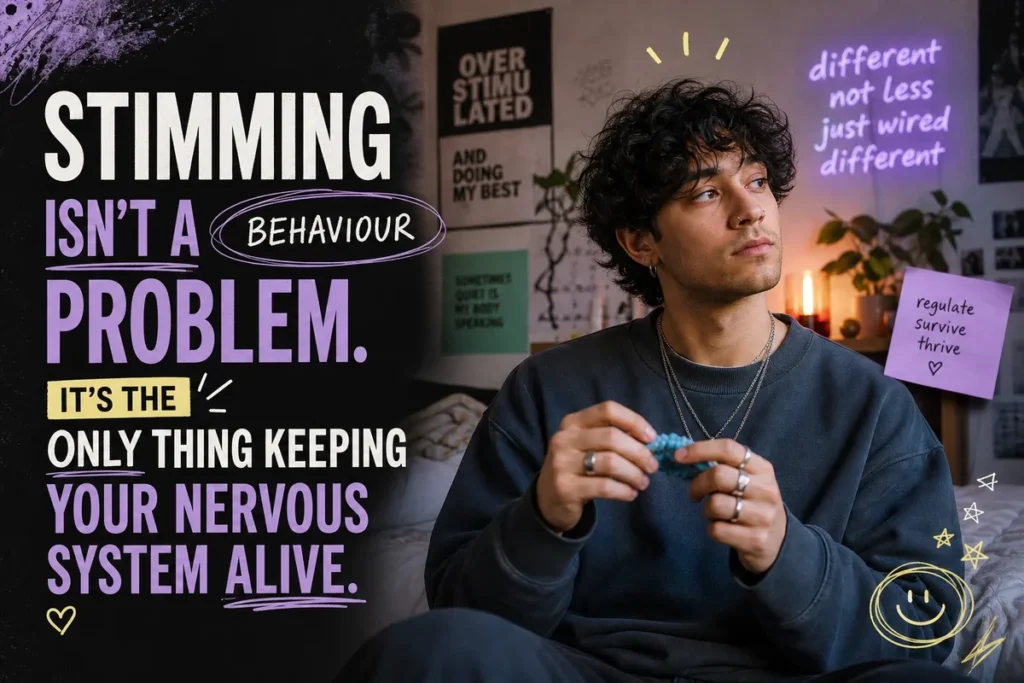
If you have AuDHD, your body already knows the answer to a question your brain is still debating: whether stimming is acceptable. Your leg is bouncing under the desk. Your fingers are tracing patterns on your sleeve. You are humming at a frequency low enough that you hope nobody can hear it. And some part of you is also monitoring yourself, calculating whether any of this is too visible, too weird, too much, because you have spent years learning that the world prefers you still. What that calculation costs you is what this article is about, and it is more than you have probably been told.
What Stimming Actually Is (and Why the Clinical Definition Undersells It)
Stimming, short for self-stimulatory behaviour, refers to repetitive movements, sounds, or sensory inputs that a person initiates and sustains for their own regulatory purposes. The clinical literature has historically framed it as a trait to be reduced: something associated with autism that, if visible, signals a need for intervention. That framing was wrong, and the evidence is now saying so clearly enough that it is worth stating directly.
Stimming is a regulatory behaviour. It is how certain nervous systems modulate arousal, manage sensory input, process emotion, and maintain enough internal coherence to stay functional. Research on autism and ADHD consistently identifies shared patterns of sensory processing difficulty and atypical arousal regulation across both conditions (Dellapiazza et al., 2021, European Child and Adolescent Psychiatry). What stimming does, in physiological terms, is provide predictable, controllable sensory input in a world where most sensory input is neither predictable nor controllable. For a nervous system under chronic overload, that matters enormously.
In ADHD, the regulatory function of movement is well-documented. Fidgeting, bouncing, and repetitive tactile contact all appear to help maintain the arousal levels that ADHD brains require for sustained attention. Research has found that many people with ADHD who are allowed to move during cognitive tasks show improved performance compared to those required to sit still. The body is not misbehaving. It is compensating for a gap between what the environment demands and what the nervous system can generate without additional input.
Stimming is not a trait to be corrected. It is a coping mechanism the nervous system developed before anyone gave it a name, and suppressing it does not make the underlying need disappear.
The AuDHD Sensory Problem Is Structurally Different
People with AuDHD sit at a particularly sharp intersection. Both autism and ADHD involve atypical sensory processing, but they tend to generate different sensory profiles and different regulatory demands. Autism often involves heightened sensory sensitivity, where specific inputs such as fluorescent lighting, fabric textures, or background conversation can become genuinely painful or overwhelming. ADHD tends to involve sensory underresponsivity in certain domains, where the nervous system requires more stimulation to register as alert and engaged. Research published in PLoS One in 2026 (Gad et al.) found evidence of sensory nerve differences in children with both autism spectrum disorder and ADHD, suggesting the sensory divergence in both conditions has measurable neurological substrate.
When you carry both, you can be simultaneously overstimulated by external input and underaroused internally, at the same time, in the same room, in the same body. This is not a paradox that resolves with coping strategies aimed at only one condition. The autistic nervous system may be using stimming to filter out sensory overload and create a familiar, manageable sensory signal. The ADHD nervous system may be using the same movement to generate enough internal arousal to stay present. The behaviour looks identical from the outside. The neurological functions it serves are running in parallel.
Why AuDHD stimming is not the same as autism-only stimming: In AuDHD, repetitive movement often serves a dual function simultaneously, filtering sensory overload (autistic regulation) while generating the internal stimulation needed to stay focused (ADHD regulation). Suppressing it leaves both systems dysregulated at once, which is why the crash after stim suppression tends to be faster and harder in AuDHD than in either single-diagnosis population.
Does Suppressing Stimming Actually Cause Burnout?
Chronic masking is one of the most consistent predictors of autistic burnout in the research literature. Raymaker et al. (2020, Autism in Adulthood) defined autistic burnout as “having all of your internal resources exhausted beyond measure and being left with no clean-up crew” and identified long-term masking as a primary contributor. Mantzalas et al. (2022, Autism Research) developed a conceptual model of risk and protective factors for autistic burnout in which chronic suppression of autistic traits plays a central role.
Stimming suppression is, by definition, a form of masking. It is the active inhibition of a regulatory behaviour in order to appear more neurotypical. A scoping review on autistic camouflaging and mental health that examined studies across multiple databases found that concealing autistic traits was associated with elevated depression, anxiety, stress, and burnout across a substantial body of published research. The evidence is not saying stimming suppression is mildly suboptimal. It is saying that doing it chronically is a reliable path toward functional collapse.
A study on autistic burnout conducted between 2023 and 2024 identified a pattern the researchers called dual-masking: concealing not just autistic traits but also the signs of burnout itself, which intensified strain, delayed recognition of the burnout, and made recovery harder to initiate. For AuDHD adults, dual-masking often includes suppressing the body movements that would signal to themselves, as much as to others, that the nervous system is struggling. The masking hides the visible behaviour. It also hides the internal signal that would prompt intervention before things get worse.
The Specific Cruelty of Being Told to Be Still When You Have ADHD
The stigma around stimming in AuDHD often comes from two directions at once, and they reinforce each other in ways worth naming explicitly. Autistic movement is historically read as something pathological that needs to be trained out. ADHD hyperactivity carries its own social stigma, read as disrespect, immaturity, or an inability to take situations seriously. For AuDHD adults, particularly those who reached adulthood without a diagnosis, these two stigmas have typically been internalised for decades before any diagnostic framework gives the behaviour a different meaning.
Research increasingly recognises masking as a significant and understudied phenomenon in ADHD as well as in autism. A paper examining the hidden burden carried by high-functioning adults with ADHD noted specifically that masking “may involve the inhibition of self-regulatory behaviours such as fidgeting, sometimes replaced by less visible movements”, movements that people learn to hide because the visible ones have attracted criticism. This substitution is not neutral. A person chewing the inside of their cheek instead of rocking is still stimming. They are also spending additional cognitive resources on the concealment, resources that were already running thin.
From the community: “People tell me I should ‘just be myself’ and that there’s no need to put on a front when I say I find social situations hard. What they don’t get is that me being 100% myself with no mask means some combination of the following at any given moment: pacing around, rocking side to side, chewing on my things…”, r/ADHD thread
Why Single-Condition Content Cannot Reach This
Content written for autistic people about stimming typically addresses the sensory regulation function and argues for acceptance of the behaviour on those grounds. That is useful, but incomplete for AuDHD. Content written for people with ADHD about movement typically frames fidgeting as a productivity tool, something to channel into stress balls or walking meetings. That is also useful, and also incomplete.
What neither framework addresses is the specific conflict that arises in AuDHD: your autistic sensory system needs the stim to complete, to sustain the regulatory loop until the nervous system settles. Your ADHD impulsivity interrupts the stim mid-cycle. Your autistic need for sameness wants the same stim every time it works. Your ADHD novelty-seeking brain gets bored of it within days and abandons the behaviour before it has become reliable enough to use under stress. The double bind described in the AuDHD literature, where your autism and ADHD spend most of the day actively undermining each other’s coping mechanisms, applies directly to stimming as a regulatory tool, and this collision of masking systems is one of the defining features of living AuDHD.
Your autistic brain builds a stim that works. Your ADHD brain interrupts it, varies it, or abandons it. Your autistic brain then cannot access the reliable regulatory behaviour it needs when the sensory environment becomes difficult, because the ADHD has already dismantled the consistency that made the stim reliable in the first place. This cycle is one of the reasons AuDHD adults often describe feeling like they cannot regulate even when they know what the regulation strategy is.
The problem for AuDHD is not a lack of regulation strategies. It is that the two neurologies share a body but operate on irreconcilable logic: one needing repetition to feel safe, the other needing change to stay awake.
What Stimming Suppression Feels Like From the Inside
Stimming suppression is rarely experienced as a conscious decision. For most AuDHD adults, it became automatic so early that the suppression itself is invisible. You may not be aware that you are doing it until the end of a day when you feel a particular kind of exhausted: not tired from what you did, but tired in a way that feels more physical than cognitive, like your body has been braced against something for hours. That bracing is the suppression.
Common patterns include holding the body extremely still during meetings while mental commentary runs at high volume internally, substituting invisible micro-movements for visible ones, waiting until a bathroom break or car ride to release movement that has been building for hours, and avoiding social situations specifically because the sensory and stimming suppression cost of attending has exceeded what the occasion is worth. Autistic burnout researchers (Raymaker et al., 2020) note that avoidance of previously manageable social and work situations is one of the later-stage markers of burnout, and suppression fatigue is one of the mechanisms driving that avoidance.
There is also the shame dimension. Research on autistic burnout has identified shame as a prominent emergent theme: shame shapes how people interpret their own functional limits, whether they seek help, and how hard they continue to mask even as the masking makes things worse. Suppressing stimming in particular tends to carry a layer of shame that other masking behaviours do not, because it involves the body in a way that feels more obviously visible and more fundamentally difficult to explain to people who do not share the experience.
The Medication Complication Nobody Mentions
For AuDHD adults on stimulant medication, the relationship with stimming adds another variable. Research on the effects of stimulant medications in AuDHD populations has found that while methylphenidate and amphetamine formulations are often effective for ADHD-specific traits, their effects in people with co-occurring autism can be paradoxical, including increased irritability, elevated sensory sensitivity, and in some cases more pronounced emotional dysregulation (as noted in research synthesis published in the Berkeley Scientific Journal, 2024). The AuDHD population has been largely neglected in clinical trial research specifically designed for their needs, which means that medication calibration often relies on single-condition evidence that may not translate cleanly.
This matters for stimming because effective medication may reduce the impulsive, ADHD-driven interruption of regulatory behaviours, giving the autistic sensory system more access to the consistent stimming it needs. But it can also, in some AuDHD presentations, heighten sensory sensitivity in ways that make the sensory environment feel more overwhelming, increasing the need to stim at exactly the moment when the person is in a work or school environment where stimming is most suppressed. The intersection is not predictable in advance. It is one of the reasons that medication calibration in AuDHD often takes longer and benefits from closer monitoring than single-diagnosis cases typically require.
On stimulant medication and AuDHD sensory experience: If starting or adjusting stimulant medication makes sensory sensitivity feel worse before it feels better, this is a recognised pattern in AuDHD. Raise it with your prescriber rather than stopping medication unilaterally, the response can shift significantly with dose or formulation changes. Monitoring the sensory dimension of response is as clinically important as monitoring attention improvement.
Reclaiming Stimming as Infrastructure, Not Indulgence
The framing shift that tends to be most useful for AuDHD adults is treating stimming not as a trait to manage but as infrastructure to maintain. Your nervous system built these behaviours because it needed them. They are not childish, not embarrassing, and not optional in the way that other habits are optional. Removing them without replacing their regulatory function is not growth. It is just a less visible form of the same dysregulation, now running internally rather than externally.
Practically, this means identifying which stims are serving which regulatory function, because not all stims are equivalent. Some are primarily sensory, helping the nervous system filter external noise. Some are primarily arousal-regulating, keeping the ADHD brain present and engaged. Some are emotional, providing a rhythmic pattern that helps process feelings that are otherwise too large to hold. Knowing which is which matters for the same reason any tool knowledge matters: it tells you what you are reaching for and why, so you can make intentional choices about when and how to use it rather than reacting to suppression pressure with pure compliance.
Broader nervous system regulation and burnout recovery are covered in depth at the ADHD Energy pillar, but the specific work of stim-awareness is internal: noticing the movement urge before it has been routed into invisibility, identifying what environment or internal state triggered it, and deciding deliberately whether suppression is worth the cost rather than defaulting to suppression as the only socially legible option.
Stimming is not something you failed to grow out of. It is something your nervous system built to survive. The question worth asking is not how to stop, it is how to stop paying for having done it in secret.
What Accommodation Actually Looks Like for Stimming in AuDHD
Workplace and social accommodation for stimming in AuDHD looks different from what single-condition frameworks tend to propose. It is not just a fidget toy in a meeting or permission to stand during a presentation. For AuDHD, meaningful accommodation means building environments where the autistic need for consistent, reliable sensory input can coexist with the ADHD need for variety, without the person having to spend executive function managing the visibility of both simultaneously.
Practically useful approaches include establishing private decompression time after high-masking environments, particularly after meetings, public transport, or social events where stim suppression was sustained for a significant period. They include designing home and work spaces with at least one zone where stimming is explicitly permitted and expected, so the decision to stim in that space requires no negotiation with shame. They include communicating with partners, close friends, or supportive colleagues that what they may observe, the leg bouncing, the rocking, the hand movement, is not a distress state requiring intervention but a regulation state that is doing its job.
The cost of chronic stimming suppression on close relationships is also underexamined. AuDHD adults who are suppressing heavily in public often cannot maintain that suppression at home, which means partners and housemates see the dysregulated, post-suppression state without context for what generated it. Understanding how AuDHD meltdowns and impulsivity interact is part of the same picture: the body that has been braced all day reaches home and releases everything that was held, including the emotional charge that accumulated alongside the physical suppression.
There is no version of sustainable AuDHD life that includes indefinite, unacknowledged stimming suppression. The research on autistic burnout is consistent enough on this point to be direct: the trajectory from chronic masking to functional collapse is not hypothetical. It is documented across multiple study designs and populations. What changes when you take stimming seriously as regulation rather than as a social liability is not that other people suddenly accommodate you. It is that you stop actively working against your own nervous system, and that changes what you have available for everything else.
Quick Dopamine Hits:
- When you feel the urge to stim in a social setting, give yourself a covert outlet immediately: press your feet hard into the floor, run your thumbnail along a seam in your clothing, or hum very quietly at a frequency only you can feel, do not wait until you’re home to release the pressure.
- After a session where you suppressed stimming to appear still, give your nervous system a deliberate decompression window: set a timer for 10 minutes, go somewhere private, and move or make noise exactly how your body wants to with zero moderation.
- Build one non-negotiable stim-safe zone into your daily environment, a specific chair, room, or commute window where stimming is explicitly allowed. Naming it makes you less likely to override the need when you’re there.
Rate this article
Was this a useful hit?