Your ADHD Sleep Debt Isn’t Just Making You Tired. It’s Dismantling Your Ability to Handle Conflict.

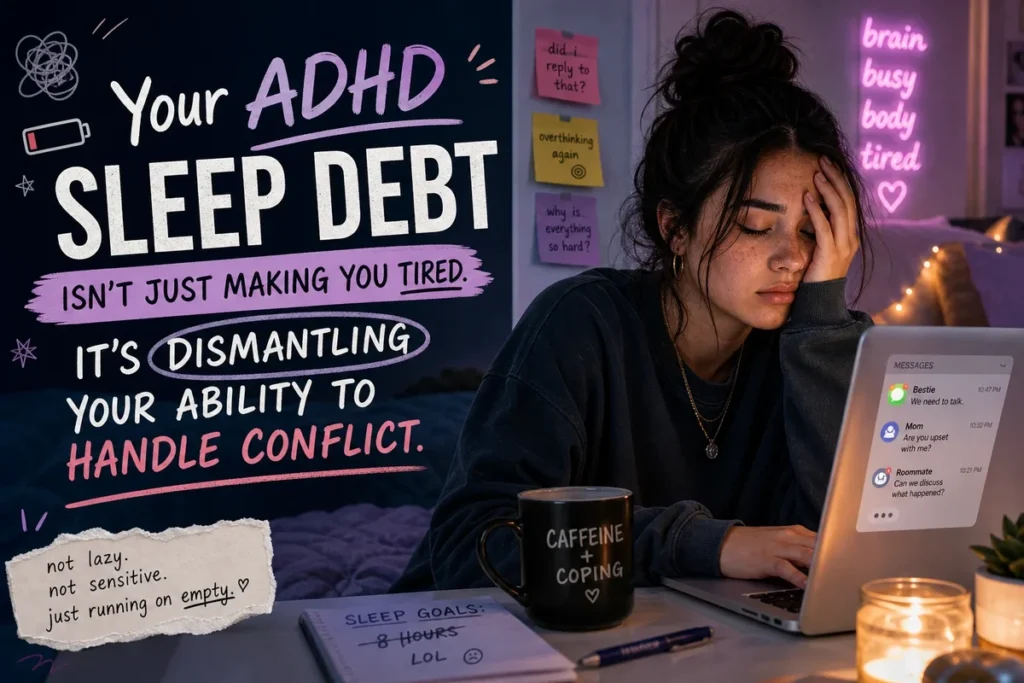
You slept badly. You know you slept badly. You drag yourself through the morning feeling like your skull is lined with static, and you tell yourself it won’t affect anything important. Then your partner makes a mildly frustrated comment about the dishes, and something detonates. Not the slow build you might expect. An immediate, full-volume reaction that leaves you both staring at each other wondering what just happened. The dishes were never about the dishes. But the intensity of your response had less to do with the relationship than with what happened in your brain during the seven hours you should have been sleeping. Poor ADHD sleep quality is not simply a fatigue problem. It is a neurological subtraction. Each night of disrupted or insufficient sleep actively reduces your capacity to process interpersonal friction without dysregulating. And for a brain that was already running with compromised emotional regulation circuits before you even got out of bed, the math gets worse fast.
Why ADHD Brains Start the Day Already at a Deficit
Sleep disturbances are not a side effect of ADHD for some people. They are structurally baked in for most. Research synthesized across multiple studies finds that up to 80% of adults with ADHD experience clinically significant sleep disturbances, and delayed sleep-wake timing occurs in up to 78% of the ADHD population. The biological mechanism involves the suprachiasmatic nucleus, the brain’s master clock, along with delayed melatonin secretion and altered cortisol rhythms. In adults with ADHD, dim-light melatonin onset (the internal signal that tells your brain to begin winding down) is delayed by approximately 90 minutes compared to neurotypical adults. This is not a discipline failure. It is a circadian rhythm that runs on a different schedule, one that intersects badly with morning alarms, nine-to-five expectations, and everything that follows.
The downstream consequence matters enormously in the context of relationships. When your melatonin fires late, you fall asleep late. When an alarm forces you up at a fixed time, you cut into REM sleep, the stage responsible for emotional memory processing and emotional tone regulation for the following day. You do not just lose rest. You lose the neurological maintenance that would otherwise prepare your brain for the emotional demands of waking life. The person who overreacts to a tone of voice at 8 AM may not be a reactive person. They may simply be someone whose brain never finished processing yesterday.
The scale of the sleep problem in ADHD: Research on circadian rhythms in ADHD found that up to 80% of adults with ADHD experience sleep disturbances, with melatonin onset delayed by approximately 90 minutes compared to neurotypical adults. This circadian mismatch is not a matter of poor discipline. It is a measurable neurobiological difference with direct consequences for emotional regulation the following day.
Does Sleep Deprivation Cause More Conflict? What Does Your Brain Actually Lose?
Sleep deprivation predictably dismantles the connection between two brain regions that sit at the centre of emotional regulation: the amygdala and the anterior cingulate cortex. The amygdala is your threat-detection centre. It fires fast, often before conscious awareness has registered anything at all. The anterior cingulate cortex, working in coordination with the prefrontal cortex, is the moderating structure: it contextualizes the threat signal, checks it against social and emotional experience, and modulates the response. When these two structures are well-connected and well-rested, you perceive a frustrated tone in your partner’s voice and your brain can run a rapid calculation: is this an actual threat, or is this normal friction from someone who is tired too? That calculation takes milliseconds, but it requires functional connectivity between those regions.
Research by Motomura et al. (2013, PLoS ONE) demonstrated directly that sleep debt diminishes amygdala-anterior cingulate functional connectivity, and that this reduced connectivity produces measurably more negative emotional reactions to otherwise neutral or ambiguous stimuli. The brain, running on sleep debt, quite literally becomes less capable of the moderating process. It does not calibrate threat proportionately. It registers friction as danger at a higher rate than it would with adequate rest.
Sleep debt does not just impair your cognitive performance. It degrades the specific neural circuit responsible for reading interpersonal situations accurately and responding proportionately. What follows is not moodiness or bad character. It is a broken signal path.
What this means for someone who also has ADHD is that the starting conditions are not neutral. ADHD neurology involves abnormal functional connectivity between the dorsolateral prefrontal cortex and other emotional regulation structures before any sleep deprivation enters the picture. Research on emotional dysregulation in adult ADHD has consistently found that the prefrontal cortex does not maintain the same inhibitory grip over the amygdala that it does in neurotypical brains (Mitchell et al., 2012, Journal of Psychopathology and Behavioral Assessment). The regulatory circuit is already running at reduced capacity. Add a night of fragmented sleep, and the modulating capacity that remained gets further stripped away. There is not a gradual transition into dysregulation. There is a step-change, often within the first interpersonal encounter of the day.
The Double Exposure: ADHD Emotional Dysregulation Meets Sleep Loss
Emotional dysregulation is not a secondary or optional feature of ADHD. Russell Barkley’s work has long argued that poor emotional self-control, specifically the diminished capacity to inhibit frustration, impatience, and anger, adds predictive and explanatory power to ADHD impairment well beyond core inattentive and hyperactive-impulsive traits (Barkley and Murphy, 2010). This is the baseline. On a well-rested night, a person with ADHD is already managing with less prefrontal modulation than a neurotypical person. Their amygdala is already more reactive. Their emotional responses already arrive faster, at higher volume, and with shorter delay between stimulus and behavioral output.
When sleep quality degrades, the one buffer available, the residual prefrontal capacity, erodes further. What research describes as emotional impulsivity in ADHD, the rapid translation of emotional state into visible behavior before conscious processing can intervene, becomes more pronounced under sleep deprivation. Mitchell et al. (2012) found that emotion dysregulation scores mediated the relationship between core ADHD traits and emotional impulsivity in adults, meaning dysregulation does not just accompany the ADHD picture. It acts as the transmission mechanism between internal state and behavioral output. Strip away the sleep that would normally restore some of that regulatory capacity, and what you get is faster escalation, a lower threshold for perceived threat, and less ability to exit a conflict spiral once it begins.
From the community: “I cannot stop staying up too late because it’s my [time]. After work, I’m sooooo tired and mentally exhausted after the day. Sometimes I make dinner, often I order dinner… but once it’s time to go to sleep, I can’t make myself do it.”, r/ADHD thread
This pattern has a name in research literature: revenge bedtime procrastination. The neurological pull to stay awake past the point of exhaustion is partly about reclaiming stimulation, novelty, and personal time that the ADHD brain craves and rarely gets during structured daytime hours. The irony is visible from the outside: staying up to feel alive strips away the exact neurological resources you need to manage the most emotionally loaded interactions of your life the next day. The cost gets paid not in tiredness, but in the argument you have over something that did not deserve one.
What Poor Sleep Does to How You Read Your Partner
One of the most underappreciated effects of sleep deprivation in relationship contexts is how it warps threat perception. A sleep-deprived brain does not simply feel worse. It processes social and emotional information differently. Neutral facial expressions read as unfriendly. A flat tone gets coded as hostile. A delay in replying becomes evidence of something more sinister. The anterior cingulate cortex, whose connectivity is already compromised by poor sleep, normally performs a function something like social calibration: it checks an initial emotional read against context, prior knowledge of the person, and the logical probability that the interpretation is accurate. When that connection is weakened, the initial read wins.
For ADHD brains already tuned toward rejection sensitivity, this is a significant problem. Rejection sensitive dysphoria (RSD), the intense emotional response to perceived criticism or rejection, operates through hyperreactive threat-detection circuitry. Add sleep debt, and the sensitivity threshold drops further. What would be a minor or manageable trigger on a well-rested day becomes overwhelming. The partner asking a mundane question with mild impatience is not behaving differently. The ADHD brain, sleep-compromised, is perceiving them through a threat lens calibrated to the most hostile possible reading. This is not paranoia. It is a measurable neurological effect, and it produces genuine conflict from situations that did not require conflict at all.
Sleep loss does not just make you feel worse. It changes what you see. A flat tone becomes an insult. A pause becomes abandonment. The fight that erupts may have started as a processing error, not a real disagreement.
REM Sleep, Emotional Memory, and Why Unresolved Arguments Feel Bigger the Next Day
REM sleep serves a function beyond rest. It is the stage during which the brain processes emotionally significant experiences from the preceding day, stripping away the acute emotional charge while preserving the informational content. Research on dreaming and emotional processing has found that REM sleep activates the amygdala intensely, but does so in a neurochemical environment low in norepinephrine, the stress neurotransmitter, effectively allowing the brain to replay emotional memories without the physiological arousal that accompanied them originally. This is, in simplified terms, how experience becomes manageable memory rather than raw wound. When REM sleep is cut short, which is exactly what tends to happen when an ADHD brain falls asleep at 1 AM and wakes at 7 AM, yesterday’s argument, yesterday’s perceived slight, and yesterday’s unprocessed frustration do not complete the detoxification process. They carry over with more emotional weight than they deserve.
Galbiati et al. (2020, Brain and Cognition) found a direct association between emotional dysregulation severity and disrupted REM sleep features in people with insomnia. The relationship is bidirectional: emotional dysregulation makes sleep worse, and disrupted sleep amplifies emotional dysregulation. For ADHD, where both sides of this loop are already compromised at baseline, this bidirectionality creates a genuinely difficult cycle. Poor emotional regulation drives poor sleep. Poor sleep returns worse emotional regulation. The couple having the same argument repeatedly may not be failing at communication. They may be caught in a neurological cycle neither of them can name.
The practical implication is specific and important: arguments that happen late at night, arguments between people who are both chronically sleep-deprived, and arguments that happen before the brain has had time to process the previous day’s emotional content are structurally worse than arguments at other times. This is not psychological advice. It is sleep neuroscience. Understanding how ADHD erodes relationship dynamics over time is easier when you can see the neurological infrastructure underneath it, and sleep is a larger part of that infrastructure than most people realise.
The Circadian Mismatch Problem in Shared Living
The delayed sleep phase that characterises ADHD neurology does not exist in isolation. It exists inside a shared household. For adults with ADHD in relationships, the circadian mismatch between an ADHD night-owl chronotype and a partner who needs to wind down at 10 PM is itself a source of relational friction. The ADHD partner stays up, often in a burst of cognitive energy or stimulation-seeking that feels productive and alive at midnight. The non-ADHD partner wakes tired and feels alone in the morning. One person is at their cognitive peak at 11 PM. The other is at theirs at 8 AM. They share a bed and a schedule, but they are, in some meaningful sense, living in different time zones neurologically.
Research classifying ADHD as a circadian rhythm disorder notes that this delayed chronotype is not a choice or a preference. It is driven by measurable biological markers including delayed dim-light melatonin onset, blunted cortisol rhythms, and clock-gene polymorphisms in the PER and CLOCK genes. Intervention studies have shown that advancing the circadian phase through melatonin use and bright light therapy can improve both sleep timing and ADHD trait severity, suggesting the circadian component is genuinely causal rather than incidental. The implication for relationships is that the morning-grumpiness pattern, the version of yourself that exists before the ADHD brain has adequately woken up, is not random. It is predictable. And predictable things can, to some degree, be planned around.
ADHD chronotype and conflict timing: Because ADHD brains commonly run behind neurotypical circadian rhythms by a measurable margin, the early morning window, when a partner may want to resolve last night’s tension, is often the window where the ADHD brain is least equipped to regulate emotion effectively. Timing difficult conversations for mid-to-late morning, after medication has taken effect and the circadian rhythm has partially caught up, is not avoidance. It is neurological strategy.
What You Can Actually Do About This
The research on sleep and emotional regulation does not offer simple fixes, but it does offer structural leverage points. The first is naming the mechanism explicitly within the relationship. When both partners understand that sleep deprivation physiologically degrades conflict-processing capacity, a bad morning is no longer evidence of a character problem. It becomes data about brain state. This reframing matters not because it excuses behavior, but because it directs attention to the right target: the sleep environment, rather than the person.
The second leverage point is timing. Understanding that emotional regulatory capacity follows a predictable pattern across the day means difficult conversations can be scheduled, at least loosely, for windows where the ADHD brain is more resourced. For many people with ADHD, this is not first thing in the morning and not late at night. It is the mid-to-late morning window after medication has had time to act and the circadian lag has partially resolved. This is not conflict avoidance. It is recognizing that the prefrontal cortex is not uniformly available across a 24-hour day, and that choosing a moment when it is more online is a relationship skill, not a weakness.
The third leverage point involves the sleep architecture itself. Because ADHD’s circadian delay is biological, fighting it with willpower alone tends to fail. Approaches that have shown measurable evidence of phase advancement in ADHD populations include low-dose melatonin taken several hours before the target sleep time, morning bright light therapy to reset the suprachiasmatic nucleus, and consistent wake times maintained even on weekends. None of these are dramatic interventions. But each one, applied consistently, moves the circadian rhythm closer to the available sleep window, which means more REM sleep, better emotional memory processing, and a brain that arrives at morning conversations with more regulatory capacity intact. For more on the physical and hormonal dimensions of how ADHD affects the body’s daily rhythms, the ADHD body pillar covers the broader landscape of nervous system and sleep regulation.
You cannot think or discipline your way to better emotional regulation in conflict if your brain is running on five hours of cut-short REM sleep. The regulatory capacity you need is built during the hours before the conversation. Not during it.
The Conversation Worth Having With Your Partner
Adults with ADHD in romantic relationships already carry a disproportionate burden of relational labor, emotional misattribution, and shame accumulation around interpersonal failures. Research by O’Brien et al. (2026, Journal of Marital and Family Therapy) found that people with ADHD consistently described feeling like a burden on their partners, overwhelmed by the gap between the relational consistency they wanted to provide and the one they could actually sustain. The emotional impulsivity driven by sleep-degraded regulatory circuits feeds directly into this shame cycle. You snap. You feel terrible. You cannot fully explain why. You apologize in ways that feel inadequate. Your partner absorbs the apology without the explanation, and the same situation happens again.
Having an explicit conversation about the sleep-emotion-conflict link changes the available options. Not by removing responsibility, but by making the mechanism visible. When your partner understands that you genuinely lose regulatory capacity after poor sleep, they can factor that into their interpretation of your responses. When you understand it yourself, you can flag it before a conversation escalates: “I slept badly. My emotional ceiling is lower today. I want to talk about this but I may need a break if I start to tip.” This is not an excuse. It is the kind of self-knowledge that prevents a neurological event from being misread as a relational one.
The ADHD brain already escalates faster in conflict than most people expect, as explored in depth in the research behind the ADHD point of no return in arguments. Sleep debt moves that threshold earlier still. The relationships most damaged by ADHD sleep patterns are often not damaged by malice or indifference. They are damaged by the same argument having the same neurological outcome repeatedly, without either person understanding what they are actually dealing with. Sleep quality is not a soft lifestyle variable at the edges of this picture. It is, for the ADHD brain, one of the central determinants of whether the next conversation goes to conflict or to connection, and it is one of the few variables in this equation that can actually be shifted.
Quick Dopamine Hits:
- Before a difficult conversation, check your sleep from the night before. If you got under six hours, explicitly say to yourself: ‘My emotional ceiling is lower today’, and name that to your partner before the conversation starts.
- Create a single hard boundary: no relationship conflict discussions after 9 PM or within two hours of waking. Sleep-deprived brains read neutral tones as hostile. Protect those windows.
- When you feel yourself tipping toward a snap response, use a one-sentence circuit breaker: ‘I need five minutes.’ This is not avoidance. It is giving your prefrontal cortex enough time to catch up with your amygdala.
Rate this article
Was this a useful hit?