Your Bank Statement Isn’t a Moral Record. It’s a Dopamine Log.

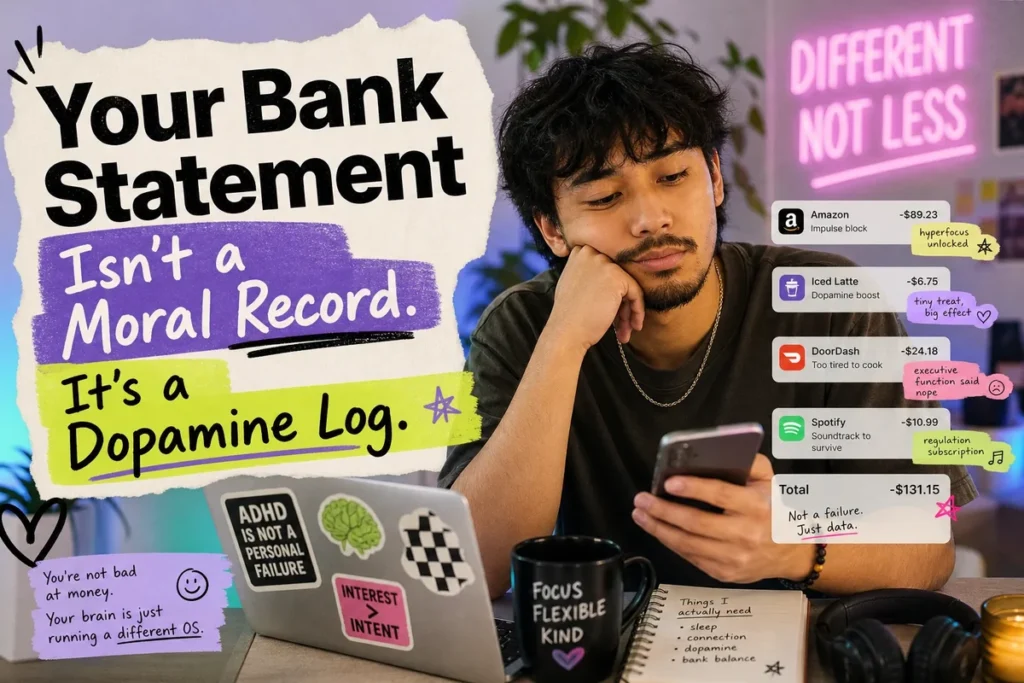
Your bank statement is not a moral ledger. For many adults with ADHD, it is a transaction-level record of how a reward system, a working memory, and an emotional regulation system behaved under pressure. ADHD impulse spending is driven largely by steeper delay discounting, meaning future rewards lose value faster than they do for most people, combined with weaker inhibitory control and working memory (Sonuga-Barke et al., 1992, Scheres et al., 2010). That makes the spending a predictable pattern to manage with structure, not a character flaw to punish with shame. As of October 2026 that is the consistent direction of the research, though individual variation is large.
If you have ever scrolled a statement and felt your stomach drop at a $212 order placed at 1:40 a.m., a $9.99 charge for something you forgot existed, and three delivery fees in one week, you know the specific shame involved. It reads like a confession. The holiday sales season is only weeks away, which is when that confession tends to get longer. This article is about reading the same document differently.
Why Does ADHD Cause Impulsive Spending?
ADHD can drive impulsive spending because the reward system often under-responds to ordinary rewards, discounts future payoffs steeply, and has weaker braking power at the moment of temptation. A purchase offers novelty, anticipation, and instant resolution, which is the fastest dopamine source available on a phone.
The neurochemistry has been measured, not just theorized. Volkow et al. (2011, Molecular Psychiatry) used PET imaging to show reduced dopamine receptor and transporter availability in the reward pathway of adults with ADHD, and that the deficit tracked with lower motivation scores. Sagvolden and colleagues’ dynamic developmental theory goes a step further: blunted bursts of phasic dopamine weaken learning from positive outcomes, so ordinary rewards register faintly while something new and immediate registers sharply.
Then there is the timing problem. People with ADHD often prefer smaller immediate rewards over larger delayed ones, producing a steeper temporal discount curve (Scheres et al., 2008, Marco et al., 2009, Sonuga-Barke et al., 1992). A review in Frontiers in Neuroscience (Chachar and Shaikh, 2024) adds that people with ADHD may show suboptimal decision-making rather than simply riskier decision-making, picking options with lower expected value even when risk is not the issue.
One finding deserves more attention than it gets. Solanto et al. (2001) found that inhibitory deficits and delay aversion were uncorrelated with each other, yet both were strongly and independently associated with ADHD. Two separate mechanisms may be pulling at your wallet, which could help explain why you can resist a pushy salesperson and still lose to a one-click upsell.
Your Statement Is a Neurological Record, Not a Character Reference
Mainstream money advice assumes that spending is a decision made by a deliberate, forward-looking person who then chooses badly. Much ADHD spending may never pass through that deliberate person at all. The click happens before the part of the brain that holds the rent, the savings goal, and the consequences has been called into the room.
A choice requires that the part of you doing the deciding was present when the purchase happened. Much of the time, it wasn’t.
Moralizing this pattern is not just inaccurate, it is counterproductive. ADDitude’s clinicians note that money is tied to identity, especially for men, who tend to read it as a measure of status and worth, so a messy financial life gets taken as a personal verdict. ADHD is linked with lower income across the lifespan, likely because of education barriers, workplace friction, and self-employment that does not always pan out, and managing ADHD and related problems carries real costs of its own. Many people with ADHD start the money game with a smaller margin for error and then get judged as though the margin were equal.
The stakes are higher than embarrassment. A 2020 population study in Science Advances on ADHD, financial distress, and suicide in adulthood linked financial distress to suicide risk in people with ADHD. Shame about money is not a harmless motivational tool. If a bank statement is beginning to feel like proof that you should not exist, that is a signal to talk to a clinician or someone you trust, not to budget harder.
Four Different Brain Systems Hide Inside One Statement
The mistake most budgeting advice makes is treating every questionable charge as the same kind of problem. A single month of transactions can contain at least four, and each one needs a different fix.
The dopamine seek is the one you recognize instantly. It is the gadget, the hobby kit, the fourth pair of nearly identical jeans, bought in a rush of anticipation that often peaks at the click rather than at delivery. We covered the mechanics in our piece on impulse spending as dopamine seeking, and the short version is that your brain was shopping for a feeling, not an object.
Relief spending looks identical on the statement but starts somewhere else. Emotional dysregulation and rejection sensitive dysphoria (RSD) can produce sudden, intense pain, and spending is a fast anesthetic. In a 2026 qualitative thesis on women who discovered their ADHD late, Cox described participants who spent significant amounts of money and incurred debt as a short-term response to the pain of rejection. One participant said it was meant to “fill the void that the rejection had created,” and described a stretch of “debt, quitting my job, making incredibly rash decisions” in response. The charge was not about the item. It was about the feeling.
Forgotten charges belong to working memory and object permanence, not to appetite. The streaming service you signed up for during one hyperfocus week, the annual renewal that arrived while you were exhausted, the late fee that appeared because a bill left your mental workspace before it reached your bank app. Nobody wanted those. They are the ADHD tax in its purest form, and the seventeen-subscriptions problem is one of the clearest examples.
Executive-function surcharges are the category that matches this article’s title most directly. Takeout ordered because starting dinner felt neurologically impossible, rush shipping because time blindness ate the week, replacement chargers, duplicate purchases of things you own but cannot see. Much of this is not indulgence. It is the price of a brain that struggles to initiate and sequence tasks, and a full fridge next to a delivery order is the whole story in one image.
Why the label matters: The same $40 charge can be a dopamine seek, an anesthetic for a painful feeling, a forgotten renewal, or an executive-function surcharge. Each one has a different fix. Treating all four as “overspending” is why willpower-based budgets keep collapsing.
The Numbers Behind the Pattern
The scale of this is easy to underestimate, so these are the figures that frame it, as of October 2026. They describe groups, not individuals, and several come from reviews and trade sources rather than a single trial.
| Measure | Figure | Source |
|---|---|---|
| Estimated global prevalence of adult ADHD | About 3.4% (range 1.2% to 7.3%) | Study of ADHD traits in non-treatment-seeking young adults |
| Childhood ADHD that persists into adulthood | Approximately 60% | Chachar and Shaikh, 2024, Frontiers in Neuroscience |
| Odds of comorbid ADHD with compulsive internet use | Odds ratio of 2.9 | Meta-analysis cited in the same young-adult study |
| Delay range in a standard delay-discounting task | Immediate rewards versus a 30 euro reward delayed by up to 2 weeks | Temporal discounting task in an ADHD incentive-delay study |
| Average US male earnings advantage over women | 19%, though ADHD is linked with lower lifetime income | ADDitude Magazine, 2026 |
The delay row is the one worth sitting with. In that experimental design, the “future” the brain struggled to wait for was a matter of days. Nobody was asking participants to save for retirement. If a short wait is enough to shift preference toward the immediate option, then an unplanned purchase against a bill due next week is not a mystery. It is the lab result, scaled up to a credit card.
Why Shame Makes the Next Statement Worse
Shame is often a trigger rather than a deterrent for a brain that spends to escape feelings. The statement produces pain, the pain demands relief, and the fastest relief on offer is the same dopamine source that created the statement. That loop is easy to mistake for a lack of discipline when it is closer to an emotion regulation problem, which is also why procrastination behaves like an emotional response rather than a scheduling one.
The other branch of the loop is avoidance. You stop opening the app because opening it hurts, and the unopened app hides the late fee, the overdraft, the duplicate charge. By the time you look again, the problem has grown and the shame has grown with it. We broke this down in the story of the missed payment you never opened again: the avoidance is not irresponsibility, it is a nervous system protecting itself from a repeated injury.
A system that punishes every look at the numbers teaches your brain to stop looking at the numbers.
This is why the first move in fixing ADHD finances is not a budget. It is changing the emotional temperature of the document, so that opening it is survivable enough to happen at all.
How Do You Stop Impulse Spending With ADHD?
You reduce impulse spending with ADHD by redesigning the environment so the urge meets friction, the obligations run without your memory, and your reward system has a planned outlet. Willpower alone is a weak tool because the system that would supply it is the one under strain. Research suggests that treating ADHD can reduce impulsivity more broadly, but whether that changes your spending is a conversation for your prescriber, not a promise.
Friction is the cheapest intervention. Remove saved card details from the two apps you use most, take shopping apps off your home screen, and park anything you want in a cart with a date attached rather than buying it. The purpose is not to forbid the purchase. It is to widen the gap between impulse and transaction so the prefrontal brake has time to arrive.
Automation is the fix for forgotten charges. Autopay for fixed bills, a calendar rule that sends renewals to a single review date, and a monthly check attached to something you already do, like payday, all remove the demand on working memory. A financial system built around how your brain actually works assumes you will forget and makes forgetting cheap.
A designated dopamine budget handles the seek. Transfer a small fixed amount weekly into a separate account and spend it without commentary or guilt. It feels counterintuitive to budget for impulsiveness, but a reward system that gets a regular, legal payout may be less likely to raid the grocery money. Pairing this with a dopamine menu for non-financial rewards gives the same circuitry more than one door to knock on.
How to Read Your Statement Without Passing a Verdict
This audit takes about 20 minutes and is designed to produce information rather than punishment. You cannot design a fix for a pattern you have only ever looked at through shame.
Set a timer for 20 minutes and pull up the last 30 days of transactions. Go line by line and tag each charge with a single letter: S for a dopamine seek, R for relief from a feeling, F for something you forgot, and L for a logistics cost that executive dysfunction created. Do not write commentary. Do not add up a total yet. When the timer ends, stop, even if the month is unfinished, because the session needs to end while it is still tolerable.
Then look at the clustering rather than the amounts. You may find that one letter dominates. A statement thick with S charges points toward friction and a dopamine budget. A statement full of R charges points toward emotional regulation, and the most useful next step may be working on RSD and dysregulation, not the card. A wall of F charges means automation will give you the biggest return. A crowd of L charges means the real upgrade is an executive-function scaffold for food, errands, and time, and the money may follow.
Check the timestamps: Add one more observation to the audit: what time of day and what emotional state surrounded each charge. Late-night purchases may point to under-stimulation or sleep debt, and charges that follow a bad email or a shame hit may point to relief spending. The pattern in the timing is often more actionable than the merchant names.
For this piece, the basis is a close reading of the neuroeconomic review by Chachar and Shaikh (2024), the delay-discounting and reinforcement-learning literature on ADHD, Cox’s 2026 qualitative work on RSD, and the clinician-written financial guidance in ADDitude, set against what we have already published on money and executive dysfunction. It is educational, not financial or medical advice.
What Changes When the Statement Becomes Data
The shift is small and enormous: you stop asking what is wrong with you and start asking what the brain was getting. That question has answers. They point to specific changes in the environment, specific conversations with a prescriber or therapist, and specific systems that do not require you to be a different person.
It also changes the conversation with other people. ADDitude’s clinicians describe a painful cycle in couples: the partner who handles daily money logistics tends to carry the emotional weight of financial stress, while the other feels blamed and avoidant. Showing someone a statement tagged S, R, F, and L is a different conversation than showing them a total. It turns blame into a diagnosis of the system.
With the holiday season approaching, pick one category rather than trying to fix everything. If the statement says seeks, add friction to one app. If it says forgotten charges, automate one bill. A good-enough fix that exists beats a perfect plan that lives in a note you never reopen. For the wider picture, the ADHD Money pillar and our breakdown of what the ADHD tax costs per year are good next stops.
Your statement was never a referendum on your worth. It is a log of a nervous system doing what it was wired to do in an environment designed for someone else. Read it like data, and you can change the system. Read it like a verdict, and you will keep paying for the shame.
Frequently asked questions
Is impulsive spending a sign of ADHD? It can be. Impulsive spending is a recognized pattern linked to steeper delay discounting, reduced reward-pathway dopamine function, and weaker inhibitory control. Individual variation is large, so not everyone with ADHD spends impulsively and not every impulsive spender has ADHD.
Why do I spend money when I am upset? Emotional dysregulation and rejection sensitive dysphoria can create sudden painful feelings, and spending delivers fast relief through novelty and anticipation. In qualitative research on women who discovered their ADHD late, participants described spending and debt as a short-term way to fill the void left by rejection.
Why do I forget to pay bills even when I have the money? Working memory lapses can drop a pending bill out of active awareness before it becomes action, which is a memory problem rather than a values problem. Autopay, a single weekly review date, and visible reminders reduce the demand on your memory.
How do I stop impulse buying with ADHD? Add friction between the urge and the purchase by removing saved cards and parking items in a dated cart, automate recurring obligations, and budget a small fixed amount for guilt-free spending. Whether medication reduces spending impulsivity for you is a question for your prescriber.
Should I look at my bank statement if it makes me feel ashamed? Yes, but in short, structured sessions such as a 20-minute audit that tags each charge by cause rather than judging it. If money shame is shifting into hopelessness, reach out to a clinician or someone you trust.
Quick Dopamine Hits:
- Open your last 30 days of transactions with a 20-minute timer running and tag each charge with one letter: S for a dopamine seek, R for relief from a feeling, F for something you forgot, L for a convenience cost of executive dysfunction. Stop when the timer ends, finished or not.
- Remove saved card details from your two most-used shopping apps and sites today. That adds a minute of friction between the urge and the purchase, which gives your prefrontal brake a chance to catch up.
- Set up a small weekly transfer into a separate account labeled ‘fun money’ and spend it without commentary. A planned dopamine outlet gives your reward system a legal channel so it stops raiding the rent.
Rate this article
Was this a useful hit?