You Weren’t Being Gross. Your Body Was Trying to Regulate. Nobody Told You That’s What BFRBs Are.

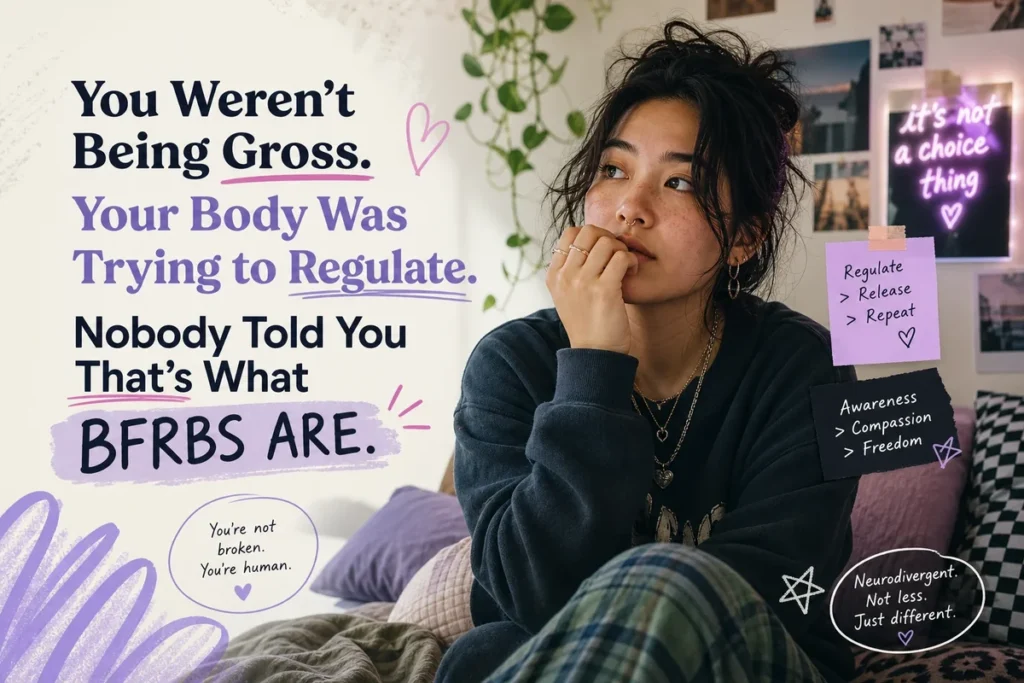
If you pick at your skin, bite your nails until they bleed, or pull your hair without quite meaning to, you have probably been told some version of the same thing: stop. Try harder. It is a bad habit. And if that framing has never actually helped you stop, there is a reason. These behaviors are not about discipline or willpower. They are your nervous system doing something it was never taught to do through any other route. The clinical term is body-focused repetitive behaviors, or BFRBs, and for people with ADHD they are one of the most underexplained and under-validated aspects of the whole condition. The short answer is this: BFRBs in ADHD function as emergency emotion regulation and sensory-seeking tools, not character flaws. Understanding that changes everything about how you approach them.
What BFRBs Actually Are
Body-focused repetitive behaviors are defined in clinical literature as repetitive, non-rhythmic behaviors directed at the body, including skin picking (excoriation), hair pulling (trichotillomania), nail biting (onychophagia), and lip or cheek biting. According to a narrative review on impulsivity and compulsivity across psychiatric disorders, BFRBs are thought to serve emotion regulation functions, including reducing distress or producing a brief sense of relief or pleasure. They sit on what researchers describe as the impulsivity-compulsivity spectrum: some begin impulsively, triggered by an emotion, and over time become compulsive and ritualized as the habit loop deepens.
They are not the same as OCD, even though the two are often conflated. The DSM-5 reclassified trichotillomania into the OCD-related disorders category, which created some clinical confusion. But the internal experience is distinct. OCD-driven behaviors are typically motivated by a need to prevent harm or neutralize an intrusive thought. BFRBs in people with ADHD are more often triggered by emotional states, sensory underarousal, or the need to do something with a nervous system that has nowhere else to put its energy. The driver is regulation, not ritual.
BFRBs are thought to serve emotion regulation functions, including reducing distress or providing pleasure. Some begin impulsively but evolve into compulsive, ritualized actions over time, a distinction that matters for understanding them and for choosing the right interventions.
Why ADHD Brains Are Particularly Prone to Them
ADHD is fundamentally a condition of dysregulation. The dopamine and noradrenaline systems that govern emotional regulation, impulse control, and arousal modulation all function atypically. When the nervous system is understimulated, or when it is flooded with emotion it cannot process efficiently, it looks for fast, reliable ways to shift its internal state. BFRBs are extraordinarily effective at this, at least in the short term.
Skin picking in particular provides tactile input, a point of intense focus, and a small but reliable sensory reward. When fingers settle on a raised bump or an imperfection, there is often a quality of locked attention that feels almost satisfying, especially for a brain that struggles to sustain attention on anything voluntary. Nail biting delivers oral-motor stimulation, which activates the vagus nerve and can briefly reduce physiological arousal. Hair pulling provides rhythmic repetition and sensory feedback through the scalp, both of which can serve a calming function for an overloaded nervous system.
Research on sensory processing in ADHD consistently identifies patterns of both under-responsivity, where the nervous system needs more input to register as alert, and sensation-seeking, where the brain actively hunts for stimulation to compensate (Chu, 2005, Brunel University). BFRBs land directly in the sensation-seeking category. The body finds what works. It just was never told that this was the mechanism, or given better alternatives.
The regulation loop: A BFRB typically starts with a trigger state, boredom, anxiety, emotional overwhelm, or sensory underarousal. The behavior provides immediate sensory feedback and briefly shifts the nervous system’s state. The relief reinforces the behavior. Over time the behavior becomes automatic and increasingly disconnected from the original trigger, which is why willpower-based approaches almost always fail.
The Emotion Regulation Evidence Is Clearer Than Most Clinicians Acknowledge
A 2026 clinical follow-up study published in the Journal of Clinical Medicine (Yazici, Kivrak, Tekeoğlu, and Hocaoglu, PMC13026607) examined 26 adolescents aged 11 to 17 who had both ADHD and comorbid skin-picking disorder. Over three months of methylphenidate treatment, participants showed statistically significant reductions in both ADHD symptoms and skin-picking severity simultaneously. The researchers found that changes in emotion regulation scores were moderately correlated with changes in skin-picking severity, and that changes in emotion regulation accounted for a meaningful proportion of the variance in picking outcomes.
The table below summarizes the key outcomes from that study, published as of March 2026.
| Measure | Direction of change | Effect size (Cohen’s d) | Statistical significance |
|---|---|---|---|
| Emotion regulation difficulties (DERS total) | Significant reduction | 1.35 | p <, 0.001 |
| Skin-picking severity (SPS-R) | Significant reduction | 1.79 | p <, 0.001 |
| Repetitive thoughts and behaviors (RTBS-CF) | Significant reduction | 0.91 | p <, 0.001 |
| Correlation: emotion regulation change to skin-picking change | Moderate positive correlation | r = 0.554 | p = 0.003 |
What this means practically: when the ADHD brain gets better at regulating its emotional states, the demand for emergency self-regulation through skin picking decreases. The BFRB was never about the skin. It was about what the skin picking was doing for the nervous system in the absence of any other effective tool. The study authors noted that the improvement in skin-picking may have occurred alongside general ADHD treatment effects rather than as a direct pharmacological result, suggesting emotion regulation capacity is the active ingredient. Treating the ADHD creates more regulatory capacity, which reduces the pressure to find it through the body.
Barkley’s research on ADHD has long argued that emotional dysregulation should be a core component of the diagnostic framework rather than a secondary feature, and this data supports that framing. When you understand that emotion regulation is impaired in ADHD at a neurological level, the prevalence of BFRBs stops being puzzling and starts being predictable.
This Is Not OCD. The Difference Changes Everything About How You Approach It.
Clinicians who see BFRBs sometimes reach immediately for OCD-based treatment frameworks, particularly exposure and response prevention. That approach can help in some presentations. But when BFRBs are primarily driven by emotional dysregulation and sensory-seeking in an ADHD nervous system, the intervention needs to address the underlying regulatory gap rather than just the behavior on the surface.
Research on the impulsivity-compulsivity spectrum distinguishes between two different urgency states that drive these behaviors. Impulsive urgency is driven by a desire to quickly achieve pleasure or relief. Compulsive urgency is tied to a rapid need to reduce distress. Both involve seeking an immediate change in emotional state. The critical point for ADHD is that many BFRBs begin in the impulsive category, triggered by boredom or understimulation, and gradually shift toward compulsive patterns as the habit loop strengthens. The starting point matters for treatment decisions. A behavior that began as sensory seeking looks different from one rooted in contamination fear, even if both involve repetitive contact with the body.
Understanding this distinction also changes the shame framework significantly. OCD-based behaviors often carry a particular distress tied to intrusive thoughts. ADHD-linked BFRBs are more likely to carry the accumulated weight of being told repeatedly that you are gross, childish, or lacking self-control. That narrative is both common and inaccurate. The body was solving a problem it had been given no other tools for.
That isolation compounds the shame. Behaviors like skin picking tend to happen in private, on skin that gets hidden under sleeves, on lips covered with chapstick, on nails kept curled into palms. The hiding is itself exhausting, and the shame is often more debilitating than the behavior itself. Many people with ADHD spend more energy managing the social visibility of their BFRBs than they spend understanding what those behaviors are actually about.
The Sensory Dimension That Most Explanations Skip
The sensory processing side of BFRBs gets less attention in clinical literature than the emotional regulation angle, but for many people with ADHD the two are inseparable. Sensory modulation, the brain’s capacity to regulate the intensity and nature of its responses to sensory input, is consistently atypical in ADHD (Chu, 2005). Some nervous systems are chronically underaroused and actively seek high-intensity sensory input to reach a functional baseline. Others are prone to sensory overload and use repetitive, self-generated sensory input as a way to tune out unpredictable external noise.
Both profiles can produce BFRBs for different reasons. The underaroused brain may pick at skin because it is bored at a neurological level and needs sensory input to feel present. The overloaded brain may pull hair in a meeting because the rhythmic, self-controlled sensation creates a predictable internal focus point amid an overwhelming environment. Same behavior, different nervous system state, different intervention needed.
This is why the stimming framework explored in neurodivergent literature is directly relevant here: repetitive, self-generated sensory input is a regulatory behavior, not a behavioral problem. BFRBs sit on a continuum with the leg-bouncing and pen-clicking and nail-tapping that ADHD nervous systems reach for all day. The difference is largely one of degree and of social and physical consequences, not of underlying function.
What Triggers a BFRB: Three Recognizable Nervous System States
Research on emotion regulation deficits in BFRB presentations points to emotion regulation impairments as a consistent predictor of BFRB severity across picking, pulling, and biting (Roberts, O’Connor, and Bélanger, 2013, Clinical Psychology Review; Alexander et al., 2018, Journal of Affective Disorders). From a lived-experience perspective, the triggering states tend to cluster into three recognizable patterns, and identifying which pattern applies to you matters more than any generic habit-breaking strategy.
Boredom and understimulation are the most underappreciated triggers. The ADHD brain at rest is not actually at rest: it is often running at a low-grade state of restless dissatisfaction, scanning for something to engage with. When external stimulation is insufficient, the body often becomes the stimulation source. Picking at dry skin, biting hangnails, or running fingers through scalp hair all provide a small but real sensory anchor that the brain interprets as relief from the flatness of understimulation.
Emotional overwhelm operates in the opposite direction. When an emotion arrives fast and strong, which is characteristic of ADHD emotional dysregulation, the nervous system needs to discharge it quickly. The impulsive component of BFRBs, acting hastily under strong emotion, is directly tied to the negative urgency dimension of impulsivity that researchers identify as elevated in ADHD. The behavior provides a sharp sensory interrupt that breaks the emotional loop, at least briefly.
Cognitive load sits in the middle. Many people with ADHD notice their BFRBs increase when they are trying to concentrate: during a difficult task, in a meeting, or reading a dense text. The body-focused behavior appears to provide enough background sensory input to help the brain maintain focus, functioning similarly to fidget tools but with higher physical cost. This reflects the sensory-seeking mechanism at its most functional: the nervous system is genuinely using the input to regulate its arousal level toward a more cognitively workable state.
The ADHD nervous system does not pick, pull, or bite because it wants to cause damage. It does these things because they work: quickly, reliably, and without requiring any executive function to initiate.
Hair Pulling Has Its Own Neuroscience
Trichotillomania occupies a specific place in the research because it has been studied more extensively than nail biting and sits on the boundary between ADHD-linked behavioral regulation and OCD-spectrum presentation. A case report in the psychiatric literature describes a 25-year-old with severe, stress-triggered trichotillomania who had a 13-year history of the behavior. The stress-triggered framing is significant: the pulling was explicitly tied to emotional states, which points toward a regulatory function rather than a purely compulsive ritual. Standard SSRI treatment failed this individual due to adverse effects, while bupropion, a norepinephrine-dopamine reuptake inhibitor with a mechanism closer to ADHD medications, combined with mindfulness-based behavioral therapy, produced marked improvement sustained over 24 months following medication cessation.
Bupropion’s mechanism is worth noting. It works on the same dopamine and noradrenaline pathways that ADHD medications target, which suggests that the neurochemical substrate of stress-triggered hair pulling may overlap significantly with the neurochemical environment of ADHD. This does not mean every person who pulls their hair has ADHD, or vice versa, but it does suggest that the two are not as categorically separate as their DSM classifications imply. For some people, the pulling is the ADHD’s emotional dysregulation finding a body-based outlet.
Why Willpower-Based Approaches Fail Reliably
The most common advice for BFRBs is some variation of “just stop when you notice you’re doing it.” This fails for two interconnected reasons that are both central to ADHD neuroscience. Working memory impairment means the intention to stop is rarely present at the moment the behavior starts. By the time the prefrontal cortex registers what the hands are doing, the behavior has often already been underway for several minutes. The automatic loop has bypassed executive awareness entirely.
The second reason is that stopping a behavior without replacing the regulation it was providing creates a regulatory gap. The nervous system notices the absence of the sensory input it was using, and the urge to return to it intensifies. The behavior is not a preference or a weakness, it is a regulatory tool. Removing it without substituting another pathway for the same regulatory need is neurologically similar to taking away a coping mechanism before any alternative has been established.
Effective approaches work with the nervous system rather than against it. Competing response training, a component of Comprehensive Behavioral Treatment (ComB), involves replacing the BFRB with an alternative behavior that provides similar sensory input, such as pressing the fingertips firmly against a textured surface instead of picking at skin. Cognitive behavioral approaches that address emotion regulation directly, rather than focusing only on the surface behavior, tend to show more durable outcomes. The 2026 Yazici et al. study found that treating ADHD pharmacologically improved emotion regulation capacity, which in turn was associated with reduced skin-picking severity, reinforcing the idea that the regulatory deficit, not the behavior itself, is the more productive target. Any treatment plan that addresses the behavior without addressing the underlying nervous system state is likely to produce partial, unstable results.
What the research supports: Comprehensive Behavioral Treatment (ComB) for BFRBs involves identifying your personal sensory triggers and the function the behavior is serving, then developing individualized alternative behaviors that meet the same sensory or emotional regulation need. It is more effective than suppression-only approaches because it directly addresses why the behavior exists rather than just the fact that it does.
The Body Is Not the Problem. The Nervous System Has a Gap.
The most clarifying thing you can know about BFRBs in the context of ADHD is that your body has been solving a problem for you, persistently and without credit, for years. The gap it was solving is real: ADHD brains have measurably impaired emotion regulation circuitry, with research on fronto-striatal and fronto-limbic networks consistently documenting the neurological basis. The amygdala response tends to be fast and strong. The prefrontal cortex’s capacity to modulate it is slower and less reliable. The nervous system needed somewhere to put the energy, and the body was the closest available option.
That is not a personal failure. It is a structural mismatch between neurological need and available tools. The fact that nobody explained this to you, possibly for decades, while you hid your hands and wore long sleeves and felt quietly ashamed, is the part that deserves more attention than the picking or the pulling ever did. The behavior is the signal. The gap underneath it is what needs to be understood.
Understanding what your nervous system is actually trying to do when it reaches for your body is the starting point for building something that can serve the same function with less cost. That work belongs to the full picture of ADHD body regulation, which includes the hormonal, sleep, and sensory dimensions that all feed into the same nervous system load, covered on the ADHD Body pillar. The more you understand the regulatory architecture underneath the behavior, the less you need willpower to address it, and the more you can work with your nervous system instead of quietly fighting it.
You were not told that your body was self-regulating. You were told to stop. Those are not the same intervention, and only one of them actually addresses what is happening.
Frequently Asked Questions
Are BFRBs a sign of OCD or ADHD? BFRBs can appear in both OCD and ADHD, but the underlying drivers differ. In OCD, they typically serve to neutralize intrusive thoughts or prevent feared outcomes. In ADHD, they are more commonly driven by emotional dysregulation, sensory seeking, or boredom-related understimulation. The two presentations call for different treatment approaches, and the distinction matters for clinical outcomes.
Is skin picking related to ADHD? Research increasingly documents a significant overlap. A 2026 clinical study by Yazici et al. found that in adolescents with both ADHD and skin-picking disorder, improvements in emotion regulation during ADHD treatment were associated with reductions in skin-picking severity, with emotion regulation changes accounting for a meaningful proportion of the variance in picking outcomes as of March 2026.
Why do I pick more when I am concentrating or bored? Both boredom and cognitive load are common BFRB triggers in ADHD. Boredom reflects neurological understimulation, where the body provides sensory input the brain needs to feel present and alert. During concentration, the sensory input from picking, biting, or pulling may help sustain the arousal level needed for focused attention. Both are regulatory functions, not failures of self-control.
Can ADHD medication reduce BFRBs? Some research suggests it may, indirectly. The 2026 Yazici et al. study observed significant reductions in skin-picking severity alongside methylphenidate treatment in adolescents with ADHD, with changes in emotion regulation appearing to mediate the effect. The researchers proposed that treating ADHD improves regulatory capacity, which reduces the pressure to regulate through body-focused behaviors. Pharmacological treatment for BFRBs specifically should be discussed with a clinician.
What is the most effective treatment for BFRBs in ADHD? Research supports Comprehensive Behavioral Treatment (ComB), which identifies the specific sensory and emotional functions a BFRB is serving and replaces it with an alternative that meets the same need. Emotion regulation skills training, often delivered through cognitive behavioral or dialectical behavior therapy frameworks, addresses the underlying dysregulation. Addressing ADHD directly, through medication or behavioral strategies, may also reduce the regulatory demand that BFRBs are compensating for.
Quick Dopamine Hits:
- Next time you notice yourself picking or biting, place both palms flat on your thighs and press down firmly for 10 seconds. You are giving your nervous system a different pressure input through the same sensory channel.
- Keep a textured object — a rough rubber eraser, a spiky fidget ring, or a folded piece of sandpaper — within reach at your desk. Reach for it the moment your hands move toward your skin or nails.
- Once a day, write one sentence about what was happening in the 60 seconds before you started a BFRB. Over two weeks you will see a pattern. That pattern is your regulation map.
Rate this article
Was this a useful hit?