You Know Exercise Would Help. Your Brain Won’t Let You Start. That’s Not Weakness. That’s ADHD.

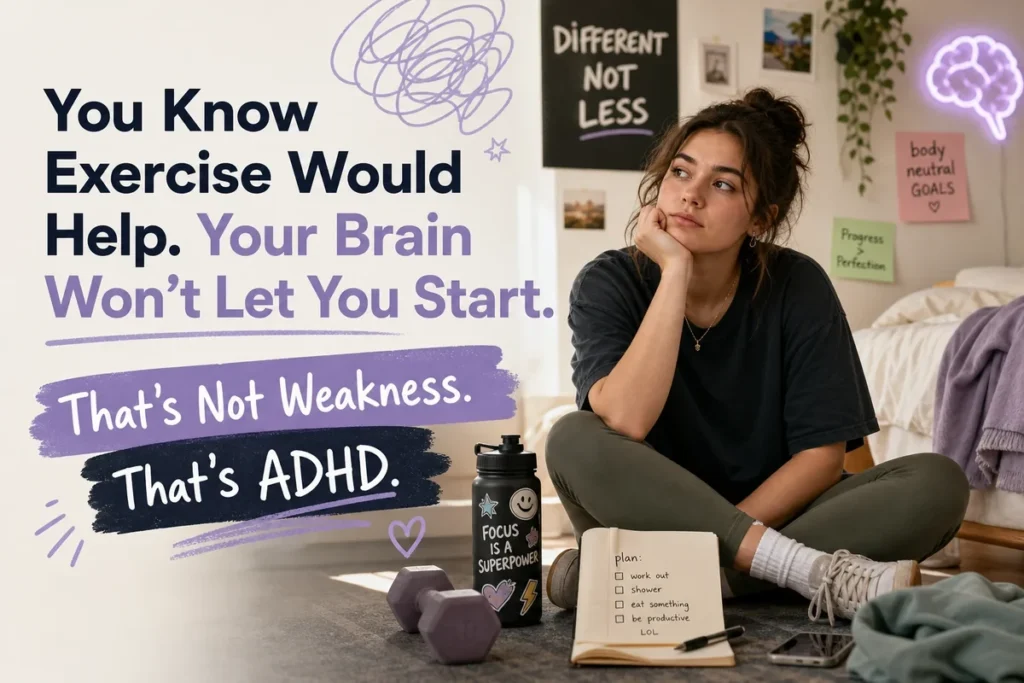
You already know exercise would help. That fact lives somewhere in your brain alongside everything else you know about yourself: drink more water, sleep earlier, eat actual meals. You know. You just cannot make yourself start. And every time you fail to start, the gap between knowing and doing gets a little more humiliating, except humiliation is the wrong frame entirely. ADHD exercise motivation is not a willpower problem. It is a dopamine architecture problem. The brain that needs movement most is the same brain that finds initiating a workout the hardest thing on its entire list.
Why Your Brain Needs Movement More Than Most Brains Do
ADHD is, at its core, a disorder of dopamine availability. PET imaging research published in Molecular Psychiatry demonstrated that adults with ADHD show significantly reduced dopamine D2/D3 receptor availability in the mesolimbic reward pathway, specifically in the nucleus accumbens and midbrain, compared to neurotypical controls. Those reduced receptor levels correlated directly with lower scores on trait motivation measures (Volkow et al., 2010, Molecular Psychiatry). This is not a metaphor. The actual physical infrastructure for generating motivational drive is operating at a deficit.
Movement directly targets this system. Aerobic exercise elevates dopamine and norepinephrine acutely, the same neurotransmitters that ADHD medications boost by blocking reuptake. The mechanism differs and the duration is shorter, but the neurochemical territory is identical. What John Ratey described as exercise functioning as ADHD medication has since been reinforced by a substantial body of meta-analytic evidence showing that physical activity consistently improves inhibitory control, working memory, and cognitive flexibility across ADHD populations.
A 2025 systematic review and meta-analysis published in the Journal of Global Health (Yang et al., 2025) examined eight studies with 373 adult participants and found that while acute exercise produced modest improvements in inhibitory control (SMD = -0.65), chronic exercise across weeks produced substantially stronger effects (SMD = -1.77). One workout helps your brain today. Consistent movement over time changes how your prefrontal cortex functions. For a condition defined by executive dysfunction, that is not a wellness perk. That is targeted neurological intervention.
The research signal is unambiguous: Yang et al. (2025) found chronic physical activity produced an effect size of -1.77 on inhibitory control in adults with ADHD, larger than many pharmacological comparisons in executive function research. The problem has never been the evidence. It is the gap between the evidence and the gym bag still sitting untouched by your door.
The Initiation Paradox: Why the Thing That Helps Is the Hardest to Start
The bitter irony of ADHD and exercise is structural. The neurological deficits that make movement so beneficial are the same deficits that make initiating movement so difficult. Starting a workout requires the exact executive functions ADHD disrupts most: working memory to hold the plan, initiation to fire the start signal, and enough dopaminergic signal for a future reward to feel real enough to pursue right now.
Research on ADHD and task initiation makes clear that the obstacle is not desire or intention. Bodalski, Canu, and Hartung (2023) found that emotional dysregulation, specifically intense feelings of boredom, frustration, and anticipated effort, is what makes a task feel impossible to begin. That emotional weight collapses confidence, which feeds avoidance, which feeds shame, which makes the next attempt even harder. Apply this to exercise and the cycle becomes painfully visible: you did not go yesterday, so today feels worse, so the activation energy required climbs higher, so you do not go today either.
Barkley’s framework for ADHD as a disorder of self-regulation (2011, Journal of Attention Disorders) identifies a central problem: the ADHD brain cannot reliably generate motivation from anticipated future rewards. Working out is a future benefit. The couch is present comfort. The prefrontal cortex, under-resourced on dopamine, cannot make “feeling better in ninety minutes” compete meaningfully with “this is comfortable right now.” That is not a character flaw. It is the architecture failing at exactly the task it is supposed to perform.
From the community: “I can be staring at something I genuinely want to do, something I chose, something I care about, and still sit frozen for 20 minutes because my brain won’t initiate the first step. It’s not laziness, and it’s not a lack of desire. It’s like my ‘start button’ is missing, and I’m constantly trying to find workarounds.”, r/ADHD thread
What Does the ADHD Brain Need Before It Can Move?
Neurotypical people often begin exercise from a fairly flat motivational baseline: mild inertia, mild desire, a push through. ADHD brains need something qualitatively different to fire the initiation sequence. Clinical observations around interest-based nervous systems in ADHD, supported by dopaminergic reward pathway research, point to four neurological fuels that reliably activate ADHD brains: interest, challenge, urgency, and passion. Routine, obligation, and long-term benefit alone do not generate sufficient dopaminergic signal for consistent activation.
This explains a pattern many ADHD adults recognise immediately. They can suddenly run five miles if a friend challenges them. They play a demanding sport for three hours in hyperfocus. They sprint to catch a bus without a second thought. The body is not the problem. The brain will not reliably produce the ignition signal for low-novelty, self-directed, future-reward-dependent activity, which is exactly what a solo Tuesday morning gym session is. A new sport with a friend checking in, or a competitive challenge with a countdown, can check three fuel boxes simultaneously.
The question is never whether the ADHD body can exercise. It is whether the ADHD brain can generate the start signal for low-stakes, self-initiated movement in a predictable routine. Those are fundamentally different problems requiring fundamentally different solutions.
Which Types of Movement Actually Stick
Not all movement is equally suited to an ADHD nervous system, and the research makes this clearer than most exercise advice acknowledges. A 2026 network meta-analysis published in Frontiers in Psychiatry (Yang, Zhao, Hu, and Zhou, 2026) differentiated exercise types by specific executive function benefits. Skill-based exercise, including martial arts, rock climbing, yoga, coordination drills, and team sports, demonstrated the highest probability of improving inhibitory control and cognitive flexibility. Aerobic exercise showed the strongest benefits for working memory. Combined exercise, which integrates cognitive demands with physical movement, such as exergames or sports with complex tactical rules, produced consistent improvements across multiple executive function domains.
Beyond neurochemistry, skill-based exercise offers something a solo treadmill run almost never delivers: novelty and immediate feedback. Martial arts require tracking a moving opponent. Climbing requires constant spatial problem-solving. Dance requires rhythm processing and rapid coordination adjustment. These activities engage the dopamine system not just through cardiovascular output but through the interest-and-challenge fuel ADHD brains actually run on. The exercise becomes intrinsically interesting rather than merely instrumentally useful.
For ADHD adults who find the gym impossibly boring, this is not an excuse to avoid physical activity. It is evidence that the gym may genuinely be the wrong prescription for their nervous system. Research consistently finds that the type of activity matters considerably for which specific executive function benefits are targeted. The research is not asking you to enjoy a treadmill. It is pointing you toward movement your brain will actually permit.
The type matters: Skill-based and combined exercise consistently outperformed pure aerobic exercise for inhibitory control and cognitive flexibility in ADHD populations (Yang et al., 2026, Frontiers in Psychiatry). If a boring workout feels impossible to sustain, the solution is not more discipline. It is a different workout.
The Initiation Problem Needs an Initiation-Specific Solution
Standard exercise advice, schedule it, track it, commit harder, assumes a brain that can self-generate activation energy from abstract future benefit. Many ADHD brains cannot reliably do this. The solution is not trying harder to be consistent. It is engineering the environment so the brain does not have to generate motivation from scratch each time.
Research on task initiation strategies in ADHD consistently points to reducing the activation energy of the first step rather than improving willpower across the whole task. The framework behind task laddering for ADHD identifies the core principle: the goal is not convincing the brain to do a whole workout. It is lowering the first step until the dopamine cost of beginning is nearly zero.
This maps directly onto exercise initiation. The cognitive load of “go to the gym for 45 minutes” is enormous: plan, pack, drive, change, warm up, work out, cool down, shower, leave. Each sub-step is its own initiation event. The ADHD brain looks at that undifferentiated blob and freezes. The workaround is decomposing the blob until the only decision is: put on shoes. Not go. Not pack. Not plan the route. Put on shoes. Research on implementation intentions, where specific actions are linked to specific environmental cues, shows this planning style dramatically improves follow-through in populations with executive function challenges (Gollwitzer, 1999, American Psychologist). “When I close my laptop, I put on my shoes” is a plan an ADHD brain can execute. “Exercise more” is not.
Novelty, Urgency, and the Social Lever
Three factors reliably generate the dopaminergic signal ADHD brains need to initiate and sustain movement. Novelty is the first. A new sport, a new route, a new playlist, or simply a different time of day can be enough to re-engage the interest fuel that routine has depleted. This is not fickleness that requires correcting. It is a feature of the ADHD nervous system that can be deliberately exploited. Rotating through different activities maintains novelty within structure without requiring the brain to invent something new each time from a motivational standing start.
Urgency is the second. External deadlines activate the ADHD brain in ways internal intention often cannot match. Booking a class with a cancellation fee, committing to a running partner who will be at the park at 7 a.m. regardless, or entering an event several weeks out creates the external pressure that registers an activity as real and imminent. This is not a crutch for people who lack discipline. It is a prosthetic for a neurological function that is genuinely, measurably impaired.
Social context is the third, and often the most powerful. Body doubling, the phenomenon where the physical or virtual presence of another person enables task completion, appears to activate ADHD dopamine reward circuits through social accountability. Applied to exercise, this means working out with a friend is not just more enjoyable. It may be neurologically necessary for many ADHD adults to begin and sustain movement at all. One other person showing up may be worth more than any tracking app, habit journal, or productivity framework ever designed.
The ADHD brain does not lack discipline. It lacks dopamine. And urgency, novelty, and social stakes are three reliable external sources of dopaminergic signal that the internal motivational system cannot always produce on a Tuesday morning when nothing is on fire.
Medication, Movement, and the Timing Nobody Mentions
For ADHD adults on stimulant medication, exercise timing introduces a variable that rarely surfaces in standard guidance. Because both stimulant medication and aerobic exercise elevate catecholamine levels through adjacent mechanisms, the two can reinforce each other when deployed in proximity. Some clinicians describe exercise as an amplifier of medication effects when used within the active coverage window, meaning the combination of medication-peak timing and post-workout neurochemistry may produce a more sustained period of executive function support than either alone.
There is also a practical observation that runs in the other direction. Stimulant medications improve the executive function of initiation, the very function most implicated in the exercise-won’t-start problem. Many ADHD adults find that the medication coverage window is the only time they can reliably initiate exercise. This is not dependency. It is using an available neurological resource to reduce the initiation barrier to a manageable height. For ADHD adults who exercise inconsistently off medication and more reliably on it, that pattern is clinically meaningful information worth discussing with a prescriber. The broader territory of how physical body systems and ADHD intersect is covered at the ADHD body pillar, including the hormonal and physiological variables most people are never told about.
The Shame Layer That Makes Starting Even Harder
Beneath the initiation problem sits something harder to name. Many ADHD adults carry a history of failed exercise intentions: the gym membership that lapsed, the running shoes worn twice, the perfectly planned workout routine abandoned after two weeks of consistent execution. Each failed attempt deposited something into a cumulative account of self-evidence, proof of laziness, proof of no follow-through, proof of fundamental personal failure.
This shame layer actively interferes with the neurological initiation problem. Research on anticipatory threat responses in ADHD indicates that prior failure experiences activate a stress response that further suppresses prefrontal function, the same region that needs to generate the start signal. The brain that most needs to begin is being undermined by the accumulated record that it cannot. Positive thinking cannot solve this. It is a physiological cycle that requires structural intervention: a new definition of what counts.
A ten-minute walk counts. Six minutes of stretching counts. Dancing in your kitchen counts. The standard against which ADHD adults typically measure themselves, an hour at the gym, five days a week, is both arbitrary and neurologically unsustainable for most without significant external scaffolding. Research on exercise interventions in ADHD populations (Yang et al., 2026, Frontiers in Psychiatry) found that twice-weekly sessions within six to ten week periods produced meaningful executive function improvements. Two sessions per week is a different number than five. And two that actually happen are worth incomparably more than five that never do.
Building Movement That Survives Your ADHD Brain
Sustainable neurodivergent workout routines do not look like neurotypical ones. They tend to be shorter, more variable, socially anchored, and deliberately designed to require as little self-generated motivation as possible. The goal is not to fix the ADHD brain’s relationship with exercise through discipline. It is to build an environment where movement happens almost despite the brain, where the friction of not moving gradually becomes higher than the friction of moving.
Proximity matters more than most people realise: an activity within five minutes is dramatically more likely to happen than one requiring a twenty-minute drive. Visual cues matter: workout clothes in plain sight, shoes already out, a bag already packed by the door. Time-linking matters: pairing movement with an existing anchor in your day, immediately after morning coffee, before opening the laptop, right when the workday ends, removes the scheduling decision that ADHD brains can stall on indefinitely. The decision was already made. The only active step is the physical one.
The neurochemistry of why movement helps ADHD brains as much as it does, the specific mechanisms, timing, and dose, is covered in depth in the companion piece Exercise Is ADHD Medicine. But the dose does not matter if the first step never happens. And the first step is an initiation problem, which means it requires an initiation solution: smaller, more external, more anchored, and considerably more forgiving than anything the fitness industry has ever designed for a brain that works the way yours does.
Quick Dopamine Hits:
- Put your workout shoes somewhere you will physically trip over them — not near the door, directly in your path. Physical obstacle beats intention every single time.
- Commit to two minutes of movement only. Set a timer. No workout plan, no routine goal — just two minutes of anything. Walking in a circle counts. The dopamine hit from completing that fires the start signal for more.
- Text one person what you are about to do before you do it, not after. The social stakes from that one message are enough to make your brain register the task as real and imminent.
Rate this article
Was this a useful hit?