You Did Nothing Today and You’re Wrecked. That’s What Negotiating With Your Own Brain Costs.

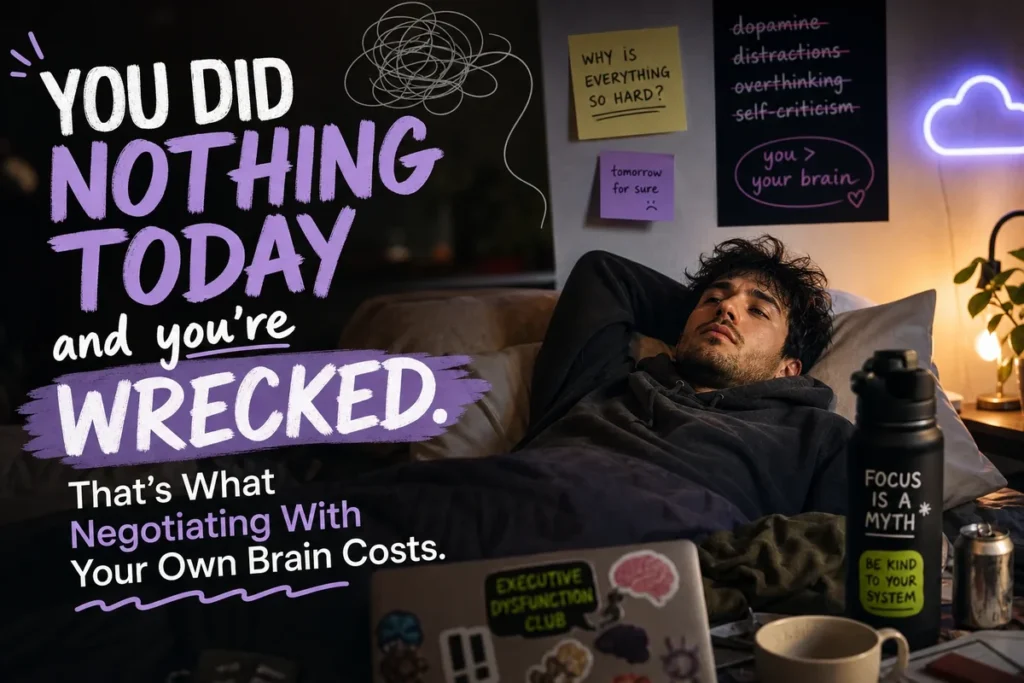
ADHD fatigue at 4pm is rarely about how much you did. It is about how many times you had to talk yourself into doing it. A neurotypical brain launches most routine tasks automatically, while an ADHD brain often launches them only after a manual override: a bargain, a pep talk, a push. Research on executive function and burnout suggests this constant self-management, more than raw workload, is what drives physical fatigue, emotional exhaustion, and cognitive weariness in adults with ADHD. The wiped-out feeling after a day of “nothing” is the predictable bill for effort nobody saw, including you. What follows covers where that cost comes from, how it can shade into neurodivergent burnout, and how to cut the number of negotiations your brain has to run.
Why Am I So Tired at 4pm When I Have Done Nothing?
Because the tiredness comes from process, not output. Each time you start, switch, or resist a distraction, you may be running an effortful override that leaves no finished work behind, so your day looks light on paper while your executive system worked hard.
The phrase “I haven’t even done anything” is the tell. You are measuring the day by output, and your exhaustion is coming from process. You answered a few messages, ate lunch eventually, moved laundry from one place to another, and sat through one meeting. Inside your head, that day was a long series of small standoffs.
Getting out of bed was a standoff. So was opening the laptop, deciding which of nine urgent-feeling tasks counted as the real one, and resisting a phone that offered an easy hit of novelty. Each one asked you to hold a goal in mind, notice your behaviour drifting from it, and steer back on purpose. Many adults with ADHD find they do this far more often than their peers, and none of it leaves evidence behind. At 4pm there is no pile of finished work to explain the tiredness, only the tiredness.
This is why rest alone often fails. If your exhaustion comes from continuous override rather than physical exertion, lying on the couch scrolling does not refill anything, because the negotiation continues in a lower-stakes form: should I get up, should I eat, should I answer that text. If you have read about the 3pm wall, this is the same crash seen from the side of effort.
What the Negotiation Actually Sounds Like
The internal bargaining has recognisable scripts. Nobody announces them, which is part of why the cost stays hidden. They sound like small, reasonable offers made to yourself by someone who does not quite believe you will deliver.
“Five more minutes, then I’ll start.” “I’ll do the hard email after the easy ones.” “If I shower now I can’t do anything else, so I’ll shower later.” Each is a bargaining move with a hidden transaction cost: you generate the offer, weigh it, decide whether to accept it, and then monitor whether you follow through. That is several executive operations for a task you have not started yet.
Bargaining is only one mode. Sometimes you argue about whether the task even matters. Sometimes you threaten (“if this is not done by noon I am a disaster”), which works until your nervous system stops believing it. Sometimes you bribe, promising a snack or a show as the price of starting. These are not stupid strategies. They are manual substitutes for the automatic start signal many people never have to think about.
One highly upvoted r/ADHD post put it in the title: everything runs on “brute force will,” nothing is automatic, and every task and micro-task comes with “enormous friction.” The poster described relief only at the peak of a stimulant dose, then being “back to fighting.” The fight is the work, and it runs in the background of every other kind of work you do.
The task you finished is rarely what emptied you. The small arguments you had to win before you could begin it often are.
Why a Manual Override Costs More Than the Task Itself
Executive functions such as starting, sustaining, switching, and inhibiting are coordinated largely by the prefrontal cortex, which depends on well-tuned dopamine and norepinephrine signalling. Arnsten (2009, CNS Drugs) described how even small shifts in catecholamine tone in prefrontal networks can produce large changes in attention, working memory, and behavioural regulation. When that signalling is less efficient, tasks that would launch on their own may need conscious scaffolding instead.
Barkley’s model of ADHD (1997, Psychological Bulletin) frames the same problem as one of self-regulation: inhibiting responses, holding information in mind, regulating emotion and motivation, and directing behaviour toward a future goal. In many brains, much of that runs quietly. In ADHD it can still be done, but often only with attention and effort pointed directly at it. Same job, more expensive tool.
The strongest recent evidence for what this does to energy comes from Turjeman-Levi, Itzchakov, and Engel-Yeger (2024, AIMS Public Health). They surveyed 171 employees and found that those with ADHD reported substantially higher job burnout, with an effect size of Cohen’s d = 1.13. Executive function deficits mediated the link: physical fatigue ran through difficulty with self-management to time, while emotional exhaustion and cognitive weariness ran through difficulty with self-organisation and problem-solving.
Read that against your own afternoon. The study did not show that people with ADHD were exhausted simply because they worked more. It showed exhaustion tracking how hard it was to manage time and organise their own behaviour. That is the negotiation, measured. For the energy side of the story, see our piece on the extra cognitive job your brain runs.
What the data says: In Turjeman-Levi et al. (2024, 171 employees), ADHD was linked to higher burnout with an effect size of d = 1.13. Physical fatigue ran through time self-management difficulty, and emotional exhaustion and cognitive weariness ran through self-organisation and problem-solving difficulty.
The Effort Nobody Counts, Including You
A 2026 perspective article in Frontiers argues that adult ADHD criteria miss a group of people for exactly this reason. Diagnostic systems lean on observable signs and measurable impairment, so adults who hold up performance through compensation, perfectionism, and constant self-monitoring can look fine while paying heavily inside. The authors call this impairment “invisible, not absent,” and note that the emotional exhaustion, cognitive fatigue, and shame it produces often go unrecorded. They also note there is still no widely adopted ADHD-specific scale for the subjective experience of effort itself.
That gap shows up in daily life too. Nobody around you can see the override, and neither can your to-do list, which records completion rather than cost. Two people can finish the same tasks while spending very different amounts of fuel. Add masking at work, suppressing and camouflaging your ADHD traits on top of the override, and the hidden load grows again. The piece on the tax your brain pays to appear fine covers that layer.
The practical consequence is that you cannot trust the usual signal of “I have not done much, so I should not be tired.” Your fatigue is accurate. The accounting is wrong.
Is This ADHD Fatigue or Neurodivergent Burnout?
ADHD fatigue is the daily, cumulative tiredness of running executive functions manually, and neurodivergent burnout is what can develop when that tiredness never fully clears. A bad afternoon is fatigue. A stretch of weeks where basic tasks feel physically impossible, sensory tolerance has collapsed, and rest does nothing is closer to burnout.
The difference matters because the responses differ. Fatigue responds to fewer overrides and ordinary recovery. Burnout usually needs more: lowering demands for an extended period, adjusting your environment, and often support from a clinician who understands ADHD. It can also look like depression, and sorting out which is which deserves care. Our articles on burnout without doing anything and on how ADHD burnout differs from depression walk through it, and the ADHD Energy pillar collects the recovery work in one place.
The warning sign that fatigue is sliding toward burnout is that the negotiations stop working. The bribes no longer land, the threats feel empty, and the effort needed to start keeps climbing. At that point the goal is to take demands off the table, not to optimise harder.
The Negotiations You Lose Cost the Most
A won negotiation costs effort. A lost one costs effort and then a second bill in shame. You bargained, promised, failed to deliver, and now hold a record of broken agreements with yourself. Over years, that record becomes the quiet evidence behind the voice that calls you unreliable or lazy, which is not what the research describes.
Emotion is part of this machinery. Slobodin, Har Sinay, and Zohar (2025, PLOS One) studied 176 women aged 20 to 30, 82 of whom reported an ADHD diagnosis, and found that working memory and task-shifting difficulties mediated the link between ADHD traits and emotional dysregulation. When the executive system is stretched, emotional control may be stretched with it, which could help explain why the late afternoon, once your override budget is spent, is when small frustrations get big. The explainer on the ADHD shame spiral shows how a missed start becomes a verdict about who you are.
A broken promise to yourself is not a character flaw. It is data about how expensive that promise was to keep.
How to Cut the Number of Negotiations Your Brain Has to Run
The most effective way to reduce ADHD fatigue is to stop paying for the same decision repeatedly. Every recurring choice you settle once, in advance, removes a negotiation from every future day. This is not about willpower or a better morning routine. It is about taking the vote away from the part of you that tends to lose it at 7am.
Rules that remove the vote work better than intentions. “I will try to take my meds in the morning” invites bargaining. “Meds go next to the kettle and I take them while it boils” is a rule with a location and a trigger. The aim is a sequence that behaves like a reflex, so nothing is left to argue about. The same goes for lunch, laundry day, and when you check email.
Moving the trigger outside your head also cuts the cost. Alarms, visible objects, a person in the room, or a task physically in your path all do work your prefrontal cortex would otherwise do. Our guide to building a visual system for an out-of-sight, out-of-mind brain shows how far a well-placed object can go, and body doubling borrows external structure in a similar way.
Shrinking the starting step removes the hardest negotiation of all, because most bargaining happens at the threshold when the task still looks enormous. If the first action is “open the document” or “put one plate in the sink,” there is less to argue about. Micro-steps and task laddering are built around this, and they pair with the low-friction approach in the ADHD Systems pillar.
Fewer open choices cut the load at the source. Default meals, a small rotation of clothes, one standard route for errands, and fixed slots for recurring tasks all turn decisions into policies. If you have ever spent forty-five minutes deciding what to eat and then not eaten, you have felt the cost of an open decision.
Medication can be a real lever for some people, because it can change how automatic initiation and sustained effort feel. The r/ADHD poster above noted relief only at the peak of a dose, which is worth raising with your prescriber: when during the day the effort returns, and what that does to your capacity. Drug and dose decisions belong to you and your clinician, and nothing here replaces that conversation.
What to Do at 4pm When the Budget Is Already Gone
By mid-afternoon, a depleted override system will not respond to more pressure. Bargaining harder at 4pm is like withdrawing from an empty account. The better move is to change what you ask of yourself.
Sort what is left by whether it truly has to happen tonight. Many items that feel urgent are only loud. Postpone what you can, and be honest about the rest. One required task with a tiny first step beats staring at six with a plan to start all of them.
Recovery should not be another negotiation. Choose restoring activities that need no decisions: a walk on a fixed route, a shower, a familiar show, food that needs no assembly. Scrolling often looks like rest but keeps the choice machinery running, which may be why it rarely refills the tank.
Build tomorrow’s rules while you are still tired. Writing the first step of tomorrow’s hardest task on a note and leaving the object for it where you will see it is a negotiation won in advance. Sleep, movement, and regular meals support the same system, and the ADHD Body pillar covers the physical side.
For the starting-step problem specifically, a tool that hands you one tiny action can beat another planner. That is what Spark is for.
Frequently asked questions
Why am I so tired when I haven’t done anything with ADHD? Research suggests ADHD-related exhaustion comes largely from the effort of managing time, organising tasks, and regulating yourself, not from workload alone. In a 2024 study of 171 employees (Turjeman-Levi et al.), executive function difficulties explained the link between ADHD and burnout, including physical fatigue.
Is ADHD fatigue the same as burnout? They are related but not identical. ADHD fatigue is the day-to-day tiredness of running executive functions manually, and burnout is what can develop when that tiredness never recovers. If rest no longer helps and basic tasks feel out of reach for weeks, it is worth talking with a clinician who understands ADHD.
Why do I negotiate with myself over simple tasks? Starting and sequencing tasks rely on executive functions that are often less automatic in ADHD, so the start signal may have to be generated deliberately. Bargaining, bribing, and countdowns are manual workarounds, and replacing open decisions with fixed rules reduces how often you need them.
What actually reduces ADHD mental load? Cutting the number of decisions and overrides tends to work better than trying harder. Fixed rules with a location and a trigger, external cues, tiny first steps, and defaults for recurring choices all lower the cost, and if you take medication, it helps to tell your prescriber how your energy varies across the day.
This piece draws on the published findings of Turjeman-Levi et al. (2024) and Slobodin et al. (2025), a 2026 Frontiers perspective on invisible adult ADHD struggles, foundational work by Barkley and Arnsten, and recent lived-experience reports from r/ADHD, with sources current as of October 2026. It is educational and not medical advice.
Quick Dopamine Hits:
- Pick one daily task you currently negotiate over (shower, first email, meds) and write a one-line rule for it tonight, such as ‘Teeth go right after I pour coffee.’ Put the rule on a sticky note where the task happens.
- Set a 3:30pm phone alarm labelled ‘Budget check’ and, when it goes off, cancel or postpone one non-urgent decision before the evening instead of pushing through all of them.
- Next time you catch yourself bargaining (‘after this video, then I’ll start’), say the very first physical action out loud and do only that action: stand up, open the document, put the plate in the sink.
Rate this article
Was this a useful hit?