You Have Seven Productivity Apps You Haven’t Opened in a Month. Here’s What Killed Each One.

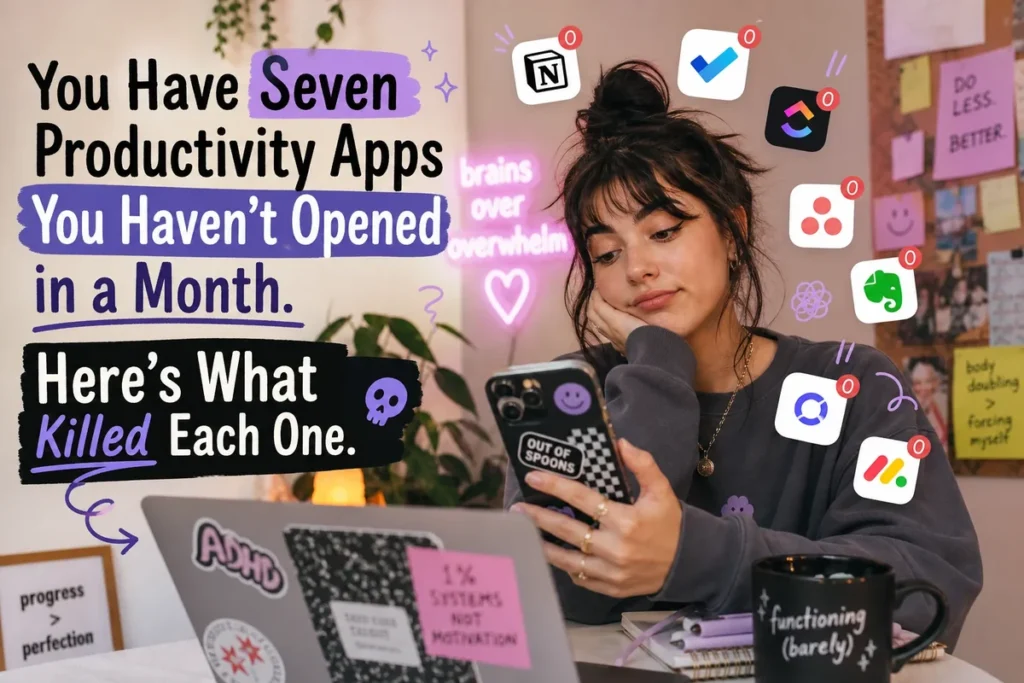
If your phone holds seven productivity apps you have not opened in a month, the cause is almost never laziness. ADHD productivity apps die from a handful of predictable causes: the setup phase delivers the dopamine and the daily use does not, the app demands working memory your brain is often already short on, and the first missed day turns the icon into evidence of failure. Systems survive when they cost almost nothing to re-enter after a bad week, never accumulate overdue debt, and live in your physical environment instead of behind a tap.
That graveyard feels like a personal failing from the inside. From the outside it looks like a dataset, and the causes of death repeat with remarkable consistency. Each app died of something specific, and each cause points to a design trait that would have kept it alive.
Why do people with ADHD abandon productivity apps?
People with ADHD abandon productivity apps because the reward of a new system comes from setting it up, while the cost comes from maintaining it. Once novelty fades, the brain has little dopamine left to pay for daily upkeep, and a single missed day adds shame to the bill. The abandonment is a predictable design mismatch, not a motivation failure.
The mechanism starts with how the ADHD brain handles reward. Tripp and Wickens (2008) proposed the dopamine transfer deficit theory: in ADHD, the dopamine response may not shift reliably from the reward itself to the cues that predict it. A brand-new app is a vivid, unexpected reward, so it fires. Once the app is familiar, there is often no strong predictive signal left to keep you coming back, and the fuel drops at exactly the moment a habit needed it.
Delay makes the drop steeper. Sagvolden and colleagues (2005) argued that reinforcement loses its power quickly as the gap between a behaviour and its payoff grows. Logging a task today pays off as a calmer week next month, and that is a delay many ADHD brains heavily discount. Time blindness compounds it: a payoff that sits “later” has no felt shape, so it cannot compete with anything happening now.
We unpacked the novelty cliff in depth in our piece on why a perfect system works for two weeks and then dies. This article picks up where that one stops: the weight of the system itself, the shame that finishes it off, and what the survivors have in common.
The setup binge was the product, and you already consumed it
A poster in r/AuDHD described the pattern in one breath, calling it a “digital graveyard of abandoned productivity systems.” The sequence runs 6 hours building the “perfect” Notion template, 3 days of use, one missed day because executive function crashed, and then they “abandon the entire app forever out of shame.”
From the brain’s point of view, the six hours were not wasted. Setup delivers novelty, a feeling of control, and the anticipation of a better future all at once, with no friction and no chance of failing yet. Choosing colours and nesting databases feels like progress while the actual tasks go untouched. For many ADHD adults, building the system is a hyperfocus-friendly project in its own right, which is why it can swallow an entire evening that the system was supposed to save.
This creates a perverse incentive. The more elaborate the setup, the more dopamine you spend up front and the less remains for upkeep. Heavy front-loading with a deferred payoff is exactly the reward shape the research above suggests an ADHD brain will tend to walk away from.
A system whose best moment is the setup has already peaked before it starts working.
Complexity is a tax on a working memory that is already overdrawn
Research on working memory in ADHD consistently identifies it as a core cognitive challenge, and that matters for apps in a way their designers rarely consider. Every tag, priority level, project folder, and recurring rule is something you must hold in mind to use the tool correctly. The app promises to offload your memory and quietly asks you to remember how the app works.
One Reddit user documented what this looks like at scale: 36 apps, at least two weeks each, 550 days in total. The verdicts repeat like a chorus. Todoist’s many layers of prioritization were flagged as overwhelming. Asana was “very confusing to both set up and actually use.” Of TickTick, the tester wrote, “I got really overwhelmed looking at my tasks for the day, which made it a lot harder to stick to the system.” Tool after tool was ruled out for the same two reasons: too much to manage, and no reward for finishing.
That is one person’s experiment, not a clinical trial, but it lines up with the design literature. Sonne and colleagues built a framework for ADHD assistive technology from empirical studies and clinical research. Two of its strategies stand out here: provide structure so activities happen in a predictable pattern, and avoid unnecessary distractions inside the technology itself. Much of that work involved children and families, so carrying it over to adult tools is an inference, but it is a sensible one.
The hidden cost is that capture, sort, review, and reschedule add up to a part-time job, and your executive function is the only employee. When a bad week cuts your capacity, that job is the first thing to go. The backlog it leaves behind is what shame feeds on.
How does one missed day turn an app into evidence of failure?
A missed day converts the app from a tool into a record of failure. Streak counters reset to zero, red badges multiply, and overdue lists grow, so opening the app means meeting everything you did not do. The ADHD brain often learns quickly to avoid cues paired with discomfort, so you simply stop opening it.
We describe the wider loop in our guide to the ADHD shame spiral: a mistake becomes a verdict, and the verdict makes the next attempt feel more expensive. For people who live with rejection sensitivity, an app full of overdue items can land like a daily reprimand from yourself. A dissertation on self-beliefs and self-regulation in adult ADHD points the same direction. Comparing adults with ADHD to controls, it reported higher state orientation after failure, which in plain terms means attention tends to stay stuck on the failure instead of moving to the next action. An app covered in overdue badges is a failure display you must walk through before you can do anything.
Habit apps can make this worse by design. An r/adhdwomen poster put the logic bluntly about streak calendars: “if you miss a day, goodbye to your streak.” Her fix was to swap the streak for a bucket, dropping a pom pom in for every effort however small or infrequent, so the record can only ever grow.
Streaks subtract, buckets add: A streak turns every absence into a loss, so a bad week erases your progress. A cumulative count turns every action into a permanent gain, so a bad week simply adds nothing. For a brain that abandons systems after a single miss, that arithmetic matters more than the interface.
Out of sight, out of system: the invisible app problem
Even a well-designed app lives behind a tap, and a tap needs a reason. For many ADHD brains, out of sight really is out of mind, a pattern we explore in our article on ADHD object permanence. The icon on page three of your phone is not a cue. It is storage.
Reminders do not reliably rescue this, because alerts you set for yourself tend to fade into background noise, which we covered in why your brain ignores its own reminders. The cue has to sit where the behaviour happens. Our guide to fixing the room before you try to discipline yourself makes the same argument for physical spaces, and it exposes a quiet disadvantage of apps: they have no room to live in.
What features keep an ADHD system alive?
ADHD-friendly systems survive when they have five traits: cheap re-entry, no accumulating debt, a place in the physical path of your day, an immediate payoff, and a version that works at low capacity. None of these depends on motivation, which is exactly why they outlast it.
Cheap re-entry means the number of steps between intent and action stays small. ADD.org’s roundup of ADHD tools notes that, as of October 2026, the Due app lets you reschedule a deadline from the notification bar without opening the app, and that it keeps sending reminders until you mark a task done or postpone it. The point is not that this app is magic. The point is that the tool meets you at the lock screen instead of demanding a full session.
Debt-free design stops the backlog from forming. A hobbyist builder in r/AuDHD described recurring tasks whose seven-day countdown “only starts after you actually do it,” so the list never piles up. That is one person’s unvalidated design, but the principle travels: recurring tasks that restart from completion rather than from the calendar cannot accumulate guilt while you are away.
Presence in the physical path matters because the environment can do what notifications cannot. A poster on r/ADHD who read dozens of productivity books landed on a low-tech anchor: “Nothing fancy. Just a little whiteboard where I write down my one task for the time.” One task, in your line of sight, at the place you work. No login, no sync, no badge.
An immediate payoff has to arrive while the behaviour is still warm. The delay-of-reinforcement research above explains why, and the 550-day tester kept circling the same complaint: tools that did not give “the reward for finishing a task.” Sonne and colleagues include praise and rewards among their design strategies for the same reason. For adults this can be as simple as a visible done pile, a satisfying check, or a count that goes up.
A low-capacity version is the trait most systems lack. Van De Voorde and colleagues at Ghent University have documented large moment-to-moment swings in ADHD performance, which means your capacity is a range rather than a fixed number. We explore what that means for design in why a system that depends on never having a bad week is not a system. A tool built only for your best day tends to fail on your worst, and your worst days are when you most need it.
The bad-day test: Before you commit to any system, ask whether you could run it on a day with a headache, poor sleep, and a fraction of your usual capacity. If the answer is no, it is a fair-weather tool and will die in the first storm.
Run the autopsy before you download app number eight
For this article I read the design research on ADHD assistive technology, the dopamine-transfer literature, and a Reddit user’s documented 550-day trial of 36 apps. The pattern across all three is that people ask which app is best when the more useful question is what killed the last one.
Open each of the seven apps and write one word for its cause of death. Setup means you loved building it and never used it. Complexity means you needed to remember how it worked. Debt means the overdue pile grew until you could not look at it. Shame means a broken streak or missed day ended it. Invisible means you simply forgot it existed. When five of seven died of debt, you do not need a better brand. You need a debt-free design.
Delete the apps that died of shame. A badge-covered icon you avoid is a small recurring dose of guilt, and removing it costs nothing. Keep at most one candidate, strip it to a single list and a single view, and resist the urge to rebuild it into something impressive.
Plan for novelty instead of fighting it. Because the dopamine from a fresh system tends to fade, you can build the refresh in: move the whiteboard, change the pen colour, shift where the cue sits, and leave the underlying list alone. Changing the surface without migrating the data gives your brain something new without paying the setup cost again. This strategy is drawn from the mechanisms above rather than from a tested protocol, so treat it as an experiment.
Ask what killed the app, not which app is best.
If you are reading this in October 2026, ADHD Awareness Month is flooding every feed with tools, tips, and apps, and the pull toward app number eight will be strong. Run the autopsy first. Whatever you add should pass the bad-day test and have a place in your physical day.
How do you restart a system after it died?
Restart by declaring amnesty, not by catching up. Archive everything overdue, begin with a single item dated today, and treat the first day back as the whole goal. Catching up rebuilds the exact debt that killed the system.
Re-entry is a skill you can shrink on purpose. Our guide to micro-steps and task laddering shows how to make the first rung small enough that starting stops requiring a surge of willpower. The broader principles behind low-friction setups live in our ADHD systems hub.
Your graveyard is not a verdict on your character. It is a record of which designs your brain rejected and why, and that makes it the most useful research you will ever do on yourself. The next system does not need to be better than the last seven. It needs to be cheaper to return to.
Frequently asked questions
Why do I keep downloading new productivity apps and never using them? Setup delivers novelty and a sense of control, which is the part of a new system the ADHD brain tends to reward most. Upkeep brings no comparable payoff, so use drops once the novelty fades.
Is abandoning productivity apps a sign of laziness? No. Dopamine-transfer and delay-of-reinforcement research (Tripp and Wickens, 2008, Sagvolden et al., 2005) points to a reward mismatch, and complexity and shame add further drag. It is a design mismatch more than a character flaw.
What makes an ADHD productivity system last? Systems tend to last when they are cheap to re-enter, never build up overdue debt, sit in your physical environment, pay off immediately, and still work on a bad day.
How do I restart a system I abandoned? Archive everything overdue, add one item dated today, and count that as the win. Catching up on the backlog recreates the pile that ended the system in the first place.
Quick Dopamine Hits:
- Open your oldest abandoned app and write one word for what killed it: setup, complexity, debt, shame, or invisible. Do this for all seven before you download anything new.
- Pick one recurring task and move it out of your phone. Put a physical cue where the task happens, such as a sticky note on the kettle or your pill bottle on the keyboard.
- Restart a dead system with amnesty: archive everything overdue and add exactly one item dated today. Count that single item as the whole win.
Rate this article
Was this a useful hit?