If You Cannot See It, Your Brain Does Not Know It Exists — Building a Visual System for an Out-of-Sight-Out-of-Mind Brain

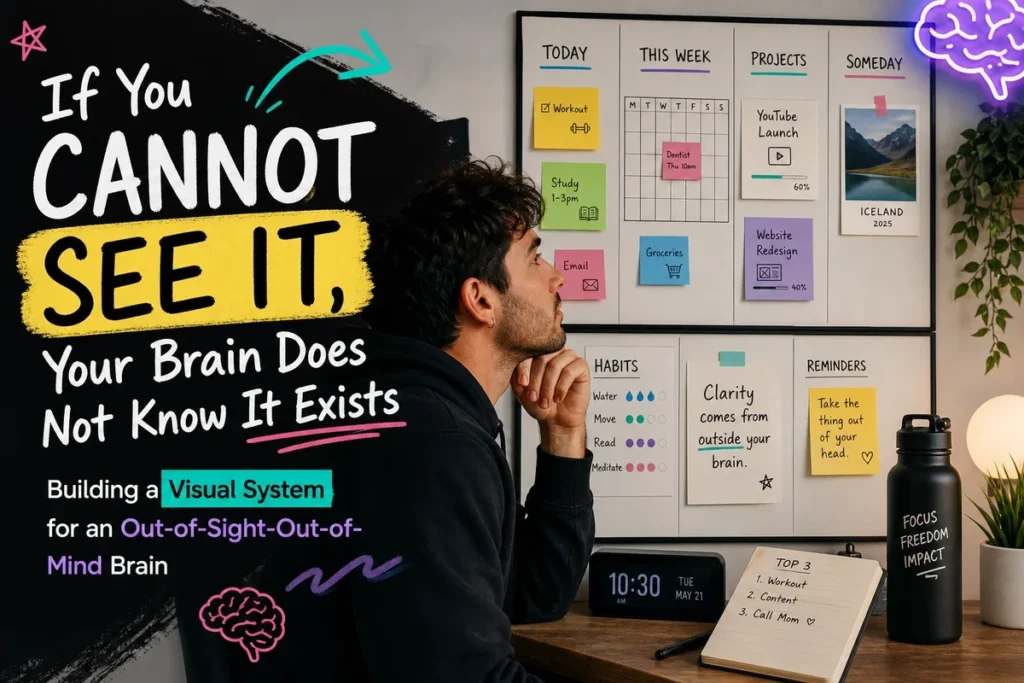
Most productivity systems are designed around the assumption that you can remember something exists without being able to see it. You can file the bill away and still pay it. You can put the medication in the cabinet and still take it. You can store the form in a folder and still submit it on time. For a brain with adequate working memory, these assumptions hold. For an ADHD brain, they are the architecture of an ongoing disaster. The principle behind ADHD visual reminders is not about decoration or tidiness preference, it is about compensating for a working memory system that genuinely cannot hold things that are not in your immediate sensory field. If it is not visible, it does not register as real, urgent, or relevant. That is not a metaphor. That is neuroscience.
Why “Out of Sight, Out of Mind” Is a Literal Description of Your Brain
Working memory is the cognitive system responsible for holding information in an active, usable state while you go about your day. In neurotypical brains, working memory maintains a kind of background queue: the dentist appointment next week stays gently present even when you are not actively thinking about it. The bill you put in the drawer still registers as something that needs handling. The task you wrote in a planner three days ago still feels connected to your lived reality.
In ADHD, that queue is considerably shorter and far less reliable. Barkley et al. (1997, Psychological Bulletin) described working memory impairment as central, not peripheral, to ADHD, the core mechanism through which executive function breaks down. Research by Arnsten et al. (2009, Neuron) established that dopamine and norepinephrine modulate the signal-to-noise ratio in the prefrontal networks responsible for maintaining these background representations. Without adequate dopaminergic signaling, the network that should be quietly holding “the bill in the drawer” gets overwhelmed by whatever is in your immediate environment. The present moment does not just feel more interesting. It wins structurally, at the level of neurobiology.
A 2026 study by Diaz-Fong and colleagues (Scientific Reports) examining alpha oscillations during visual working memory encoding found that structural abnormalities in the anterior thalamic radiation predicted attentional and working memory impairment in children with ADHD. The visual encoding pathway itself is compromised at the level of neural architecture. The ADHD brain is not simply distracted from what is in front of it. It also struggles to build and maintain internal representations of what is not.
The ADHD brain does not forget things because it is careless. It forgets them because it lacks the neurological infrastructure to hold things that are not actively stimulating it right now.
This is why the standard advice to “just write it down” or “keep a planner” so often fails. A planner in a bag is invisible. A to-do list in an app is invisible. A note in a drawer is invisible. The moment any of these systems require you to remember to check them, they have already lost. The ADHD visual system you need is not a recording device. It is a live broadcast.
What the Research Says About External Memory Systems
Barkley’s model of ADHD as a disorder of self-regulation places enormous weight on what he calls the externalization of information. His clinical framework argues that the ADHD brain fails not at knowing what needs to happen, but at performing what it knows when internal cues are the only reminders available. The therapeutic implication is direct: convert internal reminders into external ones, and the gap closes considerably.
Research across adult ADHD populations confirms this consistently. A comprehensive clinical review in ADHD in Adulthood: Clinical Presentation, Comorbidities, and Treatment Perspectives found that the compensatory strategies most reliably used by high-functioning adults with ADHD involve external structuring systems: visible calendars, physical task-specific reminders, and environmental arrangements that put required objects in the path of required behaviors. These are not workarounds or crutches. They are evidence-based approaches that work by reducing the demand on a strained internal system rather than trying to repair it through willpower.
The assistive technology research by Sonne and colleagues (Aarhus University, ACM SIGCHI proceedings) identified providing structure to facilitate activities as one of the core design principles for ADHD-supporting systems, noting that people with ADHD are significantly more likely to complete tasks when those tasks occur within a predictable, visually anchored structure, not because they need rules imposed from outside, but because external structure substitutes for the internal structure the brain cannot reliably generate on its own.
The externalization principle: Barkley’s clinical framework holds that ADHD failures are not failures of knowledge, they are failures of performance. The fix is not better memory. It is removing the need to remember at all by making the information visible at the moment it is needed.
The First Design Rule: Visibility Radius
Visibility radius is the concept that matters most when designing a visual system for an ADHD brain, and almost nobody talks about it. A reminder is only useful if it falls within the visual field you actually occupy during the moments when you need to be reminded. This sounds obvious. It is not. Most people violate it constantly.
Your bathroom mirror is inside your visibility radius when you are brushing your teeth. It is not inside your visibility radius when you are standing at your desk at 2pm and need to remember to take your medication. A sticky note on the fridge is visible when you go to the kitchen. It is invisible when you are parked on the couch at the moment a task should be triggered. A whiteboard on the wall behind you is invisible for the entire time you are facing your screen, which is most of your working day.
Effective ADHD visual reminders are placed in the actual path of the actual behavior. The medication goes next to the coffee maker, not in the cabinet. The form that needs to be mailed goes on top of your keys, not in a folder. The project you need to work on today gets written on a card sitting directly on your keyboard, not in a planner in your bag. The test of any visual anchor is simple: would you see it even if you were running on autopilot and not actively trying to remember?
From the community: “undiagnosed ADHD till i was 24, always told people i didnt care that my room was messy and it didnt bother me, much to my moms angry disagreement. so many arguments about how i dont care about cleaning my room or organizing my closet, etc., it just didnt bother me like it did other people.”, r/ADHD thread
This post captures something the tidiness debates miss entirely: the issue was never preference. It was visibility architecture. Things kept in drawers and closets are, to the ADHD brain, effectively nonexistent. What reads as clutter to the outside world is often the ADHD brain’s attempt to keep things where they can be processed: on surfaces, in sight, within reach.
The Open Container Principle: Stop Hiding Things From Yourself
One of the most counterintuitive but consistently effective environmental changes for ADHD brains is the shift from closed storage to open storage. Standard domestic and office organization logic runs heavily toward closed systems: cabinets, drawers, folders, boxes with lids. These systems work well if your working memory reliably holds a map of what is inside each container. For ADHD brains, closed storage tends to be where things go to stop existing.
Open shelves, clear bins, wall-mounted hooks, transparent containers, and open trays mean that the contents remain in your visual field during your normal daily movement through a space. You do not have to remember to look inside anything. The objects themselves are functioning as their own reminders. This is not disorganization. It is a deliberate design choice that trades the appearance of tidiness for functional accessibility to an ADHD nervous system.
The principle extends beyond physical objects. Tabs kept open in a browser are visible. Apps buried in folders are not. A calendar pinned to the wall is visible. A digital calendar that requires opening an app to check is not, unless checking that app has become automatic enough to be effectively involuntary. The question at every level of your system is the same: does this remain in my visual field without me having to remember to look for it?
Closed storage is where ADHD intentions go to die. Open systems are not a symptom of disorganization. They are an accommodation for a brain that cannot maintain internal maps of what is hidden.
Building a Three-Tier Visual Architecture
A sustainable visual system for an ADHD brain works across three tiers, each serving a different time horizon and attention demand. Trying to run everything at one tier is what causes the standard systems to collapse. The tiers are: the immediate surface, the ambient field, and the scheduled anchor.
The immediate surface is the one or two physical surfaces where you spend most of your time, typically your desk or kitchen counter. This is where today’s most urgent items live, physically present and impossible to miss. Not a list of tasks. The actual objects, or physical representations of them: a sticky note with the single most important action for today, the physical document that needs attention, the object that needs to be in your bag when you leave. The immediate surface should be ruthlessly limited. Three items maximum. When a new urgent thing arrives, something leaves. An immediate surface that holds twelve things is functionally invisible to an ADHD brain, which tends to process visual clutter as noise rather than information.
The ambient field is the larger visual space around your normal movement paths: the walls, door, fridge face, bathroom mirror, and visible shelf space. This is where you keep the medium-horizon things: appointments this week, current projects, the habit you are trying to build, things you need to track but not act on immediately. A whiteboard works well here if it is positioned directly in your line of sight from your main working position. A wall calendar works if you can see it from your chair. The ambient field refreshes more slowly than the immediate surface, weekly rather than daily.
The scheduled anchor is the only part of this system that lives in your phone or computer, and it works only when combined with a physical trigger. A calendar notification on its own is not an anchor for many ADHD brains, it fires, gets dismissed, and vanishes. A calendar notification that is paired with a physical object placed the night before (medication on the counter, bag packed and by the door, sticky note on the keyboard) closes the loop between the digital trigger and the real-world action. The scheduled anchor does not replace the physical visibility layer. It cues you to interact with it.
Why Does My Reminder System Keep Failing?
Phone reminders often fail because they require you to notice a notification in a moment when your attention is already captured by something else. By the time you have consciously registered and dismissed the alert, the window for action has often passed. Research on compensatory strategies in ADHD adults, cited across the ADHD in Adulthood clinical review, notes that single-modality digital reminders alone are insufficient for many adults with ADHD, they need to be paired with environmental changes that make the task visible and ready to act on at the moment the reminder fires.
Planners fail because they require a check-in behavior that must be remembered in order to prompt the thing you were trying to remember. This is circular and breaks immediately under stress, illness, travel, or schedule disruption. A planner also fails because writing something down can create a false sense of resolution. The act of capturing a task to a list triggers a mild dopamine response that briefly mimics the feeling of having handled it. The task can feel less urgent after being written down, which may reduce the likelihood of follow-through for an ADHD brain that relies on urgency as a primary fuel source.
Sticky notes fail when there are too many of them. A wall covered in sticky notes is functionally identical to a blank wall for an ADHD brain processing visual input. The nervous system filters it as background. Effective sticky note use means one note per surface, maximum, refreshed regularly so the visual signal stays novel enough to register.
The novelty trap: ADHD brains habituate to consistent visual stimuli over time (Linn and Hodge, 1982, cited in ADHD clinical literature). A reminder that stays in the same place for three weeks can eventually become wallpaper. Rotating and refreshing your visual anchors, changing their color, position, or format, sustains their signal value. Your system is not broken when you stop noticing it. It needs a refresh.
The Visibility Audit: Maintaining a System That Stays Alive
Any visual system for an ADHD brain will eventually stop working. Not because you failed, and not because the system was wrong, because ADHD brains habituate to consistent stimuli and gradually strip them of salience. The bill that has been sitting on your counter for two weeks has become furniture. The whiteboard you never erase has become wallpaper. The habit tracker you stopped touching three months ago is visual noise rather than a prompt.
This is why the visibility audit matters as much as the initial setup. A weekly five-minute walkthrough of your visual anchors, asking whether each one is still visible, still relevant, and still generating a signal rather than blending into background, is the maintenance protocol that keeps the system functional. It is not a sign that your system failed. It is standard operating procedure for the architecture of your brain.
During the audit, the questions are specific: Is this item still in my line of sight from my main position? Have I stopped noticing it? Does the color or format need to change to re-establish novelty? Is this task still current, or does it belong somewhere else? The goal is not to redesign the whole system weekly. It is to do the few seconds of friction removal that stops the gradual accumulation of visual noise from burying the actual signals.
This also connects to why the broader project of ADHD systems design is iterative rather than one-time. The brain changes, life circumstances change, and what was visible and salient six months ago may have become invisible by now. Building maintenance into the system from the start is the difference between a structure that degrades silently and one you can adjust before it collapses entirely.
Digital Visibility: Making Your Screens Work With Your Brain
Not everything can live in the physical world, and digital tools do have a legitimate role in a visual system for an ADHD brain, when designed with visibility as the primary constraint rather than the afterthought. The relevant question is not “what app should I use” but “will this information be in my line of sight at the moment I need to act on it, without me having to remember to look?”
A browser tab left open for a task you need to complete today is a visible reminder. A task buried in a project management system is not. A full-screen image on your phone home screen that names today’s single priority is visible. An app icon in a folder is not. A sticky note photographed and set as your phone lock screen is visible every time you pick up your phone. A note in a notes app requires a deliberate navigation step that your brain, in the moment it grabs the phone for something else entirely, will not reliably make.
The principle of minimum clicks to visibility matters enormously here. Every navigation step between the current moment and the visual reminder is a potential dropout point for an ADHD brain. If seeing a task requires opening an app, scrolling to a project, and finding the relevant item, the functional visibility of that task is close to zero. If seeing the task requires glancing at a sticky note directly in your field of view, the functional visibility is high. Digital systems earn their place in a visual architecture only when they can be set up to meet the brain where it is, not where you hope it will go looking.
The best reminder system is not the most sophisticated one. It is the one that puts the right information in your line of sight at the exact moment you need it, with zero steps between you and the signal.
Visual Clutter vs. Visual Systems: What Is the Difference?
One pushback worth addressing directly: what about the advice that visual clutter increases distraction in ADHD? Is a desk covered in objects and notes not making things worse? The answer is that both claims can be true simultaneously. Visual clutter is cognitively expensive, and total visual tidiness causes many ADHD brains to lose important information entirely. The tension resolves when you think about the difference between random objects and intentional anchors.
Random visual clutter, every surface covered with items from multiple life domains, all competing for attention simultaneously, tends to overwhelm the ADHD nervous system’s filtering capacity and can actively degrade focus. Intentional visual anchors, a small number of specifically placed, regularly refreshed cues that represent current priorities, do the opposite. They reduce the cognitive load of having to remember things internally by offloading that work to the environment.
The design goal is a high signal-to-noise ratio, not maximum emptiness. A completely bare desk is useless to an ADHD brain if the work that needs to happen lives in a closed planner inside a closed bag. A desk with three deliberately placed items, today’s task, today’s key object, and today’s one reminder, functions as an external scaffold for a nervous system that needs the support. The difference is intentionality and limit-setting, not simply the presence or absence of things on surfaces.
If you want to understand more about how the out-of-sight dynamic affects not just tasks but the people in your life, the piece on ADHD object permanence in relationships covers the same underlying mechanism in a context that tends to carry a great deal of unnecessary shame.
Starting Small: The One-Surface Rule
Building a complete three-tier visual system from scratch in an afternoon tends to fail for the same reason every ambitious ADHD overhaul fails: it requires sustained motivation, reliable executive function, and enough working memory to hold the design in mind while implementing it. These are precisely the resources that ADHD can deplete fastest under conditions of high task demand.
The one-surface rule is the entry point that actually works. Choose one surface, the one you sit at most, or the one you pass most frequently. Clear everything off it. Place exactly one thing on it that represents the most important task or item in your life right now. Keep it there until that task is done or that item is handled. Then repeat with whatever is next.
That is the full system to start with. Everything else, the ambient field, the tiered architecture, the digital layers, builds on top of this foundation and adds complexity only as fast as the foundation stabilizes. A single visible anchor, deliberately placed, tends to be more effective than a sophisticated system you never fully set up. Even a single prominent visual cue can substantially improve the likelihood that an ADHD brain encodes and acts on the associated task, because it bypasses the internal working memory queue entirely and delivers the signal directly to perception.
The goal is not to build a beautiful system. The goal is to stop hiding things from a brain that cannot find them when they are out of sight. For an ADHD brain, the most powerful organizational tool is not a better method of storage. It is the decision to stop storing things at all, and to keep what matters exactly where you can see it.
Quick Dopamine Hits:
- Put one high-priority task on a sticky note and place it directly on top of your keyboard before you close your laptop tonight. Not near it, on it.
- Pick one drawer or cabinet where important things go to die. Empty it into a clear bin or open tray and put that tray somewhere you walk past every day.
- Set a ‘visibility audit’ recurring alarm for Sunday evenings. The only task: walk through your space and move anything urgent to a surface you can see from your main chair.
Rate this article
Was this a useful hit?