Your Phone Isn’t Making You Less Productive. Your Brain Is Using It to Regulate. That’s a Different Problem.

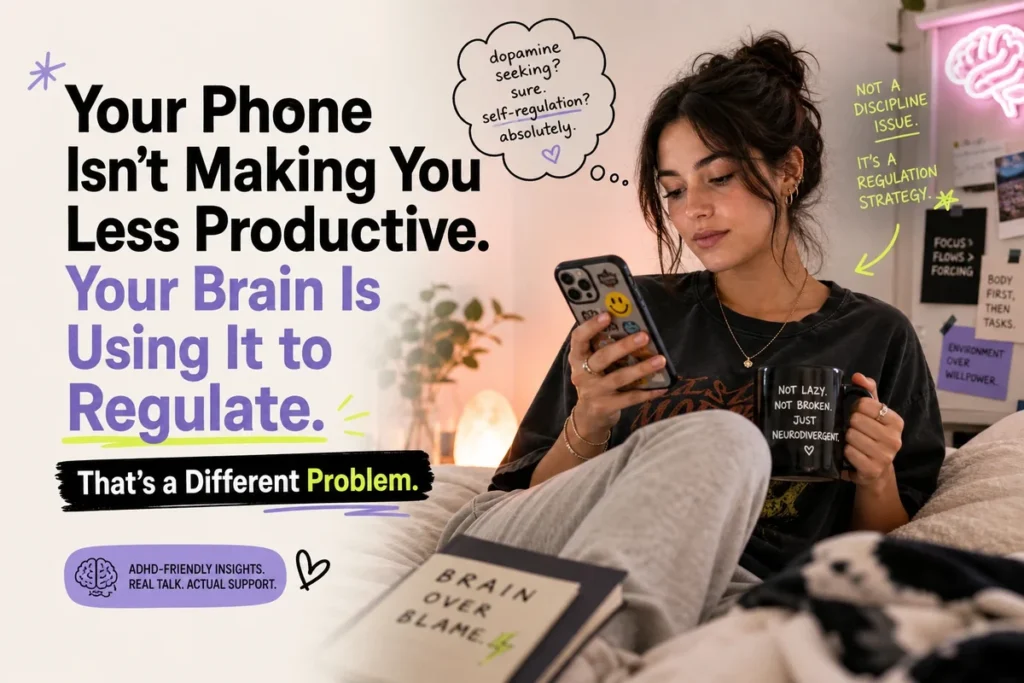
Picking up your phone every twelve minutes is not a character flaw, and it is not a sign that you lack the willpower other people apparently have in abundance. For an ADHD brain running on a chronically underactive dopamine reward system, your phone is doing something specific and functional: it is serving as an on-demand dopamine dispenser at a moment when your nervous system cannot generate enough regulation on its own. The question worth asking is not “how do I stop doing this?” The question is “what is my brain trying to regulate, and how do I give it what it actually needs?”
Why the Dopamine Deficit Makes Your Phone Irresistible
Research using positron emission tomography has found significantly decreased dopamine D2/D3 receptor availability and dopamine transporter function in the reward pathways of adults with ADHD, specifically in the midbrain and nucleus accumbens (Volkow et al., 2011, JAMA). These are the regions responsible for translating intention into motivated action, for sustaining effort toward a goal, and for generating the sense that what you are doing right now is worth continuing. When these systems underperform, the nervous system does not go quiet and wait. It goes searching.
Your phone is, from a neurological standpoint, an extremely well-designed searching tool. Notifications, social feedback, video content, and the open-ended scroll of any feed all deliver small, rapid, unpredictable reward signals. That unpredictability is not accidental. Variable reward schedules produce stronger dopamine responses than fixed ones, which is why the ADHD brain often finds a feed more compelling than a scheduled task that pays off in several hours. The reward arrives faster, with less effort, and with complete unpredictability, precisely the conditions that tend to generate the strongest dopaminergic response in a system already struggling to fire reliably on its own.
The ADHD brain does not choose the phone over work out of laziness. It gravitates toward the phone because the phone reliably delivers what the dopamine reward pathway is failing to generate internally.
A 2020 study by Panagiotidi and Overton, published in Current Psychology, found a significant positive correlation between ADHD trait levels and both problematic mobile phone use and smartphone addiction risk in a sample of 273 adults. Inattention symptoms, not hyperactivity, were the stronger predictor. Adults with higher inattention scores showed more difficulty controlling their smartphone use and exhibited more withdrawal and overuse patterns. Boredom susceptibility, which research consistently finds to be elevated in people with ADHD compared to controls (Parker et al., 2004, Pironti et al., 2016), also contributed directly to the pattern. That last piece matters: the phone is not merely filling time. It is filling an interoceptive gap, the felt absence of stimulation that many people with ADHD experience more intensely and more frequently than neurotypical adults.
What Your Brain Is Actually Doing When It Reaches for the Phone
Barkley’s model of ADHD positions the condition not primarily as an attention deficit but as a fundamental disorder of self-regulation across time. The core impairment is in the ability to inhibit an immediately available response in order to pursue a larger but more delayed goal. Picking up your phone at the moment of task onset is not procrastination in the colloquial sense. It is a direct, automatic expression of the ADHD nervous system preferring a small, immediate reward over a large, delayed one, a preference driven by steeper delay-of-reinforcement gradients in the dopamine system, as described in the dynamic developmental theory of ADHD (Sagvolden et al., 2005).
Emotional dysregulation compounds this significantly. Research indicates that a substantial proportion of adults with ADHD experience clinically significant emotional dysregulation, with prevalence estimates ranging widely across studies (Shaw et al., 2014, American Journal of Psychiatry). This is not just sadness or anger, it is a broad difficulty tolerating the unpleasant internal states that accompany hard or boring tasks. Sitting down to work generates a specific cocktail of unpleasant sensations: mild anxiety about the task, frustration at initiation difficulty, a restless bodily feeling that makes staying seated uncomfortable. The phone eliminates all of that within seconds. This is not avoidance in a phobia sense. It is regulation, crude, imprecise regulation that happens to derail your output in the process.
The regulation gap in numbers: A 2020 study (Panagiotidi &, Overton, Current Psychology) found that ADHD traits accounted for approximately 35% of the variance in problematic smartphone use in adults. Inattention symptoms were a stronger predictor than hyperactivity, suggesting the primary driver is an internal stimulation and attention deficit that the phone temporarily fills, not excess restless energy.
Sensation-seeking plays a role too. Adults with ADHD consistently show higher boredom susceptibility than neurotypical controls (Parker et al., 2004, Pironti et al., 2016). The phone, with its infinite novelty supply, is uniquely calibrated to address boredom intolerance, the felt sense that nothing in the immediate environment is stimulating enough to hold the nervous system’s interest. This is the ADHD interest-based nervous system doing what it was built to do: searching for enough stimulation to maintain any kind of arousal at all.
Why “Just Put the Phone Down” Is Neurologically Unreasonable Advice
The standard intervention for phone overuse is a restriction-based one: time limits, app blockers, grayscale screens, phones in other rooms. These tools are not useless. But they consistently underperform for people with ADHD because they address the symptom without addressing the signal. Removing the phone does not reduce the underlying regulatory need. It removes the tool the nervous system was using to meet that need, leaving the brain in an unresolved state of dysregulation with fewer options available.
This is why many people with ADHD who implement strict phone restrictions report feeling worse, not better. They are not experiencing willpower failure. They are experiencing what happens when a regulation mechanism is removed without a replacement. The restlessness, difficulty initiating tasks, and emotional discomfort do not disappear when the phone goes away. They become louder.
Blocking the phone without addressing the underlying regulation deficit is the neurological equivalent of removing someone’s reading glasses and telling them to focus harder.
The research on this is consistent with what Barkley has described as the ADHD brain’s dependence on external structure and external reinforcement. The phone functions as external reinforcement. It works, in the narrow sense, because it genuinely delivers dopamine. What it does not do is deliver it in a way that connects to any productive goal or creates forward momentum. The fix is not to eliminate the source of regulation but to find a better-matched one, or to restructure when and how the phone functions as part of the work environment rather than an interruption to it.
From the community: “What do you do for a quick dopamine hit?”, r/ADHD thread
That question, asked in a thread with over a thousand upvotes, is not someone looking for permission to slack off. It is someone asking the only practical question that actually addresses what is happening in their nervous system. The phone is one answer to that question. The goal of any meaningful intervention is to give the ADHD brain better answers.
Three Different Reasons Your Brain Reaches for the Phone
Not every phone session is the same neurological event, and treating them as identical produces unhelpful interventions. There are at least three distinct patterns worth separating, each with its own logic and its own more targeted response.
Transition-point reaching happens at the moment of switching between tasks: arriving at a desk, finishing one thing before starting another, returning from a break. The nervous system is in an arousal trough, stimulation has dropped, the next task has not yet pulled focus, and the phone fills the gap automatically. This is the most common pattern, and it is heavily driven by the ADHD brain’s difficulty with task transitions. The phone is not replacing work here. It is plugging an arousal gap that opens reliably at every transition point in the day.
Frustration escape happens when a task is genuinely hard, progress has stalled, or an obstacle has appeared. The emotional discomfort of being stuck generates an immediate drive toward something that will produce a fast reward signal. Scrolling for ten minutes after hitting a mental wall is the brain running an emergency dopamine retrieval procedure. It is not laziness, it is a nervous system that cannot easily tolerate the internal state of being stuck long enough to work through the obstacle on its own.
Boredom management is the third pattern. Repetitive tasks, data entry, form completion, filing, any administrative work with low cognitive demand, produce chronic under-arousal in the ADHD nervous system. The brain is not engaged enough to sustain attention but is too alert to disengage fully. The phone provides micro-doses of stimulation that maintain just enough arousal to stay in the chair, even if they simultaneously prevent real work. This is the phone as regulatory floor rather than reward.
Understanding which pattern is operating at a given moment changes what a useful intervention actually looks like. Treating all three as identical avoidance is both clinically imprecise and practically useless, it is the same category error as treating ADHD itself as a uniform discipline problem rather than a heterogeneous neurological condition with multiple pathways.
Designing Around the Regulatory Need, Not Against It
If the phone is serving a regulatory function, the first design question is not how to eliminate it but how to schedule it so it serves that function without fragmenting attention during work that requires sustained focus. This is a different frame entirely, it treats the phone as a neurological tool rather than a vice to be controlled.
Structured micro-breaks are one of the few phone-use strategies that actually account for the ADHD dopamine system. Rather than relying on willpower to resist picking up the phone between work blocks, a structured break explicitly assigns a short phone window at the end of each work unit. The Pomodoro technique approximates this accidentally, but for ADHD brains the interval needs to be matched to actual arousal capacity rather than an arbitrary clock. Work for as long as you can genuinely sustain focus, then take an explicit five-minute regulation break before returning. This makes the phone a reward signal at the end of a work block rather than a competing signal during one.
The second approach involves identifying which of the three patterns is dominant for you and finding the minimum-viable alternative that addresses the same regulatory need with less attentional cost. Transition-point reaching responds well to a brief physical movement routine, even ten to fifteen seconds of movement provides a proprioceptive reset without fragmenting attention the way a social media feed does. Frustration escape responds to a short timer during which you stay with the stuck feeling before picking up the phone: not to push through it heroically, but to determine whether the obstacle is a genuine problem to solve or an emotional response to difficulty that will pass with brief tolerance. Boredom management during repetitive tasks often responds well to background audio, music, ambient noise, or low-demand podcasts, that provides just enough stimulation to maintain arousal without requiring the attention the task also needs.
The replacement principle: Removing the phone without providing an alternative regulation source leaves the ADHD nervous system in an unresolved state. For any phone-reduction strategy to work long-term, it must answer one question: “What will my brain use instead to manage arousal, boredom, and emotional discomfort at this moment?”
What the Phone Is Telling You About Your Current State
One of the more useful reframes available is to treat automatic phone reaching as diagnostic information rather than evidence of failure. Every time your hand moves toward your phone without a conscious decision, your nervous system is broadcasting a signal about its current state. The signal is almost always one of three things: I need more stimulation, I need to escape discomfort, or I need a transition reset. Each of these has a more targeted intervention than scrolling, but identifying which one is happening has to come before any intervention can be designed.
The practical step is a brief verbal check-in before picking up the phone: naming the feeling out loud before acting on it. This sounds simple and is genuinely difficult for ADHD brains because the automatic behaviour is faster than conscious reflection. With practice, and this is a learnable skill, not a fixed personality trait, the gap between impulse and action grows enough to insert a deliberate choice. The check-in does not have to prevent phone use. It just has to create enough data to identify a pattern: when you notice that reaching for the phone at 2pm is consistently preceded by a feeling of stuck frustration on a particular type of task, you now have something actionable to work with at a level that app blocking never reaches.
This kind of metacognitive self-monitoring is harder for ADHD brains because metacognition is itself an executive function, and executive function is precisely what ADHD tends to disrupt. Research on self-beliefs and self-regulation in adults with ADHD consistently finds lower self-efficacy and weaker self-monitoring compared to neurotypical controls. This is not a reason to abandon the strategy. It is a reason to build external scaffolding around it. A simple timer prompt, a sticky note on the laptop, a question from a partner about what you were reaching for: these are not crutches. They are the external structure that ADHD brains require to execute behaviours that neurotypical brains can manage internally.
The phone is not your enemy. It is a very blunt tool your brain found in a moment of need. Blunt tools are not discarded, they are replaced with sharper ones.
How Medication Fits Into This Picture
Medication changes the landscape here significantly, and it is worth naming explicitly rather than leaving it as a footnote. Stimulant medications increase dopamine and norepinephrine availability in the prefrontal circuits responsible for sustained attention and impulse control. When the internal dopamine signal is stronger, the drive to seek external dopamine through the phone tends to reduce, not because willpower increases but because the underlying regulatory deficit becomes less severe. For many adults with ADHD, adequately dosed medication reduces compulsive phone reaching as a secondary effect, without any explicit phone-use strategy being implemented at all.
This is not an argument for medication as the only intervention. Behavioural and environmental strategies remain important, and they work differently than pharmacological ones, addressing the context of phone use rather than the neurochemical baseline. But it is a strong argument against treating phone overuse as a standalone problem that exists separately from the ADHD itself. If reaching for your phone compulsively is a symptom of a dopamine regulation deficit, then addressing that deficit is the most direct path to changing the behaviour.
Sustainable Change Means Accepting the Regulatory Need Is Real
Reducing ADHD phone overuse sustainably requires accepting two things that most productivity advice refuses to accept. The regulatory need is real and will not go away. Every system you build has to answer the question: where does the dopamine come from instead? If the answer is “from my discipline and willpower,” you have not built a system. You have built a countdown to when the system will collapse.
The phone itself is not equally problematic in all contexts. Using your phone between tasks, during explicit breaks, and as a deliberate transition tool is functionally different from using it during work that requires sustained attention. The goal is not to become someone who uses their phone less in some absolute sense. The goal is to restructure phone use so it amplifies regulatory capacity during the gaps rather than disrupts attentional resources during the peaks. For people building ADHD-adapted systems rather than borrowing neurotypical productivity frameworks, this distinction is foundational.
Understanding what your nervous system is actually doing when it reaches for the phone is, in the end, the same project as understanding why the ADHD brain cannot self-regulate on command. The phone is not the villain. It is the canary, signaling that the underlying system needs attention, not restriction.
A Summary of What the Research Shows
The following table draws together the key evidence connecting ADHD traits to phone overuse, as found across peer-reviewed studies referenced in this article. As of September 2026, the most robust data comes from adult self-report studies using validated ADHD and smartphone scales.
| Study | Finding | Key predictor |
|---|---|---|
| Panagiotidi &, Overton (2020), Current Psychology | Significant positive correlation between ADHD traits and smartphone addiction risk, ADHD traits accounted for approximately 35% of variance in problematic use | Inattention symptoms (stronger than hyperactivity) |
| Volkow et al. (2011), JAMA | Decreased dopamine D2/D3 receptor and dopamine transporter availability in reward pathways of adults with ADHD | Dopamine deficit in midbrain and nucleus accumbens |
| Parker et al. (2004); Pironti et al. (2016) | Adults with ADHD show higher boredom susceptibility than controls, boredom susceptibility linked to problematic media use | Sensation-seeking and boredom intolerance |
| Shaw et al. (2014), American Journal of Psychiatry | A substantial proportion of adults with ADHD experience significant emotional dysregulation, prevalence estimates vary widely across studies | Fronto-limbic dysregulation contributing to phone-as-escape behaviour |
Frequently Asked Questions
Is ADHD phone overuse the same as smartphone addiction? Not exactly. Research shows ADHD traits predict problematic smartphone use, but the mechanism differs from clinical addiction. For many adults with ADHD, compulsive phone reaching is driven by a regulatory need, filling a dopamine deficit, rather than dependency on the device itself. The practical difference: removing the phone without addressing the regulatory need will not resolve the behaviour the way addiction treatment addresses substance dependency.
Why does grayscale or app blocking often not work for ADHD brains? These interventions address the tool rather than the underlying need. The ADHD nervous system uses the phone to manage arousal, boredom, and emotional discomfort. Removing the tool does not remove those states. Strategies that provide an alternative regulation source consistently outperform pure restriction for people with ADHD, because the need that drove the phone use remains unaddressed.
Does ADHD medication help with compulsive phone use? For many adults, yes, indirectly. Stimulant medications increase dopamine availability in the prefrontal circuits responsible for sustained attention and impulse control. When the internal dopamine signal is stronger, the drive to seek external dopamine through the phone tends to reduce. This does not replace behavioural strategies, but it shifts the neurological baseline enough to make them significantly more effective.
How can I tell if I am regulating with my phone or just avoiding a task? Ask three questions: Is this a transition point between tasks? Have I just hit an obstacle? Is this task repetitively low-stimulation? If yes to any of these, the phone reach is likely regulatory. If none apply and the work was going reasonably well before the phone appeared, something else may be worth investigating, often a broader pattern of emotional dysregulation or an unmet need elsewhere in the day.
Can I use my phone deliberately as a reward without it becoming compulsive? Yes, with structure. Using phone time as an explicit reward at the end of a defined work block keeps it as a scheduled reinforcer rather than a competing signal. The critical condition is that the work block must be genuinely completed before the phone window opens, not approximated. ADHD brains are particularly sensitive to the clarity of this boundary, a fuzzy rule will collapse quickly under regulatory pressure.
Quick Dopamine Hits:
- Before opening your phone, name the feeling out loud: bored, stuck, or overwhelmed? This single step breaks the automatic reach and gives you real data about which regulatory need your brain is trying to fill.
- Replace the first phone session of your workday with a 60-second physical reset: walk to another room, do ten jumping jacks, or splash cold water on your face. This gives your nervous system the arousal signal it needs without fragmenting your attention.
- Place a fidget tool, a cold drink, or a notebook directly next to your phone. When your hand moves toward the phone automatically, redirect to that object and wait 90 seconds before deciding whether to actually pick the phone up.
Rate this article
Was this a useful hit?