Your Parents Called It Laziness. It Was ADHD. That Grief Needs Its Own Name.

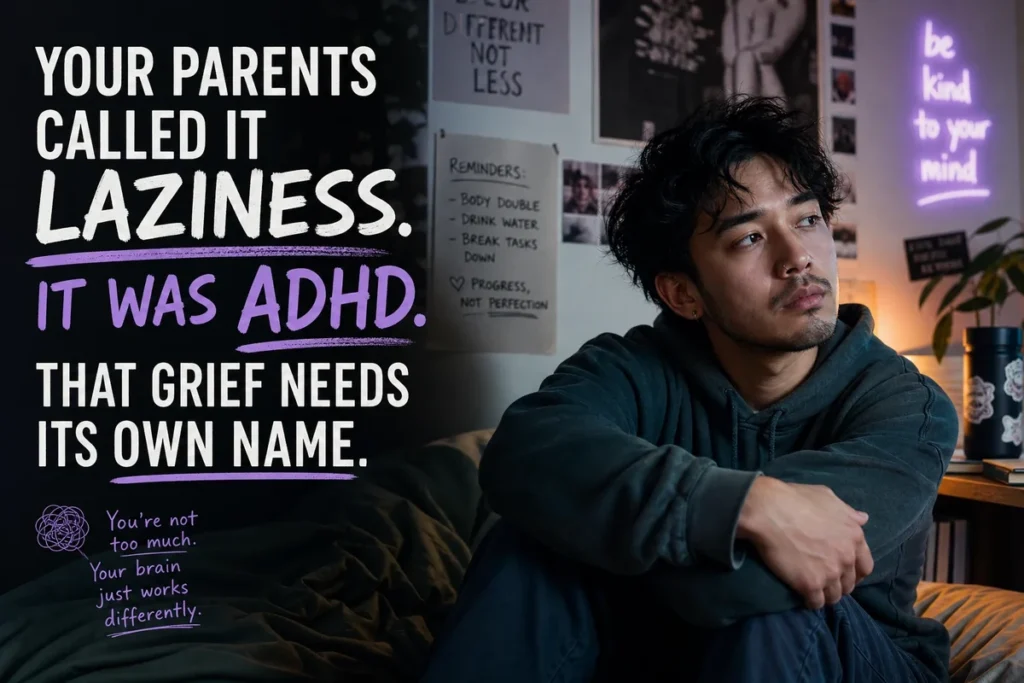
Late discovery grief often lands hardest on one point: the people who called you lazy for ADHD traits nobody had named. If that is where you are, the grief is proportionate, not dramatic. In a mixed-methods survey of 28 women who learned they had ADHD late, 96% reported effects on their sense of self, and participants described their traits being labeled “naughty,” “lazy,” or “weird” instead of recognised as ADHD (Holden &, Kobayashi-Wood, 2025, Scientific Reports). Whether you call what your parents did gaslighting depends on what they knew and intended. The damage to your self-concept is documented either way.
It is November, and family dinners are on the calendar. For many late-discovered adults, that is when the grief gets loud: you pass the potatoes to someone who once told you that you just did not try hard enough.
Late Discovery Grief Has a Specific Target When Your Parents Wrote the First Draft
Most writing about grief after a late ADHD discovery focuses on lost time or the person you might have become. We covered the effort side in the years you spent fixing yourself with the wrong target. This piece is narrower: the moment you realise the verdict you carried, that you were lazy, careless, or not trying, came from people you trusted to know you.
That changes the grief. Every memory now has two versions: the report card night, the fight over the bedroom you could not keep clean, the summer you were told to “just focus.” You are rereading them under different lighting, and the people who narrated the original may still tell it the old way. The child in those scenes was working, spending enormous effort on things that cost other kids little, and the output looked like failure from the outside.
Is It Gaslighting If Your Parents Did Not Know You Had ADHD?
Strictly, gaslighting means deliberately making someone doubt their own perception in order to control them. Many parents of undiagnosed kids did something different: they saw behavior, assumed motive, and applied the frame available to them, which was effort and character. The experience on your side can still feel identical, because you were tired and trying and were told you were neither.
One highly upvoted r/ADHD post, with close to 2,900 upvotes, came from someone whose parents knew about their ADHD for years before telling them. The poster wrote, “I felt like I was being gaslighted by everyone around me.” That sentence is about impact, and impact is real regardless of intent.
Research on how adults and children explain problem behavior offers a useful frame. The Attribution Bias Context Model predicts that adults tend to attribute a child’s problem to the child, while children tend to attribute it to the situation. A parent watching you fail to start homework sees a kid who will not start. You felt something closer to a wall. Nobody had the phrase executive dysfunction, so the adult’s explanation won by default.
A harder category exists. Some parents were given information by a teacher, a clinician, or you, and kept insisting on laziness anyway. That is refusal to update, and it deserves a different conversation. For the wider pattern, see being told a neurological condition is a personal failure.
The two-ledger rule: Intent and impact are tracked separately. Your parents’ intent may have been loving, ignorant, or both. The impact on you was a childhood spent absorbing a false explanation for a real neurological difference. Keeping both ledgers open stops you from collapsing into “they ruined me” or “I am overreacting.”
What Late Discovery Research Says About Being Labeled Lazy
As of November 2026, the research is small-sample but consistent. Holden and Kobayashi-Wood (2025) found that 85% of their 28 participants said undiagnosed ADHD negatively affected their childhood, 100% reported effects in adolescence, 92% in adulthood, and 81% reported career impacts. Participants commonly described internalising criticism, with guilt, shame, and low self-esteem. Treat the percentages as a portrait of lived experience, not population estimates.
The qualitative detail is where parents appear most clearly. In a separate qualitative study of young adults reflecting on ADHD in girls, one participant said, “my parents never really understood […] that I was trying, they just saw me being lazy. So, then they’d get angry and then I’d get angry and then there’d be a lot of screaming and upset and tantrums and doors slamming.” The loop is worth noticing. Misread effort produces parental anger, which produces emotional dysregulation in the child, which produces behavior the parent reads as more proof of bad character.
On the grief side, Mair and colleagues (2026, Autism) analysed 225 public social media posts from late-identified neurodivergent adults, mostly autistic, ADHD, or both. They identified four themes: The Life I Could Have Had, Grieving for My Younger Self, Feeling Gratitude, and Post-Diagnosis Burnout, all inside what they called the Grief, Relief, and Belief Cycle. A 2026 systematic review in the Journal of Attention Disorders, reported by ADDitude in June 2026, reached a similar conclusion: an adult diagnosis is “a complex relational process that can be both validating and destabilizing.”
Grief about your parents is not a detour from your ADHD discovery. It is one of the places the discovery does its heaviest work.
This piece rests on a close reading of those studies, plus a systematic review of stigma in adults with ADHD, a narrative review on parental ADHD, and community accounts. It is a synthesis, not a clinical assessment of your family.
Why They Could Not See It, and Why That Is Not the Same as Excusing It
A clinical commentary on high-functioning adults with ADHD argues that diagnostic systems lean on external signs, such as restlessness and visible disorganization, over internal experiences such as rumination, guilt, and cognitive fatigue. Its authors describe adults who perform well through compensation and masking as carrying a hidden burden of exhaustion, shame, and perfectionistic overcompensation. Their impairment, in the authors’ framing, is invisible, not absent.
Apply that to a childhood household. Your parents saw the late assignment, not the three hours of dread before it. They saw the forgotten jacket, not the working memory lapse that wiped the instruction before you reached the door. They saw a kid who could build a Lego city for six hours and concluded that attention was available on demand. The interest-based nature of ADHD attention made inconsistency look like selective effort.
There is also a quieter layer. ADHD is highly heritable, with estimates between 0.75 and 0.88, and a recent narrative review on parental ADHD notes that as many as half of children with ADHD have at least one parent who meets diagnostic criteria. That review also cites a finding that children of parents with ADHD are roughly three times more likely to meet criteria themselves. A parent with undiagnosed ADHD may have looked at your struggles, seen themselves, and decided this was just how life feels and you needed to push through.
A widely upvoted r/ADHD post put it this way: if you show the same traits as a parent who never got diagnosed, “they just think you take after them,” then hand you coping skills that may not fit your generation. Era played a part too. Another commenter recalled that in the late 1990s and 2000s, parents who sought ADHD medication for their kids were often judged harshly. That is context, not an excuse.
Is It Common to Feel Angry at Your Parents After a Late ADHD Discovery?
Yes. Many people report anger after a late discovery, often once the initial relief fades. It is not evidence that you are ungrateful or that your parents were monsters. It suggests your mind is reprocessing years of experience that carried a false explanation.
Emotional dysregulation is a significant part of ADHD for many adults, so a critical comment about your effort in 2003 can still land with the weight of rejection sensitive dysphoria (RSD). If that sounds familiar, the science behind RSD explains the mechanism. The volume of your anger may reflect your nervous system’s calibration, not only the size of the offense. It may also move in waves, which fits the cycle Mair and colleagues describe: months of calm, then one dismissive family group chat and everything tips again.
Anger is information, not instruction: It tells you that something mattered and was mishandled. It does not tell you what to do about it. Waiting, especially in the first weeks after a discovery, lets you separate the grief from the plan.
How the Lazy Label Hardened Into Your ADHD Personality
Children often absorb a parent’s judgment as fact about who they are. When one word, lazy, was applied to your trouble starting homework, switching tasks, meeting deadlines, and keeping a room clean, it stopped being a description and became an identity. This is the engine behind the ADHD shame spiral, where every mistake reads as a verdict.
Look at what ADHD can do in those settings. Task initiation trouble can look like refusal. Time blindness can look like disrespect for other people’s schedules. Working memory gaps can look like not caring. Emotional dysregulation can look like attitude. Hyperfocus on a favorite subject can look like proof you could do the hard thing if you wanted to. Each misreading is understandable from outside and devastating from inside. Why wanting to start is not the same as being able to lays out the neuroscience of the initiation piece.
Over time the label produces adaptations that later get mistaken for personality: perfectionism built on fear of being caught slacking, people-pleasing built on proving you were not selfish, apologising before anyone is upset, a relentless inner critic that sounds like a parent. A systematic review of stigma in adults with ADHD notes that stigma, including negative labelling, may affect quality of life across psychological and social domains. When it came from home, it arrived before you had any defenses.
The grief includes a hard question: which parts of me are me, and which parts are scar tissue? Nobody can sort that in a weekend. The ADHD identity pillar covers how people rebuild their sense of self after late discovery, including how masking and adaptation fold into what feels like character.
You are allowed to keep the traits that serve you and retire the ones that were built to survive a verdict that turned out to be wrong.
What to Do With the Grief Before You Decide What to Say
Give the grief a container that is not a family argument. Pick one memory where you were called lazy and write it in plain language. Add a sentence beneath it naming the executive function demand that was actually in play: starting, remembering, switching, regulating, estimating time. That small rewrite puts the cause where it belongs and creates a competing record to the one you have been running for decades.
Pace the rereading. Trying to reinterpret your whole childhood in one sitting tends to produce a flood followed by a shutdown, and one memory a week is a legitimate pace. Mair et al. (2026) frame diagnosis as a first step rather than a terminal event, which is a reminder that this is long work.
Name the feeling before trying to fix it. Grief, rage, embarrassment, and relief are different signals, and you may feel all four in ten minutes. One word spoken aloud can give the feeling a shape, which helps when ADHD already makes regulation expensive. The ADHD energy pillar covers nervous system regulation and recovery, and a short check-in in a tool like Steady gives the feeling somewhere to land before it becomes a text message.
Bring in someone who understands the territory. An ADHD-informed therapist can help sort grief from rumination, and a peer community can confirm that “they called me lazy” is a shared ache. Holden and Kobayashi-Wood (2025) report that participants found diagnosis healing and said it improved their self-esteem, so the grief and the repair often travel together. If you also feel you owe your family for how hard daily life has been, that debt was never yours.
Should You Confront Your Parents About Missing Your ADHD?
You are not obligated to confront anyone, and a conversation is not the only route to resolution. Many people find that journaling, therapy, and rebuilding their self-image settle most of what they hoped a confrontation would fix. A conversation can help, but only if you are clear about what you want from it.
Check whether a good outcome depends on them agreeing with you. If you need them to say “you were right, we were wrong,” you are handing control of your healing to the person least equipped to give it. One r/ADHD commenter who got their own discovery at 37 described their mother as enraged when they shared it. Some parents defend the old story because accepting the new one means grieving their own choices.
Conversations that share information tend to go better than ones that demand a verdict. You might say that you have ADHD, that it explains specific things you struggled with as a kid, and that you want them to understand it. You are not asking them to take blame, only to update how they see you now. If a parent recognises themselves in your description, the conversation can shift to ADHD as a family trait to understand rather than a family failure to assign.
Choose the setting carefully. A holiday dinner with an audience is a poor place to start, especially in a month already heavy on sensory and social demand. A phone call or letter lets you control pacing and end it when you flood. If it goes badly, you can be completely right about your childhood and never receive the acknowledgment you wanted. Then you are mourning the parent who might have said it, and holding that loss deliberately is more durable than waiting for it to resolve through them.
Frequently asked questions
Were my parents gaslighting me about my ADHD? Gaslighting implies deliberate manipulation, and many parents of undiagnosed children were misattributing ADHD traits to character rather than deliberately distorting reality. The effect on you can feel the same, and parents who kept insisting on laziness after receiving new information were refusing to update, which is a harder issue.
Is it common to grieve after a late ADHD discovery? Yes. A 2026 analysis of 225 social media posts from late-identified neurodivergent adults (Mair et al., Autism) found grief and relief arriving together in a repeating cycle, with themes that included grieving the younger self and the life that could have been.
Why did my parents think I was lazy instead of seeing ADHD? ADHD is often judged by observable signs rather than internal effort, so missed deadlines and forgotten tasks looked like low motivation. ADHD is also highly heritable, so a parent with undiagnosed ADHD may have seen your struggles as ordinary and expected you to push through.
Do I have to tell my parents about my ADHD? No. You decide whether, when, and how to share it, and many adults find that processing the grief alone or with a therapist settles much of what they hoped a conversation would fix. If you do share, going in with a goal that does not depend on their agreement helps protect you from further hurt.
Quick Dopamine Hits:
- Write down one specific childhood memory where you were called lazy, then add one sentence beneath it naming the executive function demand that was actually involved (starting, remembering, switching, or regulating).
- Before any conversation with a parent about your ADHD, write one sentence that finishes ‘What I want from this conversation is…’ and check that the answer does not depend on them agreeing with you.
- When the anger or grief spikes, put one hand on your chest, name the feeling in a single word out loud, and set a ten-minute timer before you text or call anyone about it.
Rate this article
Was this a useful hit?