You Saw That Text Three Days Ago. You’re Not Avoiding Them. You’re Avoiding Everything the Reply Has Become.

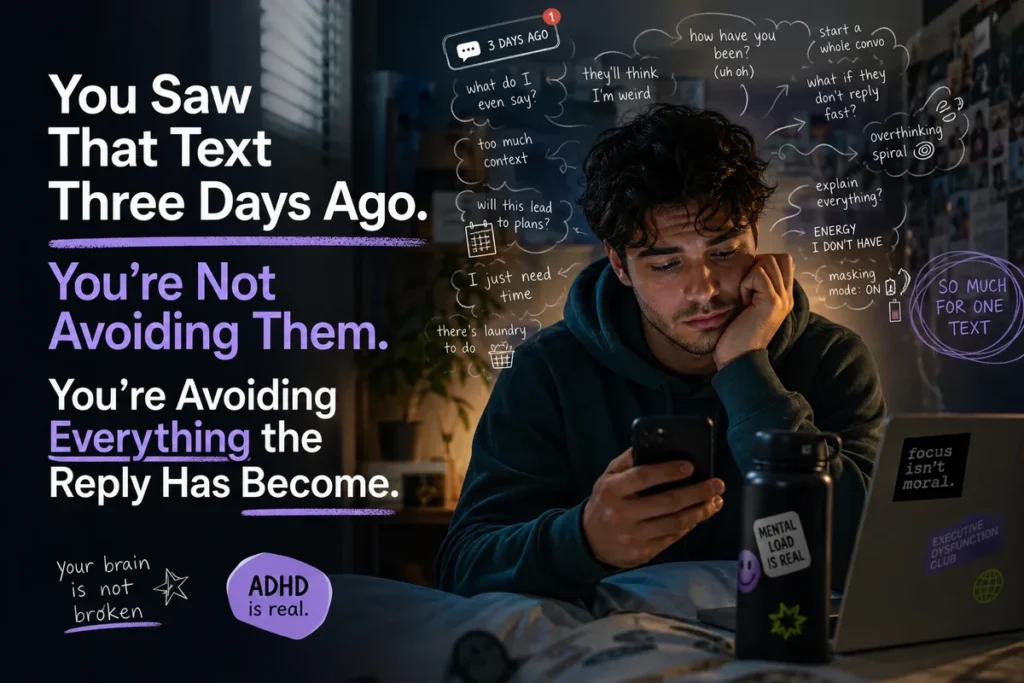
ADHD not texting back is rarely about the person on the other end. A single reply asks your brain to hold their message, your current emotional state, the tone you want, and an explanation for the delay all at once, and a brain that often struggles with working memory and emotion regulation can read that stack as a threat and step away. Every hour of silence then adds another layer to the reply, which makes avoidance feel safer and the next attempt heavier. This is ADHD message paralysis, and it is a neurological and emotional loop, not a character verdict. It breaks when you shrink the message until it stops being an event.
Why does one text feel like a dozen decisions?
One text feels like a dozen decisions because it asks your brain to settle tone, timing, apology, and commitment at once, not just to pick words. Stacked together, those choices form a planning task with emotional stakes, which is exactly the kind of task ADHD can make expensive.
Open the message and watch what your brain actually does. It asks whether this is a question or just a share, whether you also owe an answer to what they asked last week, how warm to sound, and how big the apology for the delay should be. It asks whether saying yes to Saturday makes you responsible for Saturday. None of these is large on its own.
Barkley’s (1997) model in Psychological Bulletin describes ADHD as a problem of behavioural inhibition that cascades into weaker working memory, self-regulation, planning, and internalised speech, the inner voice that rehearses and edits what you are about to say. A text reply leans on every one of those at once. Add emotion regulation, which Shaw et al. (2014) report is affected in roughly 30 to 70 percent of adults with ADHD depending on the sample, and the message becomes a small emotional event.
If you have ever composed the perfect answer in your head and never sent it, you have felt this stack running with no output. We unpacked that pattern in the piece on composing the whole reply and never sending it. The thought was finished. The execution never started.
“Knowing social expectations versus implementing them in real time is a very big challenge for people with ADHD.” Sharon Saline, Psy.D., writing in ADDitude
A text looks like the easy version of that challenge because nobody is watching you type. It is not easy, because you are simulating the other person’s reaction while you write, and that simulation eats your capacity. You are not composing a message. You are rehearsing a social event with an audience that does not exist yet.
Why does the reply get heavier every day you wait?
The reply gets heavier because the job quietly changes from answering to repairing, and every avoided attempt is rewarded with a moment of relief. Your capacity stays flat while the task grows.
On day zero, a message that says “want to grab dinner Thursday?” needs four words back. By day one, the reply needs a quick sorry. By day three, it needs an apology, an explanation, visible enthusiasm to prove you still care, and a way to handle a Thursday that has already passed. You are no longer answering a question. You are repairing a rupture, and repair is a much bigger job.
Your nervous system tracks that growth accurately, which is why the avoidance feels so reasonable from the inside. Each time you open the thread and close it again, your anxiety spikes and then drops, and the drop works as a reward. Sonuga-Barke et al. (2008) described how escaping situations associated with delay regulates negative feelings, so avoidance is negatively reinforced and becomes more likely next time. Research on emotion dysregulation in adults with ADHD frames that as one route to maladaptive coping: the avoidance works in the short term, so the brain keeps choosing it.
Bodalski, Canu, and Hartung (2023) found a related pattern in procrastination: intense emotions such as anxiety and frustration make a task feel impossible to simply start, which lowers self-esteem, which feeds further procrastination. Replace “task” with “reply” and the loop is the same. The longer the silence, the worse you feel about yourself, and the worse you feel, the harder the first word becomes.
Each hour of silence does not make the reply easier to send. It makes the reply bigger, and your brain, correctly sensing the larger size, declines to begin.
Is ADHD communication avoidance about the person or the message?
The avoidance targets the message, and the closer the relationship, the heavier the message often gets. Many people with ADHD answer a stranger’s question or a work thread within minutes while a best friend’s casual text sits for days. We looked at that mismatch in the piece on answering strangers instantly while a close friend waits. A stranger’s opinion of you costs nothing. A friend’s opinion is the thing you are most afraid to damage, so their message carries more imagined consequences.
The qualitative study by Rowney-Smith et al. (2026, PLOS One) offers a window into this. Five university students with ADHD described in focus groups how the expectation of rejection caused more distress than actual rejection, and how it pushed them to withdraw from friendships, family, and study. Participants said they “rarely reach out” to people. The sample is tiny and the findings are exploratory, so treat them as a description of experience rather than proof of prevalence. They do match what many people report about overdue replies: the dread is mostly about a reaction that has not happened.
The irony is that you know exactly how silence feels from the other side. A review of rejection sensitivity research describes hypersensitivity to social exclusion online, with a key trigger being no response to something you sent or posted (Ginapp et al., 2023). You can be rattled by a left-on-read and also be the person leaving others on read. That contradiction is part of what makes the guilt so sharp.
What the research does and does not show: As of October 2026, no study has timed text-reply delays in adults with ADHD directly. The loop in this article is assembled from established findings on working memory, emotion dysregulation, avoidance learning, and rejection sensitivity, and checked against how people describe the experience. The mechanism is well supported. The exact sequence is an informed model, not a measured one.
How does rejection sensitivity turn a reply into a verdict?
Rejection sensitive dysphoria, or RSD, is the pattern in which perceived criticism or rejection triggers an outsized wave of pain. For the person with the unanswered text, RSD does its work before anything has been sent. The draft becomes a possible exposure: they might be annoyed, they might decide you do not care, they might have decided already. Rowney-Smith et al. (2026) found participants described bodily sensations, anxiety, and misery around rejection, used masking to hide it, and sometimes ended up feeling cut off from themselves and lonelier.
That sequence explains why a dull text can produce a physical reaction. Your chest may tighten when the notification preview appears, and you swipe it away to make the feeling stop. The swipe is not laziness. It is a fast, bodily self-protection move that happens to make the eventual reply harder. Our deeper look at RSD and friendships covers why keeping people can feel riskier than meeting them.
Time blindness quietly feeds the loop. “I’ll answer tonight” dissolves because the evening never announces itself, and a two-hour-old thread becomes a four-day-old one before the debt registers.
How do you reply to a text you have avoided for days?
Reply with the smallest message that proves you are alive, then stop. A late reply does not need to be a good reply. It needs to be a reply, because what you are really paying down is the weight of the silence, and any honest message reduces it more than a perfect one that never leaves your drafts.
Give the reply one job. The job is not to repair the friendship, justify the gap, or demonstrate your love. The job is to answer or to hold the place. “Saw this and I’m glad you wrote. My head has been a mess. Yes to Thursday, or can we find another night?” does the entire job in under twenty words. Everything else you feel the urge to add is shame trying to pay itself off, and the other person did not ask for it.
Keep the apology to a single clause. Saying sorry forty times dilutes the one that matters, and a long apology hands the other person an emotional task, since they now have to reassure you. “Sorry for the slow reply” keeps the message light enough for them to answer lightly.
Send before the editor wakes up. Set a two-minute timer, type the first honest thing that comes to mind, and send it before you reread. The editor in your head is the part running the twelve decisions, and it needs time to start. If typing keeps triggering the rewriting loop, some people find a short voice note bypasses it, though others find speaking harder, so test it on a low-stakes thread first.
Use a holding reply when you truly cannot answer yet. “Got this, want to give it a real answer, will do by Sunday” converts an open-ended debt into a dated one. The danger is the date. Promise only what you will actually do, and set the reminder, with the person’s name in it, before you close the app. A forgotten holding reply is worse than silence because it adds a broken promise to the pile.
A slow exhale before you open the thread gives your nervous system a moment to register that nothing dangerous is inside. It will not fix the situation, but it can turn “I cannot look at this” into “I can look at this for two minutes.”
What do you do about a pile of old messages?
Triage by relationship, not by age. The oldest unanswered message usually carries the most shame, which makes it the worst place to start. Answer the person you would be saddest to lose, because one finished reply loosens the freeze and makes the next easier.
A widely upvoted post in r/adhdwomen captures how the pile forms. The poster wrote that she is “so good for a couple months with being responsive to texts and emails and then I procrastinate a little on responding and suddenly I’m months behind and some people are wondering if something happened to me.” She added that she feels guilty even about messages received years ago. That is the same loop stretched across months instead of days, and the length of the delay is not evidence that you are a bad friend. It is evidence of how fast the weight compounds.
For messages that are weeks or months stale, stop trying to answer them. The old question has expired, so replying to it keeps you trapped in a repair job. Start a fresh thread instead: “Thinking about you. I have been terrible at replying and I miss you. How are you?” That message answers nothing from the past and opens a present you can engage with. Many people are more relieved to hear from you than your guilt predicts, and when they are not, you have learned something real rather than something imagined.
If many threads are waiting, send three light replies in one short session and stop while the task still feels survivable. Stopping early protects the next session from dread.
How do you stop the pileup before it starts?
The cleanest fix is a rule about the moment of first contact. When you open a message, you do one of three things right then: reply in under a minute, send a holding reply, or mark it so it returns to you at a set time. The failure state is reading it, feeling the spike, and closing it, because the message now looks handled when it is not. If the preview alone triggers dread, consider not opening the thread until you have two minutes to spend. Out of sight often means out of mind with ADHD, which is why a marker with a time on it matters. Our article on how the ADHD brain stops holding people who are not in the room explains why the reminder has to be external.
Tie replies to something that already happens daily. A ten-minute window while the kettle boils, or on the train, makes messaging part of an existing routine instead of a new task that needs initiating. If you take ADHD medication, many people report that the hours when it is active are the easiest time to message, and it is reasonable to protect a few minutes of that window for it. This varies enormously between people and is not a clinical recommendation, so notice your own pattern.
Tell the people who matter how you operate. A standing note to close friends and partners works better than a thousand individual apologies: “I am slow on text. Silence is never a verdict on you. If it is urgent, call me.” That one message removes the guessing that makes your silence hurt. The wider dynamics are explored in the piece on what your partner sees that you cannot, and the relationships hub gathers our work on RSD, friendships, and communication.
The test that sizes the reply: Ask whether your reply is currently an answer or a repair. If it is an answer, send it in one minute. If it is a repair, send a short honest message and treat the repair as a separate, later conversation. Most of the weight comes from trying to do both in one text.
This article draws on the full text of the 2026 PLOS One study on rejection sensitivity in ADHD, the executive function and emotion regulation research cited above, and recent first-person accounts from adults describing this cycle. Where the evidence is thin, it says so.
Frequently asked questions
Why can I reply to work messages quickly but not to friends? Close relationships carry higher emotional stakes, so the message holds more imagined consequences and feels like it needs a better answer. Work messages usually have clear expectations and little fear of being judged as a person.
Does not texting back mean I have ADHD? Slow replies alone do not indicate ADHD, and only a clinician can assess that. A lifelong pattern of avoidance driven by overwhelm, forgetting, and fear of getting the tone wrong is common in people with ADHD, and if that recognition is new to you this ADHD Awareness Month, it is a reasonable thing to raise with a professional.
How long is too long to wait before replying? No research sets a threshold. The practical marker is when your reply stops being an answer and turns into a repair, because that is the point where the message gets heavy enough to trigger avoidance.
Quick Dopamine Hits:
- Set a two-minute timer, open the thread you have been avoiding, and send a reply under fifteen words before the timer ends. Do not edit it, and do not apologise for more than one clause.
- Write a holding reply for the message you cannot answer properly today: ‘Got this, glad you wrote, I want to give it a real answer by Sunday.’ Then put Sunday and their name in your calendar before you close the app.
- Take one slow exhale before you open the thread, then decide only one thing: is this a reply, a holding message, or a fresh start? Naming the category shrinks the pile of decisions the message seems to contain.
Rate this article
Was this a useful hit?