Your Brain Didn’t Glitch in the Grocery Store. It Went Into Survival Mode.

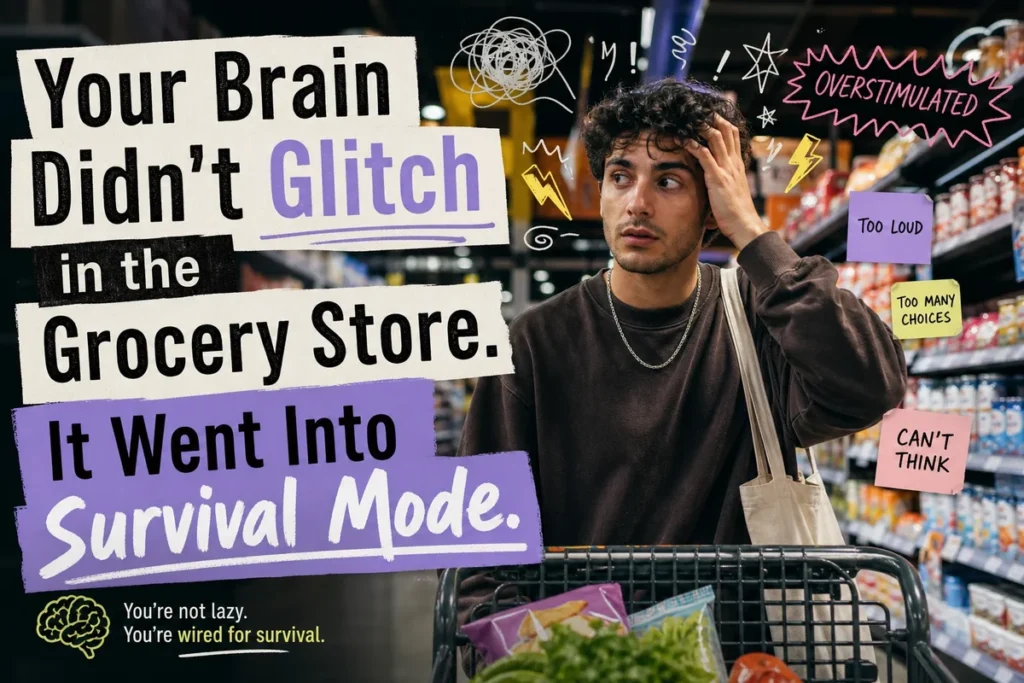
You walked into the grocery store with a list and a reasonable plan. Then the fluorescent lights hit. Then the competing music from three different store sections. Then the smell of the bakery colliding with the cleaning aisle. Then someone’s cart clipped yours. Then a child screamed two rows over. And somewhere between the dairy case and the cereal aisle, you stopped being a person doing a task and became something floating slightly outside your own body, scanning a shelf you can no longer read, holding a box you can no longer process, wishing the world would simply stop. That feeling has a name, and it is not weakness. What happened in that store was your brain triggering a physiological shutdown in response to a genuine sensory threat, and the fact that the threat was a supermarket rather than a predator does not make your nervous system’s response any less real.
Sensory Overload Is Not Just Annoying. It Is a Threat Signal.
The ADHD brain processes sensory information differently at a structural level. Research linking the frontal lobe, basal ganglia, and thalamus has described this circuit as the system responsible for activating and inactivating different parts of the brain, with ascending arousal pathways and descending inhibitory pathways working in concert (Cummings, 1993, as reviewed by Chu, 2005, Brunel University). When that circuit is functioning well, it acts as a filter: it decides which incoming signals are worth processing and which can be safely ignored. Fluorescent hum, background music, the ambient chatter of strangers, these get suppressed before they ever demand your full cortical attention.
In ADHD, that filter is measurably weaker. Research published in Translational Psychiatry (Wood et al., 2021) found that sensory over-responsivity is directly linked to reduced GABAergic inhibition in thalamocortical circuits. GABA is the brain’s primary inhibitory neurotransmitter. When thalamocortical GABA activity is low, the thalamus passes more signals upward at higher intensity than it should. Dopaminergic dysregulation compounds this further: dopamine normally plays a gating role across neural subsystems, modulating which signals get prioritized (Goto and Grace, 2008). With dopamine function disrupted, the ADHD brain often carries a double deficit in sensory gating, weakened inhibitory chemistry and a compromised salience-coding system, both working against you at the same time.
A 2025 meta-analysis confirmed that sensory processing differences are a consistent feature of ADHD, bringing years of clinical observation into formal evidence. The grocery store, with its fluorescent overload, competing soundscapes, visual clutter of thousands of products, crowd movement, and ambient smells, is precisely the kind of multi-channel sensory environment that overwhelms a system already running without adequate filtering. Your brain is not being dramatic. It is receiving genuinely more signal than a neurotypical brain in the same space, and it has fewer neurological tools to dampen that signal before it reaches the cortex at full intensity.
What sensory overload looks like in the brain: The ADHD thalamus tends to pass more sensory signals upward at higher intensity than it should, because the GABAergic inhibition that normally acts as a volume control is reduced. In a stimulating environment like a grocery store, this means the brain is simultaneously processing inputs it should be filtering, and the cortex becomes overloaded before you have even picked up a basket.
Why Your Brain Glitches: The Shutdown as Survival Response
When sensory input surpasses what a nervous system can hold, something has to give. The brain reads that overflow not as inconvenience but as threat. The amygdala, responsible for detecting threats and activating fear-related behaviours, shows structural differences in ADHD brains: research has found variations in amygdala volume and connectivity that contribute to emotional dysregulation and an amplified response to perceived danger (as reviewed in ADDitude’s summary of ADHD neuroscience, “7 Ways ADHD Can Be Seen in the Brain”). When the sensory flood tips past a threshold, the amygdala fires, and the body’s threat-response system activates.
What happens next is the part nobody explains. The freeze response, one branch of the fight-flight-freeze system, is not simply stillness. Research on threat physiology describes it as a withdrawal response, one associated with disengagement, lowered sympathetic activation, and immobilization, distinct from fight or flight precisely because it is a shutdown rather than an activation (Gray and McNaughton, 2000, as reviewed in ADHD emotion regulation literature). It emerges when the nervous system determines that neither engaging the threat nor escaping it is viable. In a grocery store, you cannot fight the sensory load and you cannot easily escape. So your nervous system does the only thing left: it reduces the intensity of your engagement with the world. It disconnects you from it.
That floating, numb, dream-like feeling in an overwhelming public space is not a malfunction. It is your brain pulling the emergency lever it has available to it.
This is what people describe as their brain “glitching” or “going blank.” It is sensory-based dissociation: a state where the connection between you and your immediate environment becomes attenuated. Research cited by Neurodivergent Insights notes that surveys of neurodivergent adults have found large proportions reporting depersonalization (a feeling of detachment from oneself), derealization (a sense that the external world is unreal), and what researchers call disengagement, the feeling of being checked out, numb, or having distance from your life. The overlap between ADHD and sensory-based dissociation is increasingly recognized in clinical literature, though it remains underdiagnosed because therapists often frame these experiences through a trauma lens without considering the sensory trigger underneath them.
What Does Sensory Dissociation Actually Feel Like?
The description varies from person to person, but the pattern is consistent. There is usually a brief period of heightened overstimulation: sounds seem closer, lighting feels aggressive, the visual field becomes too busy. Then something shifts. The world goes slightly further away. Sounds become muffled or hollow. The body continues to move through the store but the person operating it no longer feels quite present. Decision-making collapses, because the prefrontal cortex, already under strain from the sensory load, is additionally flooded by the threat response that pulled resources away from executive function. The list in your hand might as well be written in a foreign language. You stand in front of the yogurt wall for an amount of time that feels like either thirty seconds or four minutes, and you genuinely cannot tell which.
Esposito et al. (2025), publishing in Behavioral Sciences, explored differential patterns of dissociation across trauma experiences and ADHD characteristics, finding that ADHD profiles were associated with distinct dissociative patterns. The research is still developing, but the clinical picture is consistent: dissociation in ADHD is not exclusively a trauma response. It can be triggered by sensory overload alone, and the grocery store, with its unique combination of inescapable stimuli, is an almost perfect storm for this.
From the community: “As a kid I used to tug on my mom’s hand in the grocery store and ask if we were in a dream. It took me decades to learn there was a name for this experience.”, Neurodivergent Insights community thread
The Specific Design of a Supermarket Is a Sensory Assault
Grocery stores are not designed with ADHD brains in mind. They are designed to maximize the time you spend in them and the number of products you see, which means they are deliberately constructed to be stimulating. Fluorescent lighting operates at a flicker frequency that most people do not consciously register but that sensitive nervous systems can experience as a low-level persistent irritant. Competing audio zones, different music near the bakery, promotional announcements over the PA, background refrigeration hum, and the percussive sounds of trolleys and checkouts, create a soundscape with no clear foreground signal. The visual environment presents thousands of competing items at every line of sight, none of them obviously more important than any other, which means the ADHD brain’s already-compromised salience-detection system has to work overtime just to find the thing it came for.
Add a crowd, which introduces unpredictable movement, proximity to strangers (a low-grade social vigilance load), and the occasional sudden noise, and you have stacked stimuli across nearly every sensory channel simultaneously. The ADHD brain is not just handling a lot. It is handling a lot without adequate filtering, which is a fundamentally different experience from the one most people have during their weekly shop. The people around you browsing calmly are not tougher or better disciplined. Their thalamus is simply doing more of the dampening work automatically, without demanding conscious effort.
The people around you browsing calmly are not tougher. Their sensory filter is doing the work yours cannot automate. That is structural, not personal.
For a deeper look at the neurological architecture behind sensory filtering and why it costs ADHD brains so much energy to process everyday environments, the piece on the hidden energy cost of a world that’s too loud covers the thalamic gatekeeper model in full, including the role of GABAergic inhibition and how dopamine disruption compounds sensory load.
Why “Just Push Through It” Makes the Shutdown Worse
One of the more counterproductive things you can do during early sensory overload is instruct yourself to keep going, to stay focused, to just get through the list. The problem is that the threat response already underway is pulling resources from the prefrontal cortex, the brain region responsible for exactly the kind of top-down executive control that “just focus” requires. Research consistently shows that stress hormone activation, particularly cortisol and the sympathetic cascade, degrades prefrontal function (Arnsten, 2009, Nature Reviews Neuroscience). When the amygdala fires in response to sensory threat, it does not wait for the prefrontal cortex to weigh in on whether the threat is rational. The shutdown proceeds regardless of what you think about it.
Pushing through also delays the regulatory signals your nervous system needs to complete what researchers describe as the stress cycle. Without a physical or behavioural signal of safety, the nervous system stays primed, meaning that even once you are out of the store, the activation lingers. This is part of why a difficult grocery run can wreck the rest of an afternoon: the sensory threat response does not simply switch off when you reach the car park. It needs to be actively discharged, which requires time, low stimulation, and often physical movement.
What the research on nervous system intervention in neurodivergent adults increasingly supports is that grounding and deactivation need to happen during the episode, not just after it. Brief physical actions that signal safety to the nervous system, cold water on the wrists, a slow exhale longer than the inhale, pressing both feet firmly into the floor, can interrupt the escalation before full dissociation sets in. These are not mindfulness platitudes. They are physiological interventions aimed at activating the parasympathetic branch of the autonomic nervous system, which is the counterforce to the freeze response already underway. This connects directly to what the research on nervous system regulation makes clear: you cannot think your way out of a body-level response. You have to engage the body to turn it around.
The Intersection With Emotional Dysregulation
Sensory overload in ADHD rarely arrives alone. Emotional dysregulation is a core feature of ADHD, characterized by rapid and intense emotional shifts that the prefrontal cortex struggles to modulate. When a sensory flood is already pushing the system toward its ceiling, the capacity to manage emotional responses shrinks further. This is why the grocery store experience so often involves a disproportionate emotional reaction: a burst of frustration when someone stops their cart in the middle of the aisle, a sudden wave of tearfulness at the checkout, a wave of shame so acute it is almost physical when you abandon your basket and leave.
Sensory processing sensitivity research has found associations with lower connectivity in the salience network and the frontoparietal network, the circuits that normally regulate what feels emotionally urgent versus what can be held lightly (as reviewed in the neurodevelopmental disorders literature, 2025). When both networks are less connected, sensory inputs tend to feel more emotionally significant than they are, and emotional inputs feel more sensory than they should. The result is that being overwhelmed in public does not feel like being overwhelmed in public. It feels like a verdict about your capability, your worth, your ability to function as an adult. That layering of shame on top of a physiological response is a secondary injury, and understanding that the original response was purely neurological is one way to stop the second one from taking hold.
The shame spiral that follows the shutdown is a secondary injury. The shutdown itself was your brain doing exactly what it was built to do under threat.
Sensory Seeking and Avoiding Are Not Opposites
One of the confusing things about ADHD and sensory processing is that the same person who cannot survive a grocery store may also need loud music to concentrate, crave intense flavours, or voluntarily seek out physically demanding exercise. This is not inconsistency or hypocrisy. It reflects a fundamental feature of ADHD sensory processing: the system is dysregulated in both directions simultaneously. Research on sensory modulation distinguishes between over-responsivity (finding certain inputs too intense), under-responsivity (needing more input to register stimuli), and sensory seeking (actively pursuing stimulating experiences). These are not mutually exclusive, and ADHD brains frequently experience all three depending on context, channel, and baseline state.
The grocery store is overwhelming not just because of the volume of input but because of its unpredictability and uncontrollability. The stimuli arrive without pattern, without your consent, and without any way to modulate them. You cannot turn down the fluorescent lights. You cannot stop the PA announcement. Compare that to a loud music playlist you chose, playing through your own headphones, at a volume you control: the sensory intensity might be comparable but the sense of agency is entirely different. Controllable stimulation and uncontrollable stimulation tend to produce different responses in an ADHD nervous system, and the grocery store is almost entirely the latter. For more on this specific tension between needing stimulation and being destroyed by it, the piece on why you need loud music to focus but cannot survive a loud restaurant maps the neuroscience of that paradox directly.
What Actually Helps: Before, During, and After
Recovery from a sensory shutdown requires understanding that three distinct phases of intervention exist, and that most conventional advice addresses only the wrong one. The mainstream recommendation of “take a deep breath and push through” targets the middle of an active threat response, where the prefrontal cortex is already offline and cognitive reframing is neurologically unavailable. More useful is structuring the experience across all three stages.
Reducing baseline arousal before entering a stimulating environment matters more than most people realize. Going into a grocery store already depleted, hungry, post-conflict, or under time pressure means the sensory threshold for shutdown is already lower. The ADHD nervous system has a finite amount of regulatory capacity to spend, any of it used before you walk through the door is capacity unavailable for managing fluorescent lights and PA announcements. Timing matters too: a grocery store at 7pm on a Friday operates at a fundamentally different sensory intensity than the same store at 8am on a Tuesday, and for a brain without adequate filtering, that difference is not trivial.
During the experience, low-stimulation anchors interrupt the escalation cascade. A single earbud playing a familiar, predictable piece of music gives the auditory cortex a controlled foreground signal instead of competing chaos. Sunglasses, even inside, reduce the visual channel intensity. A physical shopping list organized by aisle minimizes the working memory and decision load, because working memory in ADHD is already stretched thin under normal conditions and practically nonexistent under sensory stress. Touching something cold, a refrigerator handle, a chilled bottle, can activate the vagal reflex and briefly bring the parasympathetic system back online. None of these are cures. They are regulatory tools for a nervous system doing its best with inadequate filtering architecture.
After a shutdown, the most counterproductive move is to immediately pivot to the next demand. The nervous system needs a regulatory reset: a period of low stimulation in which the stress cycle can complete and the threat response can fully deactivate. Twenty minutes in a quiet car, or at home before the next task, is not indulgence. It is the physiological recovery period that most adults with ADHD are never given permission to take. The ADHD Energy pillar covers the broader framework of nervous system recovery and burnout prevention for exactly this reason: the sensory tax compounds over time, and recovery is not optional, it is structural.
Sensory Overload at a Glance: What the Research Shows
The table below summarises the key mechanisms and research findings discussed in this article, as of September 2026.
| Mechanism | What happens in ADHD | Source |
|---|---|---|
| Thalamocortical GABAergic inhibition | Reduced, allowing more sensory signals to pass upward unfiltered | Wood et al., 2021, Translational Psychiatry |
| Dopamine sensory gating | Dysregulated, weakening the brain’s ability to prioritise relevant signals | Goto and Grace, 2008, Sikström and Söderlund, 2007 |
| Sensory processing differences in ADHD | Confirmed as a consistent feature across ADHD populations | 2025 meta-analysis (cited in Neurodivergent Insights) |
| Amygdala threat response | Structural differences associated with amplified fear-related activation | Reviewed in ADDitude, “7 Ways ADHD Can Be Seen in the Brain” |
| Dissociation patterns and ADHD | ADHD characteristics associated with distinct dissociative profiles | Esposito et al., 2025, Behavioral Sciences |
| Stress hormone and prefrontal function | Cortisol and sympathetic activation degrade top-down executive control | Arnsten, 2009, Nature Reviews Neuroscience |
This Is Not Who You Are. This Is What Your Brain Does.
Adults with ADHD frequently carry a long history of being told they are “too sensitive,” “making a scene,” or “being dramatic” about environments that other people navigate without visible difficulty. The grocery store shutdown, in particular, tends to accumulate shame because there is nothing visibly wrong. You are a functioning adult in a supermarket, surrounded by other people who appear fine. And yet you are dissociating over cereal boxes.
The research is clear that these experiences are physiological events, not personality traits, not signs of weakness, and not choices. A 2025 meta-analysis confirmed that sensory processing differences are measurable and consistent across ADHD populations: not self-reported quirks but observable neurological patterns. The dissociation that follows severe overload is the nervous system enacting a protective response, one that evolved not for supermarkets but for situations of genuine overwhelm where reducing engagement with the environment was the most viable option available.
Understanding that distinction changes the internal narrative. You did not fail to manage a basic adult errand. Your brain responded to a genuine neurological threat with the best tool it had. The next step is not to discipline yourself into functioning better under the same impossible conditions. It is to design the conditions differently, work with the nervous system’s actual architecture, and give yourself the recovery time that every physiological stress response requires. That is not accommodation. That is accuracy.
Frequently Asked Questions
Why do I feel numb or like I’m floating when I’m in a grocery store or mall? That feeling is likely sensory-based dissociation, a protective response triggered when the brain receives more sensory input than it can process. ADHD brains have reduced thalamocortical inhibition, meaning more signals pass upward unfiltered. When the system overloads, the freeze branch of the threat response activates, pulling attention away from the external environment and producing that characteristic numb, detached quality.
Is ADHD sensory overload the same as a panic attack? They share overlapping features but are distinct. A panic attack typically involves sympathetic activation: racing heart, shortness of breath, a strong urge to flee. Sensory-based shutdown in ADHD more often resembles the freeze response: numbing, withdrawal, dissociation, and cognitive shutdown. Some people experience both, particularly where anxiety and ADHD co-occur, which is common. If you experience regular severe episodes, speaking with a clinician familiar with both ADHD and dissociation is worthwhile.
Does ADHD medication help with sensory overload? For some people, yes. Stimulant medications work partly by improving dopaminergic gating, which is one of the neurological systems involved in filtering sensory input. Research on pharmacological treatment for sensory processing difficulties associated with ADHD has found measurable improvements in sensory responsivity for some individuals. Response varies significantly, and medication is one part of a broader picture that also includes environmental design and regulation strategies.
Why can I handle loud music I choose but fall apart in a noisy store? Controllable versus uncontrollable stimulation produces different nervous system responses. When you choose the stimulus, you have agency: you can turn it down, change it, or stop it. That sense of control alters how the threat-response system evaluates the input. Uncontrollable, unpredictable stimuli in a public space trigger vigilance and overwhelm precisely because you cannot adjust them. The sensory intensity may be similar, the neurological experience is not.
How long does recovery from sensory overload take? It varies by severity, individual baseline, and what you do afterward. Mild overload in a regulated nervous system might resolve in thirty minutes of low stimulation. More significant shutdown episodes can take several hours to fully clear, particularly if the person continued operating under demand immediately afterward or if the episode compounded with existing depletion. Treating the post-overload period as a genuine physiological rest requirement, rather than lost time, tends to shorten recovery over the long term.
Quick Dopamine Hits:
- When you feel the first signs of sensory overload in a public space, find a low-stimulation anchor immediately: put in one earbud with a familiar song, step outside for 90 seconds, or fix your gaze on a single object until the world stops buzzing.
- Before entering a grocery store or similarly overwhelming space, lower your baseline first: eat beforehand, go at an off-peak time (before 10am or after 8pm), and write your list in aisle order so your working memory doesn’t have to carry the whole plan under pressure.
- After a sensory shutdown episode, treat your nervous system like it just ran a race: take 20 minutes of low-stimulation recovery (dim room, familiar sounds, zero decisions) before re-engaging with anything that demands cognitive effort.
Rate this article
Was this a useful hit?