The Meds Kicked In and Now Every Broken Thing in Your Life Needs Fixing by Friday

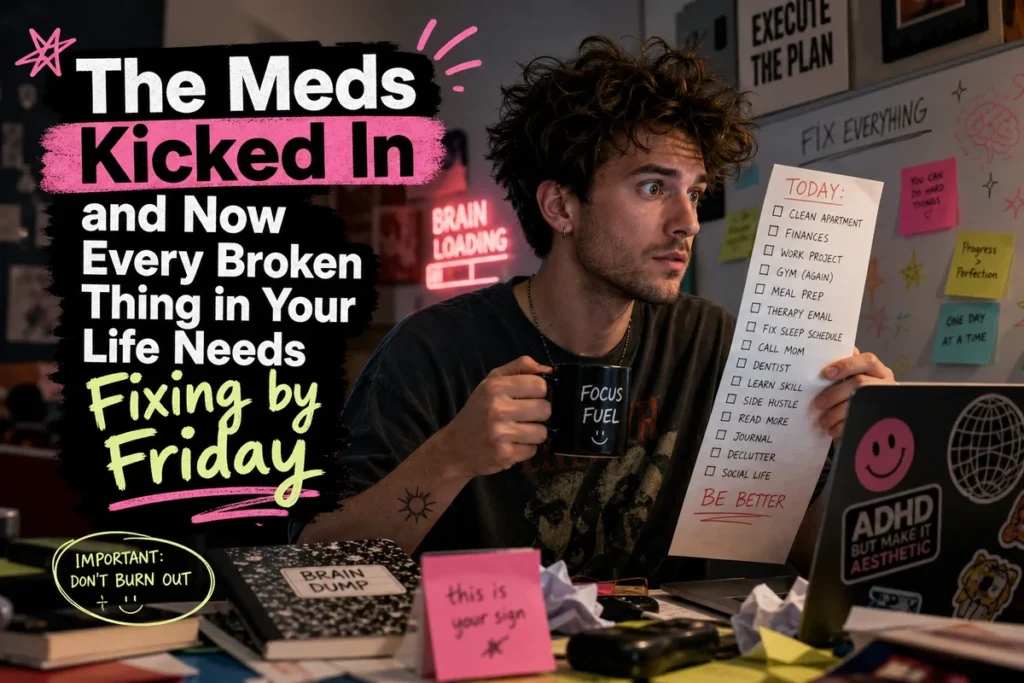
When ADHD is discovered late and finally treated, many adults realize that what they called “just getting by” was years of unpaid compensatory labor. Once treatment lowers the effort tax, every unanswered email, unfiled form and half-fixed habit becomes visible at once, and an urge to overhaul everything arrives with it. That urge is a predictable contrast effect, amplified by grief and by a perfectionism that was built as armor. It is not proof you were secretly fine, and it is not a personality upgrade. It is a life reset impulse, and it needs pacing, triage and guardrails if it is going to outlast the opening weeks. As of September 2026, the culture’s fresh-start pressure makes it louder, though not more useful.
Why Does Treatment Make You Want to Fix Everything at Once?
The short answer is that your brain finally has a baseline to compare against. For decades, the effort of starting, remembering and regulating probably felt like the ordinary price of being alive, so the mess around you read as a personal verdict instead of a workload problem. When ADHD traits ease, the workload drops, the verdict gets overturned, and everything you deferred becomes visible and fixable.
That combination is potent. Visibility without capacity produces shame. Capacity without visibility produces complacency. Visibility plus a newly cooperative prefrontal system produces urgency, and urgency in ADHD often arrives as all or nothing. You do not decide to clear one drawer. You decide to rebuild your finances, your apartment, your career, your friendships and your morning routine by Friday.
The mechanism is not mysterious. Stimulants primarily enhance dopaminergic and noradrenergic signaling in prefrontal and striatal circuits, the networks involved in task initiation, working memory and prioritization. A study of adults who had never taken ADHD medication found that people with more impaired executive functioning had more room for stimulants to improve function, which is a clinical way of saying the gap between before and after can be wide. Response varies, and plenty of people get a modest shift rather than a dramatic one. But when the gap is wide, the before stops looking like a life and starts looking like an emergency you survived without noticing.
What You Called Getting By Was Actually Enduring
High functioning is the phrase that hides the bill. A 2026 perspective paper in Frontiers, titled “High functioning, yet high suffering,” argues that adult ADHD criteria capture the end products of the condition, meaning visible behaviors and measurable impairment, while missing adults who keep performance high through compensatory strategies and masking at a steep internal cost. The authors describe impairment concealed beneath “sustained effort, perfectionistic overcompensation, and chronic self-monitoring.”
Their impairment is invisible, not absent. (Frontiers perspective on high-functioning adult ADHD, 2026)
If you recognize yourself here, “getting by” probably feels accurate and incomplete at the same time. You were passing. Bills mostly got paid, jobs mostly got kept, and because the output looked acceptable, nobody audited the input, including you. The same paper points out a cruel piece of logic: greater visible impairment can become an advantage, because people who fail visibly and repeatedly are the ones granted diagnosis and treatment, while those who sustain outward success at high internal cost often stay undiagnosed and unsupported.
Part of that input was anxiety used as fuel. The authors note that some people can overcome procrastination or start tasks only when driven by heightened anxiety and its adrenergic arousal. Most readers know this as the deadline panic that finally sends the email at 11:40 p.m., the pattern we describe in You Can Only Work When the House Is on Fire. It works, and it also means every completed task carried a small injury with it.
A case report on a physician whose professional success masked his ADHD shows how well this hides. He excelled in patient care, yet his difficulties with organizing and finishing tasks had earlier been attributed to depression, with guilt and self-blame attached, until a neuropsychological evaluation identified inattentive ADHD. The exhaustion was real. The explanation was wrong.
From the community: “My work could be done in a few hours each day, sometimes even for the whole week. Instead I procrastinate, get paralyzed with anxiety, do all kinds of weird rituals and time wasters prior to working up the urgency to do it” r/ADHD thread
That is the before picture many newly treated adults describe. Not laziness and not chaos for its own sake, but a hidden extra job of self-management running underneath a normal-looking day. When treatment shrinks that job, the first thing you notice is how much of your life it was quietly consuming.
The Contrast Effect: Why Yesterday Suddenly Looks Unlivable
Contrast is the engine of the reset urge. You cannot fully feel a weight until someone lifts it. Many newly treated adults describe realizing how much of each day had gone to pushing themselves to start, rereading the same paragraph, and rehearsing what they needed to remember. When that hidden job shrinks, hindsight does the math on the years.
The study of medication-naive adults adds a useful wrinkle. Its authors suggest that people with stronger executive skills often lean harder on compensatory strategies, so their measured response can look smaller because they already function near a ceiling, while people with weaker executive skills show more detectable gains. Read that beside the high-functioning paper and a pattern suggests itself: the adults with the most impressive scaffolding may show the least change on a rating scale and still feel the biggest drop in effort. That is an inference, not a finding from either paper, but it matches what many adults with late-discovery ADHD report. A questionnaire score counts output. It does not count what the output cost.
The emotional side of the contrast is documented too. Holden and Kobayashi-Wood (2025, Scientific Reports) examined the lived experience of women who discovered ADHD in adulthood and found that discovery was widely described as empowering and explanatory, yet living without it had affected their sense of self and, for most, their careers.
Diagnosis was seen as empowering, but this was often tinged with sadness due to previous experiences which were painful and traumatic. (Holden and Kobayashi-Wood, 2025, Scientific Reports)
That is the terrain the reset urge crosses. If the grief side of this is the louder one for you, we wrote about it in The Decade You Spent Thinking You Were Just Bad at Life.
Why the Reset Turns Into “Everything Must Be Perfect”
Perfectionism in ADHD is rarely about high standards. It is usually about protection. If your errors were met with “try harder” and “you have so much potential” for thirty years, the only safe standard was flawless. The Frontiers authors name perfectionistic overcompensation as part of the concealed cost. When treatment gives your brain capacity to deliver, that armor gets promoted into a project plan. We unpack the underlying loop in ADHD Perfectionism: Why the Brain That Cannot Finish Anything Demands It Be Perfect.
Your brain did not suddenly acquire standards. It finally acquired the capacity to chase the ones shame wrote years ago.
Novelty adds fuel. A total life overhaul is the most stimulating project available: clear stakes, endless new systems, a dramatic before and after. For an interest-based nervous system, week one can feel like the best hyperfocus of your life. Week three, when the novelty drains and the planner needs maintenance, is where the old cycle tends to return, and an all-or-nothing mindset reads the dip as proof that the medication stopped working or that you are failing again. Sometimes it is a dose question worth raising with your prescriber. Often it is just the novelty curve we describe in Your Perfect System Works for Two Weeks.
Rejection sensitivity adds another layer. Once you can see clearly how your past behavior landed on other people, the urge to repair every relationship, apologize to everyone and never disappoint anyone again can show up alongside everything else. Repair is worthwhile. Repairing all of it in a month, while emotionally raw, is how people end up sending 4 a.m. apology texts.
Is the Urgency Actually Grief?
Often, at least partly. Grief, anger and relief frequently arrive together after ADHD is discovered late, and frantic fixing is one of the ways people outrun the feeling. Research on late-identified adults describes themes such as “The Life I Could Have Had” and “Grieving for My Younger Self.”
A 2026 systematic review in the Journal of Attention Disorders described receiving an ADHD diagnosis in adulthood as “a complex relational process that can be both validating and destabilizing.” Fixing feels like the opposite of grieving because it points forward. But a to-do list cannot return the lost years, and when the list stalls, the grief it was holding off tends to land harder.
Letting some of the urgency be sadness, out loud, to a therapist or a friend or a notes app, takes pressure off the project list. The deeper work of rebuilding who you are after discovery belongs to identity, and our ADHD Identity pillar covers late discovery, masking and who you actually are. If the “who am I now” question is the sharper one, You Finally Know Why. Now You Have to Figure Out Who. picks it up.
What Medication Does Not Install
A naturalistic study of 246 adults in routine stimulant treatment, 66% of them women with a mean age of 33.5, found that stimulant medication effectively reduces core ADHD traits but often yields limited gains in adaptive functioning. Personality-related impairments appeared to restrict how far relief translated into everyday improvement. The honest framing is that medication improves the engine. It does not hand you routines you never learned, a filing system or repaired credit, and it does not erase decades of avoidance habits.
Skills training fills that gap. Solanto (2025, World Psychiatry) reviews cognitive-behavioral therapy adapted for ADHD, which targets executive dysfunction through time management, organization and planning. A meta-analysis of 17 randomized controlled trials found effect sizes of 1.03 against a waitlist, 0.66 against treatment as usual and 0.32 against active control conditions. A 2025 review in Clinics and Practice (Vega et al.) likewise reported that combined CBT and DBT achieved higher responder rates than medication alone.
As of September 2026, I could not find research that follows adults through this specific post-treatment surge of urgency, so the pacing advice below draws on the studies above and on lived-experience accounts rather than on trials of reset strategies. The practical upshot is relief, not discouragement: the reset is partly a skills project, and skills get built in increments, which is the opposite of everything by Friday.
How to Pace a Life Reset When Your Brain Finally Cooperates
Start by dumping the whole list, every broken thing, once, and sort it by consequence rather than annoyance. Anything with a legal, financial, health or safety deadline goes in the urgent pile. Everything that merely bothers you goes in the later pile. The aspirational items, the reinvented personality included, go in a final pile you do not touch for a month. Sorting converts a screaming, undifferentiated mass into a short ordered queue, which is also what your working memory needed all along.
Run one new system at a time and hold it for three to four weeks before adding another. That is a working heuristic, not a research threshold. Low friction beats impressive every time, and our ADHD Systems pillar is built around systems that survive a bad week.
Keep the scaffolding that worked. A review of adult ADHD presentation notes that qualitative studies describe digital calendars, multiple alarms and task-specific reminders as adaptive compensations. Medication has a window, and people commonly report wear-off in the afternoon or evening. Dropping every alarm because you feel capable at 11 a.m. sets up a rough 7 p.m.
A working ceiling for the reset: No more than three active projects at a time, and one of the three must be sleep or rest. Write them where you can see them. Anything new goes on a waiting list until one of the three closes.
Define done before you start. Perfectionism tends to raise the bar as tasks get easier, so name “good enough” in one sentence before you begin, then stop when you hit it. A kitchen that is seventy percent organized and in use beats a flawless plan that never leaves your head.
Protect the basics of sleep, food and recovery time. Burnout is a common end to a reset powered by adrenaline, and our ADHD Energy pillar covers recovery. If tracking what you have said yes to is the hard part, Thread is built around commitments and follow-through, so you can see every promise in one place and notice when you have agreed to fourteen at once.
When the Urgency Stops Feeling Like Clarity
Drive is not always the comfortable kind. If you are sleeping far less without feeling tired, your thoughts are racing instead of organized, irritability is climbing, or big purchases and big life decisions are piling up, treat that as information for your prescriber. Clinical literature notes irritability, sleep disruption and afternoon wear-off as commonly reported with stimulants, and prescribers expect to hear about them. Adjusting anything on your own is the wrong response. Reporting the pattern is the right one.
We covered the emotional side of this in Your Meds Are Working. That’s Exactly Why You Feel Everything So Much More. None of this is medical advice. It is context for the conversation you are already entitled to have.
Frequently asked questions
Why do I want to fix my whole life after starting ADHD medication? Treatment lowers the effort tax, so the mess you were compensating for becomes visible and fixable at once. Grief and perfectionism then amplify the urge into an all-or-nothing overhaul.
Is it normal to feel angry or sad after discovering ADHD late? Yes, it is common. Research on late-identified adults describes themes of mourning “The Life I Could Have Had,” and a 2026 systematic review called the experience both validating and destabilizing.
Does ADHD medication fix everything? No. A study of 246 adults found stimulants reduced core ADHD traits but often produced limited gains in everyday functioning, which is why skills training such as CBT adapted for ADHD matters alongside treatment.
How much should I change at once during a life reset? Fewer things than your brain suggests. A practical heuristic is three active projects, one of them rest, and one new system every three to four weeks, with big irreversible decisions run past someone you trust and your prescriber.
This article draws on peer-reviewed studies, clinical reviews and first-person accounts from adults who discovered ADHD late, and it is education rather than medical advice.
Quick Dopamine Hits:
- Write every broken thing in your life on one page tonight, then circle only what has a legal, financial, health or safety deadline. Everything uncircled waits at least a month.
- Pick three active reset projects, one of which is sleep or rest, and stick the list on your door. Anything new goes on a waiting list until one of the three closes.
- Before starting any fix, write one sentence defining ‘good enough’ (for example, ‘inbox under 20 and bills paid’) and stop when you hit it, even if you still have energy.
Rate this article
Was this a useful hit?