Your Panic Was Doing the Work. Now That It’s Quiet, You Feel Like a Failure.

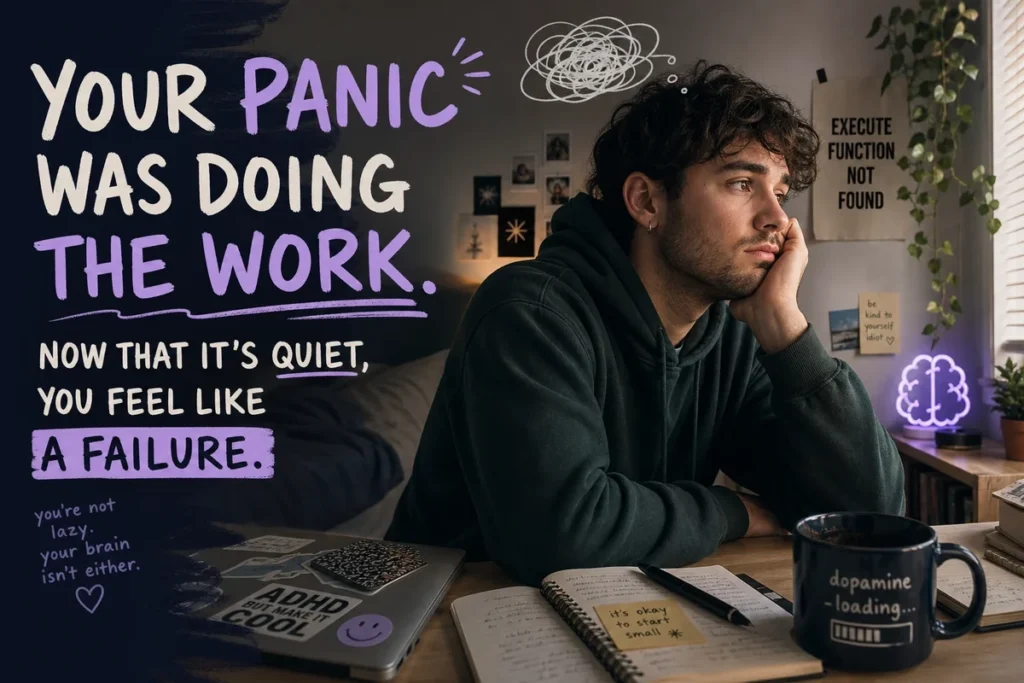
If your panic has quieted and your output has dropped with it, the most likely explanation is that ADHD anxiety was doing a job your brain never had a better tool for. Many adults who discovered their ADHD late ran on dread: the fear of missing the deadline, disappointing someone, or being found out. When treatment, therapy, or a calmer life turns that fear down, the engine goes quiet too, and the silence reads as personal failure. It is not failure. It is a fuel switch, and the work now is to build a cleaner source of drive rather than to rebuild the alarm.
The recognition usually arrives sideways. You sit down at a task that should now be easier, because your head is quieter and your chest is looser, and nothing happens. Then the thought lands: for years, the reason things got done was that you were terrified of not doing them. This article explains why that was neurologically logical, what it cost, how to tell calm from something more worrying, and how to build motivation that does not run on adrenaline.
Why Do I Feel Like a Failure Now That My Anxiety Is Gone?
You feel like a failure because you are comparing your calm output to the output of a body running on adrenaline, and the second number was never sustainable. Anxiety supplied urgency, which ADHD brains often struggle to generate from importance alone. When the anxiety fades, the task is still there but the thing that used to launch you is not, and the gap between the old fuel and no new fuel gets interpreted as a defect in you.
That interpretation is the part worth challenging. A drop in output after your nervous system settles is not proof you were secretly lazy, and it is not proof your treatment is taking something from you. It is information about how you were getting things done. Anxiety was a load-bearing wall in your productivity system, and nobody told you it was structural until it came down.
What ADHD Anxiety Was Actually Doing for Your Brain
The ADHD reward system does not reliably convert “this matters” into “start now.” PET imaging research by Volkow and colleagues (2011, Molecular Psychiatry) found lower dopamine D2/D3 receptor availability and lower dopamine transporter density in reward-related regions in adults with ADHD. In practical terms, knowing that a task is important can be neurologically inert. The information arrives, but the motivational signal that normally rides with it does not.
Fear does not need that pathway. When something feels threatening, the sympathetic nervous system releases norepinephrine into prefrontal networks, and Arnsten (2009, CNS Drugs) described how moderate noradrenergic signaling there supports working memory, attention, and inhibitory control. So the panic at 11 PM was not just emotional noise. It was a real, if expensive, boost to executive function. Your brain found a second door when the first one was locked.
A 2026 perspective paper in Frontiers titled “High functioning, yet high suffering” names this directly. The authors write that anxiety may operate as a maladaptive form of self-medication, because some people report overcoming procrastination or initiating tasks only when driven by heightened anxiety and its adrenergic activation. It is the same mechanism behind the deadline pattern in You Only Feel Like a Person When Something Is Due, seen from the other side: what happens to a brain that relied on the emergency once the emergency stops showing up.
Anxiety was never your personality. It was a workaround for a start signal that importance alone could not fire.
The Anxiety Tax: What That Fuel Actually Cost You
Every system that runs on a stress response charges interest. The anxiety tax is the total of what you paid, in sleep lost to rehearsing worst cases, in a jaw and shoulders that never fully unclenched, in relationships where you were fully present only when the stakes were high, and in a self-concept built on the belief that you are only reliable when frightened. Many people paying it never see the bill, because the output looked fine. A project got delivered, so nobody audited the input.
The anxiety tax, defined: it is the hidden physiological and emotional cost of using fear as your primary starting mechanism. The Frontiers authors describe suffering that grows out of executive dysfunction and “the cumulative burden of sustained compensatory effort,” which is why high performance and high suffering can sit in the same person for decades without anyone noticing.
Work reviewed by Amiri and colleagues (2026, Neuropsychiatric Disease and Treatment) adds a biological layer. Their synthesis suggests that chronic stress can reshape prefrontal and nucleus accumbens dopamine and glutamate signaling and raise the energetic cost of effort. The authors note that some of this mechanistic evidence comes from animal studies and should be extrapolated with caution. Still, it fits what many adults describe: years of running hot leave a brain that is tired in a way sleep does not touch.
There is a cost in getting recognized, too. A large Finnish cohort reported in 2026 in Acta Psychiatrica Scandinavica, covering 322,416 adults, 66,146 of them with ADHD, found that women received antidepressant prescriptions before an ADHD diagnosis much more often than men did. The researchers attributed this to clinicians misreading ADHD traits as anxiety or depression in women. If you were treated for anxiety for years before anyone asked about ADHD, you are in well-documented company, and ADHD and Anxiety Almost Always Travel Together explains why the two are so hard to separate.
From the community: “Now with Adderall I feel that a cloud has lifted and can notice that I’m allowing myself to be more.” Source: r/ADHD thread
That poster had taken Lexapro and Wellbutrin for anxiety and depression before starting ADHD treatment, and describes the quiet as relief and expansion. That is one real outcome. For others, the same quiet arrives with an unsettling emptiness, and both experiences deserve space.
Can ADHD Medication Lower Anxiety, and Why Does Output Sometimes Dip?
For many adults, treating ADHD does lower anxiety, but it is not guaranteed, and the effect varies by person, medication, and the type of anxiety. Output can dip in the early weeks because the adrenaline you relied on is gone before a new starting mechanism is in place. This article is educational and not medical advice, so any change in dose, timing, or medication belongs in a conversation with your prescriber.
As of October 2026, the evidence is genuinely mixed. The Finnish cohort found that antidepressant use decreased substantially after adults received an ADHD diagnosis and started a stimulant or non-stimulant medication, and a review of adult ADHD with comorbid anxiety and depression noted that when ADHD is effectively treated, comorbid conditions can also improve. Bloch and colleagues (2017, Journal of Attention Disorders) found that methylphenidate reduced state anxiety during a continuous performance test in adults with ADHD. On the other side, a systematic review of pharmacological treatments and psychiatric comorbidity called the effects on mood and anxiety ambiguous, with some people, particularly those with high physiological arousal, at risk of heightened anxiety.
Amiri and colleagues reviewed 15 primary studies (8 randomised trials and 7 cohorts) and found that stimulants consistently improved inattention, working memory, and daytime task efficiency, while evidence for emotion-linked outcomes such as irritability, sleep disturbance, and anxiety was smaller and more variable. Medication can reliably make a task easier to do, but it is not a guaranteed anxiety remover or motivation replacement. Your Meds Are Working. That’s Exactly Why You Feel Everything So Much More covers the people who feel more, not less, once treatment starts.
Timing matters too. Your nervous system just lost its dominant fuel, and it will not instantly discover a new one. In our piece on the weeks after meds kick in, visibility and capacity arrive before a stable rhythm does. Give the adjustment real data rather than a verdict made on a Tuesday afternoon.
Calm, Flat, or Depressed: How to Tell What You Are Feeling
Calm and flat can feel identical from the inside, which is why many people conclude something is wrong with them rather than with the fit. Calm tends to leave interest, humor, and emotional range intact. You can still be moved by a song, still look forward to something, and still start a task when it has the right kind of pull, even if the pull is smaller than panic used to be. Flat feels like the volume on everything has been turned down, including the good things.
A third possibility is depression, which the Frontiers authors note can be mimicked by years of unrecognized ADHD, and which can also be present alongside it. Persistent low mood, loss of pleasure that does not lift, new changes in appetite or sleep, or hopelessness are all reasons to say so out loud to a clinician rather than waiting it out. If any thought of self-harm appears, treat that as urgent and contact a crisis line or emergency services in your area.
The useful move is to replace “I feel like a failure” with observations a prescriber can work with. When in the day does the flatness start? Does it lift when the medication wears off? Did it begin with a dose change? Are you sleeping and eating? Our piece on giving your psychiatrist what they actually need shows how to translate a vague feeling into usable detail, and You Finally Started the Meds. Now You Have No Idea Who You Are speaks to the identity side.
What to avoid is the do-it-yourself fix of chasing the old feeling. Skipping sleep, stacking impossible deadlines, or quietly raising a dose without discussion in order to recreate the surge is the anxiety tax being paid again in a different currency.
Why Your Brain Keeps Waiting for the Alarm
Even with a clearer prefrontal system, your habits and expectations remain trained on the old signal. Every time panic got a task done, your brain logged the outcome as success and the relief as a reward. It did not log the cost. Over years, that makes dread feel like the correct input for starting, and a calm morning feels like one where something essential is missing.
Delay aversion makes this stickier. Research on ADHD and delay aversion, including work by Sonuga-Barke and colleagues, describes a strong preference for sooner rewards over later ones, which means distant consequences feel faint until they are close enough to threaten you. Panic compresses the distance. Calm restores it, and the future goes back to feeling like a rumor.
Emotion matters here as well. Research on emotion and procrastination in ADHD, including a 2023 paper by Bodalski, Canu, and Hartung, reports that intense feelings such as boredom, frustration, and anxiety can make a task feel impossible to start, lowering self-esteem and feeding more avoidance. When anxiety was your starter motor, it was also your avoidance driver, and removing one without building a replacement can leave a quiet that feels indistinguishable from the old stuckness.
You are not waiting for motivation. You are waiting for an alarm that was never meant to be your only way to start.
Building a Cleaner Engine Without Rebuilding the Panic
Psychiatrist William Dodson has described ADHD as an interest-based nervous system, one that responds to interest, challenge, novelty, passion, and urgency rather than importance. Panic was urgency in its most extreme form. The goal now is not to eliminate urgency but to swap its source from internal dread to external, honest structure.
Real urgency borrowed from other people works better than fake urgency made from fear. A named person expecting a specific deliverable at a specific time creates a deadline your brain can feel without a surge of cortisol. Having someone present while you work lowers the activation threshold in a similar way, and our guide to building an ADHD accountability system shows how to set that up. A short, visible timer does the same job for solo tasks, because it turns an unbounded obligation into a small contained one.
Shrinking the starting line matters more than it did before. Without the adrenaline surge to vault a big first step, the first step has to be small enough for a calm brain to take. Open the document. Type one ugly sentence. Put one dish in the dishwasher. One concrete start sentence can be the whole intervention for a task that has been sitting for days.
Novelty and interest are the other legitimate fuels, and they can be engineered. Change the location of the work, pair a boring task with music you enjoy, or race your own previous time. The ADHD dopamine menu lays out how to build a list of reliable reward sources so you are not reaching for dread by default.
Recovery belongs in the system, too. A brain that has run on cortisol for years does not become efficient overnight, and sleep, movement, and food are part of the fuel supply. If the quiet comes with exhaustion rather than ease, the ADHD Energy pillar covers nervous system regulation and burnout recovery, and the ADHD Systems pillar covers low-friction setups that do not depend on a good day.
A clean engine is slower to ignite and far cheaper to run.
Rewriting the Failure Story
The failure feeling is a story about the past as much as the present. If you discovered your ADHD late, you probably spent years crediting your results to character: I thrive under pressure, I am a last-minute person, I work best when I am scared. Now that the pressure has lifted, that story has nothing to attach to, and the leftover shame goes looking for a new target, usually you.
A more accurate story is available. You built a workable system from the materials you had, you paid a high price for it, and you are allowed to want a system that costs less. Grieving the version of you who never got to work calmly is part of that. So is noticing that being the person who always pulls it off at the last minute was real effort, and was not the only version of you available.
Change how you measure success in the meantime. Instead of judging a day by how much you produced while frightened, track starts completed, sleep, and how recovered you feel, and give any new pattern more than a weekend of data. If you are exploring what life after late discovery looks like, the ADHD Identity pillar is built for the stage where the question moves from “do I have this” to “who am I now.”
This piece draws on the 2026 Frontiers perspective on high-functioning adult ADHD, the 2026 Amiri and colleagues synthesis of 15 studies on stimulants under stress, a review of adult ADHD with comorbid anxiety and depression, a 2026 report on the Finnish cohort of 322,416 adults, and community accounts from adults living this transition. None of it replaces an individual assessment, and dosing questions belong with your prescriber.
Frequently asked questions
Why do I feel less productive now that my anxiety is better? Anxiety may have been supplying the urgency and norepinephrine boost your ADHD brain could not generate from importance alone. When it fades, output can dip until you build other starting mechanisms, such as external deadlines, shared work sessions, and smaller first steps.
Can ADHD medication reduce anxiety? It can for some people. A Finnish cohort reported in 2026 found antidepressant use fell after adults began ADHD treatment, but a systematic review found effects on anxiety are inconsistent, and some people with high physiological arousal may feel more anxious.
How do I know if I feel calm or emotionally flat on my medication? Calm leaves your interest, humor, and emotional range intact, while flat mutes everything, including things you used to enjoy. Track when it shows up in the day and share that pattern with your prescriber rather than adjusting anything on your own.
Is it bad that I used anxiety to get things done? No. It was a functional workaround, and research suggests anxiety and its adrenergic activation can help some adults start tasks. The problem is the long-term cost, which is why building lower-cost fuel sources is worth the effort.
Quick Dopamine Hits:
- Pick one task you have been avoiding and write down the real consequence of skipping it, then text one person a specific time you will start it. A real person expecting a real start time gives you urgency without manufactured dread.
- Set a visible timer for 10 minutes and do only the ugliest first step of the task, such as opening the file and typing the first ugly sentence. When the timer ends, record that you started, because a started task is the metric that counts now.
- For one week, log three numbers at the end of each day: tasks started, sleep hours, and a 1 to 5 rating of how flat or alive you felt. Bring that log to your prescriber or therapist instead of trying to describe a vague sense of failure.
Rate this article
Was this a useful hit?