You Either Don’t Notice You’re Injured or Can’t Function Through It. Your Pain Alarm Isn’t Calibrated Normally.

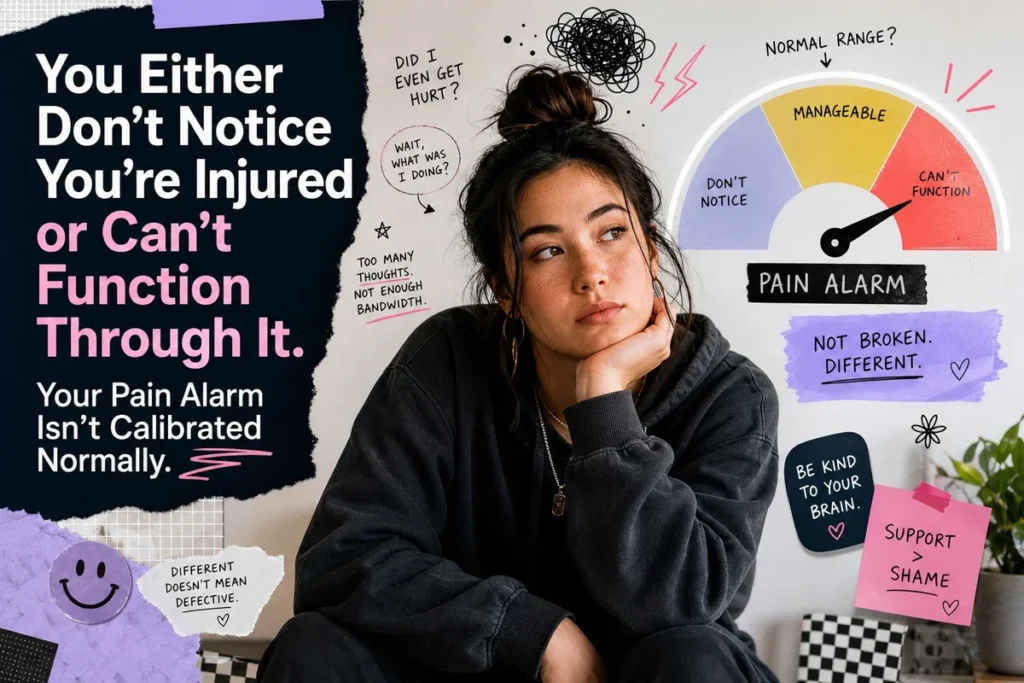
ADHD pain sensitivity does not follow one rule. Research links ADHD to higher rates of chronic pain, and many adults describe both extremes: a high pain threshold that lets an injury go unnoticed for days, and pain amplification that flattens them over something minor. The bottom line is that ADHD can change how pain signals are noticed, interpreted, and reported. That is why many people see a doctor late, undersell what is happening, or leave without answers.
Is pain processing different in ADHD?
Yes, research suggests it is, although the picture is mixed and still being mapped. ADHD is associated with higher rates of chronic pain, and people report both reduced awareness of pain and heightened pain sensitivity. The common thread appears to be how the brain attends to, filters, and emotionally weighs incoming body signals, with possible contributions from peripheral nerves that researchers are only starting to examine.
A 2026 scoping review on ADHD and chronic pain pulled together 50 studies, searching the literature through December 2025. It found that epidemiological studies have consistently reported significant associations between ADHD traits or diagnoses and chronic pain. Most of the included studies were observational, and only one was an interventional trial. We know the two travel together. We are still working out why.
If your relationship with pain feels strange, with long stretches of “I’m fine” followed by sudden collapse, you are not imagining a pattern. It sits alongside the other ways ADHD can scramble body signals, such as noticing thirst only once a headache arrives.
What the numbers say about ADHD and chronic pain
As of October 2026, one of the most striking recent datasets comes from Kasahara et al. (2026, Scientific Reports), a cross-sectional screening study from the University of Tokyo. It included 958 adults with persistent chronic pain, recruited at their first visit to 13 multidisciplinary pain centers in Japan. Of these adults, 17.1% screened positive for ADHD traits and 4.4% for autistic traits. Among those reporting extremely severe pain, an average rating of 9 or 10 out of 10, 27.4% screened positive for ADHD. Adults with chronic pain were 2.4 times more likely to have ADHD traits than the general population.
What the data actually says: ADHD traits, but not autistic traits, were tied to higher pain intensity in this sample of 958 adults. The screening tool has a documented false-negative rate of 31.3%, so the true overlap may be higher. The limitation is that ADHD was self-reported through screening, not formally diagnosed.
The same study complicates the story usefully. The link between ADHD traits and extremely severe pain weakened after the researchers adjusted for anxiety, depression, and pain catastrophizing, the tendency to magnify and ruminate on pain. That suggests the connection runs partly through emotional and cognitive processing, not only raw nerve signals. Lead author Satoshi Kasahara noted that many people with treatment-resistant chronic pain show features common in ADHD, including inattention, impulsivity, and difficulties with emotional regulation.
Some people and clinicians also report that ADHD medication eases pain in this group. It is an emerging area, not an established treatment, and any medication question belongs with your prescriber.
Why do some people with ADHD not notice they are hurt?
Many people with ADHD miss pain because noticing a signal is a separate step from receiving it. The nerves may fire, but attention, interoception (the brain’s ability to sense and interpret internal body states), and competing demands decide whether the signal ever reaches awareness. A brain locked onto an interesting task can simply never promote the ache to a conscious priority.
Pain is not only a signal from the body. It is a decision the brain makes about whether that signal deserves your attention right now.
The interoception research points the same way. A systematic review of how the brain handles internal signals describes a chain running from visceral nerves through the brainstem and thalamus to the insula and anterior cingulate cortex, where raw sensation becomes conscious awareness. Kaisari et al. (2018) found that people with ADHD traits, particularly inattention, tend to rely less on hunger and fullness cues when eating. A lived-experience survey of 195 adults found that lower body trust was statistically related to ADHD motor traits. If the brain is a less reliable reader of hunger and fullness, there is little reason to expect flawless readings of a strained tendon or a slowly worsening infection.
Hyperfocus compounds this. When you are absorbed, you can skip meals, ignore a full bladder, and work through a headache for six hours, and injury can get filtered the same way. Many adults describe finding a bruise or burn with no memory of how it happened. Our piece on why ADHD brains do not notice they are exhausted until they are destroyed covers the same delayed-invoice pattern for energy.
Crisis states plausibly add another layer. Many people with ADHD run best under urgency, and a brain flooded with stress chemistry may deprioritise everything that is not the emergency. Research on this pathway in ADHD is limited, so treat it as a reasonable hypothesis. The lived pattern is vivid, though: you feel nothing during the crisis, then everything once it ends.
Can ADHD make pain feel worse?
Yes. ADHD is associated with heightened pain in many people, and proposed mechanisms include central sensitization (a nervous system that amplifies incoming signals), emotional dysregulation, and pain catastrophizing. It is entirely possible to be bad at noticing pain and bad at tolerating it, sometimes within the same week.
That confuses people who assume ADHD means a “high pain tolerance.” A review of nutrition for young athletes with ADHD summarises findings that methylphenidate can raise pain thresholds in children with ADHD to typical levels. Read that carefully: if medication raises a threshold to typical, the untreated threshold was lower, meaning more sensitive, not less. The same review mentions a case-control study of 25 adults with ADHD who responded to methylphenidate, finding heightened muscle tone and higher reported pain than controls. Evidence is thin and mixed, which is the point. Measured sensitivity and real-world noticing can pull in opposite directions.
The emotional layer adds fuel. In an ADDitude survey of nearly 3,500 people on rejection sensitive dysphoria (RSD), respondents described rejection as “intense pain in my stomach” and “a punch to my chest.” Our deeper look at why rejection physically hurts goes further. Sensory differences feed in too: if clothing tags and fluorescent lights already drain you, your nervous system has a thinner margin before a headache or joint ache arrives.
For autistic people, the picture can be stranger still. Reviews cited in a 2026 PLoS One study describe autistic participants with typical pain detection thresholds and tolerance, yet lower subjective pain intensity alongside heightened sensitivity. AuDHD bodies may be running two calibrations at once.
There is even early evidence of nerve-level differences. A small 2026 pilot by Gad et al. in PLoS One found significantly lower corneal nerve branch density in 21 children with autism plus ADHD compared with 15 healthy controls. It had no ADHD-only group and studied children, so it cannot be generalised, but it suggests researchers should stop assuming peripheral nerves are identical. Connective tissue may play a role as well, as we explored in your ADHD, hypermobile joints, and chronic pain.
How miscalibrated pain delays medical care
Miscalibrated pain delays care from both directions. When you do not notice, you arrive weeks late with something that was treatable earlier. When everything registers at full volume, you cannot rank symptoms, you describe all of it at once, and the person across the desk hears vagueness instead of urgency.
Underreporting is the third factor, and it is learned. Many adults with ADHD spent years being told they were dramatic or too sensitive, so they developed a reflex of minimising. They say “it’s probably nothing” before the doctor can. A masked, high-performing presentation, like the one we describe in the ADHD masking tax, makes clinicians less likely to probe. As a doctor writing for ADDitude put it, medicine still has blind spots in how ADHD is diagnosed and treated, especially for females and people from racial and ethnic minority groups.
Then there are the mechanics. Booking an appointment requires task initiation, tracking symptoms requires working memory, and describing them in ten minutes requires organising a timeline under pressure. The executive functions you need to advocate for your body are the ones ADHD taxes. By the time you sit down, the sharp pain that sent you there may have faded, so you say “it comes and goes” and leave with reassurance you did not earn.
The symptom you do not report is not always the symptom you did not feel. Sometimes it is the one your brain talked you out of mentioning.
An interview study of 14 Swedish women with ADHD found a theme of frustration with lack of knowledge in healthcare, particularly around hormones and reproductive health. That frustration is a predictable result of a system built around people who describe symptoms in a linear, calm, well-organised way.
Hormones, sleep, and eating: where pain signals get lost
Cycle-related symptoms, sleep, and appetite are common blind spots, because you have lived with the baseline so long that “normal for me” swallows real problems.
Wynchank et al. (2025, European Psychiatry) report that many women with ADHD describe symptoms worsening in the late luteal and menstrual phases, coinciding with falling oestrogen. A cross-sectional study of 602 females, 377 with self-reported ADHD, found significantly higher rates of menstrual irregularity, PMS, and PMDD in the ADHD group. If this is your pattern, tracking where your symptoms cluster across the month turns a vague complaint into usable evidence. Sleep matters too: research on pain more broadly suggests short or fragmented sleep can lower pain tolerance, and our guide to ADHD and sleep explains why the shutdown switch is unreliable.
Appetite overlaps with the interoception findings above. Reviews report elevated rates of eating disorders among people with ADHD, and lived-experience research links reduced body trust with eating disorder traits. If you cannot reliably tell hungry from full, nausea or fatigue is hard to interpret too. Many people describe not knowing whether they feel sick, hungry, anxious, or tired.
For the wider physical picture, the ADHD Body hub collects our work on hormones, sleep, and physical symptoms.
How to report pain when your internal alarm is unreliable
You cannot out-willpower a miscalibrated alarm, so build an external one. Replace “how does this feel?” with observable facts that survive a distracted afternoon and a rushed appointment.
Scheduled body checks work better than waiting for a signal. A midday alarm that prompts a 30-second scan, with a one-line note for anything that registers, gives you a log without asking your brain to volunteer what it normally suppresses. The note matters more than the scan, because ADHD working memory often will not hold the detail until Thursday.
Function beats intensity. A six out of ten means different things to different people, and yours may be unreliable in both directions. “Could not lift my arm above shoulder height since Tuesday” gives a clinician something to act on, and it protects you from your own minimising, because a fact is harder to talk yourself out of than a feeling.
A rule for the unreliable alarm: Chest pain, a sudden severe headache, difficulty breathing, an injury that will not bear weight, or pain with fever should not wait for your internal alarm to agree. If your brain has a history of downgrading signals, let the list decide, not the feeling.
For appointments, front-load. Put your top two concerns in the first two lines of a phone note and read them out in the first minute, before the “I’m fine” reflex arrives. Bring dates if you see a pattern. Tell the clinician you have ADHD and tend to underreport pain, since that sentence alone changes how some people ask follow-up questions. Our guide to giving your psychiatrist what they actually need adapts well to any medical visit.
Treat the pattern itself as information. Injuries you cannot account for, long gaps between onset and awareness, or wide swings between “nothing” and “unbearable” are not character flaws. They are data about your calibration, and they belong in the conversation with your doctor.
Frequently asked questions
Do people with ADHD have a high pain tolerance? Some report not noticing pain, but that is often an attention and interoception effect rather than true nerve insensitivity. Research is mixed, and a review of nutrition for young athletes cites evidence that methylphenidate raises pain thresholds in children with ADHD to typical levels, implying sensitivity can be higher without treatment.
Is chronic pain more common with ADHD? Studies consistently report an association. In a 2026 Scientific Reports study of 958 adults at pain centers, 17.1% screened positive for ADHD traits, and 27.4% of those with extremely severe pain did.
Why do I wait so long to see a doctor when something hurts? Reduced awareness of body signals, hyperfocus, a habit of minimising, and the executive effort of booking and describing symptoms can stack up. The result is delay even when you want help.
Can ADHD make pain worse? It can for many people. Emotional dysregulation, pain catastrophizing, and possible central sensitization are proposed pathways, and the 2026 Japanese study found that anxiety, depression, and pain catastrophizing explained part of the link with severe pain.
This article draws on a 2026 scoping review of 50 studies on ADHD and chronic pain, the 2026 Scientific Reports pain-center study, interoception research, and 2025 work on hormones and ADHD. It is educational, not medical advice, so bring any persistent or worrying symptom to a clinician.
Quick Dopamine Hits:
- Set a recurring phone alarm for the middle of your workday and do a 30-second body scan: jaw, shoulders, stomach, hands, feet. Write one line in your notes app for anything that registers, even if it feels minor.
- When something hurts, record three facts instead of a rating: what time it started, what you can no longer do because of it, and what changed it. Doctors act on function and timelines far more readily than on a number out of ten.
- Before your next appointment, put your top two concerns in the first two lines of a note on your phone and read them aloud in the first minute. Do not wait to be asked, because your brain will downplay them once you are in the room.
Rate this article
Was this a useful hit?