Your ADHD Gets Worse Every Month on the Same Days. That’s Not a Coincidence.

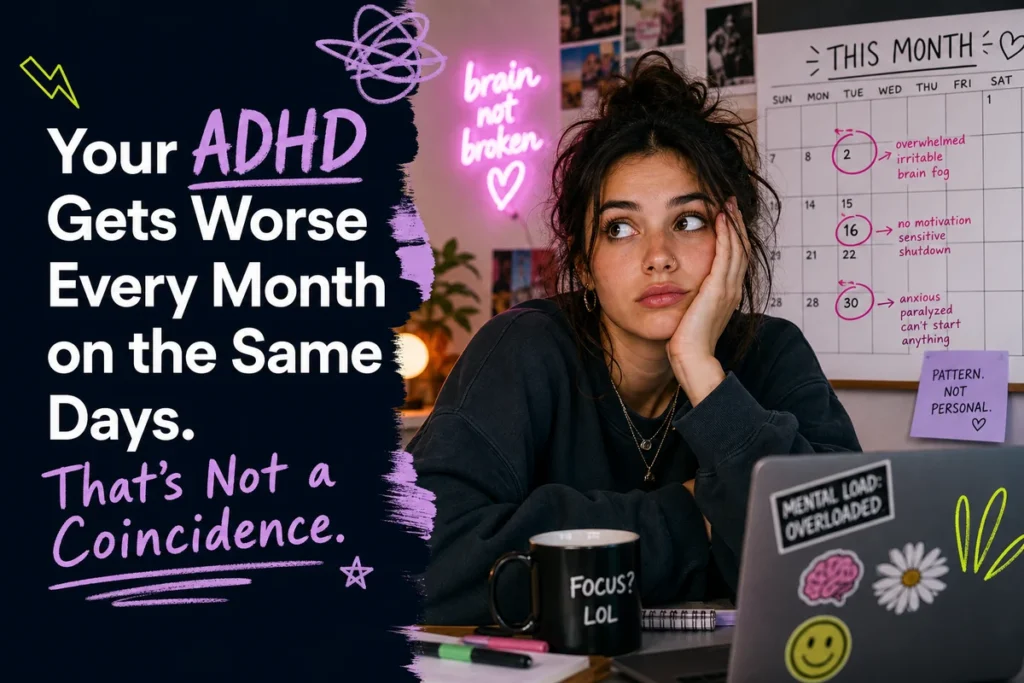
If your ADHD feels genuinely catastrophic for roughly two weeks every month, then suddenly and mysteriously manageable again, you are not imagining it. You are not deteriorating. You are not failing to apply the coping strategies you spent good money learning. You are experiencing a real, neurobiological phenomenon that has a name, a mechanism, and decades of clinical observation behind it: cyclical ADHD symptom amplification tied to the hormonal phases of your menstrual cycle. The pattern is so consistent, and so predictable once you know what to look for, that researchers have been calling for cycle-phase-specific ADHD treatment protocols for years. Yet the overwhelming majority of women with ADHD have never been told a single word about it.
The Symptom Pattern You Have Probably Been Blaming Yourself For
The experience typically follows a recognizable shape. In the first half of your cycle, the follicular phase, roughly days one through fourteen, your ADHD traits feel relatively contained. You can focus for longer stretches. Your medication seems to do what it is supposed to do. You get things done. You feel, briefly, like a competent person.
Then, somewhere around ovulation, things begin to shift. By the mid-luteal phase, approximately days fifteen through twenty-eight, focus collapses. Working memory feels like it has been wiped. Emotional dysregulation spikes. Rejection sensitivity sharpens to a point where a mildly critical email from a colleague can derail your entire day. The brain fog is so thick that tasks you completed easily two weeks ago now feel genuinely impossible. Your medication, if you take it, seems to stop working.
Most women interpret this pattern as evidence of personal failure. The good weeks feel like the real version of themselves, the broken weeks feel like who they actually are underneath the coping. Neither reading is correct. Both are your brain, doing what an ADHD brain does under radically different hormonal conditions.
Hormonal transitions exacerbate ADHD traits and mood disturbances. When oestrogen is low or declining in individuals with already dysregulated dopamine, these shortages reinforce each other, explaining mood and cognitive deterioration during hormonal fluctuation periods.
, Kooij et al., 2025, Frontiers in Global Women’s Health
Why Estrogen Is a Dopamine Amplifier
To understand what is happening, you need to understand one relationship: estrogen and dopamine are not independent systems. Estrogen acts as a modulator of dopaminergic transmission. When estrogen is relatively high, as it is during the follicular phase, it enhances dopamine signalling in the prefrontal cortex, the region responsible for working memory, attention regulation, impulse control, and executive function. Research by Jacobs and D’Esposito published in the Journal of Neuroscience (2011) demonstrated directly that estrogen shapes dopamine-dependent cognitive processes, with meaningful implications for women’s cognitive health across the cycle.
Shanmugan and Epperson (2014), writing in Human Brain Mapping, extended this finding specifically to executive function, showing that estrogen exerts significant effects on prefrontal cortex activity and that declining estrogen levels, as seen during the late luteal phase and the menopause transition, directly compromise the executive functions that ADHD already taxes. In a brain that is already operating with reduced dopamine efficiency because of ADHD, losing estrogen’s amplifying effect is not a minor inconvenience. It is a compounding deficit landing on a system that had almost no margin to spare.
The double-deficit window: During the late luteal phase, estrogen falls sharply. For women with ADHD, this means reduced estrogen amplification lands on top of an already under-functioning dopamine system. The result is not PMS with some concentration problems, it is a neurobiologically distinct period of amplified ADHD that requires its own management strategy.
What Actually Happens in the Luteal Phase
After ovulation, estrogen briefly peaks and then begins a sustained decline through the luteal phase, a pattern that parallels the dramatic estrogen drop that occurs after childbirth. Progesterone rises, and while progesterone has its own neurological effects, it does not compensate for the loss of estrogen’s dopamine-boosting action. Research suggests that progesterone can further dampen dopaminergic activity in some women, adding another layer of neurochemical pressure in the two weeks before menstruation.
A qualitative study by Bürger (2024), examining the menstrual cycle experiences of women with ADHD, found that traits specifically during the mid-to-late luteal phase included significantly increased emotional and attention dysregulation, with negative impacts on relationships, careers, and mental health. Crucially, that study also found that healthcare providers frequently lacked knowledge about the hormonal impact on ADHD medication, leaving women without clinical support for a predictable and treatable pattern.
Research published in European Psychiatry by Wynchank, de Jong, and Kooij (2025/2026) reviewing clinical evidence from a specialist adult ADHD centre found that many women reported cyclical variations in symptom intensity and reduced psychostimulant efficacy specifically during the late luteal phase. The phrase “reduced efficacy”, is worth pausing on. Your medication is not working differently because of your mindset or your sleep habits alone. It is working differently because the hormonal environment in which it operates has fundamentally changed.
Does This Explain PMDD?
Premenstrual dysphoric disorder (PMDD) is a condition characterized by severe mood, cognitive, and physical experiences in the luteal phase that resolve shortly after menstruation begins. Women with ADHD are significantly more likely to experience premenstrual depressive difficulties, research reviewed by Kooij et al. (2025) found rates of premenstrual depressive experiences in women with ADHD running at 45%, compared to 28% in the general population. Dorani et al. (2021), publishing in the Journal of Psychiatric Research, found significantly higher rates of hormone-related mood difficulties in women with ADHD compared to women without the condition.
The clinical and research communities are increasingly treating ADHD and PMDD as conditions that share a neurobiological vulnerability rather than two separate problems that happen to coincide. Both are sensitive to dopamine dysregulation. Both are amplified by estrogen decline. For many women, what looks like PMDD is actually their ADHD, fully unmasked by the loss of estrogen’s dopamine support, and expressing itself in the emotional, cognitive, and motivational register that ADHD always uses when its compensatory scaffolding collapses.
ADHD commonly co-exists with premenstrual difficulties. Clinicians and researchers should routinely ask about menstrual cycle phase when evaluating ADHD traits, the current phase contextualises both symptom severity and treatment response.
, Wynchank, de Jong &, Kooij, European Psychiatry, 2025/2026
Why This Pattern Gets Misread as Something Else
There are several reasons this cyclical pattern goes unrecognised, and most of them have nothing to do with the individual woman failing to notice something obvious.
First, the difficult weeks tend to produce the kind of distress that overwhelms self-observation. When you are in a luteal crash, you are not taking notes about the timing. You are just trying to survive the day. Second, clinicians rarely ask about cycle phase during ADHD assessments, meaning the information is simply never collected or connected. Wynchank and colleagues’, 2025 clinical review explicitly recommended that routine ADHD assessment should include the first day of last menstruation, average cycle length, and current cycle phase as standard baseline data, but this remains rare in clinical practice. Third, the pattern varies enough across cycles that it resists easy pattern recognition without deliberate tracking over multiple months.
The result is that women spend years, sometimes decades, interpreting their difficult weeks as evidence of worsening ADHD, treatment failure, depression, anxiety, or personal inadequacy. They adjust their medication on an ad hoc basis, they catastrophise about their functioning, and they miss the fact that a predictable, calendar-linked structure is sitting underneath all of it. That structure does not make the experience easier, but naming it changes the relationship to it entirely. You can plan around something you understand. You cannot plan around something you believe is random deterioration.
The Medication Question That Most Prescribers Haven’t Asked
If estrogen modulates the dopaminergic environment in which stimulant medications operate, it follows logically that stimulant efficacy will vary across the cycle. This is not a theoretical inference, it is a documented clinical observation. Cyclical fluctuations in estrogen and progesterone during the menstrual cycle modulate dopaminergic transmission, influencing both peak efficacy and the duration of ADHD medications, according to a review of clinical evidence in the adult ADHD literature. Dynamic dose adjustments aligned with menstrual phases have been recommended to optimise therapeutic outcomes.
In practice, this means that the dose of methylphenidate or amphetamine-based medication that works adequately during your follicular phase may be genuinely insufficient during the late luteal phase, not because your body has developed a tolerance, but because the hormonal amplifier that was helping the medication land effectively has been withdrawn. Some clinicians who specialise in female ADHD are already exploring cycle-phase-adjusted dosing: a modest dose increase, or the addition of a small booster dose, during the ten to fourteen days before menstruation.
This is not something to self-prescribe. However, it is absolutely something to bring to your prescriber with specific data. The difference between “sometimes my medication doesn’t feel like it’s working”, and “my medication consistently feels less effective on cycle days fifteen through twenty-eight, and I have two months of tracking to show you”, is enormous in terms of the clinical response you are likely to receive. The latter is a clinical conversation about a documented phenomenon. The former is too easily dismissed as stress.
What the research recommends clinically: Wynchank, de Jong, and Kooij (European Psychiatry, 2025/2026) recommend that ADHD and mood experiences be tracked daily for at least two months, with cycle phase recorded alongside daily ratings, before any medication adjustments are made. This gives prescribers the pattern data they need to make genuinely informed decisions about cycle-phase dosing.
Hormonal Contraception Adds Another Layer of Complexity
The relationship between hormonal contraception and ADHD functioning is an area where the research is still catching up to clinical reality. Some women with ADHD report that hormonal contraception stabilises their experience by flattening the cyclical estrogen curve and removing the dramatic luteal-phase drop. Others report that it worsens their baseline functioning, particularly with progesterone-dominant formulations.
A large cohort study by Lundin et al. (2023), using Swedish national population-based register data covering hundreds of thousands of women with and without ADHD, found that women with ADHD using hormonal contraception showed a different risk profile for depression compared to women without ADHD using the same methods. The interactions between exogenous hormones and the ADHD nervous system are not uniform across individuals or across contraceptive types. Estrogen-containing combined oral contraceptives behave differently from progesterone-only methods, and both behave differently from non-hormonal approaches. This is an active research area, and the honest answer for now is that the right hormonal picture varies substantially between individuals and requires a conversation with a clinician who understands both conditions.
What this research confirms is that hormones are not an afterthought in ADHD management for women. They are a primary variable, one that shapes the effectiveness of every other intervention in your toolkit, including medication, cognitive strategies, and the environmental supports you rely on. You can explore more of the body-based picture of ADHD functioning in the ADHD Body pillar, which covers hormones, sleep, and physical factors that shape daily functioning.
What This Means for Emotional Dysregulation
The luteal-phase amplification of ADHD does not just affect focus and working memory. It hits emotional regulation particularly hard. Research on emotional dysfunction in adult women with ADHD, including a 2025 controlled study published in PLOS One by Slobodin and colleagues, found that emotional dysregulation in women with ADHD is closely linked to executive function deficits, particularly working memory and task-shifting capacity. When the luteal phase degrades both of those capacities simultaneously, the emotional regulation consequences can be severe.
The ADHD trait of rejection sensitive dysphoria (RSD), the intense, neurologically driven pain response to perceived criticism or failure, also tends to intensify during the luteal phase. RSD is mediated by prefrontal cortex and limbic system interaction, and both of those structures are dopamine-sensitive and directly affected by estrogen’s declining presence in the late luteal phase. If you find yourself more easily devastated by normal friction in the two weeks before your period, that is not a personality flaw or heightened sensitivity as a character trait. It is your emotional regulation system operating on a depleted neurochemical substrate.
Women with ADHD consistently report greater emotional lability, irritability, chronic overwhelm, and relational strain, patterns that are exacerbated during hormonal transition periods when the dopamine-modulating effects of estrogen are reduced.
, Adult ADHD: Clinical Presentation, Comorbidities, and Treatment Perspectives
Understanding the ADHD energy and burnout cycle helps here too. The luteal crash is not just a hormonal event, it interacts with accumulated cognitive load and the kind of chronic compensatory effort that women with ADHD sustain continuously. When estrogen drops, the reserve that was masking the cost of that effort disappears, and what surfaces looks like collapse but is actually the honest accounting of what has been running underneath the whole time.
How to Actually Use This Information
Knowing about the estrogen-dopamine connection is not useful if it stays abstract. The practical application comes down to three things: tracking, communicating, and restructuring your demands across the cycle.
Tracking means recording your cycle day alongside a daily rating for at least two months. Not a detailed diary, a simple nightly note of your focus, emotional reactivity, and sense of overwhelm, each on a five-point scale, alongside the day of your cycle. What many women find when they do this is that the pattern is far more consistent than they realised. The difficult weeks are not random. They land in roughly the same window every month. Seeing that pattern in writing converts what felt like unpredictable collapse into a predictable biological event you can prepare for.
Communicating means bringing that data to your prescriber with specific language. Describe which cycle days feel harder and when your medication feels insufficient. Ask directly whether cycle-phase dosing is something your prescriber is familiar with and open to exploring. If they are not familiar with it, the Wynchank, de Jong, and Kooij (2025) clinical review published in European Psychiatry is a peer-reviewed starting point you can reference in that conversation.
Restructuring means deliberately reducing your highest-demand tasks during the predictable low windows and front-loading strategic work into the follicular phase when your cognitive capacity is closer to its ceiling. This is not about giving up or accepting less. It is about working with your neurobiology rather than against it, which is the only approach that produces sustainable results for ADHD brains over time. The same principle that makes body doubling and external scaffolding effective applies here: reduce friction when the system is depleted, and build in support before you need it.
None of this replaces a clinical conversation. If you recognise yourself in this pattern, it is worth raising with a GP, psychiatrist, or specialist familiar with women’s ADHD. Understanding that this is cyclical, neurobiological, and well-documented in the research is the foundation, but the specific management steps need to be tailored to your own cycle, your own medication, and your own comorbidities. If you are not yet diagnosed but this pattern resonates, the ADHD identity and late discovery resources on this site are a useful starting point for understanding what the path toward answers can look like for women.
What it all comes down to is this: the two weeks before your period are not a character test you keep failing. They are a neurobiologically distinct phase of your cycle in which the hormonal support your dopamine system depends on has been quietly withdrawn. You were never going to think or will your way through that gap. You just needed someone to tell you it existed.
Quick Dopamine Hits:
- For the 10 days before your period, reduce your hardest cognitive tasks by 30% and move them to mornings, dopamine availability is lowest in the afternoon during the late luteal phase.
- Start a two-month cycle symptom log today: each evening, rate your focus, emotional reactivity, and overwhelm on a 1, 5 scale alongside the cycle day number. This data is what gets clinicians to take you seriously.
- Before your next appointment, tell your prescriber specifically which cycle days your medication feels ineffective, not just ‘sometimes it doesn’t work.’, Cycle-phase dosing is a real clinical option backed by current research.
Rate this article
Was this a useful hit?