You Go Quiet for Weeks Because You’re Terrified of What You Might Say If You Don’t

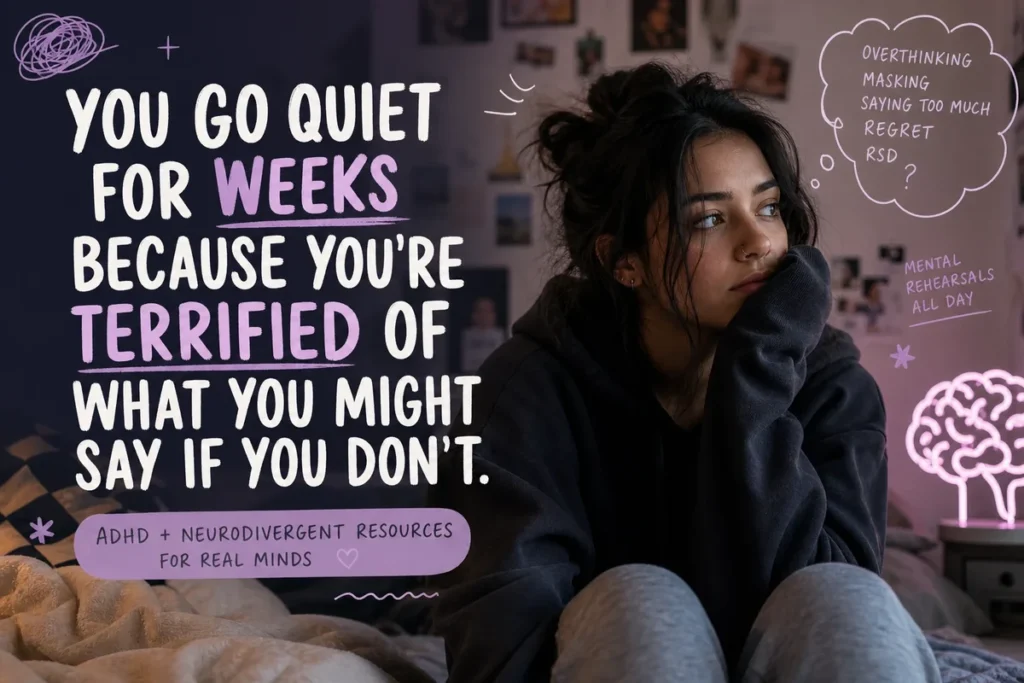
You notice you have not replied to anyone in eleven days. The group chat has moved on without you. Your friend sent a check-in message a week ago and you have composed the reply in your head seventeen times without sending it. And the reason is not what most people assume. It is not that you forgot, or that you got busy, or that you do not care. The reason ADHD ghosting happens is something closer to the opposite of not caring. You went quiet because you cared so much, and you were so afraid of what you might say or do if you showed up, that disappearing felt like the responsible thing to do.
This is one of the least-discussed cycles in adult ADHD: social withdrawal used not as avoidance of intimacy, but as protection of it. You pull back not because the people in your life stopped mattering, but because your dysregulated nervous system felt like a live wire, and you did not want anyone touching it.
The ADHD Brain Has a Temper Problem, and It Knows It
Emotional dysregulation is not a side effect of ADHD. It is a core feature, even if the diagnostic manuals have been slow to catch up. Research by Faraone et al. (2019, Journal of Child Psychology and Psychiatry) describes emotional dysregulation as one of the most impairing and most overlooked dimensions of the condition, encompassing low frustration tolerance, affective lability, and what researchers call emotional impulsivity: the tendency for emotions to arrive at full volume before the brain has any chance to moderate them.
Russell Barkley’s model of ADHD describes this as a failure of inhibition. The prefrontal cortex, which in a neurotypical brain would put a moment of pause between a stimulus and a response, is underactive in ADHD. Emotions, particularly frustration, impatience, and anger, arrive and immediately begin to shape behavior, before the slower, deliberative parts of the brain can step in and say “let’s think about this first” (Barkley, 2010). Corbisiero et al. (2012, European Archives of Psychiatry and Clinical Neuroscience) documented this across three domains: temper control failures characterized by feelings of irritability and frequent outbursts of short duration, affective lability involving unpredictable mood shifts, and emotional overreactivity to ordinary stressors.
What this means in practical terms is that when an adult with ADHD is already overloaded, deadline pressure, sensory overwhelm, a week of poor sleep, a conversation that got under their skin, their emotional thermostat is calibrated to blow. And many of them know this about themselves. That self-awareness is both a gift and a trap.
The problem is not that you lose control. The problem is that you know you might lose control, and you love the people in your life too much to take that risk.
Why Disappearing Feels Like the Kindest Option
Social withdrawal in ADHD is rarely about not wanting connection. It is almost always about managing risk. When your emotional regulation is compromised and you have spent years accumulating evidence of what you are capable of when you are dysregulated, the sharp word you cannot unsay, the overreaction that still makes you wince six months later, the moment someone flinched because your tone came out wrong, you develop a threat assessment system around your own presence.
The internal logic is almost parental in its protectiveness. If I show up right now, in this state, I will say something I do not mean. I will be short with someone who does not deserve it. I will make this about me when it should not be. Better to disappear for a while. Better to wait until I am safe to be around again.
A 2026 qualitative study by Rowney-Smith et al. (PLoS One) explored how adults with ADHD experience rejection sensitivity and emotional dysregulation in their relationships. Withdrawal emerged as one of three dominant themes in the data. Participants described pulling back from friendships, academic contexts, and professional opportunities specifically because they anticipated their own reactions would cause harm. The study noted that this withdrawal, sustained over time, typically produced the exact loneliness the person was trying to avoid, confirming a painful irony at the centre of the cycle.
The protective isolation paradox: The strategy designed to protect relationships from dysregulated reactions often ends up destroying them through absence. Staying away to avoid causing harm causes a different harm, one that is slower, quieter, and harder to explain to anyone, including yourself.
What Triggers the Disappearance
The ghosting cycle rarely starts with a decision. It starts with a moment. A comment that landed wrong. An interaction where you could feel yourself getting too intense and had to exit. A situation where your frustration came out louder than you intended and you saw the other person’s expression shift. After that moment, shame moves in fast, and shame, in the ADHD nervous system, is not a low hum. It is total.
Research on ADHD and social functioning consistently shows that adults with ADHD are more likely to receive negative social feedback over their lifetimes than neurotypical peers, and that this feedback compounds into a kind of relational learned helplessness: the conviction that showing up authentically means showing up badly, and that the safest version of you is the one nobody can see. CHADD notes that over 25 percent of Americans report chronic loneliness, and that the figure among adults with ADHD is almost certainly substantially higher, given the specific relational difficulties the condition creates.
The retreat happens in stages. First, you cancel one plan because you are not in the right headspace. That feels reasonable, even responsible. Then a week passes, and now the guilt of being gone has layered on top of the original dysregulation, making the prospect of returning even heavier. The silence that started as a protective measure becomes a wall built from shame. Walls do not let you back out any more than they let other people in.
The Shame Loop That Extends the Silence
One of the cruelest mechanics of the ADHD ghosting cycle is that the emotion meant to interrupt it, guilt, actually extends it. Guilt in ADHD does not typically motivate repair. It activates paralysis. The longer you have been gone, the more you owe someone an explanation. The more you owe someone an explanation, the more terrifying it becomes to reach out. The more terrifying it becomes to reach out, the longer the silence extends. This is not weakness. This is a nervous system treating social re-entry as a threat on the level of a physical danger.
A study exploring the experience of romantic relationships in adults with ADHD (Müller et al., 2024, Frontiers in Psychiatry) described participants oscillating between intense connection and withdrawal, noting that many came to see themselves as fundamentally unfit for sustained relationships. One participant described simply accepting that they were “a rotten girlfriend and wife”, a verdict that was never challenged because no one connected the behavior to ADHD. The shame calcified into identity.
When you have spent years watching yourself react in ways you could not predict or control, you stop trusting yourself around the people who matter. Isolation becomes a form of damage control, even when the damage it causes is worse.
The Rowney-Smith et al. (2026) study observed the same pattern: sustained withdrawal from friends and family left participants lonely in exactly the way they had feared. The expectation of causing harm drove behavior that caused a different kind of harm, the harm of absence, of one-sided silence, of a friendship that quietly ran out of oxygen.
Why This Is Different From RSD-Driven Ghosting
Precision matters here, because this pattern differs from other forms of ADHD social withdrawal. Rejection sensitive dysphoria, the neurological pain response to perceived criticism or exclusion, often produces ghosting too, but the fear in RSD points outward: it is about what other people will do to you, the anticipated abandonment, the judgment, being found lacking. Protective isolation runs in a different direction. The fear is about what you will do to them.
This distinction matters because the repair strategies look different. RSD-driven withdrawal often lifts when reassurance arrives, when someone demonstrates that they have not left, that you are still valued, that the rejection you feared is not happening. Protective isolation does not resolve with reassurance. It only shifts when you have enough confidence in your own nervous system to believe you will not hurt someone the moment you walk back into their life. You can read more about how RSD specifically reshapes friendship patterns in our piece on RSD and friendships, the mechanisms are related but distinct, and understanding both helps clarify which one is driving the silence on any given day.
For many adults, both patterns run simultaneously. The fear of being rejected mingles with the fear of causing harm. The result is a person who has reasoned themselves out of nearly every available social connection, while also feeling unable to sustain the ones that remain. That is not character. That is a dysregulated nervous system doing its best with the information it has.
What the Cycle Actually Costs You
Chronic social withdrawal carries real neurological and psychological consequences, independent of the relational damage. Adults with ADHD who have smaller social networks face compounding difficulties: fewer sources of emotional support, less access to practical help, and a diminished buffer against the anxiety and depression that frequently accompany ADHD. Research on social functioning in young adults with ADHD consistently finds that those with smaller social networks receive less practical assistance and emotional support from relationships, resources that matter more, not less, when executive function is already stretched (Babinski et al., 2011, cited in peer socialization research). The brain is a social organ. Isolation is not rest for it. Isolation tends to amplify rumination, increase emotional sensitivity, and reduce the regulatory buffer that close relationships provide.
The friendships that quietly die during these cycles were not just social niceties. For many adults with ADHD, close relationships represent one of the primary sources of the external structure and co-regulation that make everyday functioning more manageable. A friend who texts at 2pm can interrupt a shame spiral. A standing coffee plan can provide the external time anchor that the ADHD brain cannot generate internally. Losing those relationships to protective isolation means losing more than warmth. It often means losing scaffolding. The ADHD relationships pillar explores how these connection patterns show up across different types of relationships, and why the repair is almost always more possible than the shame loop makes it feel.
What Breaks the Cycle, and What Doesn’t
The standard advice, “just reach out,” “people will understand,” “your friends are not judging you”, is not wrong, exactly. But it misses the mechanics. The barrier is not information. You already know your friends are not judging you. The barrier is neurological: the nervous system that sent you into withdrawal in the first place is still running, and it does not particularly care what you know.
What actually interrupts the cycle tends to be smaller and more structural than the grand reconnection moment. The first thing that helps is naming the pattern for what it is, to yourself and when possible to the people in your life. Not a full explanation of ADHD neuroscience. Just enough: “I disappear sometimes. It is not about you. I am working on it.” Research on ADHD in relationships consistently shows that self-understanding has a transformative effect on how people interpret their own behavior, and how the people around them interpret it too (Müller et al., 2024, Frontiers in Psychiatry).
The second thing that helps is addressing the dysregulation directly, rather than managing it solely through avoidance. Avoidance keeps you safe in the short term but never builds capacity. The ADHD nervous system benefits from repeated experiences of surviving social contact while emotionally charged, not to prove it can be done, but to update the threat assessment that says “showing up equals causing harm.” Therapy approaches like dialectical behaviour therapy have a strong evidence base for building specific skills including distress tolerance, emotional regulation, and interpersonal effectiveness, all of which reduce both the severity and duration of dysregulated states.
The goal is not to never disappear. The goal is to make the disappearance shorter, the re-entry less fraught, and the silence less likely to calcify into permanent distance.
The third piece is repairing what the silence damaged, not with a lengthy explanation or a flood of apology that puts the other person in the position of managing your guilt, but with simple, low-stakes contact that says: I am still here, I was just somewhere else for a while. Most people who care about you are waiting for exactly that. They do not need the explanation as much as they need the proof that you came back.
When You Come Back, What Do You Say?
Many adults with ADHD report that the barrier to ending the silence is the conversation they imagine having to have. They rehearse explanations that feel enormous: how do I account for three weeks of nothing, how do I explain something I barely understand myself, how do I apologize without making this about me? The weight of the imagined conversation becomes another reason not to reach out, which extends the silence further.
The underestimated truth is that most meaningful reconnection does not require a full explanation. The absence of contact is what felt significant. Contact itself, in almost any form, begins to repair it. A meme. A voice note. A two-line text that does not mention the gap at all. The return matters more than the reason for it. For people who want to offer some context without a major conversation, “I have been in a bit of a tunnel” lands with most people who care about you. It is honest, it is brief, and it does not demand anything from the other person in return.
For adults with ADHD who find this kind of communication chronically difficult, not occasionally, but as a sustained pattern that is isolating them from the support they need, the underlying dysregulation may be worth addressing more directly. Emotional regulation strategies, whether through therapy, medication, or structured behavioural support, can reduce both the frequency and intensity of the states that drive protective withdrawal in the first place. The goal is not to eliminate the impulse to protect. The goal is to develop enough nervous system confidence that the protection does not require removing yourself entirely from your own life.
On medication and emotional impulsivity: Stimulant treatments that address core ADHD traits also tend to reduce emotional impulsivity, the speed and intensity of emotional responses before the thinking brain can catch up. For many adults, this is one of the most meaningful effects of treatment, and one of the least-discussed. If emotional flooding is a significant driver of your social withdrawal, it is worth raising with your prescriber explicitly.
You Are Not Too Much. You Are Under-Supported.
The ADHD ghosting cycle is one of the most misread patterns in adult neurodivergent life. From the outside, it looks like flakiness, detachment, or self-absorption. From the inside, it is often a desperate act of care: remove yourself before you hurt anyone, and come back when you are safe. The tragedy is that the strategy, however well-intentioned, causes the harm it was designed to prevent, just in a different shape, spread over a longer timeline, visible only to the people who notice the absence and do not know what to make of it.
Understanding the mechanics does not fix the cycle on its own. But it does shift the story you tell yourself about it. You are not someone who does not care about your relationships. You are someone whose nervous system has been trying to protect the things it loves with a blunt instrument. The work is not to stop caring. The work is to build enough steadiness in your own regulation that you can stay in the room.
That is harder than disappearing. It is also the only thing that actually keeps people close.
Quick Dopamine Hits:
- When you feel the pull to go quiet, send one sentence before you disappear: ‘I’m in a hard place right now, I’ll be back.’ It costs you almost nothing and keeps the door open.
- After an emotional outburst or a moment you regret, resist the urge to let shame make the silence permanent. Text the person one honest line within 48 hours, not a full explanation, just contact.
- Build a personal regulation signal: choose three things you do before entering any social situation when you’re dysregulated, a walk, water, five minutes alone. Make them non-negotiable.
Rate this article
Was this a useful hit?