Your Fridge Is Full. You’re Ordering Takeout Again. Your Brain Isn’t Being Lazy.

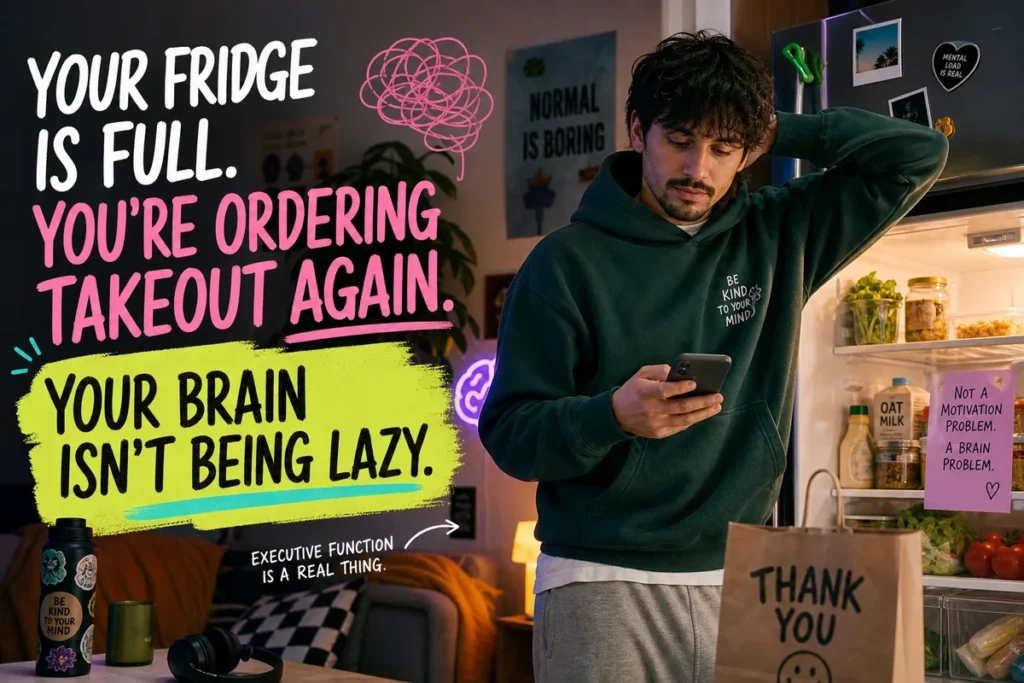
You bought groceries on Sunday. You had a plan. Three dinners, at least. You even wrote a list. By Tuesday night you are staring into a fridge full of food you cannot figure out how to combine into a meal, and twenty minutes later you are watching a delivery driver’s little icon move across a map while $19 in pad thai works its way toward your door. This is not a willpower failure. It is not laziness. It is one of the most consistent and least discussed ways that ADHD food spending quietly drains hundreds of dollars a month from people who cannot figure out why their food budget never holds.
Why “I’ll Just Meal Prep” Is a Trap for ADHD Brains
Meal planning sounds like an organizational system. The problem is that it is actually a stacked sequence of executive function demands, and every single step is one the ADHD brain handles poorly. To successfully execute a meal plan, you need to hold a future scenario in working memory (what will I want to eat Thursday?), map ingredients to outcomes, remember that plan while you are at a grocery store navigating sensory overload, remember it again three days later when you are exhausted, and then initiate cooking at exactly the moment when your brain has the least available capacity, after a full day of work.
Working memory is the cognitive system that holds information in your mind while you use it. Research consistently finds that people with ADHD have impairments across both verbal and visuospatial working memory domains (Alloway et al., 2009, Frontiers in Human Neuroscience). This is not a matter of forgetting to try. The plan genuinely cannot be held in the mental workspace long enough to become action. The broccoli you bought on purpose gets forgotten behind the leftovers until it is yellow, and by that point the shame of wasted food makes you less likely to engage with grocery planning next week. The system collapses not because you are disorganized. It collapses because it was designed for a brain that naturally holds plans as stable, retrievable objects, and yours often does not.
Meal planning tends to fail for ADHD brains not because the plan is wrong, but because working memory cannot reliably hold the plan long enough to execute it. The food rots. The delivery app opens. And the cycle charges you twice: once for the unused groceries and once for the takeout.
The Pantry Paradox: Full Fridge, Still Ordering Out
The pantry paradox is one of the most recognizable ADHD food experiences, and one of the least explained. You are standing in front of a refrigerator with plenty of ingredients and your brain returns nothing. Not a recipe, not a starting point, not a single actionable path forward. The cognitive load of translating raw ingredients into a finished meal, at the exact moment when you are depleted and hungry, exceeds what your prefrontal cortex can manage in that moment. So you close the fridge and order food instead.
This is a task initiation problem wearing a meal-planning disguise. ADHD can significantly impair the ability to begin complex multi-step tasks, particularly when those tasks lack external structure, clear starting points, and immediate feedback. Cooking provides none of those things by default. It requires you to sequence decisions, hold sub-steps in mind while completing other sub-steps, tolerate the delay between starting and eating, and manage the sensory environment of a hot kitchen while your blood sugar is dropping. For a brain already running at a deficit on dopamine-driven motivation, none of those conditions reliably trigger the activation signal needed to actually begin.
The real cost of the pantry paradox: If you spend $60/week on groceries that partially go to waste, plus $80 in delivery and takeout to fill the gaps, your actual food spend reaches $140, double what most budgets account for. Across a year, that gap compounds significantly. This is not a food problem. It is an executive function problem with a food-shaped price tag.
Why Does ADHD Make You Spend More on Food Specifically?
Three neurological mechanisms converge to inflate ADHD food spending beyond what any budget can comfortably absorb.
The first is delay aversion. Research using probabilistic choice tasks consistently demonstrates that people with ADHD tend to show a steeper temporal discounting curve than neurotypical controls, discounting the value of future rewards more aggressively and more rapidly (Sonuga-Barke, Sergeant, Nigg, and Willcutt, 2008, Journal of Child Psychology and Psychiatry). In plain terms, the meal you could cook in forty-five minutes feels neurologically distant. The food that appears at your door in twenty minutes does not. This is not impatience in the everyday sense. It is a documented feature of how the dopamine reward pathway processes time. Takeout wins the comparison before your prefrontal cortex has had a chance to run the numbers.
The second mechanism is decision fatigue, amplified by ADHD. Every food decision, what to buy, what to cook, whether you have the ingredients, how long it takes, whether it is worth the effort at this hour, draws on the same cognitive resource pool that ADHD depletes faster. By the evening, when most eating decisions happen, that pool is often nearly empty. Research on ADHD and executive function points to impaired cognitive flexibility as a core feature (Karakaya and Öncü, 2026, Frontiers in Psychiatry), meaning that switching between options, adapting plans when ingredients are missing, and generating alternatives on the fly are all significantly harder for many people with ADHD. When flexible thinking is compromised, the easiest available path tends to win. That path usually costs more.
The third mechanism is impulse purchasing at the grocery store itself. The ADHD brain can under-buy staples because the future feels abstract, and over-buy novelty items because they are immediately compelling. Research using positron emission tomography found measurably reduced dopamine D2/D3 receptor availability in the nucleus accumbens of adults with ADHD (Volkow et al., 2009, JAMA), the precise circuitry that regulates reward anticipation. When a brain is chronically undersupplied with the neural currency of motivation, anything novel and immediately rewarding becomes disproportionately attractive. This is why your grocery cart ends up with three types of expensive specialty cheese and no pasta, and why Tuesday night finds you staring at components with no coherent path between them.
What Emotional Eating Adds to the Bill
ADHD and emotional eating are not separate phenomena for many adults. A 2026 case-control study by Karakaya and Öncü (Frontiers in Psychiatry) compared 76 adults with ADHD to 69 healthy controls using the Emotional Eating Questionnaire. The ADHD group scored significantly higher on emotional eating measures (t = 5.39, p = 0.001), and regression analysis identified attention deficit specifically as the strongest predictor of emotional eating behavior in the ADHD group. Critically, reduced cognitive flexibility, the ability to shift out of a mental rut and adapt behavior, was independently linked to higher emotional eating scores.
When emotional regulation is difficult, food becomes a fast, reliable, low-friction dopamine source. It requires no scheduling, no other person’s cooperation, no delay between wanting it and having it. For an ADHD brain that finds emotional regulation genuinely harder than most people understand, this is not a character failing. It is a predictable consequence of a reward system that turns to the fastest available source of relief when the nervous system is overwhelmed. The result tends to be expensive food choices made rapidly, without the cognitive overhead of comparison shopping or meal consideration. The dopamine arrives. The bill arrives after.
From the community: “After work, I’m sooooo tired and mentally exhausted after the day. Sometimes I make dinner, often I order dinner.”, r/ADHD thread
Why Meal Planning Systems Keep Failing
The most common advice for ADHD food spending is to meal plan better: use an app, batch cook on Sunday, make a spreadsheet. This advice tends to work for about two weeks. Then life introduces one bad day, a meeting that runs long, a low-dopamine afternoon, a headache, and the system collapses. The meal prep container in the fridge becomes a source of guilt rather than convenience, and the gap left by the failed system gets filled with delivery food.
The flaw in most standard meal planning systems is that they front-load the work. You invest significant planning effort at the beginning of the week when motivation might be temporarily higher, but the payoff is spread across six evenings when motivation and cognitive capacity are at their lowest. For neurotypical brains that can sustain a plan across time using autobiographical memory and prospective planning, this structure works reasonably well. For ADHD brains, working memory erosion, time blindness, and the unpredictability of day-to-day executive capacity can make the plan functionally invisible by Wednesday. Research on working memory in ADHD consistently finds that verbal working memory, the system that holds the “what I planned to do” signal, is among the most reliably impaired domains in the condition (Alloway et al., 2009, Frontiers in Human Neuroscience). The plan does not just feel vague by midweek. For many people with ADHD, it has genuinely dropped out of accessible memory.
Standard meal planning systems tend to fail ADHD brains because they demand sustained prospective memory across a week, the exact cognitive capacity that ADHD consistently undermines. It is not a willpower problem. It is a system mismatch.
The broader pattern connects to something the research on ADHD and financial systems makes clear: any strategy that requires you to make the right decision at the wrong moment, using depleted cognitive resources, will fail consistently regardless of your intelligence or intention. Food planning is a financial planning problem in disguise. It demands future-oriented thinking, delayed gratification, and sustained attention, all in a domain where the failure mode is immediate and the cost compounds daily.
The Grocery Store Is an Obstacle Course for ADHD Brains
Even when the intention to buy sensible food is solid, the grocery store itself creates conditions that predictably undermine ADHD food spending control. Sensory overload from lights, crowds, and noise consumes the cognitive resources needed for rational decision-making. Object permanence difficulties, the ADHD tendency to lose track of things that are not immediately visible or salient, mean that a mental grocery list can dissolve the moment you walk past the first enticing display. The immediate visual appeal of processed and convenience foods triggers the same reward-proximity pull that makes takeout feel more compelling than home cooking.
Shopping hungry, which people with ADHD do at a higher rate due to time blindness and irregular meal patterns, compounds every one of these effects. Impulsive item selection increases, budget adherence decreases, and the likelihood of buying exciting novelty items rather than actual meal components rises significantly. This is not weak willpower in the grocery store. It is the dopamine-seeking mechanism described by Volkow et al. (2009, JAMA) operating exactly as its neurology dictates: in an environment dense with immediate reward cues, a brain running on a chronic dopamine deficit moves toward stimulation with urgency that the rational prefrontal cortex often cannot override in the moment.
The structural design of grocery stores also works against ADHD brains specifically. High-margin impulse items are placed at eye level and near checkout areas precisely because they catch attention, a strategy that affects everyone but hits harder when inhibitory control is already reduced. Long store layouts that require navigating the entire floor plan to reach staples increase the exposure time to novel, appealing products. And the sheer number of decisions involved in a full weekly shop, hundreds of individual choices across multiple aisles, depletes working memory and executive resources progressively as the trip continues. By the time you reach the fresh produce section at the back, your cognitive capacity for evaluating whether you actually need three avocados has quietly evaporated.
ADHD and disordered eating patterns: Meta-analyses examining the overlap between ADHD and eating disorders report substantially elevated odds ratios for binge-type presentations in adults with ADHD compared to those without. The dopaminergic hypothesis points to reward processing deficits increasing vulnerability through delay aversion and impulsive choice mechanisms. Recognizing this overlap is not about adding a diagnosis, it is about understanding that food relationships in ADHD often have neurological roots that standard advice completely misses.
What Low-Friction Food Systems Actually Look Like for ADHD Brains
The central design principle for any food system that works long-term with ADHD is this: the friction for the affordable option must be lower than the friction for the expensive option at the exact moment the decision happens. Not the morning before. Not the previous Sunday. Right now, when executive function is depleted and hunger is adding a cortisol edge to everything.
The most effective ADHD-compatible food strategies tend to share several features. They are anchored in repetition rather than variety, the same breakfast, the same two lunch options, rotating through a small set of known dinners. Repetition feels boring and is supposed to. Predictability eliminates the decision load that depletes the working memory capacity needed to actually cook. Research on ADHD and executive function consistently identifies cognitive flexibility as a relative strength in ADHD in novelty-seeking contexts, while working memory remains a consistent vulnerability (Karakaya and Öncü, 2026, Frontiers in Psychiatry). A food system that plays to that profile means leaning into structure for staples and reserving variety for occasions where energy is available.
Keeping a visible, physically accessible “panic meal” list, written on a whiteboard in the kitchen or pinned in a phone note, is one of the most practically effective interventions for the pantry paradox. This externalizes the working memory problem entirely. Instead of asking a depleted brain to generate a meal idea from scratch, you are asking it to read a list of five options it has already pre-approved. This sounds almost insultingly simple, but it works precisely because of how the ADHD brain often fails in these moments: not from lack of information, but from inability to retrieve information under conditions of depletion and hunger. Externalized prompts bypass that failure point entirely.
For grocery shopping specifically, the most effective ADHD modification is often not a better list app, it is a smaller, more predictable store trip more often. Weekly mega-shops require sustained attention, working memory across a long list, and the ability to project meals across a full week of uncertain future days. Smaller, more frequent shops with a short item limit match the ADHD brain’s capacity for present-focused, low-cognitive-load tasks far better. They may cost slightly more per unit but tend to cost dramatically less than the combination of wasted groceries and panic takeout. This is the same logic behind low-friction ADHD systems design more broadly: stop fighting the brain’s operating constraints and redesign the environment around them instead.
Why This Matters Beyond the Food Budget
ADHD food spending is not a trivial line item. For many adults with ADHD, food represents one of the largest and most variable categories of their monthly budget, and one of the least understood. Food is uniquely difficult because it is also physiologically urgent, you cannot simply decide not to eat. Every day creates new decision points, new opportunities for executive function difficulties to compound, new chances to spend $24 on delivery food from a restaurant three blocks away because the kitchen felt impossible at that specific hour.
Understanding why this happens does not make the problem disappear. But it does stop the secondary damage: the shame spiral that follows each takeout order, the feeling that you are uniquely terrible with money, the belief that if you just tried harder you would finally make the meal prep work. None of that framing is accurate, and all of it makes the underlying problem harder to address. Shame depletes the emotional regulation capacity that ADHD already taxes heavily. The worse you feel about last Tuesday’s delivery habit, the harder it becomes to engage with food planning on Wednesday.
The food budget problem is an ADHD tax problem. It sits alongside late fees, duplicate purchases, forgotten subscriptions, and every other financial consequence of navigating a system designed for a different kind of brain. Addressing it means applying the same logic as every other ADHD system design: externalize memory, reduce friction, shorten the delay between intention and reward, and stop expecting that enough motivation will eventually override a structural pattern that is rooted in neurology. It will not. But a lower-friction environment, built deliberately around how the ADHD brain actually works, often will.
Quick Dopamine Hits:
- When hunger hits and your brain goes blank, open a ‘panic meals’ note on your phone right now, write five things you can make in under ten minutes using ingredients you actually keep. Pin it. This note does the working memory work for you so you don’t have to hold the plan in an already-depleted brain.
- Batch decisions, not food. Spend two minutes this week picking one breakfast and one lunch you’ll repeat every day. Repetition feels boring by design, which is the point. Decision fatigue is the enemy, and removing the choice is the cheapest friction-reducer available.
- Before you open a food delivery app tonight, set a physical friction rule: you have to drink a glass of water and walk to your kitchen first. If you still want to order after that, order, but about 40% of the time, being in the kitchen cues the low-effort option your brain couldn’t see from the couch.
Rate this article
Was this a useful hit?