You Don’t Just Feel for People. You Feel as Them. That’s ADHD Hyperempathy.

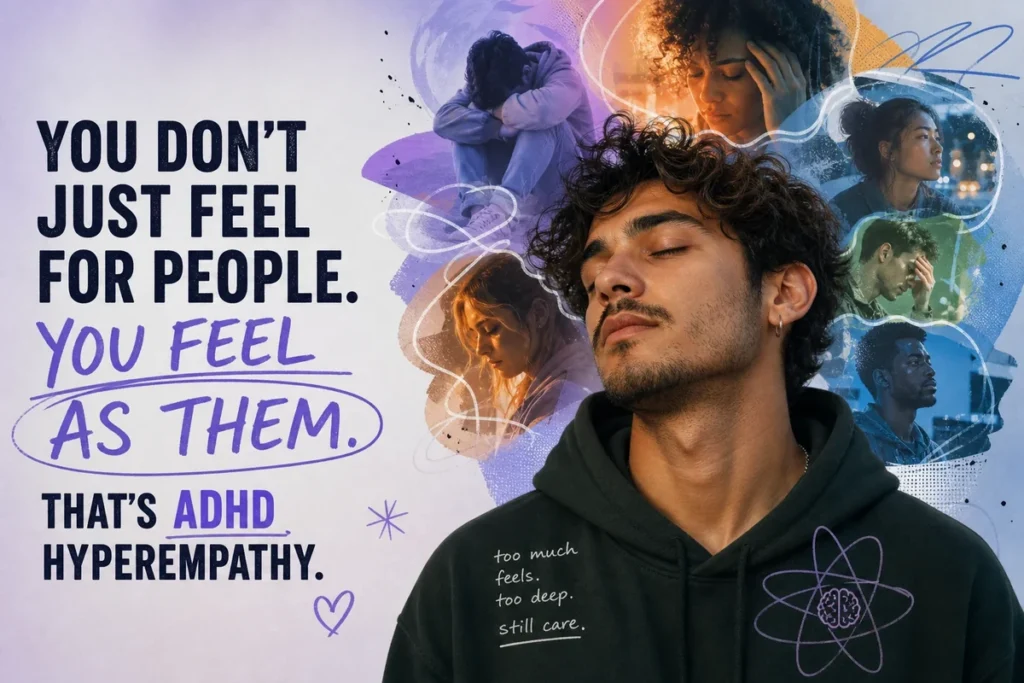
You walk into a room where two people had an argument an hour ago. They have moved on. Nobody mentions it. But you feel it, a specific low-level dread sitting somewhere between your sternum and your stomach, and it takes you the rest of the evening to understand that the feeling was never yours to begin with. This is ADHD hyperempathy: not simply feeling concerned for other people, but absorbing their emotional states into your own body so completely that the boundary between their distress and yours disappears. It is one of the least-discussed features of the condition, and arguably one of the most exhausting ones.
What Hyperempathy in ADHD Actually Means
Hyperempathy is not a formal diagnostic term, and it does not appear in the DSM-5 criteria for ADHD. This absence is part of the problem. For decades, the diagnostic framework has treated emotional features of ADHD as secondary, interesting side effects rather than central, disabling phenomena. But for many adults with ADHD, the emotional dimension is not secondary at all. It is the room they live in.
Emotional dysregulation is now recognised by researchers including Russell Barkley and Thomas Brown as a core feature of ADHD, not an occasional complication. Barkley and Murphy (2010) found that poor emotional self-control in adults with ADHD added explanatory power to multiple domains of impairment, including marital satisfaction, educational outcomes, and occupational functioning, above and beyond the standard inattentive and hyperactive-impulsive symptoms. The emotional system in ADHD is not merely louder than average. It operates differently, governed by weaker inhibitory connections between the prefrontal cortex and the amygdala.
Emotional dysregulation in ADHD is not a personality trait. It is a neurological architecture in which the emotional signal goes up fast and the braking mechanism arrives late, or sometimes not at all.
Hyperempathy sits inside this architecture. The ADHD brain does not just experience its own emotions more intensely. Research suggests it is also more porous to the emotions of others, picking up and internalising the affective states of its environment in ways that many neurotypical brains filter out more efficiently. The result is less “I feel sorry for you” and more “I am now feeling what you are feeling, in my chest, and I cannot switch it off.”
Why Does This Happen? The Neuroscience Behind Emotional Absorption
The mechanism begins with how the ADHD nervous system processes social and emotional information. Research by Chronaki and colleagues, published in the Journal of Child Psychology and Psychiatry, found that children with ADHD showed amplified early neural responses to hostile vocal tones, a faster and louder initial orienting to emotional signals in the environment. The ADHD nervous system does not wait to consciously evaluate a social cue before responding. It fires early, at the preattentive level, before the thinking brain has a chance to contextualise or modulate the signal.
This rapid emotional orienting creates a nervous system that is constantly, automatically tracking the emotional weather of its surroundings. What enters the nervous system quickly tends to be felt somatically, as a physical sensation, before it is recognised as information originating from outside the self. A spike of someone else’s anxiety registers as tightness in your own throat. Someone’s unspoken anger shows up as a heaviness in your shoulders that you spent the morning thinking was fatigue.
Interoception adds another layer. Research on interoceptive processing in ADHD, including work reviewed by Yang et al. (2022), suggests that ADHD is associated with altered internal body-signal processing: heightened reactivity to incoming emotional input combined with reduced reliability in identifying the source of that input. You feel it clearly. You just cannot always tell where it came from, or whether it originated from a person standing three feet away rather than from something inside you.
The inhibition gap: Neuroimaging research on children with ADHD and emotional dysregulation has found abnormal functional connectivity between the dorsolateral prefrontal cortex and the orbitofrontal cortex, regions critical for moderating emotional reactivity. This connectivity pattern means emotional signals tend to arrive at full intensity without the top-down dampening that allows most brains to register something as “not mine to carry.”
Hyperempathy Is Not the Same as Hypervigilance
A careful distinction matters here. Hypervigilance is the nervous system scanning for threat, a survival adaptation that many people with ADHD develop after years of criticism, social rejection, and unpredictability. Hyperempathy is something meaningfully different: the passive absorption of another person’s emotional state, including positive states, not only threatening ones. You can absorb someone’s anticipatory joy before an event, their grief about something they have not mentioned aloud, their low-level restlessness on a Tuesday afternoon. None of those are threats. You still carry them home.
The two phenomena often co-exist in ADHD and can amplify each other. If your nervous system is already scanning for social threat, the emotional signals you pick up are more likely to land with urgency. But hyperempathy is not reducible to anxiety. Many people with ADHD describe it as a kind of background audio feed that never fully mutes, a continuous stream of emotional data from the people around them that runs whether they want it to or not, regardless of whether the signal is benign or distressing.
What Emotional Absorption Actually Feels Like
The experience of ADHD hyperempathy is specific enough to be recognisable once named. You leave a friend’s house after they unloaded a stressful situation, and you arrive home feeling actively sad, not empathetically sad, but sad in a way that has weight and location in your body. You attend a tense family dinner where nobody says anything confrontational, and you spend the next day with a low-grade dread you cannot explain. Your partner is quietly frustrated about something entirely unrelated to you, and within thirty minutes you have internalised their frustration as your own, lost your ability to concentrate, and started wondering what you did wrong.
That last pattern, absorbing someone else’s emotional state and then running it through the lens of rejection sensitive dysphoria, is where hyperempathy becomes particularly costly. Rejection sensitive dysphoria (RSD) in ADHD is the neurological tendency to experience real or perceived rejection as a sharp, often physical pain, and to interpret ambiguous social signals as rejection signals. When you combine the absorption of someone else’s quiet displeasure with RSD’s tendency to personalise negative emotional signals, you get a response that looks disproportionate from the outside but makes complete internal sense. You felt something real. You ran it through a meaning-making system that defaults to “this is about me.” You arrived at a conclusion that does not match the facts of the situation, because the facts of the situation were never fully visible to you.
Qualitative research on ADHD in romantic relationships captures this pattern precisely. Participants described their relational experience as oscillating between overwhelming devotion and withdrawal, with one noting they “always went in full steam and they would feel overwhelmed,” and another describing how RSD extended beyond reassurance-seeking into a constant undercurrent of relational anxiety. The intensity was genuine. So was the depletion that followed it. The relational cost compounds over time: if you are absorbing emotions from everyone around you and also interpreting those absorbed emotions as information about your own worth, you are carrying weight that was never yours, and then being blamed internally for the way it makes you stumble.
The Cost Nobody Names: Empathy Exhaustion
Research consistently links emotional dysregulation in ADHD to elevated rates of burnout. A 2024 study in AIMS Public Health (Turjeman-Levi, Itzchakov, and Engel-Yeger) found that employees with ADHD reported substantially higher levels of emotional exhaustion compared to non-ADHD colleagues, with executive function deficits serving as the mediating mechanism. The emotional exhaustion dimension of burnout is not a character failing. It is the predictable output of a nervous system doing considerably more emotional processing than those around it.
Hyperempathy accelerates this depletion. If the standard ADHD nervous system is already working harder to manage its own emotional regulation, a hyperempathic ADHD nervous system is simultaneously managing its own emotions and the imported emotional residue of everyone it has encountered. After a full day of social interaction, many people with ADHD hyperempathy do not just feel tired. They feel as if they are still in several conversations at once, still processing emotional content from hours ago, still carrying the mood of a stranger they sat next to on the bus.
The social exhaustion many ADHD adults experience after group settings is not social anxiety. It is the aftermath of emotional absorption. The nervous system needs time to return what it borrowed.
This exhaustion often gets mislabelled. Friends and partners see someone who cares deeply, who is present and attentive and responsive. They are not wrong, those things are real. What they do not see is what happens afterward, when the absorbed emotional weight finally has nowhere to go. The withdrawal that follows is not coldness. It is recovery. This pattern contributes directly to the dynamics described in research on how ADHD relationships erode over time, with both people increasingly alone in an exhaustion they cannot quite explain to each other.
Why This Often Shows Up Differently in Women
Hyperempathy is reported across all genders in ADHD, but it tends to present with particular intensity in women and people socialised as women, for reasons that are social as much as neurological. Girls with ADHD who could not regulate their own emotional responses often learned early that managing other people’s emotional states was a form of social survival. Reading the room was not a gift. It was a necessary skill for avoiding the consequences of being “too much.” Over time, that hyperattunement became automatic, and the capacity to distinguish between someone else’s emotion and one’s own became harder to access.
The pattern intersects with what clinicians sometimes call the fawn response: the tendency to prioritise other people’s emotional comfort as a way of managing perceived social threat. For someone with ADHD who has accumulated years of criticism, late discovery, and the experience of being labelled oversensitive, the fawn response can become a default operating mode nearly indistinguishable from genuine care, because it often is genuine care. The problem is not the caring. The problem is the absence of a permeable filter between their experience and yours.
Late discovery compounds this in a specific way. Many adults who receive an ADHD identification in their 30s or 40s have spent decades explaining their emotional sensitivity as a personality feature, as who they are, not as how their nervous system operates. Recognising that hyperempathy is part of the ADHD picture can be disorienting. It can also be the beginning of understanding why certain relationships, jobs, and environments have consistently drained them when they seemed to energise other people. Research on rejection sensitivity in ADHD friendships adds important context here: the fear of getting it wrong socially sharpens the emotional monitoring that makes absorption more likely.
The Environments Where Absorption Hits Hardest
Certain contexts amplify ADHD hyperempathy in predictable ways. Open-plan workplaces are among the most difficult. The ambient emotional noise of many people’s moods, frustrations, and anxieties running simultaneously creates a level of emotional stimulation that a porous nervous system cannot filter efficiently. Many people with ADHD hyperempathy find they cannot concentrate in emotionally charged environments not because they are distracted in the conventional sense, but because the emotional processing load consumes the cognitive bandwidth available for anything else.
Caring professions, nursing, teaching, social work, counselling, and parenting among them, are simultaneously well-suited to people with ADHD hyperempathy and extremely high-risk for depletion. The genuine attunement is a professional asset. The cumulative absorption across a working day is a fast path to the kind of burnout that does not resolve with a weekend. Research among physicians with ADHD-like traits found significantly higher rates of burnout, depression, and anxiety in that group compared to those without such traits, a finding that maps clearly onto the hyperempathic absorption model when the emotional demands of patient care are factored in.
Emotionally intense content online presents a different kind of challenge. The ADHD brain’s difficulty disengaging from stimulating input, combined with hyperempathic absorption, means that distressing content does not fade when the screen goes down. The emotional residue persists into the next hour. What looks like doomscrolling from the outside is, from the inside, often an inability to stop absorbing something that has already registered as viscerally present, regardless of the physical distance between the screen and the source of the distress.
The Relational Double Bind
ADHD hyperempathy creates a painful paradox in close relationships. The people who live with this experience are often the most genuinely attuned partners, friends, and family members in the room. They notice what others miss. They respond before being asked. The care they offer can feel extraordinary, because it often is. And then they disappear.
The double bind emerges when the post-absorption withdrawal gets interpreted as rejection. A partner who does not understand ADHD hyperempathy experiences the withdrawal as distance, just as the person with ADHD is genuinely trying to recover enough emotional ground to be present again. Qualitative research on ADHD in romantic relationships found that adults with ADHD frequently described oscillating between overwhelming devotion and withdrawal, a pattern that bewildered both partners and that maps precisely onto the absorption-depletion-recovery cycle. The devotion was genuine. So was the withdrawal. Neither contradicted the other.
There is also the question of whose emotions belong to whom. In a relationship where one person absorbs the other’s emotional states and then responds to them as internally generated, conversations can spiral into confusion. The person with ADHD hyperempathy may become visibly distressed in response to their partner’s unspoken tension, escalate in a way that seems disconnected from anything their partner actually said, and then be unable to explain the source of their response, because the source was an import that was never labelled as such.
The anticipation problem: Research on rejection sensitivity in ADHD (Rowney-Smith et al., 2026, PLoS One) found that even the anticipation of rejection produces a dysphoric response in people with ADHD. When hyperempathy is layered on top, ambient negative emotional signals are absorbed before they are even directed at you, which means the window between calm and distressed can be extremely narrow, and the apparent trigger invisible to anyone else in the room.
Protective Practices That Actually Work
Protective boundaries for ADHD hyperempathy do not look like the standard advice about saying no or putting yourself first. Those instructions assume a clear internal signal telling you an emotional state has been absorbed rather than self-generated. The work starts earlier, with building the habit of distinguishing your emotional baseline from what you have taken on from others.
Physical reset protocols matter more than cognitive reframing in the immediate aftermath. When the body has absorbed an emotional state somatically, the fastest route out runs through the body, not the thinking brain. Cold water on the face, brief intense physical movement, a few minutes of outdoor air: these are nervous system interruptions that break the emotional residue before it becomes indistinguishable from your own experience of the day. Research on ADHD and interoception supports the idea that body-based interventions reach the nervous system faster than thought-based ones when emotional dysregulation is already in play.
Environmental structure also helps, more than most people with ADHD hyperempathy expect. Choosing where you sit in a group, controlling the emotional intensity of your inputs before high-stakes interactions, building genuine recovery time into your schedule after socially demanding situations: none of these are antisocial acts. They are low-friction accommodations for a nervous system that processes more than it was asked to. The boundary is not between you and other people. It is between what entered your nervous system and what you choose to retain.
The most durable long-term shift involves developing a consistent emotional ownership practice: a brief, specific habit of asking, when you notice an emotional state arrive, whether it was present before your last significant interaction. Not rumination, but a short deliberate check. This is not about blaming the people you care about for the emotions they carried into a room. It is about maintaining a functioning record of what entered your nervous system from outside so you can set it down, rather than building an extended internal narrative around feelings that were never originally yours. The energy spent absorbing and processing and recovering from other people’s emotions is energy that could sustain the relationships themselves, if the nervous system has enough left over to get there. Managing this well is part of what the ADHD relationships hub was built to support.
Quick Dopamine Hits:
- After a socially intense interaction, spend 5 minutes alone doing a physical reset: splash cold water on your face, step outside, or do 10 slow breaths. This interrupts the emotional residue your nervous system is still processing.
- Before entering a room where you know tension exists (a family gathering, a difficult meeting), name the emotion you are likely to absorb out loud or in writing. Naming it in advance reduces the chance your nervous system files it as your own.
- Set a check-in alarm for 30 minutes after an emotionally heavy conversation. Ask yourself: is this feeling mine, or did I pick it up? If you cannot remember feeling this way before the conversation started, it may belong to someone else.
Rate this article
Was this a useful hit?