You Followed All the Sleep Hygiene Rules. Your Brain Ignored Every Single One.

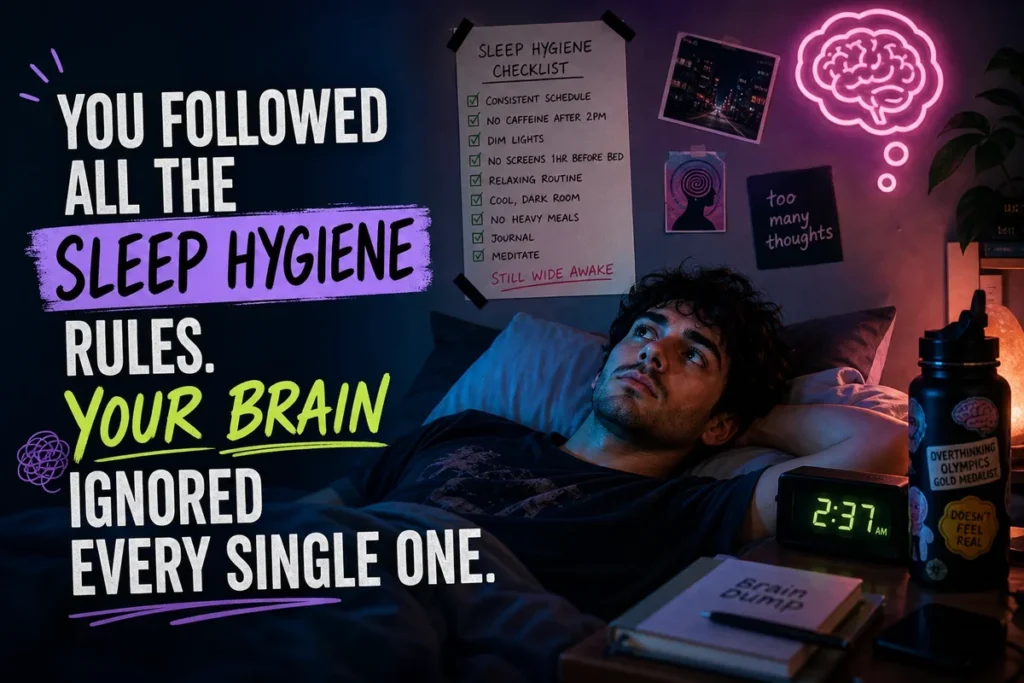
You’ve done it right. No screens after 9pm, bedroom kept cool, a consistent bedtime, caffeine cut off by noon. You followed the rules for a week, maybe two. And then you were still lying awake at 1am, brain fully online, completely unable to explain why none of it worked. The problem isn’t your commitment. The problem is that standard ADHD sleep advice was built for a biological system you don’t have. Sleep hygiene protocols, as conventionally taught, assume a neurotypical circadian system that is broadly functioning and just needs tidying at the edges. Effective ADHD insomnia treatment requires something fundamentally different, and the research is now clear enough on what that looks like.
Why Standard Sleep Hygiene Misses the Point
Sleep hygiene advice comes from good science. For the general population, habits like consistent wake times, limiting alcohol, reducing blue light exposure, and keeping the bedroom associated only with sleep genuinely improve sleep quality. A 2026 clinical review in the Journal of Clinical Psychiatry (Andrade, 2026) confirmed that sleep hygiene interventions, while necessary, are “usually not sufficient to effectively treat insomnia” even in neurotypical people. For ADHD brains, that insufficiency is dramatically amplified, because the advice targets behavioral patterns sitting on top of a neurological mismatch it never touches.
The mechanism matters here. Standard sleep hygiene assumes that your body’s internal clock, the circadian rhythm, is calibrated roughly correctly and just being disrupted by bad habits. In ADHD, the clock itself runs late. Not because of poor choices. Not because of screen addiction. Because of how dopamine pathways and clock genes are wired in the ADHD nervous system. Telling someone with a phase-shifted circadian system to simply go to bed earlier is like telling a left-handed person to write more neatly with their right hand. The instruction makes sense in theory. It just doesn’t address what’s actually happening.
What Is Actually Different in the ADHD Brain’s Clock?
Your body’s master clock sits in a structure called the suprachiasmatic nucleus, a small cluster of cells in the hypothalamus that coordinates nearly every biological rhythm in your body: sleep, temperature, cortisol, appetite, immune function. The suprachiasmatic nucleus runs on a set of clock genes, including PER and CLOCK, that cycle over roughly 24 hours. Research has identified that ADHD is associated with specific polymorphisms in both the CLOCK gene and the PER gene, genetic variants that produce a biological clock that runs systematically late (Carpena et al., 2019, Genes).
This isn’t a metaphor for night-owl preference. It shows up in the blood. The gold standard measurement for circadian phase is dim-light melatonin onset, or DLMO: the precise moment your pineal gland begins releasing melatonin, signaling to every cell in your body that the night has started. In adults without ADHD, DLMO typically occurs around 9 to 9:30pm. In adults with ADHD, research now consistently finds that onset is delayed by approximately 90 minutes. One comprehensive synthesis of the evidence on ADHD as a circadian disorder found that delayed sleep-wake timing occurs in up to 78% of people with ADHD, with DLMO delayed by around 45 minutes in children and approximately 90 minutes in adults.
Sleep disturbances affect up to 80% of adults with ADHD and up to 82% of children with ADHD. The delayed circadian phase, confirmed by biological markers rather than self-report alone, is among the most consistent neurobiological findings in the ADHD research literature.
The implications of this for sleep hygiene advice are significant. When your melatonin onset is shifted 90 minutes later than average, the instruction to “be in bed by 10:30pm” asks your brain to sleep before its night has begun. Your body temperature hasn’t dropped to its sleep-phase low yet. Cortisol is still elevated. Your brain is in its biological equivalent of mid-evening. Lying there trying to force sleep doesn’t just fail: it actively builds the association that your bed is a place of frustration, which makes the next night harder.
Is It a Phase Problem, a Hyperarousal Problem, or Both?
Delayed sleep phase explains why many ADHD adults can’t fall asleep before midnight regardless of how tired they feel. But it doesn’t explain the full picture on its own. A 2025 clinical guidance paper in CMAJ by Dey, Do, Almagor, and Khullar identified at least three distinct sleep problem profiles that overlap substantially in the ADHD population: delayed sleep phase syndrome, chronic insomnia with hyperarousal, and comorbid sleep conditions like restless leg syndrome and obstructive sleep apnea. These patterns have different underlying mechanisms and require different interventions. Treating them all with identical sleep hygiene recommendations is one reason so many ADHD people experience the same advice as useless.
The hyperarousal component deserves particular attention. Research using actigraphy, which objectively tracks movement and rest over multiple days, has found that adults with ADHD show greater day-to-day instability in their rest-activity rhythms compared to neurotypical controls. The ADHD nervous system doesn’t settle into the predictable biological rhythms that most sleep advice assumes. Cortisol rhythms are blunted and delayed. The pineal gland, which produces melatonin, appears reduced in volume in some ADHD populations. The norepinephrine system, which governs arousal and alertness, runs differently. The brain that struggles all day to modulate attention and inhibit impulses does not simply switch modes cleanly at bedtime because the lights are off.
From the community: “Please, tell me, do normal people just go ‘oh, it’s 10 PM, I gotta stop doing what I’m doing, I’ll go to bed, shut my eyes and I’ll be sleeping in a matter of few minutes or so’? It’s just… Abstract for me.”, r/ADHD thread
That experience, the sheer abstraction of simply deciding to sleep, captures something the biological research confirms. Going to sleep on cue is an executive function task: it requires time estimation, self-interruption, transition management, and arousal downregulation. Every one of those is an area where the ADHD brain tends to struggle structurally. Sleep hygiene advice does not address executive function. It assumes it.
What Does Work: Chronotherapy and the Evidence Behind It
The research on ADHD-specific sleep interventions centers on chronotherapy: working with the biology of the circadian system rather than against it. The two most evidence-supported approaches are timed melatonin and bright light therapy, and they work through different but complementary mechanisms.
Timed melatonin in ADHD sleep treatment is not the same as taking a sedating supplement. The clinical guidance that has emerged from the ADHD sleep literature recommends low-dose immediate-release melatonin, typically 0.5mg rather than the 5 to 10mg doses found in most pharmacy products, taken approximately three hours before desired sleep onset, with timing advanced gradually over three to four weeks (Dey et al., 2025, CMAJ). The goal isn’t sedation. It’s phase advancement: shifting the timing of your melatonin onset earlier so that your biological nighttime begins to align with your required social schedule. When melatonin is used this way, clinical trials in both children and adults with ADHD have demonstrated measurable shifts in DLMO and improved sleep onset timing. In at least one adult randomized clinical trial by van Andel et al. (2021, Chronobiology International), phase advancement correlated with self-reported improvements in ADHD-related functioning.
The dose matters enormously: Most over-the-counter melatonin is sold in 5 to 10mg doses, which is far higher than the clinical recommendation for circadian phase work. Higher doses don’t shift your clock further, they blur morning alertness and can worsen daytime fatigue. The low-dose timing protocol is about signaling the clock, not sedating the brain.
Bright light therapy targets the same mechanism from the morning side. The suprachiasmatic nucleus resets its clock primarily through light hitting the retina in the first hours after waking. Getting morning sunlight or using a bright light therapy lamp within an hour of waking sends the clock a clear anchoring signal. Multiple studies have demonstrated that bright light therapy advances DLMO in ADHD populations, and a comprehensive review on ADHD as a circadian disorder found that combining morning light therapy with timed melatonin produced more consistent phase advancement than either intervention alone.
The Medication Variable Nobody Addresses
ADHD medication adds a layer of complexity that standard sleep advice ignores entirely. Stimulant medications increase dopamine and norepinephrine signaling and can either help or worsen sleep depending on timing and dosing pattern. A dose taken too close to bedtime is an obvious issue. Less obvious is that insufficient stimulant coverage in the late afternoon can leave the ADHD brain under-regulated in the evening, producing the late-night mental acceleration that makes sleep onset extremely difficult. This creates a pattern where stimulants appear to be causing the sleep problem when the real issue is timing, not the medication itself.
The evidence on this is complex enough that it requires individual assessment with a prescriber rather than a general rule. What the research does confirm is that stimulant timing relative to sleep difficulty cannot be reduced to a simple cut-off point, because the same dose taken an hour later can have opposite effects in different individuals. Non-stimulant ADHD medications tend to carry a different sleep profile for some people, though effects vary. Emotional dysregulation, which sits at the intersection of ADHD and poor sleep, also contributes to the cycle: research connecting nocturnal awakenings with racing thoughts is one of the most consistent findings in the adult ADHD sleep literature, and accumulated executive function fatigue across the day tends to peak in the late evening, making self-regulation and wind-down harder precisely when it matters most.
Untreated sleep problems don’t just run alongside ADHD, they amplify it. Research by Kooij (2021, European Psychiatry) found that sleep deficiency in ADHD exacerbates core difficulties through cognitive impairment, memory disruption, and mood destabilization, with long-term consequences including increased obesity risk and broader health deterioration.
Comorbid Sleep Conditions That Often Go Undiagnosed
A significant proportion of ADHD adults carry an additional sleep condition they don’t know about. The 2025 CMAJ clinical guidance by Dey and colleagues reported that adults with ADHD show restless leg syndrome at a rate of approximately 30% and obstructive sleep apnea at 20 to 30%, both substantially higher than the general population. Restless leg syndrome, the uncomfortable urge to move the legs that intensifies during rest, may share a dopaminergic mechanism with ADHD, which is one reason both conditions involve overlapping neurochemistry. Obstructive sleep apnea, where breathing repeatedly pauses during sleep, fragments sleep architecture in ways that directly worsen attention, working memory, and emotional regulation: the same areas of difficulty that define ADHD.
Neither of these conditions is addressed by any sleep hygiene protocol. Someone following every recommendation in the book, no screens, cool room, consistent schedule, will still wake up cognitively impaired and emotionally depleted if they have untreated sleep apnea. Clinical experts recommend that any ADHD adult with persistent sleep problems that don’t respond to behavioral or chronotherapy approaches be screened for these conditions using validated tools, including the Epworth Sleepiness Scale, the Insomnia Severity Index, and the STOP-Bang questionnaire for sleep apnea screening (Dey et al., 2025, CMAJ).
What Actually Replaces the Standard Advice
The neurodivergent sleep framework isn’t a rejection of every conventional sleep recommendation. Some elements remain valid across populations: alcohol and cannabis genuinely disrupt sleep architecture and contribute to non-restorative sleep even when they feel sedating. Reducing very late caffeine intake matters. Creating a bedroom environment associated with sleep rather than work and anxiety is worth doing. The difference is where the emphasis goes, and what it adds.
For ADHD brains, the hierarchy of interventions that carry actual evidence looks like this. First: address your clock, not just your habits. Morning light exposure is free, takes five minutes, and is one of the most potent circadian anchoring tools available. If you’re not getting outside within an hour of waking, that’s the most underused lever in ADHD sleep management. Second: evaluate your medication timing with your prescriber, framing the question explicitly around sleep onset rather than just daytime symptom coverage. Third: if delayed sleep phase is the primary presentation, discuss low-dose timed melatonin as a phase-shifting tool rather than a nightly sedative. Fourth: if chronic insomnia with hyperarousal is the main issue, cognitive behavioral therapy for insomnia (CBT-I) carries the strongest long-term evidence for insomnia treatment and is a more appropriate starting point than sedative-hypnotic medication, though CBT-I often needs adaptation for the executive function challenges that come with ADHD.
One thing that consistently does not work: trying to force an earlier bedtime without shifting your circadian phase first. Going to bed at 10pm when your melatonin doesn’t rise until 12:30am doesn’t teach your body to sleep earlier. It teaches your body that your bed is the place where you lie awake feeling anxious about not being asleep.
The summer schedule collapse many ADHD adults experience right now, with unstructured days, no fixed commitments pulling them out of bed, and screens available at 3am, is exactly the environment that allows a phase-shifted clock to drift further out of alignment with the social world. External structure had been compensating for an internal timing problem that was there all along. Without it, the clock does what it was always going to do. Understanding that isn’t an excuse. It’s the starting point for building an approach that fits your neurology rather than fighting it.
The Bidirectional Loop and Why Treatment Sequencing Matters
A feedback relationship between ADHD and sleep dysfunction makes the whole picture harder to disentangle. Poor sleep worsens inattention, impulsivity, and emotional dysregulation. Harder-to-regulate ADHD traits make sleep onset more difficult. Difficult sleep onset increases the pull toward stimulating late-night activities that feel like the only available source of reward and calm. Which worsens sleep further. This loop is documented, and it’s the reason so many ADHD adults describe themselves as both exhausted and unable to stop being awake.
Treatment sequencing matters in ways that rarely get discussed. Treating ADHD first while ignoring sleep can mean that medication adjustments never reach their full potential, because cognitive impairment from sleep deprivation masks treatment response. Treating sleep first without addressing ADHD means trying to implement behavioral changes with a brain specifically impaired in the areas those changes require: planning, self-regulation, consistency, and acting on delayed reward. The emerging clinical consensus is that these need to be addressed in parallel, with sleep formally screened as part of initial ADHD evaluation rather than treated as a separate problem that can wait.
If you’ve followed every sleep tip and felt like you were the problem, you weren’t. You were applying a reasonable framework to the wrong biology. The research on ADHD sleep has moved substantially in the last decade, and it points clearly toward an approach built on understanding your circadian neuroscience rather than overriding it. The way your body’s systems connect in ADHD runs deeper than most clinical protocols address, and sleep sits at the center of almost all of it. The version of sleep hygiene written for your brain looks different from the version in the wellness articles. It starts with what’s actually different about your clock, and it builds from there.
The goal isn’t perfect sleep hygiene. It’s a framework that accounts for delayed melatonin onset, dysregulated arousal, dopamine-driven nighttime activation, and the executive function demands of actually ending the day. That’s a different problem. It has different solutions.
For more on how circadian patterns interact with ADHD energy, burnout, and nervous system recovery, the ADHD energy pillar maps the connections between dysregulation, exhaustion, and recovery in ways that sleep alone can’t fully resolve.
Quick Dopamine Hits:
- Tonight, dim all overhead lights and switch to lamps or warm-toned bulbs 90 minutes before your target bedtime, this is the single highest-leverage light intervention for shifting your body clock earlier.
- Set a ‘screens off’ alarm 45 minutes before bed, then fill that gap with something low-stimulation you actually enjoy, an audiobook, a podcast, a drawing app, rather than forcing yourself to sit in silence.
- Tomorrow morning, get outside or sit by a bright window within 30 minutes of waking. Even five minutes of morning daylight helps anchor your body clock, and it costs nothing.
Rate this article
Was this a useful hit?