Your Brain Wants Routine AND Novelty at the Same Time — That’s the AuDHD Trap Nobody Talks About

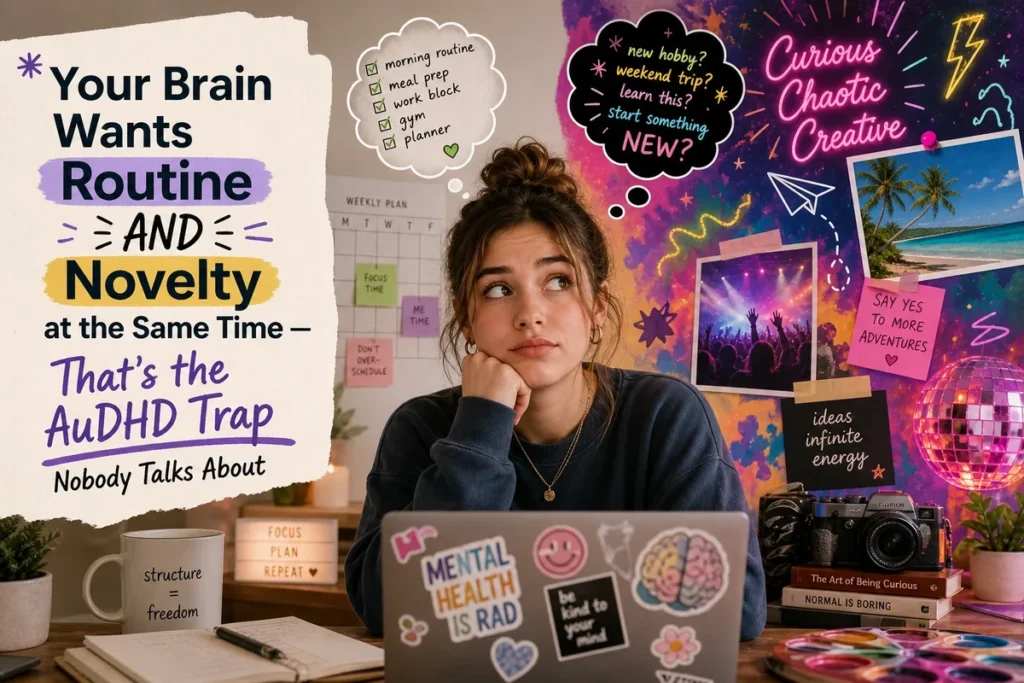
If you have AuDHD, you have probably spent years suspecting that you are uniquely, specifically bad at being a person. You know you need structure. You build it. Then something in you dismantles it within days, not from laziness but from a kind of neurological restlessness you cannot override. Then the chaos becomes too much, and you rebuild the structure again. The cycle repeats. What nobody has told you is that this is not a failure of willpower or a character flaw. It is a structural brain conflict that sits at the very centre of what AuDHD actually is: your autistic nervous system is biologically oriented toward sameness, predictability, and routine, while your ADHD nervous system is biologically oriented toward novelty, stimulation, and change. Both drives are real. Both are neurological. And they are not taking turns. They are running simultaneously, pulling in opposite directions, and they will keep doing so until you understand the mechanics of what is actually happening inside your brain.
Why This Is a Neuroscience Problem, Not a Personality Problem
The conflict between autism and ADHD is not a metaphor. It is the result of two distinct neurological profiles sharing the same brain, each with its own regulatory logic, each demanding a different environment in order to function.
Autistic brains, as research consistently documents, use predictability as a regulatory tool. When the environment is known and sequenced, the sensory and cognitive processing load drops significantly. The autistic nervous system actively monitors for deviations from expected patterns, and when those deviations arrive unannounced, the system responds with dysregulation. The DSM’s criteria around restricted and repetitive patterns of behaviour, including insistence on sameness, strict adherence to routines, and distress at small changes, reflect not a preference but a functional coping mechanism. Cognitive inflexibility in autism has been linked to dysfunction in cognitive control circuits including the anterior cingulate cortex, a brain region responsible for updating expectations and managing environmental change (reviewed in neurodevelopmental comorbidity literature, 2025).
The ADHD brain operates from a fundamentally different neurological demand. Dopamine dysregulation in ADHD produces underarousal in reward-related circuits, particularly in the nucleus accumbens and midbrain dopamine pathways. Research using positron emission tomography has shown decreased function in the dopamine reward pathway in adults with ADHD, with that reduction directly correlated with motivation deficits (Volkow et al., reported in motivation deficit literature).1 The ADHD brain responds to chronic underarousal by seeking novelty, urgency, and stimulation: the things that reliably generate a dopamine response when the baseline system is running low. Put plainly, routine to an ADHD brain is not comfort. Routine is the absence of dopamine.
The autistic nervous system treats predictability as safety. The ADHD nervous system treats predictability as starvation. In AuDHD, both systems are running at full volume, and neither one is wrong.
This is not a soft incompatibility. It is a collision between two regulatory systems with opposing core requirements, operating inside the same brain at the same time. And it has a specific daily signature that most people with AuDHD recognise immediately.
What Does the AuDHD Routine Conflict Actually Look Like Day to Day?
The routine-novelty war rarely announces itself as a neurological conflict. It shows up as a pattern that looks, from the outside, like inconsistency or poor follow-through. You start a morning routine and feel, for a few days, genuine relief at the predictability. Your autistic nervous system relaxes because it knows what comes next. Then the ADHD begins its campaign. The routine starts feeling suffocating. Not difficult exactly, but draining in a specific way, like a slow bleed of life from something that was helping you two days ago. You make one small change. Then another. Then you miss a day, the structure collapses, and the relief at the chaos lasts approximately forty-eight hours before your autistic nervous system begins its distress signal: too unpredictable, too much to process, where did the sequence go?
Research published in Health (Craddock, 2026), using interpretative phenomenological analysis with women who received both diagnoses in adulthood, documented this exact dynamic with striking clarity. One participant described her daily experience in terms that have since resonated widely in AuDHD communities because they name the thing so precisely:
“My autism creates a need for order, formality, structure, routines, repetition, solitude, and intense interests, all of which are disrupted by my ADHD’s chaotic impulse towards newness, variety, inconsistency, and inattention. So I am forever starting routines and habits [autism] but I can never stick to them because I lose motivation and get bored [ADHD].”
What is significant here is not just the frustration but the clarity. This person understands exactly what is happening. They are not confused about their needs. They are caught between two legitimate neurological demands that cannot simultaneously be satisfied by any single structural approach. The problem is not self-knowledge. The problem is that no existing framework for managing daily life was built for this specific collision.
The conflict shows up across multiple domains. In work, it produces a pattern of designing elaborate systems and then abandoning them when the novelty wears off, not from carelessness but from genuine dopamine withdrawal. In relationships, it means needing to know plans far in advance while also spontaneously wanting to abandon those plans because the predictability has become unbearable. In rest and recovery, it means that too little structure feels unsafe while too much structure feels suffocating, producing a narrow corridor of tolerable daily life that is extremely difficult to maintain.
The diagnostic history matters here: Before the DSM-5 update in 2013, clinicians were not permitted to diagnose autism and ADHD in the same person. The assumption was that the two conditions were mutually exclusive. As a result, many people received only one diagnosis and spent years failing at advice designed for a neurological profile they only partly had.
Why You Feel Like Two Different People
One of the least-discussed consequences of the routine-novelty conflict is what it does to identity. Research by Craddock (2026) found that AuDHD adults frequently described their internal experience not as one integrated person with complex needs, but as two separate parts of a brain operating as internally autonomous agents. One participant described it as having “two separate parts of my brain, the autistic part and the ADHD part.” Another found it “difficult to articulate my AuDHD experience and identity in a holistic way.”
This is not simply a metaphor for conflicting preferences. It reflects the lived experience of a nervous system that sends fundamentally incompatible directives within the same hour. You want to stay in. You want to go out. You want the plan to be set in stone. You want the plan to be abolished. You spend the morning feeling grateful for the structure you built and the afternoon feeling trapped by it. Neither response is irrational. Both are neurologically driven. But from the inside, the experience produces a fragmented sense of self that is exhausting and deeply disorienting.
This fragmentation is compounded by the fact that most identity resources, whether therapeutic, clinical, or community-based, are built around one condition. Autistic community spaces tend to emphasise and celebrate sameness, deep interest, and the value of predictable environments. ADHD community spaces tend to celebrate novelty-seeking, creative chaos, and the joy of the next hyperfocus. Both feel partially true and partially wrong for someone who is both. You end up feeling like you fit nowhere completely, which Craddock’s research framed as the experience of inhabiting a “liminal diagnostic space” with no established cultural narrative to draw from.
The AuDHD identity challenge is therefore not simply “which condition am I more?” It is the deeper question of how to hold a coherent sense of self when your brain’s regulatory systems are in structural disagreement about what kind of environment, what kind of day, and what kind of life actually fits you.
Is It Possible to Want Both? Yes. That Is Exactly the Point.
A common response to learning about the AuDHD conflict is to ask which need is really dominant. The assumption is that if you work out whether you are more autistic or more ADHD, you can prioritise accordingly and build a life around the dominant profile. This approach consistently fails, and the reason why is worth understanding at a neurological level.
The needs do not alternate. Both are present all the time. The autistic nervous system’s requirement for predictability does not go offline when the ADHD is seeking stimulation. The ADHD’s dopamine-seeking does not pause when the autistic system is demanding sameness. What changes is which need is being more acutely frustrated in a given moment, which is why the experience can shift so rapidly from craving more structure to finding the existing structure unbearable.
Chang (2024, Berkeley Scientific Journal) framed this as a tug-of-war: ADHD pulling toward novelty, energy, and stimulation, autism pulling toward repetition, predictability, and sameness. What makes AuDHD distinct is not that these two forces trade off, but that they run simultaneously, which is why trying to satisfy one completely tends to create an acute crisis in the other within hours or days.
From the community: “My autism creates a need for order, formality, structure, routines, repetition, solitude, and intense interests, all of which are disrupted by my ADHD’s chaotic impulse towards newness, variety, inconsistency, and inattention. So I am forever starting routines and habits [autism] but I can never stick to them because I lose motivation and get bored [ADHD].”, r/ADHD thread
The Inertia Problem: When Both Systems Freeze at Once
The routine-novelty conflict does not only create oscillation between structure and chaos. It also produces a third state that many AuDHD people describe as the most disabling of all: complete paralysis. When the autistic nervous system is demanding predictability that the ADHD has already destroyed, and the ADHD is demanding stimulation that the dysregulated autistic system cannot tolerate, the result is a freeze state where neither direction feels accessible.
Research on autistic inertia describes this as Newton’s first law in neurological form: a body at rest tends to stay at rest, a body in motion tends to stay in motion. For AuDHD people, the inertia problem is specifically amplified by the interaction between the two conditions. A 2026 study analyzing inertia across autistic and AuDHD adults found that participants described ADHD novelty-seeking and autistic need for predictability as directly clashing in their experience of getting stuck, producing a state where everything feels simultaneously too boring to start and too uncertain to approach. The result is that nothing happens, and the stuckness deepens.
This differs from the ADHD paralysis that comes from executive dysfunction alone, and it differs from the autistic inertia that comes from transitioning between tasks. It is a third kind of stuck that is specific to the interaction between the two conditions, and which standard task-initiation strategies rarely address because those strategies were designed for one neurological profile at a time.
You may recognise this as the hours spent knowing exactly what you need to do, having adequate time, and being completely unable to begin. Not because you are bored (the ADHD would have something to say about that) and not because the task is too unpredictable (the autistic system would have resolved that by now), but because both systems are gridlocked. Understanding this as a structural feature of AuDHD, rather than evidence of personal failure, is one of the more useful reframes available.
What Gives When Advice Is Written for One Condition
The practical consequence of the routine-novelty conflict is that almost all mainstream advice about building daily structure tends to fail AuDHD people in predictable ways. Advice written for autistic people tends to recommend more rigidity, more sameness, more detailed scheduling. This can satisfy the autistic nervous system for a while and then trigger the ADHD acutely. Advice written for ADHD tends to recommend more novelty, more variation, more flexibility in systems. This can satisfy the ADHD temporarily and then send the autistic nervous system into dysregulation.
Neither failure is random. Both are entirely predictable once you understand what is happening at the neurological level. The advice is not wrong for the audience it was written for. It is wrong for an audience that is simultaneously both.
This is why, as Craddock (2026) noted, participants in her research had developed a specific kind of self-knowledge: they could articulate exactly what each part of their neurology needed, without being able to apply that knowledge effectively to their daily lives. The problem was not information. The problem was the absence of a framework that took both needs seriously at the same time, rather than treating one as the real need and the other as a complication.
Knowing what you need is not the same as having a system that delivers it. For AuDHD people, the gap between those two things can last decades.
The specific failure mode that matters most for daily life is what happens to identity over time. When someone repeatedly builds routines and fails to maintain them, the cultural narrative they have available is almost always “I am bad at follow-through.” When someone repeatedly disrupts their own carefully constructed systems, the available narrative is usually “I am self-sabotaging.” Neither narrative is accurate. Both create shame that compounds the original neurological difficulty. Building a more accurate narrative, one grounded in the actual structural conflict happening in the brain, is not optional for long-term wellbeing. It is the foundation that everything else builds on.
The Masking Layer That Makes This Worse
For people who received a late discovery of autism, ADHD, or both, the routine-novelty conflict has typically been running for years underneath a layer of masking. Autistic masking involves suppressing or camouflaging autistic traits to appear more neurotypical, including suppressing the need for sameness, pushing through sensory and environmental demands, and performing flexibility that the nervous system cannot actually sustain. ADHD masking involves concealing impulsivity, suppressing the need for stimulation, and performing sustained engagement with routine and structure that the dopamine system cannot actually maintain.
When both are present, the masking load doubles. The AuDHD person who looks functional from the outside is frequently managing the autistic drive for sameness, the ADHD drive for novelty, and the social pressure to appear to have neither. This is why many late-discovered AuDHD adults describe a specific kind of exhaustion that preceded their diagnosis by years: not the exhaustion of a busy life, but the exhaustion of performing a person who has entirely different neurological needs than the person being performed.
The masking also explains why the conflict can be difficult to notice from the inside until it produces a crisis. If you have spent years learning to suppress the signals from both nervous systems simultaneously, the internal war becomes background noise. You are not aware of craving structure. You are not aware of craving novelty. You are only aware that something is perpetually wrong, that you feel perpetually inadequate, and that the advice other people seem to find useful reliably does not work for you.
Medication adds another layer of complexity: Research indicates that stimulant medications effective for people with ADHD alone can have paradoxical effects in people with co-occurring autism, sometimes increasing irritability or other difficulties (Chang, 2024, Berkeley Scientific Journal). This is one reason AuDHD people often need more careful and individualised medication review, and why a prescriber who only knows one half of the diagnosis may miss the other half’s response entirely.
Toward a Framework That Holds Both Needs
Understanding the AuDHD routine-novelty conflict as a structural brain problem rather than a personality trait does not resolve the conflict. But it changes what kind of solution is worth looking for. Strategies that try to satisfy one need at the expense of the other will keep failing in the same predictable ways. Strategies that try to hold both needs simultaneously, even imperfectly, tend to produce more durable outcomes.
The core principle is not balance in the sense of giving each system exactly equal weight. It is the recognition that the autistic nervous system needs to be able to predict the shape of a day without needing every element of it to be identical, and that the ADHD nervous system needs novelty to exist within that shape rather than replacing it. In practice, this often means distinguishing between the architecture of a routine and the content that fills it. The sequence can be predictable, what happens inside each slot can vary. The time can be fixed, the activity can rotate.
It also means building genuine tolerance for the oscillation itself. An AuDHD person will sometimes find their routine unbearable and will sometimes find chaos unbearable. This is not a sign that the system is broken. It is the expected signature of two neurological systems with competing needs. The goal is not to eliminate the oscillation but to have a plan for both states, so that the switch from “the routine is essential” to “the routine is suffocating” does not require burning the whole structure down and starting from scratch.
A useful framing comes from research into AuDHD burnout recovery, which describes the goal as cultivating rhythms that offer enough novelty to engage the ADHD brain and enough predictability to soothe the autistic nervous system. Neither alone is sufficient. Both together are what actually works. Building a low-friction daily system that genuinely accounts for this requires accepting the paradox rather than resolving it, and designing around the gap rather than hoping it will eventually close.
The Conflict Is Real. You Are Not Making It Harder Than It Is.
The AuDHD routine-novelty trap is one of the least-named features of a condition that is itself still relatively new in clinical and community consciousness. Most people who live with it arrive at the pattern through years of failing at strategies that should work, being told they are not trying hard enough, and eventually constructing a private theory that they are somehow uniquely incompatible with functional daily life.
They are not. They have a brain running two legitimate regulatory systems that are in structural conflict. They have been offered advice designed for one of those systems. They have been evaluated against standards that assume a brain with a single dominant neurological drive. And they have been doing the invisible labour of managing both needs without a language for what is actually happening.
Naming the conflict accurately is not a small thing. Craddock’s (2026) research found that AuDHD adults actively sought objective understanding of their conditions as a way of resolving the ambivalence that came from inhabiting a diagnostic space with no formal name or established framework. Understanding what your brain is actually doing does not stop the conflict. But it stops the shame spiral that turns a neurological problem into a verdict about who you are. And that is where everything else begins.
Quick Dopamine Hits:
- Pick one fixed anchor in your day, same time, same location, and let everything else be variable. The anchor tells your autistic nervous system ‘this is safe’ while the open structure gives your ADHD room to move.
- When you feel the urge to blow up your routine, pause for ten minutes before acting. Ask: is this the ADHD needing novelty, or is the routine genuinely wrong? Often the urge passes, if it does not, change one element rather than the whole system.
- Design novelty within sameness: keep the same morning sequence but rotate the content inside it, such as a different podcast or breakfast, while preserving the same order of events. Both nervous systems get something without either one winning outright.
Rate this article
Was this a useful hit?