Your Brain Stopped Feeling Excited About Your Partner. That Doesn’t Mean the Relationship Is Over.

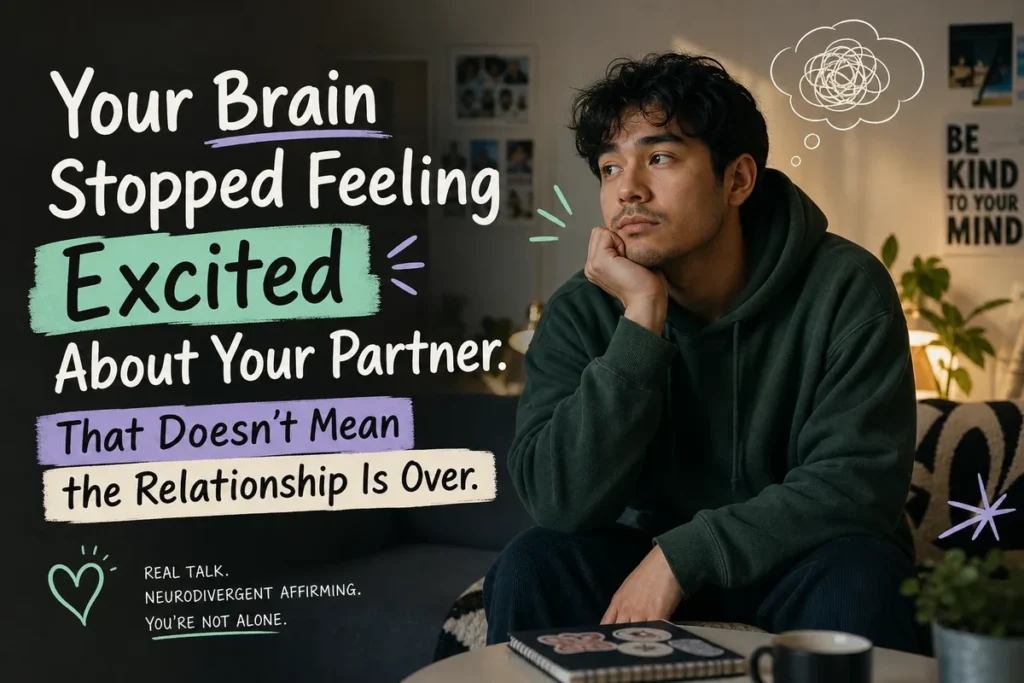
You woke up one morning and the feeling was just gone. Not dramatically, no fight, no betrayal, no obvious turning point. The person next to you is objectively fine. Thoughtful, reliable, genuinely good. And yet something in you feels flat, restless, or quietly suffocated. You start wondering if you are falling out of love, or if you never really were in it. Then, about twenty minutes later, a notification comes in from someone new, and your brain lights up like it got a shot of something warm. If you have ADHD, this experience is not a verdict on your relationship. It is a window into how your dopamine system actually works, and learning to read that window correctly might be one of the most important relationship skills you ever develop.
The ADHD Brain Is Not Designed for Steady States
Most relationship advice assumes that genuine love feels consistent: warm, stable, quietly sustaining. For neurotypical nervous systems, that description is roughly accurate. For ADHD brains, it is almost pharmacologically impossible. Research using positron emission tomography has found measurably decreased function in the dopamine reward pathway in adults with ADHD, specifically in the midbrain and nucleus accumbens, the brain regions most responsible for motivation and the anticipation of reward (Volkow et al., 2011, Molecular Psychiatry). Lower dopamine receptor availability in those regions correlates directly with lower trait motivation. This is not a personality issue. It is structural.
What this means in a relationship context is that the ADHD brain often cannot generate the same sustained sense of reward from a stable, familiar situation that other brains can. The ventral tegmental area, which drives the brain’s “wanting” system, responds most intensely to novelty and unpredictability. A new relationship offers both in abundance: unknown outcomes, exciting firsts, unpredictable texts, a still-forming impression. Established relationships, by design, reduce novelty. They become safe. And safety, to the dopamine-depleted ADHD brain, can register as something dangerously close to numbness.
The ADHD brain is not falling out of love. It is running out of the neurochemical fuel that made the early relationship feel so electrically alive, and mistaking that depletion for a signal about the relationship itself.
What Does the Research Say About ADHD and the Novelty Cliff?
A 2026 study published in the Journal of Marital and Family Therapy surveyed 355 adults with ADHD about their romantic relationship experiences. The findings were striking in their honesty. One of the study’s core themes, which the researchers titled “The Struggle for Stability: ADHD’s Battle Between Passion and Distraction,” documented how participants repeatedly described the same internal arc: intense engagement in the early stages of a relationship, followed by a pull toward novelty once the initial intensity faded (O’Brien et al., 2026). One participant put it plainly: “Got bored easily and moved on looking for something new.” Others described feeling genuinely committed to their partner while simultaneously being pulled toward stimulation elsewhere. Some participants noted explicitly that this pattern “was not indicative of a lack of commitment.” They understood intellectually that the relationship was good. Their nervous system had simply stopped generating the signal that felt like proof.
This is the core confusion in ADHD dating: adults with ADHD often interpret the absence of a neurochemical high as the presence of a relationship problem. The two can coincide, but they do not have to, and treating them as equivalent leads to a string of relationships that all follow the same arc, intense beginning, quiet fade, restless exit, without ever naming what is actually driving the cycle.
The novelty cliff is predictable: For many ADHD brains, the initial hyperfocus on a new partner begins fading somewhere between a few months and a couple of years into a relationship, roughly the same window in which early-stage neurochemical intensity cools for everyone. ADHD brains often feel that drop more acutely, and can misread it as a relational signal rather than a neurological one.
Does Your Brain Want Someone New, or Just Something New?
This is the question that most relationship articles never ask precisely enough. The ADHD interest-based nervous system, a term used by psychiatrist William Dodson to describe the ADHD motivational architecture, does not run on importance or commitment. It runs on novelty, challenge, urgency, passion, and competition. When those inputs are absent, the system goes quiet. Critically, the system going quiet about a relationship is not the same as the system telling you the relationship is wrong. It means the relationship has become familiar. Familiar is not a synonym for finished.
The question to sit with is not “do I feel excited about my partner right now?” because ADHD will reliably answer “not particularly” about most things that do not currently have a dopamine hook. The more useful question is: “Is my brain flat about everything, or specifically about this person?” Because ADHD dopamine depletion tends to be non-specific. It shows up as a general restlessness, a scanning quality, an inability to feel satisfaction in anything that is not new. If you are also flat about your job, your hobbies, your friendships, and your apartment, the flat feeling about your partner is part of a larger neurological pattern, not a relationship verdict. If you feel alive and engaged in every other area of life except when you are with this person specifically, that is a different conversation.
What Does Genuine Incompatibility Actually Feel Like?
Dopamine flatness and genuine incompatibility are not the same experience, and they tend to produce different internal signatures once you know what to look for. Dopamine flatness tends to feel like restlessness, a vague dissatisfaction, a sense that something is missing without a clear name for what. It often lifts temporarily when the relationship gets novel again, during a trip, a conflict, a significant event, a period apart. The relationship becomes interesting again, and the feelings return with enough intensity to feel real. That cycling quality is a sign of dopamine dynamics at work.
Genuine incompatibility tends to feel different. It shows up not as restlessness but as something more specific: a chronic mismatch in values, a recurring sense of not being seen or understood, a pattern of conflict that does not resolve because it touches something fundamental about who both people are. It does not lift on a vacation. It follows you. Research on ADHD and relationships notes that emotional dysregulation and rejection sensitivity are significant factors in how adults with ADHD experience conflict, meaning that ADHD brains can amplify incompatibility signals, interpreting normal relationship friction as evidence of fundamental wrongness. This matters because it cuts both ways: ADHD can make you feel more disconnected than you are, and it can also mask genuine disconnection behind the easier explanation of “this is just my brain doing its thing.”
One participant in O’Brien et al. (2026) described their ADHD-related inattentiveness in a way that illuminated both sides of this confusion: “issues staying focused while being intimate caused partner to query if I was even interested or thinking of someone else.” This sits at exactly the intersection this article is navigating. The ADHD partner was present. Their attention just could not stay there.
The Role of Emotional Dysregulation in Misreading the Signal
Emotional dysregulation in ADHD is not just about getting upset quickly. It also affects how emotional information is processed and stored over time. Research has found that poor emotional self-control in adults with ADHD adds measurably to relationship impairment, above and beyond core inattentive and hyperactive-impulsive traits (Barkley and Murphy, 2010). What this means practically is that ADHD adults are more likely to respond to the emotional texture of a relationship moment than to its actual context. A conversation where you feel unheard can register as “this relationship is wrong” when it might mean “I am dysregulated right now and my partner said something in a way that triggered my rejection sensitivity.”
Rejection sensitive dysphoria compounds this further. If your partner expresses frustration, disappointment, or even mild criticism, the ADHD nervous system can interpret that as a signal that the relationship is fundamentally unsafe or incompatible. The emotional intensity of that interpretation feels true in the moment. It can generate a genuine impulse to leave, to pursue someone new, to find a relationship that “does not feel this hard.” The problem is that the interpretation is being generated not by the relationship’s actual quality but by a misfiring threat-detection system. Understanding this does not mean you have to stay in every relationship. It means you need to be cautious about which data you are trusting when you make that assessment. The ADHD relationships pillar covers more on how rejection sensitivity specifically reshapes how we read our partnerships.
From the community: “Does your poor attention make you doubt your own memories?”, r/ADHD thread
This question, which gathered thousands of upvotes in r/ADHD, points at something deeply relevant to relationship decisions: ADHD attention gaps do not just affect tasks. They affect the reliability of your emotional record. When you are trying to decide whether you are genuinely unhappy in a relationship, your memory of how good or bad it has been is filtered through a brain that pays inconsistent attention and stores emotionally charged moments more vividly than mundane, stable ones. The good weeks may genuinely not feel accessible. This is not distortion in a psychiatric sense. It is a structural feature of how ADHD memory works.
How to Actually Tell the Difference
No article can tell you whether to stay or go. What it can offer is a more reliable diagnostic framework than “I do not feel excited anymore.”
Start by tracking the flatness over time rather than diagnosing it in the moment. ADHD emotional states shift quickly and dramatically. A feeling that arrives on a Tuesday and feels like the final word often looks very different by Thursday. If the feeling of disconnection from your partner persists across multiple weeks, across mood states, across different contexts including ones where novelty has been introduced, that is more meaningful data than any single afternoon of restlessness.
Notice whether the feeling is about your partner’s specific qualities or about the absence of stimulation. The ADHD brain can be deeply attracted to novelty alone, the idea of a new relationship, a new person, a new beginning. That attraction is real. But it is not the same as evidence that your current relationship is wrong. Ask yourself honestly: is there a specific quality of this person, a values conflict, a recurring dynamic, a pattern of disrespect or mismatch, that you can name concretely? Or is the primary complaint that things feel predictable? Predictability is not incompatibility. It is often just ADHD signalling that it needs more input.
Also watch what happens when the relationship gets novel again. Plan something genuinely new together. Travel somewhere unfamiliar. Break a routine that has calcified. If the feelings return with some authenticity, you have useful information about what has been driving the flatness. If even novelty does not restore any sense of connection, that matters differently.
The participant in O’Brien et al. (2026) who said they were “always distracted and looking for something new” was not describing a broken relationship. They were describing a brain without a sufficient stimulation baseline, and they were acting on it in ways that caused damage they later recognized as unnecessary.
The Hyperfocus Honeymoon and What Comes After
ADHD dating often begins with something that can feel almost supernatural. The hyperfocus phase, in which the ADHD brain locks onto a new partner with near-obsessive intensity, produces an early relationship that feels extraordinary from both sides. Texts answered in seconds. Plans made with creativity. An attentiveness that makes the other person feel uniquely important. This phase is real and the feelings it generates are real. But it is also neurologically unsustainable in its initial form, and its ending is not evidence that the relationship was built on illusion.
When the hyperfocus lifts, the ADHD brain does not downgrade to neutral. It can swing toward something that reads like indifference. The partner who once felt like the center of the universe can start feeling like ambient noise. This is not the relationship becoming bad. It is the relationship becoming familiar, and familiar, for an ADHD nervous system that was running on hyperfocus fuel, can feel like a crash. The research published by O’Brien et al. in 2026 found that this pattern was one of the most consistently reported relational experiences across the 355 adults with ADHD surveyed: intense early engagement followed by a pull toward novelty and the genuine challenge of sustaining investment once routine set in.
Understanding this arc does not make the post-hyperfocus flatness feel less real. But it does reframe what the flatness means. It is a transition, not an ending. And it is a transition that many ADHD adults have mistaken for a signal to leave before giving the relationship a chance to find a different, more sustainable rhythm.
Worth knowing: Adults with ADHD report notably higher rates of relationship instability across research studies. But research also consistently shows that ADHD-specific self-awareness and psychoeducation substantially improve relationship outcomes, suggesting that instability is driven more by misunderstanding the neurological dynamics than by any inherent incompatibility between ADHD brains and long-term partnership.
When the Restlessness Is Telling You Something Real
It would be dishonest to frame every relationship exit as ADHD getting it wrong. Sometimes the dopamine shift coincides with a genuine recognition, a clarity that arrives once the initial neurochemical intensity has cleared and you can see the relationship more accurately. Some people spend years in relationships sustained primarily by the ADHD brain’s hunger for novelty and stimulation, where the actual compatibility was never strong. The hyperfocus phase can mask significant values mismatches, communication failures, and fundamental differences in what both people want. When that phase ends, what is left might genuinely not be enough.
The signal that distinguishes this from plain ADHD restlessness tends to be specificity. Genuine incompatibility can usually be named. There are concrete things: a difference in how both people handle conflict that has never resolved, a mismatch in values around family or intimacy or ambition that surfaces repeatedly, a pattern where one person consistently feels unseen or dismissed regardless of how clearly they try to communicate. These are not the ambient restlessness of a dopamine-depleted brain scanning for stimulation. They are specific, consistent, nameable patterns that do not shift when the relationship gets novel again.
Self-awareness about ADHD also matters here in a way that often goes underdiscussed. Participants in the O’Brien et al. (2026) study who understood their ADHD were far better positioned to distinguish neurological patterns from relational ones. One participant described being in a relationship for the first time where they “don’t have to pretend my way through the day,” not because novelty was sustaining them, but because genuine compatibility was. That kind of recognition requires knowing what the neurological noise sounds like, so you can hear what is underneath it. The ADHD identity pillar covers this self-knowledge work in depth, particularly for adults who have only recently come to understand how ADHD has shaped their relationship patterns.
A Framework for the Moment You Are In Right Now
If you are sitting with uncertainty about whether what you are feeling is a dopamine shift or a real signal, a few questions are worth sitting with deliberately rather than answering in the middle of a flat mood. First: does this feeling persist across multiple weeks and mood states, or does it come and go with your overall dopamine levels? Second: can you name something specific and concrete about this person or dynamic that is not working, or is the complaint primarily about intensity and stimulation? Third: when you imagine leaving this relationship, what is the feeling you are moving toward, genuine relief, or the idea of novelty? Those three questions do not give you the answer, but they give you better data than “I do not feel it anymore.”
ADHD dating and long-term partnership carry a genuine neurological load that most relationship frameworks do not account for. The dopamine system that creates such challenges in structured environments also shapes what intimacy feels like, how interest sustains itself over time, and what the brain interprets as a signal worth acting on. Understanding that system, with enough clarity and honesty to use it as a lens rather than a lever, is not easy work. But it is work that can save you from leaving something real because your brain ran out of novelty, and from staying in something that is not working because “maybe it is just my ADHD.”
Both mistakes are common. Both are correctable. The correction starts by learning to tell the difference.
Quick Dopamine Hits:
- Write down three specific things your partner does that no one else in your life does. If you struggle to name them, that is data. If they come quickly, so is that.
- Notice whether the flatness you feel is global — affecting your hobbies, friendships, and work too — or specifically relational. Global flatness usually points to dopamine depletion, not a bad relationship.
- Before any major conversation with your partner, wait 48 hours from the moment you first feel the urge to ‘have a talk.’ ADHD emotional urgency peaks and often shifts significantly in that window.
Rate this article
Was this a useful hit?