Your ADHD Strengths Are Real. So Is the Trap of Saying Yes to Everything That Feels Like Dopamine.

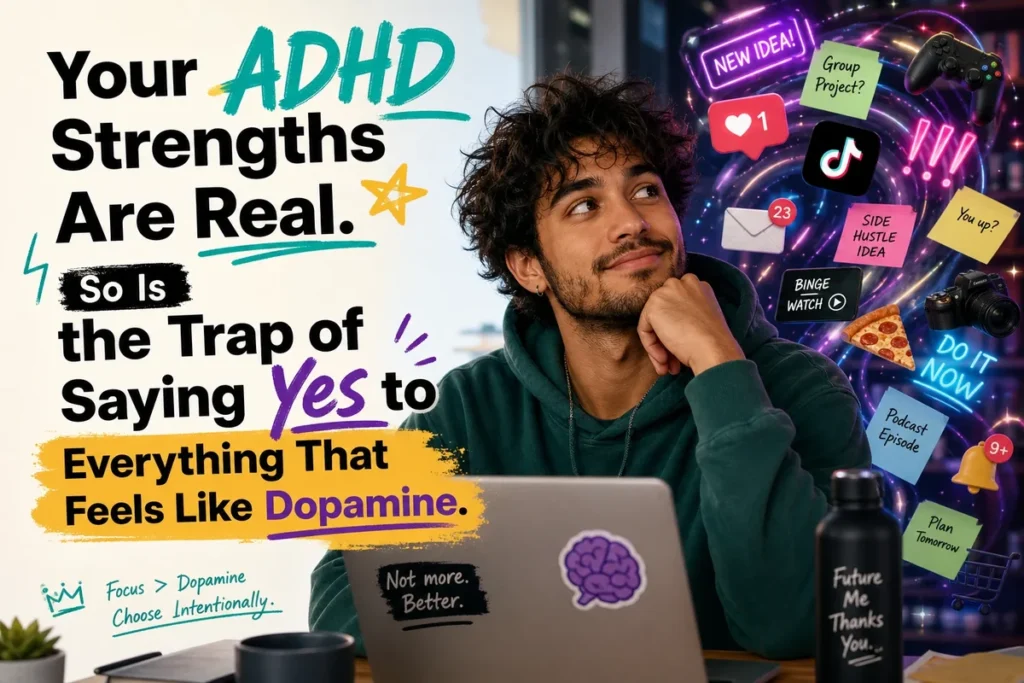
If you were diagnosed with ADHD as an adult, one of the first things people told you was probably some version of “but you’re so good at…”, the hyperfocus, the creativity, the ability to connect ideas across domains that nobody else thought to link. They weren’t wrong. The problem is that nobody followed it up with the part that matters most: that the same brain wiring making you exceptional at certain things also makes you almost constitutionally unable to say no to anything that arrives with a dopamine hit attached. Building a career out of your ADHD strengths without burning out isn’t about working harder or getting better at everything. It’s about understanding exactly which mechanism is driving the yes, and building a different mechanism around it before overcommitment does what it always does.
Why Every New Commitment Feels Like the Best Idea You’ve Ever Had
The ADHD brain does not generate dopamine at the same baseline rate as a neurotypical brain. Research using PET imaging demonstrated reduced dopamine receptor availability in adults with ADHD, particularly in the regions governing motivation and reward processing, with availability in the nucleus accumbens directly correlated with achievement motivation scores (Volkow et al., 2009, Journal of Clinical Investigation). What this creates in practice is a nervous system that is chronically under-stimulated, and that responds with intense, disproportionate activation when something genuinely novel appears.
A new project lands in your inbox. A collaborator pitches an idea that lights up every corner of your brain. Your manager asks if you want to lead the initiative nobody else has attempted. In that moment, the dopamine response is not subtle. It feels like clarity. Like finally being in the right conversation. Like this is the thing that will make the next six months feel alive.
The problem isn’t that the excitement is fake. It’s that the dopamine hit of saying yes arrives instantly, while the administrative weight of actually doing the thing arrives on a delay your brain genuinely cannot account for in that moment.
This is the core mechanism behind overcommitment in people with ADHD. It isn’t poor judgment and it isn’t arrogance about what you can handle. It is a neurological timing problem. The reward for accepting is immediate and vivid. The cost of accepting is distributed across weeks or months of follow-through that feels nothing like the initial rush, and for a brain that runs on present-moment dopamine, future administrative burden doesn’t register as real until it’s already crushing you.
What Happens When Your Strengths and Your Impulsivity Share the Same Switch
Many of the qualities that genuinely make ADHD brains valuable in professional settings are direct extensions of the same neural architecture that creates the overcommitment problem. Research on ADHD learners documented hyperfocus as the capacity for hours of intense, sustained mental engagement with a subject of genuine interest (Brown, 2006). Studies examining creativity in ADHD found consistently elevated scores on measures of divergent thinking, generating original ideas, making unexpected connections, challenging assumptions (White and Shah, 2006, 2011). The prosocial risk-taking literature notes that people with ADHD are more likely to take meaningful action on behalf of others, to speak up when something is wrong, and to push for change in environments that need it.
These are not compensations for deficit. They are real, documented strengths. The difficulty is that they are packaged with impulsivity in a way that makes it genuinely hard to deploy them selectively. A field study involving 171 employees found that executive function deficits specifically mediated the relationship between ADHD and job burnout, and that the most predictive mediators were self-management to time and self-organization and problem-solving. In other words, the burnout didn’t come from doing too little. It came from being unable to manage the full operational weight of what had already been committed to.
The overcommitment pattern: ADHD workplace research consistently identifies one specific impulsivity pattern as a core professional challenge: “agreeing to take on too much at once.” This sits alongside time management difficulty and emotional dysregulation as one of the primary ways ADHD disrupts careers, not because the person lacks capability, but because the decision to commit was made in a neurological state that couldn’t process what was actually being accepted.
The fawn response adds another layer, particularly for people who received a late discovery of their ADHD after decades of feeling like they were failing neurotypical standards. Research on ADHD adults’ workplace experiences found that many developed a pattern of overcompensating to reduce the perceived risk of rejection, volunteering for extra responsibilities, saying yes before fully processing the ask, and tolerating workloads that ultimately led to burnout (Beaton et al., 2022). When your brain has spent thirty years interpreting other people’s disappointment as evidence of your fundamental inadequacy, saying yes to every interesting thing that comes along stops being purely about dopamine. It becomes armour.
What Overcommitment Actually Looks Like in a Career
The pattern is recognizable even if it’s been invisible to you until now. You volunteer to lead the new initiative. You agree to mentor two junior colleagues while finishing a major deliverable. You take on a freelance client because the work is genuinely fascinating and it feels wrong to say no. Within six weeks, the new initiative requires weekly reporting nobody mentioned upfront. The mentoring sessions need preparation. The freelance client has a revision cycle consuming three times the estimated hours. You are carrying the work of three people and none of it is going well, because none of it has your full attention, and the shame of that, of being the person who said yes to everything and is now quietly failing at all of it, starts to compound into something that looks a lot like depression but is probably burnout.
From the community: “Corporate life is just constant punishment for thinking too fast but working too slow.”, r/ADHD thread
That quote from r/ADHD captures something that career advice consistently misses. The problem isn’t a lack of ideas, drive, or raw capacity. It’s the gap between the speed at which an ADHD brain generates and commits, and the sustained operational pace required to execute across weeks of routine follow-through. The ideas are real. The enthusiasm is genuine. The follow-through collapses not because you didn’t care, but because the scaffolding required to hold multiple commitments simultaneously is exactly what executive dysfunction dismantles.
For late-discovery adults, this pattern typically carries extra weight. A 2026 systematic review published in the Journal of Attention Disorders found that receiving an ADHD diagnosis in adulthood reshaped self-concept in highly variable ways, often producing both relief and destabilization simultaneously. Many adults reinterpreted a career full of overcommitment as evidence of a lifelong compensation strategy rather than a personal failing. But that reinterpretation, while accurate, doesn’t automatically install a new decision-making mechanism. Knowing why you say yes to everything doesn’t stop the dopamine from arriving before the executive function does.
Can You Build a Career on ADHD Strengths Without the Crash?
Research on neurodivergent employees points to genuine value in innovation, creative problem-solving, rapid learning, and resilience under pressure. These qualities make ADHD professionals particularly effective in dynamic, exploratory, or high-stakes environments. The Employer Assistance and Resource Network on Disability Inclusion (2023) identifies out-of-the-box thinking, deep domain focus, and structurally different problem framing as measurable contributions that neurodivergent employees bring to organizations that know how to receive them.
The key distinction is between roles where your strengths are the primary deliverable and roles where your strengths are the front door to a structure that then demands sustained, low-novelty execution. ADHD hyperfocus, deployed on the right problem, produces genuinely exceptional output. Deployed as a reason to say yes to six new problems simultaneously, it fragments into noise. The sustainable career is built by narrowing the scope of what you commit to, not broadening it, and by designing the scaffolding for follow-through before the commitment is made rather than after.
This is harder than it sounds if you have spent your career proving worth through volume. The implicit message many late-discovery adults internalized, often before they had any framework for understanding their brain, was that visible effort was the only acceptable currency. Saying yes to everything was how you demonstrated you were trying hard enough. Declining felt like confirming every fear about unreliability. Unlearning that equation is not a cognitive exercise. It’s a nervous system recalibration, and it takes time. The ADHD Career pillar covers the broader framework of what job fit actually means for a brain that doesn’t run on willpower, including workplace accommodations and how to negotiate the shape of your role.
The Difference Between Hyperfocus as a Strength and Hyperfocus as a Yes-Trap
Hyperfocus operates as a genuine career asset when it is directed at a narrow, high-value problem with clear parameters and a defined endpoint. It operates as a trap when it drives commitment to new projects based on how fascinating they look in the first conversation, rather than what they will require of you in weeks three, four, and five, when the novelty has worn off and administrative scaffolding has become the actual work.
Novelty activates the dopaminergic reward system with genuine intensity. The brain is responding to uncertainty, to the gap between what it predicts and what it hasn’t yet encountered. This produces the characteristic state ADHD adults often describe as finally feeling switched on: rapid ideation, pattern recognition, intense motivation, the sense that this time it will be different. The brain often cannot sustain this state once the uncertainty resolves. Once a project becomes known, once the structure is understood, the stakeholders are mapped, and the work has shifted from exploration to execution, the dopaminergic signal flattens. The project hasn’t changed. Your neurological relationship to it has.
Building a sustainable career means learning to distinguish between the excitement of novelty, which is neurological and temporary, and genuine alignment between a commitment’s ongoing demands and your actual capacity to meet them across its full duration. This is related to, but distinct from, the experience of the ADHD novelty cliff in an existing role, where the job stops being interesting and engagement gradually disappears. Overcommitment is the active version: you engaged intensely, you multiplied the commitments, and now you’re holding more of them than the follow-through system can support.
The 48-hour intervention: When a new opportunity arrives, the initial dopamine response is at its peak within the first few hours. Imposing a structured delay, committing to reply within two days rather than immediately, allows the prefrontal cortex to weigh in after the excitement settles. Decisions made once the novelty dopamine has levelled are almost always more calibrated than decisions made at the peak. “Let me look at my current bandwidth and get back to you by Thursday” is a complete, professional sentence that requires no apology.
Protecting Your Strengths Requires Protecting Your Capacity
One of the most counterintuitive aspects of managing ADHD in a professional context is that your genuine strengths only show up reliably when you have protected the conditions that allow them to function. Hyperfocus requires a nervous system that isn’t already running on fumes. Creativity and lateral thinking collapse under the weight of competing obligations that each demand partial attention. Empathy, which research identifies as a documented prosocial strength in ADHD, tends to burn out faster than almost anything else when overall cognitive and emotional load is too high.
The executive function burnout research is explicit on this mechanism: the pathway from ADHD to job burnout runs directly through deficits in time self-management and self-organization. When you are overcommitted, these capacities are the first to fail, which means overcommitment doesn’t just produce more work, it actively degrades the executive function that would allow you to manage it. More commitments produce less capacity to manage them, which produces worse outcomes across all commitments, which generates shame and compensatory effort, which accelerates the burnout cycle. Understanding this loop is the precondition for interrupting it.
The end-of-summer period is worth naming here. August and September carry a cultural urgency to reset, take on new projects, and commit to ambitious autumn plans. For ADHD brains, that urgency is amplified by the novelty of a seasonal shift and the dopamine pull of fresh starts. It is a high-risk moment for overcommitment, not because new starts are bad, but because the decision is being made at maximum novelty dopamine and minimum follow-through data. If the past few months already feel like too much, adding ambitious new commitments in September will not fix the problem. It will arrive as more weight on a structure that hasn’t been cleared yet. The ADHD Energy pillar covers what sustainable recovery actually looks like for an ADHD nervous system, distinct from the flatline that mimics it.
Building a Commitment Filter That Works for Your Brain
The most effective strategy is not learning to want fewer things. It’s building a decision architecture that intervenes between the dopamine surge and the spoken yes. This doesn’t require willpower. It requires structure that functions even when your executive function is temporarily offline, which, for ADHD brains, happens routinely under excitement, social pressure, or novelty activation.
A commitment filter for an ADHD professional needs to account for at least three things that impulsive yes-decisions consistently skip. The first is the administrative maintenance cost of the commitment: not the exciting work, but the status updates, coordination meetings, version tracking, revision cycles, the things that feel invisible from the outside but consume real executive function bandwidth from the inside. The second is the opportunity cost across existing commitments: every new yes is a partial no to something already in progress, and ADHD brains often struggle to calculate this trade-off in real time because future costs feel abstract compared to present-moment excitement. The third is your current baseline capacity, which changes with sleep, stress, hormonal fluctuation, medication timing, and a dozen other variables that the excitement of a new project temporarily overrides.
The goal isn’t to say yes less. It’s to say yes to fewer things, so that the things you do commit to actually get the version of you that made someone want to involve you in the first place.
Late-discovery adults who have rebuilt their professional lives around this principle consistently describe the same shift: moving from a career that looked impressive from the outside and felt chaotic from the inside, to one with fewer visible commitments and dramatically higher quality output. The trade-off feels like loss at first. Then it feels like finally working the way your brain actually works.
What Leveraging ADHD Strengths Actually Requires
Leveraging ADHD strengths in a career is a structural decision, not a mindset shift. It means actively seeking roles, projects, and environments where the high-value deliverable is exactly the kind of work your brain does well, rapid synthesis, novel problem framing, creative ideation, high-pressure responsiveness, and where the administrative scaffolding is either minimal or genuinely handled by systems or people who do that work well. It means being honest with yourself and others about what you will and will not sustain at high quality, rather than saying yes to the full package and quietly underdelivering on the parts that don’t engage you.
Practically, this often means negotiating the shape of commitments rather than accepting them as offered. A person who brings genuine creative value to early-stage work is not necessarily the right person to manage the twelve-week rollout documentation process, and acknowledging that difference is not a failing. It is accurate self-knowledge, which is the actual foundation of professional effectiveness. Research on neurodivergent workplace inclusion consistently finds that individualized approaches, ones that account for specific strengths and genuine constraints rather than applying blanket solutions, produce better outcomes for both the employee and the organization.
It also means accepting that the most career-damaging version of your ADHD often won’t be the things you couldn’t do. It will be the commitments you made in a dopamine surge that overwhelmed the things you could do brilliantly. The strengths are real. The trap is real. The work is learning, systematically and without self-blame, to tell the difference before you’ve already signed up for both.
Quick Dopamine Hits:
- Before accepting any new project, write down the three non-exciting administrative tasks it will require, weekly check-ins, status reports, version tracking. If those tasks alone feel impossible, the answer is probably no.
- Schedule a 15-minute ‘commitment audit’ every two weeks: list everything you’ve said yes to, mark what’s still receiving real effort, and identify one thing you can responsibly exit or delegate before adding anything new.
- When a new opportunity arrives and you feel the dopamine surge, impose a 48-hour rule before responding. Reply with ‘Let me check my current bandwidth and get back to you by Thursday’, this buys time for the dopamine to settle and your executive function to weigh in.
Rate this article
Was this a useful hit?