The Data on Why Hustle Culture Breaks ADHD Brains in a Specific Way (and Why Rest Won’t Fix It)

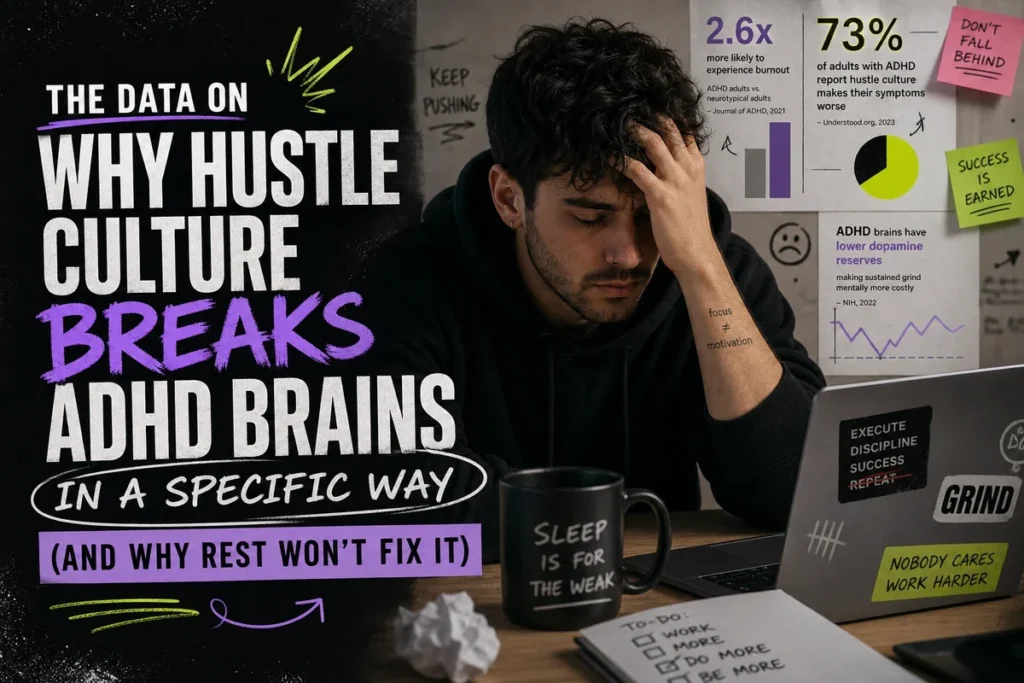
Hustle culture was not designed to hurt neurodivergent people specifically. It was just designed for a nervous system that ADHD brains do not have. The result is a collapse pattern so specific, so neurologically predictable, that the research has started to name its parts: the over-performance phase fuelled by artificial urgency, the invisible masking overhead that drains cognitive resources before a single task begins, the dopamine crash that is not about willpower, the shame cycle that forms when inconsistent output meets a culture that interprets output as character. The anti-hustle backlash gathering force in 2026 gets the diagnosis partly right and the prescription almost entirely wrong. Rest is not the antidote. For ADHD brains in particular, unstructured rest can deepen the crash rather than resolve it. What the data actually says is more complicated, and more useful, than “slow down.”
What Hustle Culture Actually Demands from an ADHD Brain
To understand why hustle culture is specifically harmful rather than generically stressful, it helps to look at what the framework actually requires neurologically. Hustle culture is built on three implicit demands: consistent daily output, visible productivity across a standard work structure, and the ability to self-generate motivation without waiting for the right conditions. For neurotypical nervous systems with intact dopaminergic reward pathways, these demands are achievable with effort. For ADHD brains, all three of them target the exact subsystems that function differently.
The dopamine reward pathway in ADHD is not simply “low”, it is dysregulated. Research using positron emission tomography demonstrated decreased function in the dopamine reward pathway in adults with ADHD, with reduced D2/D3 receptor and dopamine transporter availability in the midbrain and nucleus accumbens correlating significantly with lower achievement motivation scores (Volkow et al., Molecular Psychiatry). The ADHD brain is not unmotivated. It is running a reward prediction system that requires a different set of inputs to generate the signal that makes sustained effort feel possible. Interest, novelty, urgency, and stakes-based pressure can activate the system. Routine, low-stakes grind, and deferred reward largely cannot. Hustle culture’s entire architecture is built on the latter.
In production-centered societies, emphasis tends to fall on external productivity metrics, ignoring internal effort or psychological cost. A significant subgroup of individuals with ADHD sustains high levels of performance across multiple life domains, but at the expense of compensatory strategies and masking. Their impairment is invisible, not absent.
This framing, from a 2024 perspective paper in Frontiers in Psychiatry, cuts to the core of the problem. The person who appears to be thriving under a hustle framework is often not thriving at all. They are burning an invisible fuel that has a hard ceiling.
The Masking Overhead Nobody Accounts For
One of the most important and underreported findings in recent ADHD research is the concept of effort cost: the neurological energy expenditure required just to appear to be functioning, before any actual work begins. A 2024 qualitative synthesis titled “I Work Twice as Hard to Look Normal” documented the lived workplace experiences of adults with ADHD across global contexts. The study found that adults with ADHD consistently described a parallel performance layer operating beneath their visible work output: managing how they appeared, suppressing impulses, compensating for executive function gaps in real time, and monitoring their own behaviour for deviation from neurotypical norms. This is masking, and it is not free.
Masking draws on working memory, inhibitory control, and sustained attention, which are precisely the cognitive resources that ADHD brains already manage with difficulty. The research paper “High Functioning, Yet High Suffering” (2024, Frontiers in Psychiatry) identified this as a critical diagnostic blind spot: adults who maintain high occupational performance through compensatory strategies and masking often experience substantial internal burden including emotional exhaustion, chronic stress, shame, and cognitive fatigue, while their difficulties remain invisible within behavior-based assessment systems. Hustle culture does not just ignore this overhead. It actively incentivises increasing it. Work harder, look more productive, take on more. The hidden cost compounds with every iteration.
The invisible effort gap: Research suggests there is currently no widely adopted ADHD-specific scale that measures the subjective experience of sustained mental effort, including cognitive fatigue and the perceived cost of maintaining attention, as a distinct variable. This means that the most damaging dimension of hustle culture for ADHD adults is also the one that clinical systems are least equipped to measure.
Why ADHD Brains Run the Boom-Bust Cycle So Reliably
The boom-bust productivity cycle is not a habit problem or a discipline failure. It is a predictable output of the ADHD dopamine system interacting with an environment that provides irregular reinforcement. During a boom phase, some combination of novelty, urgency, hyperfocus, or high-stakes pressure temporarily brings the dopaminergic system online. Output becomes possible, sometimes extraordinary. This is the phase hustle culture celebrates, and the phase that ADHD adults themselves often mistake for their “real” capability.
What hustle culture does not account for is the neurological depletion that follows. The computational models of ADHD dopamine function, including work by Sagvolden et al. (2005) on the dynamic developmental theory, show that the ADHD dopaminergic system operates with blunted phasic signals. Learning from positive outcomes is impaired, and the extinction of non-rewarded behaviours is slower. In plain terms: the ADHD brain often cannot easily sustain the motivational signal that the boom phase generates, and it cannot easily let go of the seeking behaviour that drives it to try again. The result tends to be cyclical: intense effort when conditions align, then a hard floor when they do not, then the attempt to force another boom cycle through increasingly extreme urgency, novelty-seeking, or deadline pressure.
Hustle culture’s response to the bust phase is to treat it as a character deficiency. Work through it. Find your why. Build better habits. Each of these responses applies neurotypical repair logic to a neurologically distinct problem, which is why they consistently fail to produce lasting results. They also produce something more damaging: shame about inconsistent output in a context where inconsistency is not a choice.
From the community: “I have dreams and ideas that exceed my capabilities at times and I’m living my life throwing stuff on the wall seeing what sticks, cause truly, I don’t know what the hell I’m doing at all, no idea of what future I can even aspire to. No matter what I do, I always get the short stick. I don’t want to give up.”, r/ADHD thread
Does Hustle Culture Create Burnout, or Reveal It?
Hustle culture does not simply cause burnout through overwork, that framing would apply equally to neurotypical workers. For ADHD brains, the mechanism runs through the interaction between executive function demands and emotional regulation capacity, and the research has started to map this precisely. A field study with 171 employed adults found that executive function deficits fully mediated the relationship between ADHD and job burnout, with self-management to time and self-organisation as the specific mediating pathways (published in Journal of Occupational Health Psychology, 2023). This is significant because it locates burnout not in effort or workload per se, but in the structural mismatch between the executive demands of standard work environments and the executive resources available to ADHD brains.
Hustle culture does not create this mismatch. It maximises exposure to it. Every element of the hustle framework, including long unstructured hours, self-directed task prioritisation, and performance measured against consistent daily output, is a direct amplifier of the exact deficits that drive ADHD job burnout. And crucially, the relationship between ADHD and burnout remains even when you account for workload itself, because the depletion is occurring at the level of executive function, not simply effort.
Burnout is not about returning to your previous level of output as quickly as possible. It is about learning, maybe for the first time, what your actual capacity is, and structuring your life around that.
The broader cultural context matters here too. Research on ADHD in cultural ecosocial niches has noted that production-centered cultural conditions become active social forces when distilled into everyday customs and beliefs. Qualitative work has found that ADHD adults consistently situate their struggles within a framework of cultural expectations around self-sufficiency and continuous productivity, not just as external pressure, but as internalised standards they have absorbed and now apply to themselves. The harm of hustle culture is not only structural. It is also what it teaches you to believe about your own worth when the boom ends.
The Shame Layer: Why Inconsistent Output Hits Differently with ADHD
Inconsistent output is not rare in ADHD. It is one of its most reliable features. Performance variability across days, weeks, and contexts is well-documented in the ADHD literature and is distinct from the more stable patterns seen in other neurodevelopmental profiles. The boom week followed by the invisible week is not unusual. It is the pattern. But hustle culture treats inconsistency as the definitive evidence of insufficient commitment, and for an ADHD adult who has already absorbed years of “try harder” messaging, this lands as something much worse than criticism.
The “High Functioning, Yet High Suffering” commentary identifies this directly: the psychological burden from sustained masking and compensatory performance includes shame, emotional exhaustion, and a kind of diagnostic invisibility where the internal cost of functioning goes entirely unrecorded. Adults with ADHD who have succeeded within hustle environments often carry a specific form of imposter experience: they know the output came at a cost that is unseen, and they cannot predict whether they can replicate it. The good week was real. The crash was also real. Hustle culture has no framework for this duality, and so the person living it has no language for it either. Shame fills the gap.
The emotional dysregulation that tends to characterise ADHD, particularly the tendency toward rejection sensitive responses, makes this shame layer self-reinforcing. When inconsistent performance is read by an employer, a manager, or a social media culture as evidence of laziness or lack of discipline, the ADHD nervous system often does not register mild disappointment. It registers something closer to a verdict. The result is frequently a frantic return to the hustle, not because conditions have changed, but because the shame of the crash is intolerable. This is how the cycle tightens rather than resolves.
Why the “Just Rest More” Counter-Narrative Also Misses the Point
The anti-hustle movement that has gathered momentum offers a sincere corrective to genuinely damaging cultural norms. But its primary prescription, rest more, protect your time, slow down, solves a different problem than the one ADHD brains face. And for many neurodivergent people, unstructured rest is not restorative. It is another form of dysregulation.
The research on AuDHD burnout recovery is particularly instructive here. A 2026 clinical piece from Neurodivergent Insights noted that for many ADHD and AuDHD adults, “slowing down often feels more threatening than running fast, too little stimulation can be just as dysregulating to my system as too much.” Unstructured rest leaves the ADHD nervous system without the environmental scaffolding it needs to regulate. The result is not recovery. It is a different kind of stuck, characterised by boredom, inertia, and the worsening guilt of time that feels wasted.
The biological research reinforces this. Burnout is increasingly recognised as a chronobiological condition involving endocrine dysregulation and circadian disruption (Ungurianu and Marina, 2025, Clocks and Sleep). The hypothalamic-pituitary-adrenal axis dysfunction that underlies burnout is not reset by rest alone. The continuous effort of social adaptation in neurodivergent contexts generates what the literature calls allostatic load, a cumulative wear on the stress response system that produces its own hormonal dysregulation (Davatz et al., 2026, preprint). Simply removing demands does not restore the system. It needs active recalibration, which involves something more specific than rest: predictability, sensory regulation, minimal masking demands, and a reduction of the structural conditions that created the overload, not just the temporary removal of tasks.
What recovery actually requires: Neurodivergent burnout research suggests the recovery formula is not “rest until you’re better” but rather: reduce the demands that are burning you out, create lower-masking conditions, and then slowly reintroduce small amounts of structurally nourishing activity. Passive rest steadies the system. It does not rebuild it.
What the Research Suggests Recovery Actually Looks Like
If rest is insufficient and hustle is actively harmful, what does the evidence point toward instead? The data does not produce a clean protocol. If it did, that would itself be a red flag, because ADHD brains vary considerably in which executive functions are most affected, which sensory environments are regulating, and which structural accommodations produce the most return. But some consistent patterns emerge from the research.
The first is structural demand reduction, which is distinct from taking a break. It means identifying and removing the specific cognitive loads that are disproportionately expensive for a neurodivergent nervous system: meeting-heavy schedules that fragment sustained attention, communication norms that require real-time verbal fluency under pressure, environments with high sensory noise, task structures that require constant reprioritisation. Research on flexible workplace arrangements found that neurodivergent employees have vastly different responses to work structure, and that the most effective arrangements involve individualised approaches and a genuine cultural shift toward neuroinclusive design rather than the same accommodations applied uniformly (Szulc et al., 2021). Rest does not change these structural conditions. Only changes to the structure do.
The second consistent finding is that masking reduction matters more than output reduction. A person who works fewer hours but continues to mask heavily, suppress their needs in every interaction, and monitor their behaviour for neurotypical compliance will not recover. The metabolic cost of performing a neurotypical identity is independent of how much task work is happening. The “I Work Twice as Hard to Look Normal” study found that the subjective experience of workplace exhaustion for adults with ADHD was often less related to task volume than to the ongoing social performance requirement around the work itself. Addressing burnout without reducing masking demand means addressing the wrong variable.
Recovery does not usually look like suddenly feeling better. It looks like small moments of engagement returning: a flicker of interest in something, the ability to take a shower without it feeling like a monumental task, laughing at something unexpected.
Third, the evidence on dopamine regulation suggests that total stimulus deprivation is counterproductive for ADHD specifically. The nucleus accumbens and its role in reward anticipation means that an ADHD brain with no novelty, no interest-based engagement, and no achievable near-term reward is not resting. It is understimulated in a way that compounds the flat affect of burnout. Recovery involves identifying the type of engagement that is genuinely low-demand rather than eliminating engagement altogether. This is a meaningful distinction that the “just rest” narrative collapses.
What Changes When You Name the Mechanism
The practical value of understanding the specific neuroscience of ADHD collapse under hustle frameworks is not primarily therapeutic. It is clarifying, in the sense of helping you identify what you are actually dealing with. The shame that accumulates around inconsistent output is not a reasonable response to a character flaw. It is a predictable consequence of applying a neurotypical productivity framework to a brain that does not run on the same reward circuitry, and then interpreting the mismatch as personal failure.
Naming this shifts the intervention target. If the problem were insufficient effort, the solution would be more effort. If the problem is structural mismatch amplified by masking overhead and a dopamine system that often cannot sustain reward prediction across low-interest tasks, the solution is structural: reduce masking demand, build in interest-based fuel sources, find or create environments where your actual executive function profile is accommodated rather than performed around, and stop measuring your capacity against what you could output during a hyperfocus-fuelled boom phase. The boom was real. It was also not the baseline. Hustle culture valued only the boom and discarded the data from every other phase. That is not a productivity framework. It is a cherry-pick.
The ADHD Energy pillar on this site goes deeper into burnout patterns and nervous system regulation for neurodivergent adults. If you are trying to understand whether what you are experiencing is burnout or something else entirely, the distinction matters for what you do next, and the article on ADHD burnout versus depression covers the diagnostic terrain in more detail. The short version is that both conditions respond badly to the wrong intervention, and hustle culture creates conditions that make both more likely and harder to distinguish.
Hustle culture broke something specific in you if you have ADHD. The data is fairly clear on what it broke and why. The more useful question now is what the non-hustle alternative actually requires: not a softer version of the same framework, not empty rest, but a genuinely different operating model built around how the ADHD nervous system actually functions rather than how you have been performing it.
Quick Dopamine Hits:
- Name the last time you were in a genuine boom phase. Write down what external condition made it possible: novelty, urgency, an audience, a deadline. That’s your actual fuel source, not your work ethic. Knowing this is step one toward building a sustainable version.
- After a crash, resist the urge to immediately rebuild your productivity system. Give yourself 72 hours before you touch any task management tool. Your nervous system cannot take in new scaffolding while it is still in cortisol recovery mode.
- Identify one structural demand in your week that you are absorbing at a neurological cost no one can see: a meeting format, a commute, a communication channel. Write down one concrete ask that would reduce that hidden load. You do not have to send it yet. Just name it.
Rate this article
Was this a useful hit?