You’re Exhausted and Numb — But Is It ADHD Burnout or Depression? The Answer Changes Everything

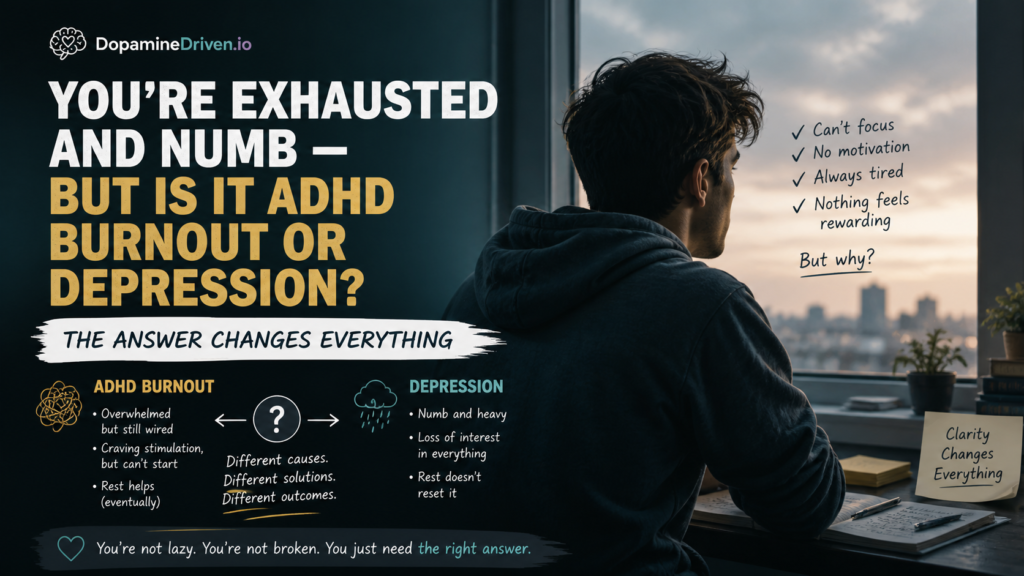
ADHD burnout and depression can look identical from the outside, and nearly identical from the inside. Both hollow you out. Both kill motivation. Both make the couch feel like the only survivable location. The problem is not the overlap, the problem is what happens when you pick the wrong recovery strategy. Rest alone can deepen depression. Forced behavioral activation can worsen burnout. If you are trying to figure out whether you are dealing with ADHD burnout vs depression, the stakes of getting the answer approximately right are real. This is not about self-diagnosing your way out of a mental health crisis. It is about having enough of a framework to stop actively working against yourself while you seek proper support.
The Overlap Is Real: and It Is Not a Coincidence
Start here: the overlap between ADHD burnout and depression is not a diagnostic accident. Both states genuinely share common features at the level of the nervous system. Fatigue, anhedonia, withdrawal, cognitive fog, emotional flatness, reduced executive function, these show up in both. For ADHD adults in particular, the comorbidity rate with depression is high. Research has consistently found that adults with ADHD have substantially elevated rates of major depressive disorder compared to the general population, and the causal arrows run in multiple directions: ADHD creates life conditions that predispose depression, depression worsens executive function in ways that mimic ADHD symptoms, and burnout can eventually transition into clinical depression if left unaddressed.
So when people say “I can’t tell if I’m burned out or depressed,” they are often not being imprecise. The conditions genuinely co-occur, and a period of burnout that is not addressed can shade into depression over weeks or months. This does not mean the distinction is meaningless, it means the distinction requires more than a surface symptom checklist. What differentiates burnout from depression is not the symptom list, it is the pattern of onset, the response to rest, the mood specificity, and the relationship between demands and internal state.
Burnout is the nervous system’s signal that the demands placed on it have exceeded what it can sustainably meet. Depression is a mood state that persists regardless of what the demands are.
The Onset Story: How Each One Arrives
One of the most useful differential clues is how the low state began. ADHD burnout almost always has a traceable origin in demand overload. You can usually point to a period of sustained overcommitment, chronic masking, a major life transition involving high performance pressure, or a long stretch of operating without adequate support or accommodation. The collapse is typically preceded by a ramp-up phase: the hyperfocus surge that powers through impossible demands, followed by the crash when the fuel runs out. There is a story with a recognizable arc.
Depression, particularly major depressive episodes that are not burnout-driven, often arrives more diffusely. It may follow a loss, a transition, or a change in neurochemistry, but it can also emerge without a clear external precipitant. The person struggling with depression often cannot identify a single cause or period of overload. The low state feels less like a consequence and more like a weather system that moved in. That distinction is not absolute, but it is a useful starting frame: burnout is typically downstream of something traceable, depression is often not.
For neurodivergent adults, this is complicated by the fact that years of chronic masking can make the “precipitant” invisible until you look for it. If you have spent a decade performing neurotypicality at work, in relationships, and in every public-facing context, the burnout may feel sudden even though the accumulation was years in the making. Ali et al. (2025, Clinical Psychology Review) found that autistic burnout often becomes a chronic pattern with intermittent crises, shaped by cumulative factors including sensory and social overwhelm, camouflaging, everyday life stress, and alexithymia, the difficulty identifying your own internal states. For many late-diagnosed adults, the burnout has been happening in cycles for years before anyone had a name for it.
The Rest Test: What Happens When Demands Actually Drop
This is arguably the most useful self-assessment tool available to you, and it requires more than a single weekend of rest to interpret. The question is: when demands genuinely decrease, does anything improve, even slightly?
In burnout, genuine demand reduction tends to produce at least small signals of recovery. Not a full return to functioning, that takes much longer, but micro-improvements: a flicker of interest in something, the ability to complete a small task without it feeling catastrophic, a moment of laughter that felt impossible the week before. The nervous system, given actual room to breathe, begins to signal that it is capable of returning online. Recovery is nonlinear and often two steps forward and one step back, but the directional response to rest is detectable.
In depression, the relationship with rest is more complicated. Rest is not inherently restorative in depression, and for some people, increased inactivity and withdrawal actively deepens the depressive state. This is the neurological basis behind behavioral activation therapy, a well-established intervention for depression that works by deliberately reintroducing small, pleasurable, value-aligned activities rather than waiting for motivation to return on its own. The key insight from behavioral activation research is that in depression, the motivational system needs external prompting because it has lost its internal signaling capacity. Waiting to feel better before acting rarely works because the mood system is not responding to environmental inputs the way it does in burnout.
The rest-response test: Give yourself two to three days of genuinely reduced demands, not just physical rest, but actual removal of performance pressure. If you notice even small flickers of engagement, interest, or relief returning, that response pattern points toward burnout. If your internal state does not shift at all regardless of external demands, that is a stronger signal that mood-level intervention may be needed.
When Rest Becomes a Trap: The Lethargy Cycle
Here is where burnout recovery gets genuinely complicated, and where ADHD and autistic nervous systems introduce a specific wrinkle. The conventional advice for burnout is “rest more.” That advice is partially correct and partially dangerous, depending on how you implement it.
The AuDHD burnout recovery literature describes something called the lethargy cycle: activity drops, stimulation drops, and at first that feels protective. But for many neurodivergent people, the stillness gradually morphs into numbness. Days fill with scrolling or staring or sleeping because everything else feels too heavy to start. The nervous system, which needed rest, has now been deprived of the gentle stimulation and pleasure signals it needs to stay oriented. As one source on AuDHD burnout recovery describes it: “rest very easily tips into that lethargy cycle,” and the more depleted and low you feel, the harder it becomes to initiate anything, which deepens the lethargy and can slide into depression and an even more entrenched inertia.
The research-supported correction is not to push harder or activate more aggressively. It is to pair rest with two specific things: genuine reduction of the demands that caused the burnout in the first place, and slow, careful reintroduction of activities that are genuinely nourishing to your particular nervous system. The emphasis on “genuinely nourishing” is important. This is not a to-do list in disguise. It is a warm drink, a texture you like, twenty minutes with a special interest, a short walk somewhere quiet. Small signals to the nervous system that it is safe and that aliveness is still available.
Burnout recovery requires rest paired with gentle pleasure. Pure passivity, for a neurodivergent nervous system, can deepen the hole rather than fill it.
This is where the burnout-to-depression transition becomes a real risk. Unaddressed burnout with pure passivity, no demand reduction, and no pleasure reintroduction can slide into a depressive episode. At that point you are dealing with both, which is why early pattern recognition matters.
Mood Specificity vs. Nervous System Collapse
One of the clearest distinguishing features between burnout and depression is what is actually absent. In depression, the primary loss is typically mood-level: persistent sadness, pervasive hopelessness, or anhedonia that cuts across most or all contexts, including things the person has historically loved. The depressive state does not respect contextual variation much, it applies everywhere, including to special interests, relationships, and experiences that previously generated consistent positive affect.
Burnout looks different at the emotional level. The predominant experience is often not sadness but flatness, or what some clinicians describe as a loss of capacity rather than a loss of want. The person in burnout may still know, abstractly, that they care about something. They may feel a faint pull toward their special interest, their creative work, their relationships. But the wiring between the want and the actual engagement feels cut. There is also a characteristic irritability in burnout that is tied directly to overstimulation: the threshold for sensory and social inputs has dropped, and things that were previously manageable now trigger a strong avoidance or shutdown response.
In depression, the irritability pattern is typically more pervasive and less tied to specific sensory triggers. In burnout, you can often identify specific inputs that set it off, and removing those inputs produces at least partial relief. That specificity is diagnostically meaningful.
The Masking and Alexithymia Wildcard
For late-diagnosed neurodivergent adults, there is a particularly insidious layer that makes this entire differential harder: many of us do not have reliable access to our own internal states. Alexithymia, the difficulty identifying and labeling emotions and body sensations, is significantly more prevalent in autistic and ADHD populations than in the general population. It does not mean the person has no emotions, it means the signal between internal state and conscious awareness is degraded or delayed.
The practical consequence is that burnout can be well advanced before you notice something is wrong. The early warning signs, increased sensory sensitivity, shortened frustration tolerance, reduced masking capacity, subtle skill regression, often get interpreted not as burnout signals but as personal failure. Without the framework of “this is what nervous system overload looks like in my neurotype,” the internal narrative becomes: “I used to cope better than this. I am getting worse. Something is wrong with me.” That narrative itself is exhausting, and it increases demand on an already depleted system.
Alexithymia and misattribution: Research by Ali et al. (2025, Clinical Psychology Review) identifies alexithymia as a factor that delays early warning recognition in autistic burnout. If you have difficulty reading your internal states, you may interpret burnout as depression, or as laziness, or as a character flaw, long before you recognize it as a nervous system response to unsustainable demands.
Decades of masking compound this further. If you have spent years performing competence, sociability, and emotional regulation that did not reflect your actual state, you may have lost reliable contact with your own baseline. You do not know what “normal” feels like for your system because you have been suppressing your system’s actual signals for so long. This is not a minor inconvenience for differential assessment, it is a fundamental epistemological problem that makes professional evaluation not just helpful but genuinely necessary.
Autistic Inertia: The Hard Case That Looks Like Both
There is a specific presentation that deserves its own discussion because it is frequently misread as depression: autistic inertia, the profound difficulty initiating or transitioning between activities. Inertia operates in extremes. You are either stuck in rest and cannot initiate movement, or absorbed in something and cannot stop. Both states can feel involuntary and can be disabling. A large study analyzing hundreds of online posts found that inertia is cyclical, fatiguing, and deeply entangled with co-occurring conditions, particularly the interaction between autism and ADHD.
When someone is stuck in inertia, the presentation can look almost identical to depression’s withdrawal and psychomotor retardation. They are not engaging. They cannot get off the couch. They are not responding to things they used to enjoy. To an outside observer, and sometimes to the person themselves, this reads as depression. But the mechanism is different, and that matters for intervention.
Inertia in burnout does not necessarily respond to antidepressants, and forcing behavioral activation without addressing the underlying demand-overload and sensory context can worsen the burnout. What tends to help inertia recovery, according to the AuDHD burnout recovery literature, is cultivating rhythms that offer enough novelty to engage the ADHD nervous system alongside enough predictability to soothe the autistic one: gentle structure, low-pressure pleasurable activities, special interest time, and sensory-friendly environments. These are not the same interventions as those used for clinical depression, which is why the diagnostic distinction has direct treatment implications.
Inertia that looks like depression may respond to structured predictability and gentle pleasure, not mood intervention. Getting this wrong can mean months of the wrong treatment.
When to Stop Self-Assessing and Seek Professional Help
Self-observation is valid data. It is not sufficient data. There are specific thresholds where professional evaluation is not optional, and it is worth naming them clearly rather than burying them in hedged language.
Seek professional assessment when: suicidal ideation is present, even passive, when anhedonia is extending to your special interests or the few things that reliably generated positive affect, when you have genuinely reduced demands for six or more weeks and still cannot detect any directional improvement, when a major loss or significant life event preceded the low state, or when the low state is interfering with basic self-care, safety, or essential functioning. These are not signs of weakness or failure to cope. They are neurological signals that the system needs a level of support that self-assessment and lifestyle adjustment cannot provide.
The comorbidity of ADHD and depression is well-documented, and the presence of one does not preclude the other. A clinician experienced with neurodivergent adults can assess whether you are dealing with burnout, depression, both simultaneously, or a burnout episode that has tipped into a depressive episode. That distinction changes medication decisions, therapy modality, and recovery timeline expectations. It is worth getting right.
It is also worth naming that not all mental health providers are equally equipped to make this differential in neurodivergent adults. A provider who defaults to a generic depression framework without considering masking, sensory load, demand-capacity mismatch, and inertia may miss the burnout component entirely. Seeking a provider with specific experience in adult ADHD and autism is not a luxury, for this particular differential, it is a meaningful difference in care quality.
Your Self-Observation Is Valid: Here Is How to Use It
Nothing in this article is an argument against using your own pattern recognition. Your observations about your internal state, your recovery response, your mood specificity, and your relationship to demands are all legitimate first-pass data. The goal is to use that data intelligently rather than either dismissing it entirely or treating it as a complete clinical assessment.
The most useful things to track are: whether your state has a traceable precipitant in demand overload or masking, how your internal state responds to even brief, genuine demand reduction, whether your flatness is mood-level (pervasive sadness, hopelessness) or capacity-level (want without access); whether sensory and social inputs have a specific effect on your threshold, and whether small pleasurable activities produce any response at all in your nervous system. These are not diagnostic criteria. They are signal patterns that give you something concrete to bring to a professional conversation, and that help you make slightly better short-term decisions about whether rest, gentle activation, or urgent support is the most appropriate next move.
Recovery from either state, but especially from burnout, is not a clean arc. It is nonlinear, full of days where you cannot tell if you are improving or just getting used to feeling this way. The fact that you are trying to understand what is happening to you is already a form of self-advocacy. The next step is making sure the framework you are using is accurate enough to actually help.
Recovery looks like small moments of engagement returning: a flicker of interest, the ability to shower without it feeling monumental, laughing at something unexpected. You are looking for direction, not destination.
Quick Dopamine Hits:
- Set a 10-minute timer and do one sensory-nourishing activity right now: hold a warm drink, put on one song you actually like, or step outside briefly. Notice whether anything shifts, even slightly. That micro-response is data.
- For the next three days, keep a one-line log after waking up: write one word for your mood and one word for your energy level. You are looking for whether those two things track together or diverge, burnout and depression have different signatures here.
- Identify one demand you can drop or delay today, not tomorrow. Then pair that removal with something that has previously felt pleasurable, not productive. The combination, not rest alone, is the test.
Rate this article
Was this a useful hit?