You’re Not Zoning Out. Five Specific Things Are Breaking in Your Brain During Every Meeting.

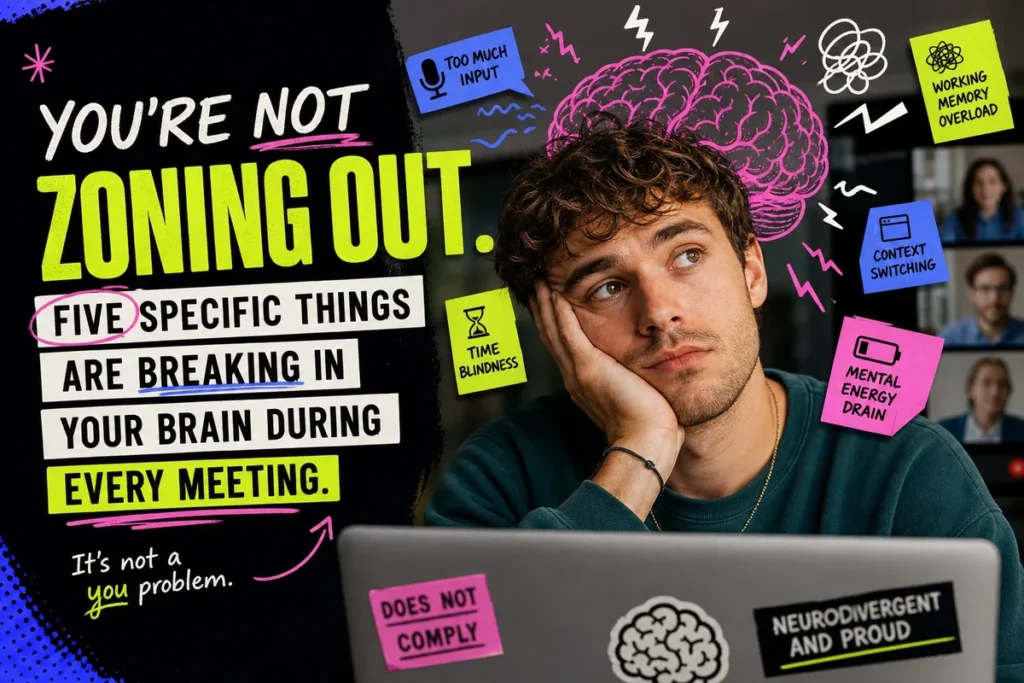
You are sitting in a meeting. You heard the first five minutes clearly. Then something shifted, not dramatically, not in a way anyone else noticed, and by the time someone asked for your input, you had a general sense that the conversation had been about something, but the specifics were gone. You nodded. You said something plausible. You spent the next hour quietly terrified that you’d agreed to something you didn’t catch, or missed a decision that was now your responsibility to act on.
This is the daily reality of ADHD in meetings, and it is not one thing going wrong. It is five specific cognitive systems breaking at the same time, in predictable ways, every single time the conditions are right. Understanding which systems are failing and why is the difference between generic “tips for staying focused” and strategies that actually address the underlying mechanism. This article is the latter. It also covers the disclosure question: whether to tell your employer, what to say if you do, and what you are legally entitled to ask for.
Why Meetings Are a Neurological Obstacle Course
The standard meeting packs an almost perfectly calibrated set of conditions for ADHD failure. The content is not novel enough to trigger the dopamine signal the ADHD brain needs to engage. The format demands sustained, passive attention, listening without doing, which is the modality where ADHD attention regulation is weakest. There is no immediate consequence for drifting (the deadline pressure that sometimes rescues ADHD performance in other settings is absent). Movement is discouraged or impossible. And the information arrives in a linear, sequential stream that requires you to hold the beginning of a sentence in mind while the speaker finishes it, then connect that sentence to something said four minutes ago by a different person.
Research by Barkley (1997, Psychological Bulletin) established that ADHD is fundamentally a disorder of behavioural inhibition and self-regulation rather than a simple attention deficit. The prefrontal cortex, which governs the ability to direct and sustain attention voluntarily, depends on adequate dopaminergic signalling to stay online. When that signal is weak, as it chronically is in ADHD brains, the cortex cannot maintain voluntary attention against competing internal stimulation. In a meeting, “competing internal stimulation” means everything: the sound of the ventilation system, a thought triggered by something someone said three topics ago, the fluorescent lights, your own hunger, an unresolved conversation from this morning. The meeting never stood a chance.
Failure Mode One: The Auditory Processing Gap
Many people with ADHD discover, often well into adulthood, that they have something that looks a lot like an auditory processing problem. This is not the same as hearing loss. The ears are working. The signal arrives at the brain. The problem is what happens next: the working memory system that should be capturing and organising incoming verbal information is already under load, and some of the signal simply does not get processed before it is overwritten.
From the community: “holy shit. all this time i thought i had awful hearing. my friends joke a lot about me needing to get my hearing checked. but i’ve always said, ‘i can hear your voice, i just can’t understand what you’re saying right now.’”, r/ADHD thread
Research on selective attention dynamics in adults with ADHD confirms that auditory and visual attention operate somewhat differently in ADHD brains, with some presentations showing relative difficulty filtering competing auditory input while trying to focus on a single speaker. When there are multiple people in the room, background noise bleeding in from an open-plan office, or the ambient distraction of a video call with everyone’s home environments visible in thumbnail, the auditory processing load compounds rapidly. What feels like “zoning out” is often more precisely described as the brain failing to segment and encode incoming speech fast enough to keep up with the pace of spoken conversation.
Failure Mode Two: Working Memory Drain
Working memory is the cognitive scratchpad that holds information active in your mind long enough to use it. It is where you store “the point the last person made” while the current person is responding to it. In people with ADHD, working memory capacity is reliably impaired, with research consistently identifying it as one of the strongest neuropsychological markers of the condition. A comprehensive investigation published in the Journal of Child Psychology and Psychiatry (Rhodes et al., 2011) found that ADHD is associated with impaired performance across both storage and central executive aspects of working memory.
A meeting is a working memory stress test run continuously for 30 to 90 minutes. Every new speaker, every topic shift, every decision point requires you to update what you are holding in mind, and for an ADHD brain, each update carries a meaningful chance of wiping what came before it.
The result is a specific kind of meeting experience: you follow the conversation in fragments. You understand each individual sentence as it is spoken, but you lose the thread connecting the sentences into a coherent argument. By the time someone says “so, building on what Marcus just said,” you cannot remember what Marcus just said. You are not inattentive to the meeting. You are inattentive to the thread of the meeting, which from the outside looks identical but is a meaningfully different problem with meaningfully different solutions.
Failure Mode Three: Event Segmentation Breakdown
This is the failure mode almost no one talks about. Research on event segmentation, the process by which the brain divides continuous experience into discrete, memorable chunks, has found that individuals with ADHD show coarser segmentation and impaired temporal order memory compared to people without ADHD. In ordinary language: the ADHD brain is less reliable at mentally marking “this is where one thing ended and another thing began.”
In a meeting, this matters enormously. Meetings move through multiple agenda items, sub-discussions, tangents that get resolved and abandoned, decisions that get revisited. A neurotypical brain continuously places mental timestamps on this flow, which is what allows someone to reconstruct “we agreed X in the first half, and then in the second half we revisited it and changed it to Y.” The ADHD brain places fewer of these timestamps, which is why meeting memories often feel like a blur even when you were paying attention. You were present. You just could not reliably mark the boundaries between moments.
Why written notes don’t always help: Note-taking during a meeting also requires working memory and divided attention. Writing the last thing said while listening to the next thing means neither gets full cognitive resources. This is why the advice to “just take notes” often fails for ADHD brains, you end up with fragments that make less sense when you reread them than they did when you wrote them.
Failure Mode Four: Impulse Control and the Interrupt Problem
For many people with ADHD, especially those with combined or hyperactive-impulsive presentations, meetings create a different kind of tension. You have a thought, a relevant, often genuinely good thought, and you know that if you do not say it immediately, it will be gone by the time the current speaker finishes. So you interrupt. Or you visibly hold yourself back from interrupting, which consumes cognitive resources that should be allocated to listening. Or you hold the thought in your head so tightly, repeating it to yourself to prevent it from disappearing, that you miss the next three things that are said.
Clinical guidance from CHADD notes that impulsive speech, including interrupting, talking excessively, and intruding on conversations, is among the specific ADHD traits that create the most visible friction in workplace social settings. The frustrating irony is that the behaviour usually comes from high engagement, not disrespect. The ADHD brain is so activated by an interesting point that the normal inhibitory circuit that produces polite turn-taking simply does not fire in time. You are not being rude. You are being fast, and the room does not always have the context to read that correctly.
Failure Mode Five: The Masking Tax
On top of all four cognitive failures above, many adults with ADHD are simultaneously trying to appear fine. They maintain eye contact deliberately. They nod at appropriate intervals. They position their body to look engaged. They suppress fidgeting. They calculate whether they have been visibly checked-out long enough that someone might have noticed, then recalibrate their performance. This is called masking, and it is not free.
A qualitative synthesis of lived workplace experiences found that adults with ADHD consistently described having to work significantly harder than neurotypical colleagues to produce the same observable outputs, a burden summed up by one participant as “I work twice as hard to look normal” (from research published under that title in the peer-reviewed literature on ADHD workplace experiences). Research on adults with ADHD who appear professionally competent confirms that the internal cost of maintaining that appearance includes emotional exhaustion, chronic self-monitoring, anxiety, and shame. None of this appears on any productivity metric. All of it is real.
Masking in meetings does not solve the underlying problem. It adds a sixth cognitive load on top of the five already in play, which is why you sometimes walk out of a meeting feeling like you ran a half-marathon even though you sat still for an hour.
What Actually Helps (and Why Most Advice Misses the Point)
Most advice for ADHD in meetings reads like it was written by someone who has never experienced ADHD. “Pay attention.” “Take notes.” “Arrive prepared.” These are descriptions of the desired outcome, not mechanisms for achieving it. What actually helps is addressing specific failure modes at the system level, before, during, and after the meeting.
Before the meeting, request an agenda in advance. This is not just about knowing what will be discussed. It primes your brain with context so that when topics arise, they arrive into a prepared mental framework rather than a blank slate. A primed brain segments and retains information more effectively. Even reading a three-item agenda on the way into the room lowers the cognitive load of the first minutes, which is often when drift starts.
During the meeting, write questions rather than summaries. The problem with traditional note-taking is that it can convert an active cognitive task, understanding, into a passive one: transcription. Writing questions such as “What does ‘revised by end of month’ mean for my workload?” or “Did we just agree to drop the feature, or pause it?” keeps your brain in an investigative posture that is closer to the interest-based engagement the ADHD nervous system actually responds to. Questions also give you a physical task to do with your hands, which reduces the pull toward checking your phone.
Movement and doodling have a genuine neurological basis as supports rather than distractions. Research on the stochastic resonance model of ADHD suggests that moderate additional sensory input, such as background noise or light tactile stimulation, can improve cognitive performance in ADHD brains by raising baseline arousal toward a more optimal level (Söderlund et al., 2016, Frontiers in Psychology). A quiet fidget object, a pen to turn in your fingers, or walking a short distance to reach a meeting rather than logging in from your desk can meaningfully shift your arousal state before the room settles into silence.
After the meeting, do not trust your memory. Your brain did not fully encode the event boundaries in that room. Before you open anything else, before you check messages, before you get a drink, write two or three sentences about what was decided and what you are now responsible for. If you can do this within ten minutes of the meeting ending, while residual working memory traces are still relatively fresh, you will capture far more than if you try to reconstruct it an hour later. This is not a moral failing. It is working with, rather than against, the specific way memory consolidation works in ADHD brains.
On recording meetings: Many workplaces now record video calls by default, or allow it with consent. For ADHD brains, being able to re-listen to a recording at 1.5x speed, scanning for the moment you lost the thread, transforms the retention problem fundamentally. This is a reasonable, low-cost accommodation that requires no formal disclosure. If your workplace does not do this, it is worth asking casually whether it is possible before making any formal accommodation request.
The Disclosure Question: Should You Tell Your Employer?
This is not a simple yes or no. Disclosing a neurodevelopmental condition to an employer involves a real calculation of risk and benefit that depends on your specific workplace, your relationship with your manager, and what you actually need from the conversation.
In workplaces covered by the Americans with Disabilities Act, employers with 15 or more employees are legally required to provide reasonable accommodations for disabilities that significantly impair major life activities. ADHD, when it substantially affects concentration, communication, or work organisation, qualifies. Similar legal frameworks exist in the UK under the Equality Act 2010 and in most EU member states under equivalent legislation. Accommodation is a legal right, not a favour being granted.
Research on neurodivergent employees’ experiences consistently shows that stigma and discrimination remain real concerns. Studies on neurodiversity in the workplace have found that a majority of neurodivergent employees report worrying about judgment from management or colleagues if they disclose a diagnosis (Pryke-Hobbes et al., 2023, in research on neurodiverse workplace experiences). This fear is not irrational. It reflects something genuinely real about workplace cultures that have not yet fully shifted on neurodivergence.
The research also shows the other side. When disclosure goes well, it goes very well. Workplaces that respond with genuine accommodation and understanding tend to produce dramatically better outcomes for the employee, not only in performance, but in wellbeing, retention, and job satisfaction.
One approach that reduces risk without requiring formal disclosure: frame what you need as a working preference rather than a medical need. Asking “could we send an agenda 24 hours before our team meetings? I do better when I can prep” is a different conversation from “I have ADHD and need accommodations.” Both requests lead to the same outcome. One requires you to disclose a diagnosis. The other requires you to know what you need and ask for it directly. Many of the most effective meeting accommodations, written agendas, meeting recordings, a designated note-taker, written follow-up summaries, are things reasonable managers will agree to for a whole team without anyone needing to name a diagnosis.
If you do decide to disclose formally, come to the conversation with specific requests already prepared. Something like: “I have ADHD, which affects my ability to retain verbally delivered information, especially in group settings. The accommodations I’m requesting are written meeting agendas sent at least 24 hours in advance, permission to record meetings for personal review, and written action-item summaries after each session.” This framing is clear, solution-oriented, and demonstrates that you have thought about what you need rather than simply surfacing a problem. Research on workplace disclosure experiences consistently finds that employees who arrive with specific, practical requests are received more constructively than those who disclose without a clear ask attached.
Working With Your Brain, Not Around It
There is a version of meeting management that tries to make ADHD brains perform neurotypically for 60 minutes through sheer effort and the right app. That version tends not to work. The executive function challenges that make meetings hard are not fixed by discipline alone. They are addressed by building external systems that do the cognitive work the brain cannot do reliably on its own.
This is what neuroscience-informed systems design actually means in practice. If working memory drains, you create an external record before it empties. If event segmentation is coarser, you add artificial boundaries, a written agenda, a question prompt at intervals, a mid-meeting written summary. If auditory processing is slower, you create the option to replay the audio later. You are not compensating for a flaw. You are building scaffolding around a brain that runs on a different architecture. The ADHD career pillar at dopaminedriven.io/career covers more of the structural approaches to building work environments that don’t require you to fight your own nervous system all day.
One thing worth naming directly: the strategies in this article will help, but they will not eliminate the difficulty entirely, and that is not a failure on your part. Meetings, as they are currently designed, genuinely do stack the deck against ADHD brains. The DSM-5 itself notes that ADHD traits are more likely to occur in group situations and that difficulties may be minimal or absent when a person is engaged in especially interesting activities or in one-to-one situations. A poorly structured, agenda-free, hour-long meeting with seven people covering three unrelated topics is not a neutral environment that just happens to be difficult. It is a specific format that taxes the specific cognitive systems your brain finds most challenging. That matters, because when you understand the mechanism, you stop blaming yourself and start engineering solutions. Understanding how your ADHD affects your working life more broadly, including the ways executive dysfunction shapes your career, is part of the same shift. The ADHD systems pillar is a good place to keep building from there.
The goal is not to get through meetings without anyone noticing the effort. The goal is to leave meetings having captured what matters, contributed where you have something real to say, and spent your cognitive resources on the actual work rather than on performing the appearance of neurotypicality. Those are different targets, and the second one is both more achievable and more worth achieving.
Quick Dopamine Hits:
- Before your next meeting, write down the one thing you must leave that room knowing. Put it on a sticky note on your laptop lid. This single anchor point prevents total loss if you drift.
- If you’re allowed to take notes, write in questions, not statements, ‘What did she mean by Q3 target?’ forces active processing and gives you something concrete to do when your attention slips.
- For any meeting over 30 minutes, set a silent phone vibration at the halfway point. When it goes off, write one sentence summarising what has been decided so far. This resets working memory before it can fully empty.
Rate this article
Was this a useful hit?