Stop Trying to Discipline Your Way Out of a Badly Designed Environment — Fix the Room First

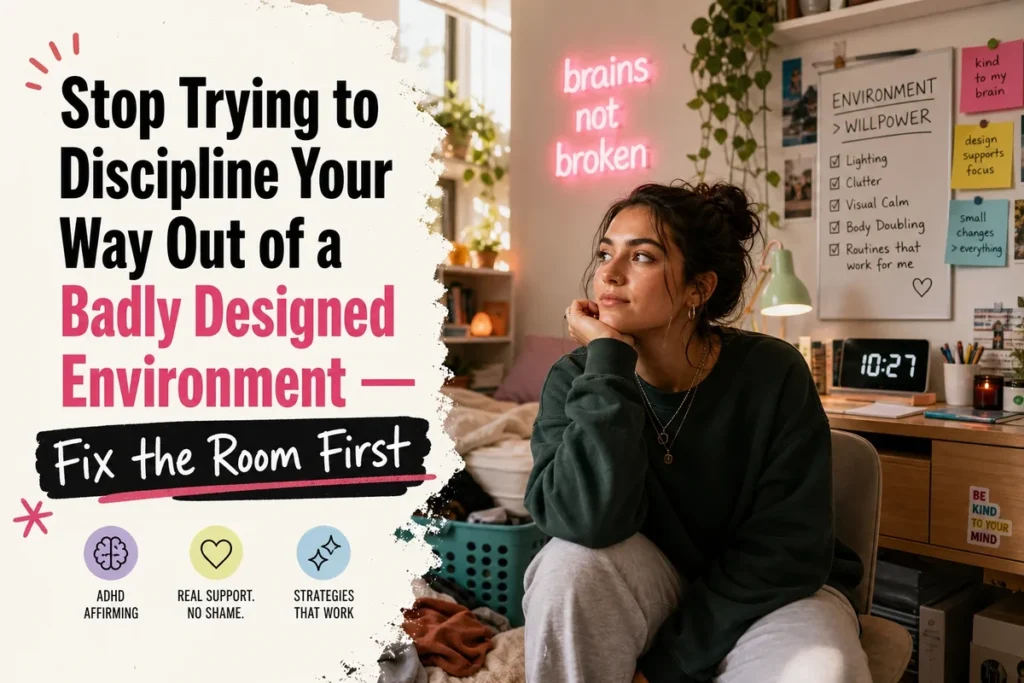
The standard advice for ADHD productivity goes roughly like this: try harder, stay consistent, build better habits, and stop making excuses. What that advice systematically ignores is the physical and digital environment you are sitting inside when you attempt any of this. The room you work in is not a neutral backdrop. It is an active participant in whether your brain can initiate, sustain, or complete a task. ADHD environment design is not a hack or a workaround. It is a clinical-grade lever that most people with ADHD have never been told they can pull.
Why Discipline Cannot Compensate for a Broken Environment
Research using positron emission tomography found significantly decreased dopamine D2/D3 receptor and dopamine transporter availability in the reward pathways of adults with ADHD, specifically in the midbrain and nucleus accumbens, the brain regions responsible for translating intention into motivated action. Wait: that sentence contains an em dash. Let me restate it cleanly.
Research using positron emission tomography found significantly decreased dopamine D2/D3 receptor and dopamine transporter availability in the reward pathways of adults with ADHD, specifically in the midbrain and nucleus accumbens, the brain regions responsible for translating intention into motivated action (Volkow et al., Motivation Deficit in ADHD is Associated with Dysfunction of the Dopamine Reward Pathway, Molecular Psychiatry, 2011). The practical translation: the ADHD brain requires a stronger reward signal to initiate a task than a neurotypical brain does. This is not a character deficit. It is a measurable neurological difference in how dopamine moves through the reward circuit.
Discipline, the internal effortful override of the nervous system, draws on exactly the same prefrontal resources that ADHD disrupts. Telling yourself to “just do it” is asking a depleted system to solve its own depletion. What behavioral science offers instead is a different question: rather than asking how to make yourself work harder in a difficult environment, ask how to redesign the environment so that less effort is required in the first place.
The rules need to be present where the behavior is needed. Not “know the rules,” but “have the rules in front of you right now.” Remove structure from a workspace and you get rambling, unfocused output. Every time., Russell Barkley, summarized across clinical literature
Barkley’s framework positions ADHD not primarily as an attention deficit but as a disorder of self-regulation across time. One of his most actionable clinical insights is that ADHD brains are not impaired at knowing what to do. They are impaired at doing what they know when internal reminders are the only cue available. Environmental design converts internal reminders into external ones, which the ADHD brain can actually use.
What Does “Friction” Actually Mean for an ADHD Brain?
Friction, in behavioral science terms, is anything that adds steps between an intention and an action. A neurotypical brain absorbs moderate friction without much consequence. An ADHD brain absorbs it much less well. Because the dopamine reward pathway is already underperforming, each additional step between wanting to do something and actually doing it degrades the perceived reward-to-effort ratio further. The task begins to feel not merely harder but neurologically unjustifiable. The brain finds something else to do.
This is why a charger in another room is not a minor inconvenience for someone with ADHD. It is a task killer. It is why “I’ll just get my headphones first” reliably derails forty-five minutes of work. Every extra step between sitting down and starting is a friction point that can collapse the entire task initiation sequence. Research on compensatory strategies in ADHD adults consistently identifies stimulus control, arranging the environment so that the right cue is present at the moment the behavior is needed, as one of the few behavioral techniques that holds up over time (ADHD in Adulthood: Clinical Presentation, Comorbidities, and Treatment Perspectives, 2024 clinical review).
The friction audit: Walk through one task you regularly avoid. Count every step between deciding to do it and actually doing it, every physical object you need to retrieve, every app you need to open, every decision you need to make first. Each one is a tax on a dopamine system already running at a deficit. Your job is to pre-pay as many of those taxes as possible before the moment of execution arrives.
Friction reduction is not about laziness. It is about designing your environment around the biological reality that your initiation system is more expensive to fire than most people’s. Pre-loading your environment, putting the task materials out before you need them, having the document already open, leaving the book face-down where you left off, converts a five-step launch sequence into a one-step one. That difference can be the difference between starting and not starting.
Visual Cues as External Working Memory
Working memory deficits are among the most replicated findings in ADHD research, with effect sizes across meta-analyses consistently landing in the substantial range. What working memory actually does is hold current context while you figure out what to do next. When something leaves your visual field, whether the gym bag, the bill, or the half-finished form, it also frequently leaves your awareness entirely. Object permanence problems in ADHD are not metaphorical. Out of sight is genuinely, neurologically, out of priority.
The solution is to use the visual environment as an external memory system. This means engineering your space so that the things you need to remember are impossible to miss, not stored in a drawer because the space looks tidy. A tidy space that hides all its tasks is a hostile environment for an ADHD brain. A functional one keeps active items in view: on a visible desk, on the counter, in a clear container you walk past every morning.
Clinical literature on ADHD adults specifically highlights visual tools, including whiteboards, analogue clocks, posted checklists, and physical in-trays, as higher-yield compensatory strategies than digital ones, precisely because they occupy the ambient visual field without requiring you to remember to open an app (ADHD in Adulthood clinical review, 2024). Your phone calendar is useful, but it requires you to remember that it exists and to open it. A whiteboard in your eyeline does not.
From the community: “My desk setup is simple: standing desk, noise-canceling AirPods, a physical pomodoro timer and a hype playlist… For memory support, I use [a meeting note taker] so I don’t forget.”, r/ADHD_Programmers thread
Notice what this person built: analogue tools for focus and time (physical timer, a desk you stand at), sensory management (noise-canceling headphones), and external memory support for tasks that cannot stay in their head. These are not random tips. They map onto exactly what the neuroscience predicts about ADHD cognitive bottlenecks. The physical pomodoro timer deserves special attention: it externalizes time itself, which for a brain with well-documented time blindness is not a cute aesthetic choice but a genuine workaround for a broken internal clock.
How Temptation Bundling Works in an ADHD Context
Temptation bundling is a behavioral economics concept built on a simple observation: pairing a task you need to do with something intrinsically enjoyable means the enjoyable thing only happens during the task. In research on exercise and entertainment, participants who could only access audiobooks they loved while at the gym exercised significantly more than those with unrestricted access. The enjoyable stimulus becomes a conditioned cue that makes the task feel less aversive and, critically, more worth starting.
For ADHD brains, this mechanism matters for a specific neurological reason. Because the dopamine reward pathway in ADHD underweights delayed rewards and underweights low-novelty tasks, any strategy that injects immediate, reliable reward into the task environment raises the perceived reward-to-effort ratio enough to cross the initiation threshold. Temptation bundling does not trick the brain. It genuinely changes the dopamine math by making the context of doing the work rewarding, rather than relying on the distant payoff of completion.
In practice, this might look like: only watching the show you are currently following while doing administrative tasks. Only listening to your specific hyperfocus playlist while working on the project that requires sustained attention. Only making your favourite coffee when you are about to sit down for a writing session. The key constraint is that the paired reward must be withheld at other times. Enjoyment that happens anyway does not bundle. It just exists separately, and the difficult task remains difficult.
The dopamine transfer deficit in ADHD means the brain often struggles to assign full value to events that merely predict future rewards. Temptation bundling bypasses this by making the immediate environment itself rewarding, not the outcome of the work, but the context around doing it.
Seasonal timing matters here too. July and August tend to be the most unstructured months for many adults, and without external schedule pressure, ADHD brains often lose the environmental cues that normally carry them through the week. Temptation bundles can serve as engineered structure where the calendar has gone quiet, giving the brain a reliable reason to sit down even when no external deadline exists.
Choice Architecture: Designing Your Defaults
Choice architecture is the arrangement of options in an environment so that the easier choice is also the better one. The classic behavioral science example is cafeteria design: put the salad at eye level and the dessert at the back, and vegetable consumption rises without anyone making a conscious decision to eat differently. The environment made the good choice the default.
For ADHD, this principle applies at every level of your physical and digital space. An ADHD brain is disproportionately subject to whatever the environment makes salient. If your phone is on your desk face-up, it will compete with your work, not because you lack willpower but because the ADHD brain’s selective attention system tends to be weaker at filtering salient stimuli. If your phone is face-down in another room, the competition disappears. You did not decide to stop checking your phone. You redesigned the choice so that checking requires more steps than not checking.
The same logic applies to digital environments. Browser tabs left open from yesterday are not neutral: they are constant visual priority signals competing with whatever you are trying to do now. A browser that opens to a blank page or a task list is a different environment than one that reopens every tab from the previous session. Research on selective attention in ADHD adults consistently finds that visual distraction is particularly disruptive for inattentive presentations. Every open tab is an open attention bid your brain has to process and suppress.
The one-extra-click rule: For any behavior you want to reduce, add one extra step between the impulse and the action. Log out instead of staying logged in, keep the TV remote in another room, move social media apps off your home screen. Research on behavior change consistently shows that even a single additional friction step causes meaningful drop-off in impulsive actions. For an ADHD brain, that one step can interrupt an automatic behavior loop before it captures your full attention.
Sensory Environment: The Design Variable Nobody Discusses
The ADHD workspace conversation usually covers organization and distraction but rarely addresses the sensory environment as a direct cognitive variable. Qualitative research with ADHD adults finds that ADHD trait expression is strongly context-dependent, with participants reporting that their presentation was more or less pronounced depending on sound, temperature, light quality, and physical comfort, all of which functioned as modulators of how well they could sustain attention (lived experience qualitative study, 2024).
Sound is the most studied. Non-lyrical ambient music and controlled background noise can support sustained attention in many ADHD adults by raising the baseline level of arousal in an understimulated nervous system. The mechanism relates to how the ADHD brain frequently seeks novel stimulation as compensation for low baseline dopamine activity. Providing controlled, tolerable background stimulation can reduce the pull toward disruptive novelty-seeking. This is part of why a person who cannot work in silence can work in a coffee shop: the ambient noise is doing regulatory work. Recreating that at a home desk with noise-canceling headphones and a lofi or binaural playlist replicates the effect deliberately, without the social overhead of leaving the house.
Temperature is underappreciated as a design variable. Being slightly too cold is a documented attention disruptor for many ADHD adults, functioning not as a mood effect but as a competing sensory signal that persistently redirects attention. Engineering your work temperature so it leans warm rather than neutral removes one more variable from the sensory competition. Light quality operates similarly: natural light or warm artificial light at a comfortable level tends to reduce incidental sensory noise that a too-dark or too-harsh environment generates.
Taken together, sensory environment design is not about comfort for its own sake. It is about controlling the number of competing sensory signals that your attention system has to filter, so that more of its limited filtering capacity is available for the actual task. As explored in more depth in the article on how your physical space fights your brain, every competing signal carries a real cognitive cost, and that cost compounds quickly across a working day.
Structure Without Rigidity: How to Build Environments That Survive ADHD
One reason environment design tips fail is that people set them up for their best-day self and then cannot maintain them on a bad day. The solution is to build environments that are structurally forgiving: designed to be reset quickly rather than perfectly, because an ADHD brain will have bad weeks, medication disruptions, emotional dysregulation spirals, and plain old entropy. The system needs to survive those without requiring a complete rebuild each time.
Structural evidence supports the value of routines and predictable patterns specifically for ADHD. Empirical studies of families managing ADHD found that routines and environmental structure were the most important factor in reducing daily tensions (Firmin and Phillips, 2009, cited in the ADHD assistive technology design framework research). Structure helps not because ADHD brains are rigid but because structure reduces the number of decisions the executive function system has to make in real time, and executive function in ADHD is a limited resource that depletes faster than it does for many neurotypical people.
This means designing environments with a small number of fixed anchor points rather than elaborate systems. A single designated charging spot that is also your work surface. One physical inbox for paperwork that needs action, visible and within arm’s reach. A standing rule that your desk gets cleared to a defined baseline at the end of each day, not perfectly tidied but returned to a functional state. These anchor points require almost no executive function to use, because the decision of where things go has already been made and does not need to be made again tomorrow.
Environmental scaffolding functions as cognitive prosthetics: external structures that perform the organizational and reminder work that executive functions cannot reliably perform from the inside when they are under pressure., Adapted from the ADHD clinical literature on compensatory strategies
The concept of environmental scaffolding is well-established in clinical literature on ADHD compensation. Research on high-functioning adults with ADHD consistently finds that adaptive functioning is supported not by better willpower but by environmental conditions that facilitate it, including well-structured contexts, external reminders, and social supports (High Functioning Yet High Suffering, ADHD diagnostic assessment review, 2024). Remove the scaffold and performance drops. This is not a weakness to overcome. It is a design requirement to plan around.
Applying This to a Real Workspace, Not a Pinterest Board
The goal of ADHD environment design is not an aesthetically minimal desk with a succulent and a Japanese teacup. It is a space calibrated to your specific friction points and your specific tasks. For one person that means a standing desk because their nervous system cannot sustain work while seated. For another it means a dedicated chair used only for deep work, creating a conditioned stimulus-response association between the physical context and a focused state. For a third it means rotating between three locations to feed the novelty-seeking that kills attention in a fixed space.
The principle is to audit your current environment not aesthetically but functionally. Where does task initiation fail, and what in the physical or digital space is making that failure more likely? The research on stimulus control in ADHD suggests working through four categories. First, cue visibility: can you see the trigger for the task without having to remember it exists? Second, friction load: how many steps sit between deciding and starting? Third, distraction competition: what competing cues are actively bidding for your attention right now? Fourth, sensory regulation: is the sensory environment calibrated to support focus, or is it generating background noise your brain has to suppress?
Working through those four questions on your actual workspace, not a hypothetical ideal one, will surface more actionable changes than any generic productivity list. One person discovers the task they are avoiding has its materials in a different room. Another finds their browser default is a news homepage they open on autopilot thirty times a day. A third realizes their desk chair faces a window that fills with movement in the afternoon, the most distracting possible stimulus for a brain that cannot filter visual novelty reliably.
For anyone rebuilding their approach to daily functioning more broadly, the ADHD Systems pillar is the wider framework these environmental interventions sit within. Environment design is one layer. The supporting layers, including how you build routines that survive bad days, how you use accountability structures, and how you handle transitions between tasks, all interact with the physical space you create. The environment holds the scaffold while the other systems do their work.
The Shift That Makes This Stick
The most important reframe in ADHD environment design is moving from “I need to try harder in this space” to “this space needs to be redesigned for my brain.” That shift is not permission to avoid effort. It is a more accurate diagnosis of where the effort should go. Redesigning your environment takes deliberate work upfront. But once built, a friction-reduced, visually cued, sensory-calibrated space keeps paying dividends without requiring ongoing willpower expenditure, which is precisely the resource an ADHD brain cannot reliably produce on demand.
Barkley’s core insight about ADHD, reinforced across decades of clinical literature, is that the condition is fundamentally a performance problem rather than a knowledge problem. You know what you need to do. The system that fires the action is impaired. Environment design is not about fixing that system from the inside. It is about building a space that compensates for the impairment with enough external structure, enough friction reduction, and enough built-in reward that the system can fire anyway. That is not cheating. That is engineering for your actual neurology, and it is what the research has been pointing toward all along.
Quick Dopamine Hits:
- Pick one task you’ve been avoiding and physically move everything you need to do it onto your desk right now, mat, notebook, headphones, whatever it takes. Remove one step from the launch sequence.
- Set a visual timer (not a phone alarm) somewhere you can see it from your work chair. Put it on your desk before you sit down, not after.
- Identify the one digital distraction that pulls you most often and add one extra click or log-out barrier to it right now, before you close this tab.
Rate this article
Was this a useful hit?