You Can’t Get a Job Without Meds. You Can’t Pay for Meds Without a Job. This Loop Is Real and It Has a Name.

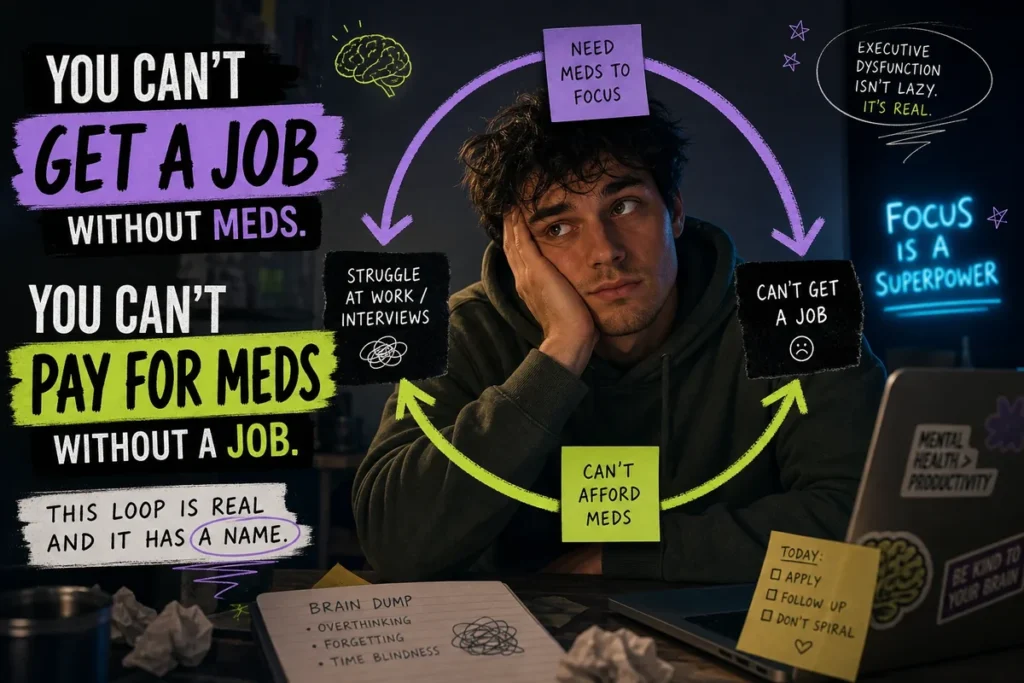
If you have ADHD and you are currently out of work, there is a particular kind of dread that might be familiar: you know you need to apply for jobs, but without medication your brain resists every step of that process. And you know you need medication, but without income you cannot pay for it. The loop closes around you before you have done anything wrong. This is not a motivation problem, and it is not a character flaw. It is a structural feedback loop built from real neurological deficits colliding with a healthcare system that makes treatment hardest to access for the people who need it most.
The Employment Gap Is Not About Trying Harder
Adults with ADHD are significantly overrepresented among the unemployed and economically inactive. The Adult Psychiatric Morbidity Survey 2014, a large population study conducted across England, found that unemployed adults and economically inactive adults were substantially more likely to screen positive for ADHD traits than their employed counterparts. Among people receiving disability-related out-of-work benefits specifically, roughly one in three screened positive for ADHD, compared to fewer than one in eleven among people not receiving such benefits. That gap is not explained by personal effort. It reflects the accumulated weight of executive dysfunction across every job-related task: applying, interviewing, maintaining performance, and avoiding the pattern where the novelty of a new role carries someone for a few months before the job’s demands outpace what an unsupported ADHD brain can reliably deliver.
The same survey found that ADHD traits became more prevalent as household income decreased, not randomly, but as a consistent gradient. The lowest-income quintile carried the highest rate of ADHD characteristics. This pattern appears across national surveys and points to something more than individual misfortune. When a neurodevelopmental condition consistently shapes educational outcomes, occupational trajectories, and the ability to maintain employment over time, the result is a compressed income baseline that makes every subsequent financial crisis harder to absorb.
Delays in diagnosis lead to academic and occupational setbacks, which then restrict financial access to care, perpetuating a cycle of disadvantage. Addressing these issues will require not only targeted service improvements but also coordinated, cross-sector reform.
That framing comes from a 2024 analysis of lived-experience submissions to an Australian Senate Inquiry on ADHD, a study that reviewed hundreds of first-person accounts of what it actually costs to have ADHD and limited income at the same time. The language is clinical. The lived experience beneath it is not.
What Happens to the ADHD Brain When Medication Disappears
ADHD medication does not give the brain something it is missing the way that insulin provides something a diabetic body cannot produce. Stimulant medications primarily enhance dopaminergic and noradrenergic signalling in prefrontal-striatal circuits, the pathways that govern sustained attention, working memory, response inhibition, and the ability to initiate goal-directed behaviour when there is no immediate reward attached to starting. When that signalling is supported, many people with ADHD experience meaningful improvements in exactly the functions a job search demands: holding a task in working memory long enough to complete it, sustaining attention through a cover letter when no one is watching, resisting the pull of avoidance when the anxiety of rejection feels louder than the urgency of applying.
Take those supports away, and the brain does not simply return to a neutral state. It returns to a state where working memory errors are frequent, delay discounting is steep, and decision-making under uncertainty becomes markedly harder. Research by Ikegami et al. (2026, BMC Psychology) used structural equation modelling to trace how these deficits interact: steeper delay discounting reduces sustained attention, which compounds with working memory errors, which together produce significantly poorer decision-making outcomes. The pathway is sequential. Losing one function destabilises the next. For someone trying to navigate a job search, which requires sustained attention, future-oriented planning, complex multi-step task management, and repeated tolerance of delayed rewards, that cascade is not a minor inconvenience. It is the difference between being able to function and not being able to start.
Why job searching is uniquely hostile to the unmedicated ADHD brain: Job applications combine almost every demand that ADHD executive dysfunction struggles with most, unstructured time, no external accountability, high anxiety, distant rewards, and tasks that require initiating without a clear first step. Unmedicated, each of those frictions compounds the others.
Does Medication Actually Improve Employment Outcomes?
Research suggests it helps, though the relationship is not perfectly clean. A retrospective study drawing on Medical Expenditure Panel Survey data from 2013 to 2019 compared employment and behavioural outcomes between adults with ADHD who received stimulant treatment and those who did not. Among the weighted patient sample studied, the large majority were receiving stimulant treatment. Adherence to medication was associated with improved social and behavioural outcomes, and subgroup analyses pointed toward meaningful differences in functional capacity between those who were consistently treated and those who were not.
A separate line of research has identified that stimulant efficacy depends in part on the nature and degree of executive function deficits being addressed. Clinical research on predictors of stimulant response found that people with weaker baseline executive function often showed greater detectable improvement from medication, likely because those individuals had fewer compensatory strategies available and therefore showed clearer gains when prefrontal signalling improved. In plain terms: many of the people most impaired by untreated ADHD tend to be the ones for whom medication produces the largest functional shift, and those are often the same people with the fewest financial resources to maintain access to that medication.
This is where the loop closes most cruelly. The severity of impairment increases the likelihood of unemployment. Unemployment removes access to the treatment that most directly targets that impairment. And the impairment, now unaddressed, makes it harder to do the thing needed to restore the access that was lost.
The Neuroscience of Why a Job Search Can Feel Impossible Unmedicated
Job searching without adequate ADHD support is not just difficult. For many people with ADHD, it can be genuinely neurologically unsustainable for any meaningful duration. This deserves to be said clearly, because the cultural default is to treat job-search struggle as a motivational problem, a matter of not wanting it badly enough, not trying hard enough, not getting off the couch.
The research on executive function and ADHD paints a different picture. Russell Barkley’s model of ADHD as primarily a condition of executive functioning situates the core problem not in attention per se, but in the brain’s capacity to self-regulate behaviour over time, across contexts, and toward delayed goals. A job search is a long, unstructured, anxiety-saturated exercise in exactly that capacity. Tasks must be generated with no one assigning them. Effort must be sustained without visible progress for weeks or months. Rejection must be tolerated repeatedly without letting it collapse the sense of self. Multiple applications, contacts, and deadlines must be held in working memory simultaneously, with no external system providing reminders.
For a brain with impaired working memory, steep delay discounting, and reduced prefrontal regulation of emotional responses, this is not a test of willpower. It is a test of neurological infrastructure that ADHD specifically compromises. The Australian Senate Inquiry submissions described this reality in unambiguous terms: participants reported that ADHD made it functionally very difficult to sustain the behaviours required to secure employment, and that without employment they lost access to the very supports that would have made those behaviours more accessible.
From the community: “I truly want to know if anyone with ADHD has found an occupation that they thrive at. Like to the point where they don’t feel like they need to try to be neurotypical, in order to succeed at their job. I have this recurring thought where I feel like I’m forcing myself into something that just doesn’t fit.”, r/ADHD thread
What Financial Stress Does to Medication Effectiveness
There is a second layer to this that most conversations about ADHD and unemployment skip entirely. Even when someone manages to access medication while under significant financial strain, the medication’s effectiveness is not operating in a neutral environment. Research synthesised in a 2026 evidence review on stimulant treatment and stress found that financial strain was specifically associated with attenuated functional benefits from stimulant medication, alongside higher rates of affective and sleep-related side effects. The prefrontal-striatal circuits that stimulants target are the same circuits that are most sensitive to chronic stress. When financial pressure is ongoing, cortisol can disrupt the very dopaminergic pathways that medication is attempting to support.
This means the benefit of treatment is not simply binary, medicated versus unmedicated. It exists on a spectrum, and that spectrum is compressed by the same conditions that make unemployment most damaging. Someone who is medicated but facing eviction, food insecurity, or sustained financial pressure is unlikely to experience the same functional return from their medication as someone taking the same dose under stable conditions. The crisis compounds the impairment even when treatment is nominally in place.
Financial strain was specifically noted as a factor associated with attenuated functional benefits from stimulant treatment, suggesting that the economic conditions of poverty may reduce the effectiveness of the very thing poverty has forced someone to rely on to function.
Why Healthcare Access Disappears Precisely When You Need It Most
In the United States, ADHD medication access is tightly coupled to insurance coverage, which is in turn tightly coupled to employment. Employer-sponsored health insurance covers the majority of working-age adults. Lose your job and you typically lose your coverage, sometimes immediately, sometimes after a bridge that costs more than many people’s rent. The medication that was helping maintain the executive function to do your job becomes inaccessible exactly when you most need it to find the next one.
This is not a bureaucratic oversight. It is the predictable outcome of a system where healthcare is structured as an employment benefit rather than a baseline service. For people without ADHD who become unemployed, the disruption is real but more likely to be navigable. For adults with ADHD, losing insurance mid-episode of unemployment often means losing the neurological scaffolding that would make climbing back out possible. The Australian Senate Inquiry data found that financial barriers to accessing therapeutic services were among the most consistently cited unmet needs, with the majority of submissions naming affordable access to care as a core problem. The pattern is not unique to Australia. It reflects a structural reality about how ADHD care intersects with income across healthcare systems.
Out-of-pocket costs for ADHD psychiatric care without insurance vary widely, but in many private practice settings they represent a significant barrier for anyone on an interrupted or reduced income. Monthly medication costs without coverage range from relatively modest amounts for older generic formulations to substantially more for newer extended-release options. For someone who is unemployed and uninsured, this is not a access barrier that perseverance alone overcomes. It is a structural wall, and it tends to be highest for the people who have the least capacity to scale it.
A note on the 340B program: Federally Qualified Health Centers in the United States operate under the 340B drug pricing program, which reduces medication costs dramatically. Many can prescribe stimulant medications at sliding-scale fees based on income. Finding one near you is one of the highest-leverage actions available when insurance is gone. Start at findtreatment.gov or search your state name alongside “340B health center.”
The Shame Layer That Makes Everything Harder
Running underneath all of this is something that makes the neurological problem significantly worse: shame. When ADHD leads to missed application deadlines, flaked interviews, or job leads that felt urgent in the moment and faded before any action was taken, the cultural narrative that arrives is rarely “this person has a neurological condition affecting executive function.” The narrative that arrives, from employers, from family members, from an internal voice shaped by decades of unexplained failure, is that the person is simply not trying hard enough.
That verdict is not just painful. It is neurologically costly. The ADHD shame spiral activates threat-response systems that further compromise prefrontal function, narrowing the very cognitive resources needed to problem-solve a way out of the situation. Research examining the lived experience of rejection sensitivity in ADHD has documented how perceived failure and criticism can produce acute emotional dysphoria that makes sustained task engagement effectively impossible in its immediate aftermath. Every failed application is not just a failed application. It is potential fuel for a shame response that shuts down the next attempt before it begins.
The insidious feature of this loop is that the shame narrative feels true. Not enough applications are going out. Follow-up is not happening. The things that people say you need to do to find a job are not being done. The reasons for this are neurological, but they manifest as behavioural failures, and behavioural failures feel like character flaws. This is what ADHD paralysis looks like from the inside when the stakes are highest: not laziness, but a system under pressure, calling itself a failure for the locking.
Adults with ADHD who maintain high functioning often do so at the expense of compensatory strategies and sustained masking. Their impairment is invisible, not absent, and the psychological burden of that concealment, including shame, emotional exhaustion, and cognitive fatigue, frequently remains invisible within systems designed to measure only what they can see externally.
What Actually Breaks the Loop
The cycle is real. That does not mean it is permanent. Breaking it requires working on two problems simultaneously rather than waiting for one to solve the other, because the whole trap of the loop is the belief that the medication must be fixed before the job can be found, or the job must be found before the medication can be afforded.
On the medication access side, Federally Qualified Health Centers and community mental health centres in the US operate on sliding-scale fees and are often able to prescribe ADHD medications at significantly reduced cost. The 340B drug pricing program, combined with manufacturer patient assistance programs, can bring monthly medication costs within reach even without insurance. Telehealth ADHD services have also expanded access considerably, though prescribing regulations for controlled substances vary by state and country. In the UK, a GP can provide referrals to NHS ADHD services, and some areas have community mental health teams that do not require private coverage. These routes are not easy to navigate. They are, however, navigable, and they do not require a job first.
On the job-search side, the key is reducing reliance on the exact cognitive functions ADHD most compromises. External structure replaces internal working memory: visible task systems, body doubling, time blocking with real external accountability, and scheduling application tasks at the specific time of day when medication, if available, is typically most effective. If your medication peaks mid-morning and fades by early afternoon, applying during the peak is not a preference. It is a clinical strategy. Your career path may already reflect the chaos that untreated ADHD creates across years of employment. The ADHD Career pillar covers the structural barriers in more depth, including how to identify roles where ADHD traits create advantage rather than friction.
The financial dimension of ADHD deserves its own honest reckoning too. Adults with ADHD are overrepresented in the lowest income brackets not because of poor values but because of accumulated executive dysfunction costs across years of decisions made with a brain running at a neurological disadvantage. Understanding that framing does not solve the debt or the unemployment, but it changes what the solution looks like. It shifts the question from “how do I try harder” to “what external structure do I need to compensate for what my brain cannot reliably do alone.” That is a solvable question. The first one is not. The ADHD Money pillar goes deeper on how executive dysfunction creates financial patterns that look like poor choices but are actually predictable outputs of specific neurological deficits, which matters when you are trying to rebuild financial stability while under pressure and under-supported.
The Structural Problem Deserves a Structural Name
What this describes is not a series of individual failures. It is a predictable systemic outcome: a neurodevelopmental condition that compromises employment is treated through a system that requires employment to afford treatment. The result, for a significant proportion of adults with ADHD, is a loop with no internal exit. It cannot be worked around by trying harder. It cannot be saved through when the savings never accumulated. It cannot be overcome through self-motivation when the working memory deficit is, by definition, the thing preventing the self-motivation from converting into action.
The first thing that needs to change is the framing: from “why won’t they just apply for jobs” to “how is someone expected to execute a complex, multi-week, rejection-saturated, unstructured task without the neurological supports that make that task possible?” The second thing that needs to change is access. Not as a favour, and not as a safety net framed as charity, but as a recognition that ADHD is a disability with documented occupational consequences, and that restricting treatment access based on income produces exactly the outcomes the data shows it produces.
Until that changes at a policy level, the practical work is about finding every crack in the wall: every subsidised service, every sliding-scale clinic, every external structure that reduces the load on a working memory system that is already carrying too much. Not because you should have to. Because the loop only breaks from the inside until the system decides to break it from the outside.
Quick Dopamine Hits:
- Write three job application tasks on separate sticky notes and place them somewhere physically visible right now. Do not keep the list in your head or on your phone. Visibility is the workaround when working memory fails.
- Set a one-hour body double session with someone online, a friend on a video call, a coworking stream, a library. Your nervous system needs an external presence to activate when internal motivation is depleted.
- If you are uninsured, search your state name plus ‘340B health center’ or use SAMHSA’s treatment locator at findtreatment.gov. Many federally qualified health centers can prescribe ADHD medication on a sliding-scale fee, often at significantly reduced cost.
Rate this article
Was this a useful hit?