A Minor Critique Just Knocked the Air Out of You. Your Brain’s Homeostasis System Is the Reason Why.

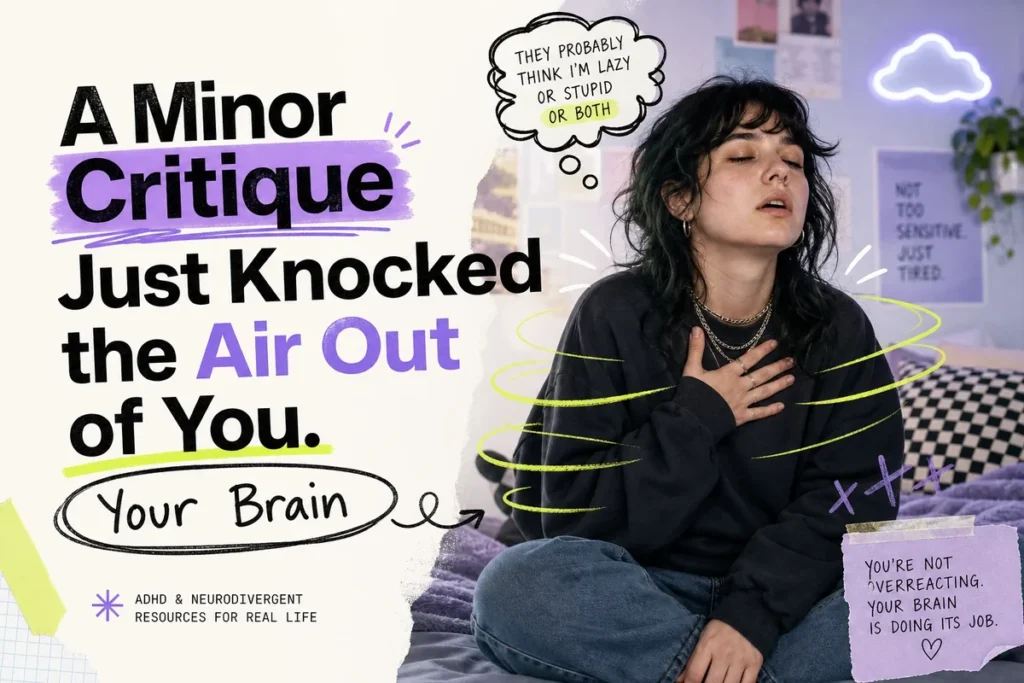
Someone gives you constructive feedback on a piece of work. They word it carefully. Their tone is kind. The criticism is probably accurate. And within seconds, your heart rate climbs, your throat tightens, and the day that was fine two minutes ago is now functionally over. You’re not sad, exactly. You’re not angry, exactly. You’re something that doesn’t have a clean name but sits in your chest like a fist. Later, replaying it, you know the feedback was reasonable. You know your reaction was disproportionate. And you add that knowledge to the growing pile of evidence that something is wrong with you.
Nothing is wrong with you. What is happening is a measurable failure of the brain’s emotional homeostasis system, and understanding the specific mechanics of that failure changes the story from character flaw to neurobiology. This is about RSD symptoms, but it is also about something more precise: why the scale of the trigger does not determine the scale of the response, and why that gap is not psychological weakness but structural architecture.
What RSD Symptoms Actually Look Like in the Minor-Critique Moment
Rejection sensitive dysphoria in the context of ADHD is most commonly described through the lens of obvious rejection, the unanswered text, the social exclusion, the failed job application. But the version that does the most daily damage is subtler. It is the colleague who flags a small error in a meeting. The partner who suggests a slightly different approach. The friend who offers an opinion about a choice you made. These are not attacks. Nobody intended harm. And yet the response your body produces is indistinguishable, in its early seconds, from genuine threat.
Dr. James Kustow, a psychiatrist specializing in adult ADHD, described RSD as “real, embodied, and deeply impairing” in a June 2026 ADDitude webinar, adding that its clinical significance is still catching up to what people with ADHD report experiencing. What they report experiencing, consistently, is not just emotional pain but physical sensation. A 2026 qualitative study by Rowney-Smith, Sutton, Quadt, and Eccles, published in PLoS One and conducted through Brighton Sussex Medical School, found that participants with ADHD described rejection sensitivity as producing immediate, overwhelming bodily responses: one participant described “a pinch in your heart, like a very swift, brief… your heart or like your throat closing up… feels like your heart kind of drops maybe a bit.” Another described the sensation as though “a chair had been taken out from beneath you.” A third used the image of a hand warmer clicking into heat, “getting warmer inside me… everything inside.”
“Rejection sensitivity is a painful and overwhelming experience which often lasts a significant amount of time, between hours and weeks, and can resurface many years later.”, Rowney-Smith et al., 2026, PLoS One
These are not metaphors for emotional discomfort. They are descriptions of an autonomic nervous system response triggered not by a disaster but by mildly critical feedback on a Tuesday afternoon. The mismatch between input and output is the core of the problem, and it points directly to a specific failure in the brain’s emotional regulation circuitry.
Why the ADHD Brain Cannot Calibrate the Size of a Threat
To understand why a minor critique can produce a response this large, you need to understand what is supposed to stop it from doing that. In a brain where emotional regulation is working as designed, the process goes roughly like this: a signal arrives that could be threatening, the amygdala generates an emotional response, and the prefrontal cortex evaluates whether that response is proportionate to the actual situation and applies braking force where needed. The emotion is registered, modulated, and returned to baseline. The key word is modulated. The system is not meant to eliminate emotion but to scale it to fit the situation.
In ADHD, neuroimaging consistently shows reduced functional connectivity between the prefrontal cortex and the limbic system, including the amygdala. Russell Barkley identified emotional dysregulation as a core component of ADHD as early as 2014, explicitly linking it to deficient cortical regulation of the limbic system’s emotional outputs. When the inhibitory function of the prefrontal cortex is underperforming, the emotional signal from the amygdala arrives at something close to full intensity, without the usual filtering before it reaches consciousness and behavior. The response is not amplified beyond what the amygdala generates at the source. What is failing is the scaling function, the part of the circuit that is supposed to match output to input.
A narrative review synthesizing evidence across neuroscience, cognitive psychology, and clinical psychiatry, building on research into fronto-limbic networks in ADHD, described this as metacognitive dysregulation: an impaired ability not just to manage emotions but to accurately appraise whether the emotion being generated is appropriate for the situation triggering it. Many people with ADHD are not simply experiencing more fear in response to a critique. They are experiencing fear without the usual real-time feedback that the threat is small.
The Homeostasis Problem: Why Your Brain Cannot Return to Calm
The physical sensations of RSD are not just distressing in the moment. They persist in a way that ordinary disappointment typically does not. The Rowney-Smith et al. study noted that participants described rejection sensitivity episodes as lasting “between hours and weeks,” and as capable of resurfacing “many years later.” This durability points to a second failure beyond the initial disproportionate response: the return-to-baseline mechanism itself is often impaired in ADHD.
Allostasis, the term researchers use for the brain’s capacity to anticipate and recover from physiological disruption, depends on the same prefrontal and limbic circuits that are underperforming in ADHD. Barrett et al.’s framing of certain conditions as “disorders of allostasis” is illuminating here: when the regulatory circuitry that should bring the body back to equilibrium is unreliable, a single small trigger can keep the system in an elevated state far longer than the situation warrants. For many people with ADHD, this means the four-second incident of critical feedback can translate into hours of a chest that won’t settle, followed by a quiet, background hum of shame that persists into the next day.
The proportionality gap: RSD is not simply about feeling emotions more intensely than other people. It involves a specific failure to scale the emotional response to the size of the trigger, combined with a slower return to baseline. These are two separate structural problems, both rooted in the same fronto-limbic circuitry.
This is why you can know, intellectually, that the feedback was minor and still not be able to feel it as minor. Knowing and feeling draw on different systems. The cognitive appraisal that says “this is not a crisis” lives in the prefrontal cortex. The body’s thermostat, the one that decides when it is safe to come down from alert, runs on the same circuitry that is not communicating well with the rest of the system. Understanding is not the same as regulation, and no amount of talking yourself through it will fully compensate for a circuit that isn’t reliably completing the loop.
Why It Hits the Body First
The physical sensation that arrives before you have even consciously processed what was said is not incidental to RSD. It is part of the mechanism. Emotional signals in the brain are processed partly through interoceptive pathways, the networks that register and interpret what is happening in the body. The insula, a brain region that plays a central role in integrating bodily signals with emotional experience, shows distinct patterns of activity in conditions involving emotional dysregulation. When threat is detected, the body responds first, heart rate, skin conductance, muscle tension, and the brain then reads those signals as part of constructing the emotional experience.
This sequence means that the physical reality of RSD tends to arrive first. The chest tightening and the racing heart are not downstream symptoms of an emotion that already formed. They are part of how the emotion is built. For people with ADHD, whose interoceptive signaling may itself be dysregulated, this creates a compounding problem: not only does the initial response often fail to scale to the trigger, but the bodily sensations that follow make the emotion feel more real, more urgent, and more threatening than it was. The body is providing evidence that something serious happened. The brain, already running on impaired modulation circuitry, takes that somatic evidence seriously.
The Rowney-Smith et al. study specifically noted that the bodily sensations described by participants were “a new finding in the context of rejection sensitivity.” The researchers flagged this as significant because it suggests that RSD is not merely an emotional or cognitive phenomenon but a somatic one, a full nervous system event that uses the body as both signal and amplifier. This matters practically because it points toward body-based intervention, not just cognitive strategies, as the most effective first response in the acute moment.
From the research: Participants in the 2026 Brighton Sussex Medical School study described RSD bodily sensations as “a pinch in your heart,” a feeling of heat flooding inward, and the sense that “a chair had been taken out from beneath you.” The researchers flagged this somatic dimension as a new and clinically significant finding, one that points toward body-first interventions rather than purely cognitive approaches.
The Identity Threat Hidden in Every Critique
One of the most important clinical observations about RSD is what Kustow calls “identity-level pain.” Minor criticism, even when framed generously, is often not processed by the ADHD brain as information about a specific piece of work or behavior. It arrives as information about the person. The fronto-limbic dysregulation that prevents proportionate scaling also impairs the normal ability to contextualize feedback: to hear “this section of your report could be clearer” and file it as a bounded observation about a document rather than evidence of personal inadequacy.
This is why the shame response follows so quickly after the initial physical sensation. For many people with ADHD, decades of accumulated experiences of being corrected, misunderstood, and found wanting have built a hypervigilant threat-detection system that is already primed to find confirmation of unworthiness. The feedback itself does not have to be harsh. The system is already loaded. What looks like an overreaction to the person giving the feedback is actually a very fast trip-wire response in a system that has been collecting evidence for years that the next critique will confirm what it already suspects about you.
“RSD causes identity-level pain. It can shape a person’s entire approach to life.”, Dr. James Kustow, psychiatrist specializing in adult ADHD, ADDitude webinar, June 2026
Alex Partridge, author and founder of the ADHD Chatter podcast, has described the behavioral consequences of this pattern plainly: “you’re making decisions dictated by a fear of being criticized, you’re putting everyone else’s needs ahead of your own, and/or you’re overworking to protect yourself from criticism to such an extent that you’re exhausted.” The minor critique, in this context, is not a standalone event. It is one data point in a pattern of self-protection that has been shaping choices about relationships, careers, and self-expression for years, often long before anyone had a name for what was driving it. For those who discovered their ADHD late, this accumulation can span decades of identity built around managing a response they never understood.
What Happens When You Try to Mask the Response
Most people with ADHD who experience RSD have developed an elaborate system for hiding it. The Rowney-Smith et al. study identified masking as one of the three primary themes in participants’ descriptions of rejection sensitivity, alongside withdrawal and bodily sensations. Masking in this context means adopting a performance of calm or nonchalance in the immediate aftermath of the trigger, suppressing the visible signals of distress while the internal response continues unchecked.
The researchers noted a particularly damaging dynamic that participants described as a “vicious circle”: when others perceive the mask as evidence that the person is genuinely unaffected by criticism, they tend to increase the frequency of critical feedback, which increases the frequency of RSD episodes, which demands more masking, which leads to greater dissociation from the person’s own emotional experience. One participant in the study described needing therapy specifically to “re-identify their true self” after years of consistent masking had created a genuine disconnection from their own reactions and preferences.
This long-term consequence of masking is one of the most under-discussed costs of RSD. Suppressing the visible evidence of emotional pain does not discharge the physiological response. Research on emotional suppression more broadly indicates that the internal arousal associated with an emotion continues, and may even intensify, when its external expression is blocked. The person who appears fine after receiving feedback is not fine. They are absorbing the full intensity of the response without the release valve that expressing it would provide, and doing so repeatedly takes a cumulative toll on emotional capacity that connects directly to ADHD burnout and nervous system depletion.
Does Medication Help With RSD Symptoms?
Stimulant medications for ADHD work primarily by increasing the availability of dopamine and norepinephrine in the prefrontal cortex, which theoretically should improve the inhibitory control that modulates emotional responses. In practice, the picture is more complex. A research synthesis on stimulant use in adults with ADHD found that while stimulants consistently improve core attention and hyperactivity traits, benefits for emotion dysregulation are “smaller and more variable,” particularly during periods of high psychosocial stress.
For RSD specifically, clinical reports suggest that stimulants help some people and do comparatively little for others. Non-stimulant medications that target norepinephrine pathways, such as guanfacine and clonidine, are sometimes used off-label for emotional dysregulation with more consistent results in this domain. Some clinicians, including William Dodson whose work focuses specifically on ADHD emotional dysregulation, have noted that certain monoamine oxidase inhibitors may address the RSD response more directly than stimulants. The honest position is that medication is not a reliable off-switch for RSD, and for many people with ADHD, emotional dysregulation remains one of the more variable treatment targets. This is not a reason to avoid seeking support, it is a reason to have realistic expectations about what medication alone can and cannot address in this specific domain.
What Actually Helps in the Moment and After
Because RSD is a body-brain event rather than a purely cognitive one, the most effective immediate interventions tend to work through the body. The physiological component of the response, elevated heart rate, muscle tension, flooding heat, runs on the autonomic nervous system, and the autonomic nervous system responds to physical signals more readily than to reassuring thoughts in the acute phase.
Slow, extended exhales activate the parasympathetic nervous system through the vagus nerve, which directly opposes the sympathetic activation driving the physical sensations. A breath out that is longer than the breath in, repeated for two to three minutes, can shift the physiological state enough to create a window for more effective cognitive processing. This is not a soft relaxation technique. It is a direct neurological intervention supported by research on cardiac vagal control and autonomic regulation.
Physical pressure also provides competing sensory input. Researchers and clinicians working with ADHD note that proprioceptive stimulation, the sense of pressure or resistance from the environment, can help ground an overwhelmed nervous system by giving the interoceptive processing system something concrete to register. Pressing a hand firmly against the sternum, the physical location where many people feel the RSD response most intensely, offers the body a different signal to process alongside the alarm.
The return to baseline after an RSD episode takes far longer than it feels like it should. Knowing that in advance changes the calculus: still feeling the response 90 minutes later is not weakness. The circuit is slower to reset, and patience with that lag is not self-indulgence, it is working with your actual biology.
Naming the sensation before interpreting the feedback also matters for a structural reason. When you label a physical experience before constructing a narrative about what it means, you engage the prefrontal cortex in a task it can manage in that moment, description rather than evaluation, which helps bring the inhibitory system back online incrementally. “I feel tightness in my chest” is something your brain can process without amplifying the threat. “They think I’m incompetent” is a narrative that feeds directly back into the amygdala’s threat-detection loop.
Over the longer term, one of the most consistent findings in qualitative research on RSD is that the expectation of rejection causes more distress than actual rejection for many people. The Rowney-Smith et al. study found that participants experienced more suffering from anticipating criticism than from the criticism itself when it arrived. This points toward a productive edge of longer-term work: not eliminating the response when it happens, but gradually building a track record of experiences in which feedback arrived and the world did not end, giving the threat-detection system real evidence rather than accumulated fear to draw from.
The Difference Between Knowing and Healing
Understanding the neuroscience of RSD symptoms does not make them stop. It does not mean that the next piece of constructive feedback will land without a body-level response. What it does is interrupt the second layer of pain: the shame spiral that begins when you watch yourself react to something objectively small and conclude that something is deeply wrong with you at the core.
The reaction to minor critique is not evidence of weakness or immaturity. It is the predictable output of a nervous system whose emotional homeostasis circuit is not reliably performing the scaling and recovery functions it is supposed to perform. That circuit can be supported with body-based tools, with medication in some cases, and with therapeutic approaches that address accumulated hypervigilance rather than only the acute response. But it starts with understanding that what you are experiencing when a minor critique knocks the air out of your chest is a measurable failure of brain architecture, not a failure of character.
If the patterns described here, the body-level response, the prolonged recovery, the way criticism arrives as identity information rather than bounded feedback, feel familiar, the relationships section of this site covers how RSD reshapes communication and connection over time, including the specific dynamics that tend to develop when one or both people in a relationship are navigating this response. The physical blow of minor criticism is not the end of the story. But understanding its architecture is where the rest of the story begins.
Quick Dopamine Hits:
- When critique lands and your chest tightens, press one hand flat against your sternum and breathe out slowly for 6 counts, the physical pressure gives your nervous system a competing signal to focus on.
- Name the sensation before the story: say out loud or write ‘I feel [sensation] in [body part]’ before you allow yourself to interpret what the feedback meant. Naming the physical experience interrupts the escalation loop.
- Set a 20-minute timer before you respond to any criticism in writing. Your emotional return-to-baseline takes longer than it feels like it does, give your prefrontal cortex time to come back online before you react.
Rate this article
Was this a useful hit?