Your Nervous System Isn’t Being Mean. It’s Being Adjusted. How to Tell Your Partner the Difference.

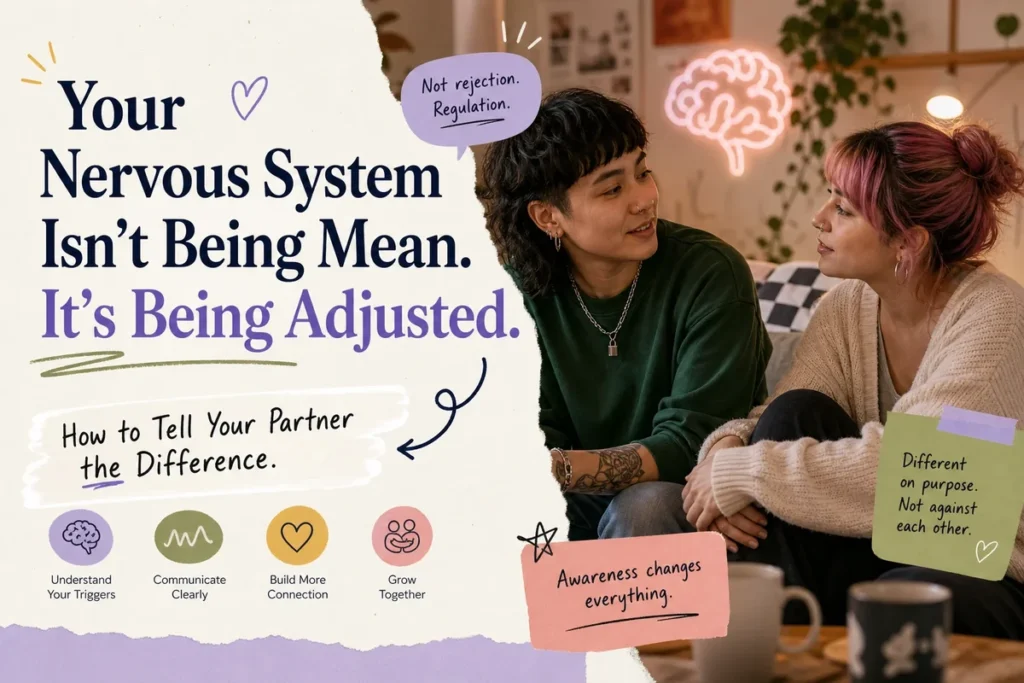
The medication adjustment period has a particular cruelty to it. You started the process because you wanted to function better, to be less chaotic, to finally show up the way you’ve always meant to. And then, for days or weeks while the dose is being dialed in, you become harder to be around than you were before. Sharper. More irritable. Emotionally unpredictable in ways that feel entirely out of your control. Your partner, who was probably hoping the medication would make things calmer, is now walking on eggshells around someone who snaps at questions and goes cold without warning. You’re standing inside that experience, acutely aware that something is physiologically wrong with your system right now, desperately wishing they could see it the way you feel it, and having absolutely no framework to explain it to them.
This article is about that gap. Not the long-term relationship strain that ADHD creates over years, not the general communication advice for neurodivergent couples, but the specific and underserved problem of the medication window: how to bridge the distance between what your nervous system is doing and what your partner is allowed to understand about it.
What Is Actually Happening Inside Your Nervous System Right Now
ADHD medications, primarily stimulants like methylphenidate and amphetamine formulations, work by increasing extracellular dopamine through blocking dopamine transporters, which affects both noradrenergic and dopaminergic signalling simultaneously. The adjustment period exists because your brain doesn’t simply receive more dopamine and immediately behave better. It is recalibrating. The prefrontal cortex, striatum, and related networks that support attention, emotional regulation, and impulse control are all responding to a new chemical environment. That recalibration has real, measurable neurological noise while it’s happening.
Research published in 2026 found that pharmacological response in ADHD is not determined solely by drug class or dose but is moderated by context, including sustained stress exposure and comorbid emotional traits, with core symptom improvements remaining robust while emotion-linked outcomes showed smaller and more variable effects (Central Stimulants in a Stressed Brain, 2026). In other words, during periods of psychosocial demand, which includes the inherent stress of an uncertain medication process, your emotional system tends to be the last thing to stabilise and the first thing your partner will notice destabilising.
The emotional system is the last thing to stabilise on a new dose and the first thing your partner notices going wrong.
There’s also the rebound problem. Clinical guidance is explicit that stimulants can have withdrawal effects as blood serum levels begin to decline each day. Many people experience increases in irritability and emotional volatility in the hours after peak plasma levels drop, particularly in the late afternoon and evening. Research on stimulant effects on emotional lability confirms that while improvement in emotional dysregulation can be expected for many people with ADHD over time, in a minority of cases stimulants can induce or worsen emotional volatility, and as serum levels decline, a rebound effect can trigger increased emotional reactivity (Posner, Kass, and Hulvershorn, reviewing stimulant and emotional lability evidence). For many people on medication, this creates a predictable window, typically in the late afternoon and evening, where the nervous system is neither medicated nor recovered, and the emotional threshold is at its lowest point of the day. That is often exactly when a partner comes home, starts dinner, and tries to have a normal conversation.
Why Your Partner Cannot See What You’re Experiencing
The fundamental problem is one of invisible physiology. Your partner can observe your behaviour. They cannot observe your neurology. When you snap at a small question, what they see is someone being short with them. What you’re experiencing is a nervous system that is hypersensitive in a way that makes ordinary conversational input register at threat-level intensity. When you go cold and withdraw, what they see is someone shutting them out. What you’re experiencing is a brain that has hit its processing limit and initiated a kind of emergency shutdown to avoid saying something worse.
Emotional dysregulation is a well-documented feature of ADHD that operates independently of the attention traits most people associate with the condition first. Research across multiple studies confirms that emotional dysregulation in ADHD emerges from direct dysfunctions in emotional processing rather than being merely secondary to inattention or hyperactivity. It accounts for real impairments in daily life beyond what attention traits alone would predict (research on emotional dysregulation and ADHD, multiple review studies). During medication adjustment, this system is particularly unstable. The baseline dysregulation that ADHD produces is compounded by the neurological noise of recalibration.
Your partner, who is not inside that system, has no access to this information unless you give it to them. And the cruelest part of the adjustment period is that your capacity to explain it clearly tends to be at its lowest precisely when the dysregulation is at its highest.
The rebound window is real and it has a time stamp: For many people on stimulant medications, emotional volatility peaks in the hours after plasma levels begin to drop, typically late afternoon or early evening. If you can identify your specific window with your prescriber, you can give your partner a time-based context rather than a behaviour-based mystery.
The Language Problem: Why “I’m Just Adjusting to My Meds” Doesn’t Land
You may have already tried to explain this. “It’s the medication.” “I’m still adjusting.” “I’m not actually angry.” And it probably didn’t land the way you needed it to, because that explanation, while accurate, doesn’t give your partner anything they can hold on to. It tells them the cause but not the mechanism. It describes the label without the experience inside the label.
Neurotypical communication about emotional states tends to operate through context. When a neurotypical person says “I’m overwhelmed,” their partner can usually map that to something recognisable: a hard day at work, a conflict, an obvious external trigger. What they don’t have a map for is a state that looks like anger but isn’t about them, or a withdrawal that looks like sulking but is actually neurological resource depletion. The mismatch is structural, not personal. Your partner isn’t failing to understand you because they don’t care. They’re failing to understand you because the experience you’re having doesn’t have a widely shared cultural reference point.
A 2025 qualitative study of adults with ADHD and their romantic relationships (Rudden et al., “I Felt Like a Burden”) found that participants consistently described the exhaustion of navigating an unbalanced emotional dynamic, where their internal experience was invisible to their partner and their behaviour was the only data available. Partners reported lower intimacy and relationship satisfaction in part because they were responding to observable behaviour in the absence of the context that would make that behaviour make sense (Ben-Naim et al., 2017).
Giving your partner the mechanism, not just the label, is what changes this. Not “I’m adjusting to my meds” but something closer to: “My nervous system is currently running without its normal damping mechanism. The medication is recalibrating how much emotional signal gets through. Right now, everything registers at about three times its normal intensity, which means I’m not actually responding to you. I’m responding to the volume of my own nervous system.”
The Three Phases of the Adjustment Window and What Each Feels Like
Not all of the adjustment period feels the same, and naming the phases can give your partner a more useful map than a general warning about mood instability. Most people move through a rough sequence that’s worth articulating out loud before the window begins.
The first phase, typically the first few days on a new dose, tends to involve heightened sensitivity and sharpness. Everything is louder. Transitions are harder. The brain is experiencing more noradrenergic activity than it’s calibrated to, and the nervous system hasn’t yet found its footing with the new level. Emotionally, small things can hit disproportionately hard, not because you’ve stopped caring about your partner but because the signal-to-noise ratio in your brain is temporarily disrupted.
The second phase, often somewhere around days four through ten depending on the medication and dose, is where the emotional rebound issue tends to become most pronounced. The brain is beginning to integrate the new dopamine environment, but the daily peaks and drops of plasma levels create a predictable cycle of better and worse windows. The better window, typically in the hours after dosing, may actually feel more emotionally available than your pre-medication baseline. The worse window, in the late afternoon and evening, may feel more reactive than your pre-medication baseline. Partners often experience this as someone who seems fine at noon and difficult by 6pm, which from the outside reads as inconsistency rather than chemistry.
The third phase is the stabilisation that tends to arrive somewhere between week two and week four, where the nervous system has adapted enough to the new medication environment that the extreme peaks and valleys begin to smooth. This is when the relational static usually quiets down. Getting there, through the first two phases, is where relationship damage tends to accumulate if there’s no shared framework in place.
The adjustment period doesn’t ask for your relationship’s patience. It demands it. And partners can only offer patience they’ve been given a reason to believe in.
How to Give Your Partner a Map Before the Territory Gets Rough
The most effective communication about the adjustment period happens before the hardest moments, not during them. During a moment of emotional dysregulation, executive function can be significantly compromised, working memory may be degraded, and the ability to construct a clear explanatory sentence is often at its minimum. Trying to explain your nervous system in real time while it’s over-firing is like trying to read a map while the car is on fire. It’s not the moment for nuance.
Before a dose change, or at the start of a titration process, one calibrated conversation does more work than a dozen in-the-moment explanations. That conversation has three components. The first is the timeline: “This adjustment period typically lasts two to three weeks. It won’t feel like this indefinitely.” The second is the mechanism: “During this window, my emotional threshold will be lower than usual, especially in the late afternoon and evening. Things that wouldn’t normally bother me will. That’s not a change in how I feel about you. It’s a neurological recalibration.” The third is the specific request: “What I need from you is to try not to take the sharp edges personally, and to flag for me gently when I’ve crossed a line, rather than withdrawing, because I may not be able to see it clearly from inside it.”
Research consistently points to partner understanding of ADHD as one of the most protective factors in these relationships. When partners of people with ADHD understand the neurological basis for the behaviours they’re experiencing, relationship satisfaction tends to improve, even without the behaviours themselves changing. The 2025 qualitative study by Rudden et al. found that when partners understood the condition, participants described experiencing less shame and less internalised self-blame for their relationship difficulties. The map matters as much as the territory.
What Your Partner Is Actually Experiencing (And Why That Matters)
Giving your partner the framework doesn’t mean their experience disappears into the background. During a medication adjustment period, your partner is managing something real. They’re absorbing unpredictable emotional output from someone they love and trying to figure out whether this is temporary chemistry or something permanent about who you’re becoming. Research on ADHD relationships confirms that partners of individuals with ADHD tend to report lower intimacy and relationship satisfaction when ADHD-related behaviour is unexplained (Ben-Naim et al., 2017). The explanation doesn’t just protect you. It protects them from building a narrative that isn’t true.
Partners who are given a clear framework tend to shift from a threat-detection response, “Is this my fault? Is this who they are now?”, to a support response: “This is a temporary physiological event. My job is to stay steady rather than react.” That shift is not possible without the information to support it. Expecting your partner to intuit it, or to tolerate the adjustment period without context, is asking them to trust a black box, which rarely ends well for either person.
An ADDitude survey of 2,500 readers in relationships affected by ADHD found that the happiest couples shared three core attributes: communication, compassion, and curiosity. Not the absence of difficulty, but the presence of a framework for navigating it. The adjustment period is a test of that framework in its most concentrated form.
The Repair Conversation and Why It Cannot Wait
Even with the best pre-adjustment conversation in the world, there will be moments that go wrong. You’ll snap. You’ll go cold. You’ll say something in a dysregulated state that your calibrated self wouldn’t have chosen. The repair after those moments is not optional, and it cannot be deferred to “when things are calmer” in a vague future sense. Working memory in ADHD often means that for your partner, an unrepaired moment sits in memory and forms part of a pattern, even when you’ve moved on internally. The time horizon of the repair matters.
A repair conversation after a dysregulated moment doesn’t need to be long. What it needs to do is separate you from the behaviour, offer the mechanism as context rather than excuse, and re-establish the connection. Something close to: “I know I was sharp with you earlier. That wasn’t about you and it wasn’t who I’m trying to be. My nervous system hit its ceiling. I’m back now, and I’d like to start again if you’re willing.” The goal isn’t to over-explain or to relitigate what happened. The goal is to re-establish that you’re still the same person who chose them, even when your neurology was temporarily making choices they wouldn’t have endorsed.
Emotional dysregulation and stimulants: Treatment trials show that stimulants produce meaningful clinical improvement in emotional dysregulation over time, with robust effect sizes reported in extended studies (Reimherr et al., 2005, 2007, Rösler et al., 2010). But these improvements take time to manifest, and during dose titration, the picture is temporarily messier before it gets cleaner.
When the Adjustment Period Ends but the Pattern Remains
One thing worth naming directly: for some people, the emotional difficulty of the adjustment period reveals something that was already present rather than creating something new. ADHD emotional dysregulation doesn’t simply disappear when the correct dose is found. Stimulants, while effective at reducing core ADHD traits and improving emotional lability in most people, tend to produce smaller and more variable effects on emotion-linked outcomes than on attention outcomes (Central Stimulants in a Stressed Brain, 2026). If the relational difficulty you’re experiencing during adjustment feels like a more intense version of a pattern that was there before medication, it probably is.
This is useful information rather than a problem. It means that the conversation you’re having with your partner about the adjustment period is also the beginning of a longer conversation about what life with your nervous system actually looks like, and what systems and agreements make it sustainable for both of you. For more on building those longer-term patterns, the ADHD Relationships pillar covers how emotional dysregulation, rejection sensitivity, and the daily dynamics of ADHD shape intimate partnerships over time.
The adjustment period is temporary in its most acute form. But the communication skills you build to navigate it become the infrastructure of the relationship that follows. Partners who learn to name the physiology together, to distinguish the nervous system from the person, and to build agreements around predictable flashpoints, consistently describe feeling more connected than before the medication process began. Not despite having navigated the difficulty, but because of it. The window that feels like it’s threatening the relationship is also, if you can find language for it in time, the window that teaches you both how to talk to each other with more precision than you managed before.
The sharpest version of you isn’t the real version. But explaining that requires words you can only find when the sharpness has passed. Find them now, before you need them.
Building the Shared Language Before You Need It
The most durable thing to come out of a medication adjustment period is a shared vocabulary for your nervous system that didn’t exist before. Couples who move through the window without significant relational damage tend to have built two or three specific phrases together in advance: phrases that can be deployed in the moment without requiring the full explanation again. A single word or short phrase that means “I’ve hit my neurological ceiling and need space” is more useful than any amount of retroactive explanation. A pre-agreed signal for “I’m in my rebound window, please don’t initiate hard conversations right now” prevents the conflict from starting rather than managing it after it’s already begun.
This is not about giving ADHD a pass on behaviour that genuinely causes harm. Naming the mechanism doesn’t erase the impact of sharp words, forgotten commitments, or emotional withdrawal. What it does is give both people a fighting chance to respond to what’s actually happening rather than the interpretation that hurt the most. Your partner is not wrong to be affected by the difficult moments. You are not wrong that your nervous system is doing something genuinely physiological. Both of those things are true simultaneously, and the relationship lives in the space between them.
If you’re in the middle of the adjustment period right now and you haven’t had this conversation yet, the first step is simpler than building a full framework. One sentence, tonight, before anything else goes wrong. Something that says: this is temporary, you’re not the target, and I know I’m asking you to hold on. That sentence, sent or said at the right time, has the potential to preserve more than any amount of post-conflict processing ever will. The ADHD Energy pillar explores why nervous system regulation matters beyond medication alone and offers a wider lens on what it costs your system to be in a constant state of recalibration. Steady, the tool built for exactly this kind of high-emotional-load period, can help you track your own patterns and identify the flashpoints before your partner has to find them for you.
Quick Dopamine Hits:
- Before your next dose adjustment, text your partner one sentence: ‘This week my nervous system is calibrating, if I seem on edge, that’s chemistry, not criticism.’ Send it now, before things get hard.
- Pick one predictable flashpoint (evening rebound, morning before meds kick in, high-stress transitions) and name it together out loud: ‘Between 5pm and 7pm I’m at my most raw. Can we agree not to have hard conversations in that window?’
- After a moment where you snapped or went cold, use this exact repair: ‘That wasn’t me being done with you. My nervous system hit a wall. I’m back now. Can we try again?’
Rate this article
Was this a useful hit?