You Keep Ending Up as the Therapist Friend. Your ADHD Is Not a Coincidence.

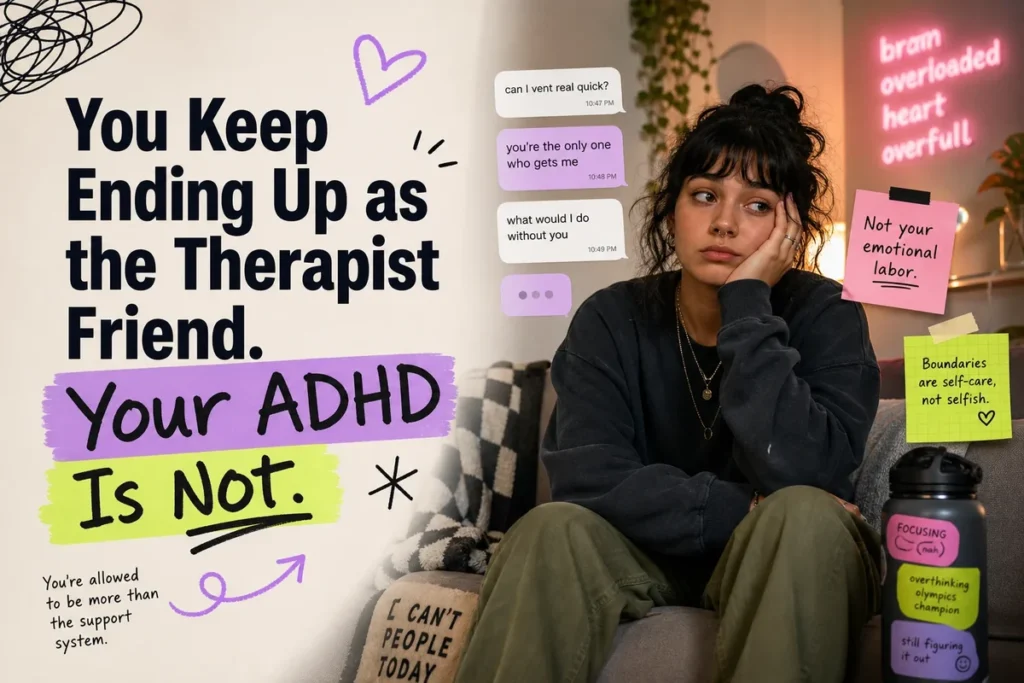
If you look back at your friendship history with ADHD, there is a reasonable chance you will find a pattern: the person who called you at midnight in crisis but didn’t pick up when you were struggling. The friend who needed two hours of processing every time something went wrong, then disappeared when things were fine. The person who described you as their best friend after three weeks, and whose problems became your constant mental background noise for months. You did not choose badly on purpose. Your ADHD brain was doing what it was built to do, and it pulled you directly toward the kind of relationships that would eventually leave you empty.
ADHD one-sided friendship tends to emerge from a specific combination of neurological features: hyperempathy that makes you acutely attuned to other people’s pain, a fawn response that makes keeping others comfortable feel like survival, and a social calibration system that is genuinely disrupted by the executive function deficits at the core of the condition. Understanding each piece of this does not fix the pattern instantly. But it makes the pattern recognisable, and recognition is the only way out.
Why the ADHD Brain Is Unusually Drawn Toward Emotionally Demanding People
The ADHD nervous system does not process social information the way a neurotypical brain does. Research by Chronaki and colleagues found that ADHD is associated with amplified early neural responses to emotionally charged and hostile social cues, a preattentive, near-automatic orienting to emotional signals that fires before conscious thought can intervene. The ADHD brain is not slow to pick up on distress in other people. It registers those signals faster and more intensely than average.
The practical consequence is that when you are near someone who is hurting, anxious, or emotionally dysregulated, your nervous system notices immediately and viscerally. You feel the pull of their need before you have consciously decided to help. This is what people mean when they describe ADHD hyperempathy: not simply caring about others, but absorbing their emotional states so rapidly and completely that the line between their distress and your own becomes difficult to locate. People in distress tend to be expressive, intense, and demanding of emotional attention. For an ADHD brain wired to track emotional signals, these people can be neurologically compelling in the same way that novelty is compelling. They generate a constant supply of emotional information for a nervous system that often struggles with the predictable and the flat.
Young adults with ADHD reported receiving less assistance and advice in their friendships than young adults without ADHD, and their relationships were less characterised by the positive qualities of traditional mutual support (Bukowski and Hoza, 1989, Hartup and Stevens, 1997, cited in peer socialization research).
This does not make emotionally demanding friendships good for you. It makes them feel familiar and activating in ways that quieter, steadier friendships often do not. When someone needs you intensely, your brain registers a reward signal. When someone is doing fine and simply wants to spend time with you, the signal is subtler and the ADHD brain, which runs on interest and urgency, can undervalue that kind of connection without realising it is doing so.
The Fawn Response and Why Saying No Never Felt Like an Option
The fawn response is the least discussed of the primary stress responses. Where fight escalates and flight escapes, the fawn response manages perceived threat by becoming useful, agreeable, and emotionally accommodating. You sense the possibility of someone’s displeasure and your nervous system moves, before you consciously decide anything, toward whatever will prevent that displeasure from materialising.
For many adults with ADHD, particularly those who grew up undiagnosed, the fawn response was not a choice. It was a solution to a recurring problem: having a nervous system that was visibly out of step with what was expected, and learning that the social consequences of that mismatch could be softened by being sufficiently helpful, warm, and agreeable. Research and clinical writing on rejection sensitive dysphoria in ADHD describes this pattern as a form of chronic self-abandonment, seeking safety through people-pleasing, perfectionism, and avoidance. These patterns fuse into the person’s identity over time, making them particularly difficult to recognise from the inside. The fawn response does not feel like self-abandonment while it is happening. It feels like being a good friend. The exhaustion usually arrives later, after the call has ended and you realise you have no idea how you actually feel about anything that was just discussed.
The fawn-to-friendship pipeline: Research on rejection sensitivity in ADHD (Rowney-Smith et al., 2026, PLoS One) found that the expectation of rejection caused more distress than actual rejection itself. When friendship withdrawal feels like rejection, the brain will work extraordinarily hard to keep even unsatisfying relationships intact, because staying feels neurologically safer than the alternative.
The fawn response also warps how you read reciprocity. When you are trained to prioritise other people’s comfort above your own needs, you can lose the ability to notice when an exchange is imbalanced, because the discomfort of imbalance gets filed under “my problem to manage” rather than “something worth naming.” You become very good at generating reasons why the other person’s unavailability is understandable. You become less practised at asking whether the arrangement is actually working for you.
Does ADHD Pull You Toward One-Sided Friendships?
Research suggests that yes, several ADHD-related mechanisms work in parallel to make one-sided friendship patterns more likely. The first is the emotional pull described above: the ADHD nervous system often finds high-need, emotionally intense people more activating than low-drama ones, at least initially. The second is a social calibration problem rooted in executive function.
Social calibration requires working memory to hold the history of a relationship in mind and assess whether the pattern over time is fair, impulse control to avoid immediately agreeing to things before evaluating whether they are good for you, and planning capacity to notice when a friendship is systematically taking more than it gives. These are precisely the executive functions that ADHD disrupts most reliably. Research consistently identifies working memory deficits as central to ADHD impairment in adults (Barkley and Murphy, 2010), and those deficits affect not just task management but the ongoing monitoring of social dynamics.
The result is a combination that is genuinely difficult to override: you tend to be drawn toward people whose needs are loud and compelling, you have a trained instinct to make yourself useful to those people, and you may lack the background processing capacity to reliably notice when the pattern has tipped into something that is only ever flowing in one direction.
The Social Calibration Gap: Why You Often Don’t Notice Until You’re Already Drained
Social calibration in many adults operates automatically. The brain keeps an informal ledger without conscious effort, tracking who initiates, who follows up, whose needs dominate conversations, who asks questions and who only answers them. This tracking does not require deliberate attention. It runs in the background and surfaces as a general sense that a relationship feels right or feels off before anything specific can be named.
In ADHD, this background tracking tends to be unreliable. Working memory deficits mean that individual instances of imbalance get processed and then slip out of the accessible record before they can accumulate into a visible pattern. You might remember that a friend didn’t show up during your difficult week, but not reliably connect that to the several times in the previous month when you showed up for theirs. Each instance feels isolated rather than cumulative. The friendship gets assessed interaction by interaction rather than as an evolving relationship with a history.
Girls and gender-diverse individuals with ADHD were found to be socially motivated to avoid rejection and engage in masking and compensatory behaviours specifically in social contexts, with their difficulties appearing more internalised and harder for others to detect (Williams et al., 2025, Archives of Disease in Childhood).
This calibration gap is compounded by hyperempathy. When a friend is in front of you in distress, your nervous system responds to the present moment, not the accumulated history. The pull of their current pain can override the calculation of whether the relationship as a whole is working. By the time the depletion becomes undeniable, you may have been giving for months and have very little map of exactly when it started or how you got here.
From the community: “He described how the story often begins in high school. That early sense of not quite fitting in, of watching the other girls from a distance… Girls in circles chatting and bonding effortlessly while someone lingers nearby, never quite part of it.”, r/ADHDwomen thread
What One-Sided Friendships Actually Look Like From the Inside
One-sided friendships rarely announce themselves. They tend to arrive as connections that felt, at least initially, like an intensity you recognised: someone who wanted to be known and who seemed genuinely interested in knowing you. The initial depth can feel like relief after years of surface-level social interactions. The pattern underneath only becomes visible gradually.
The clearest markers, once you know to look for them, fall into a few recurring shapes. The first is conversational asymmetry: you consistently know more about what is happening in their life than they know about yours, not because you are private, but because the emotional bandwidth of conversations is almost always occupied by their material. You might leave a two-hour call having said very little about yourself. The second marker is crisis-only contact: they reach out with urgency when they are struggling, but contact quiets considerably when things are stable. Your availability is valued functionally, as a resource, rather than because your company itself is wanted.
The third marker is what might be called effort invisibility: the practical and emotional labour you put into the friendship simply does not register as labour in the way it would to a more reciprocal friend. Research on ADHD and romantic relationships found that people with ADHD regularly described an “over-reliance on partner for emotional labour” and that the exhaustion this created was felt by both parties over time (O’Brien et al., 2026, Journal of Marital and Family Therapy). The same dynamic plays out in friendships, but without the formal commitment structures of a partnership to name it or contain it.
The fourth marker is the subtlest: you feel slightly smaller after time with this person. Not because they said anything cruel, but because the implicit relational contract is that your role is support, not the one being supported. Over time, that role can become identity-level. You start to organise yourself around their availability, their moods, their crises, and you lose track of what you actually want from a friendship at all.
How RSD Makes It Harder to Leave or Even Name the Problem
Even when the pattern becomes visible, renegotiating it is made significantly harder by rejection sensitive dysphoria. RSD shapes not only how you experience rejection but how you anticipate it. The prospect of naming an imbalance, of saying “I need this to look different,” carries an enormous predicted cost for the ADHD nervous system: the imagined rejection that would follow if the other person responded badly.
Clinical descriptions of RSD in ADHD characterise it as causing “identity-level pain” that shapes an entire approach to life. For many people with ADHD, this means that confronting a friendship imbalance feels equivalent to risking the friendship entirely, and the fawn response activates specifically to prevent that from happening. You manage your own discomfort rather than addressing the source of it. You tell yourself the other person is going through a hard time, that you are being too sensitive, that a good friend would not be keeping score.
Qualitative research on rejection sensitivity in ADHD (Rowney-Smith et al., 2026, PLoS One) found that people with ADHD regularly described pre-emptive withdrawal from relationships and opportunities specifically to avoid the anticipated pain of rejection, choosing absence over the risk of being found insufficient. In the context of one-sided friendships, this can translate into staying in arrangements that are hurting you, because the alternative feels even more threatening to a nervous system calibrated to treat social rejection as an emergency.
The ADHD Relationships pillar covers this dynamic in more depth, particularly how RSD rewires decision-making around any social risk. What matters here is recognising that the difficulty of leaving is not a character flaw and is not evidence that the friendship is genuinely good for you. It is a predictable output of a nervous system that treats the loss of connection as a threat, even when the connection is actively harming you.
Research on rejection sensitivity in ADHD found that masking these feelings caused people to become dissociated from their authentic selves over time, describing how they adopted a “mask of toughness” to hide the pain of anticipated rejection (Rowney-Smith et al., 2026, PLoS One).
Spotting the Pattern Early: Signals Worth Paying Attention To
Pattern recognition is the practical skill that matters most here, and it is worth building deliberately rather than waiting for exhaustion to do the work. The ADHD brain tends to need an external framework for this, because the internal calibration system is unreliable. What follows is not a scorecard but a set of questions that interrupt the automatic functioning long enough to generate real information.
The first question is directional: who initiates? Not just texts, but the initiation of actual connection, asking how the other person is doing when nothing is wrong, following up on something they mentioned last time. If you are the consistent initiator and the other person primarily responds rather than reaches out, that asymmetry is worth noting. The second question is presence-based: when you are together or talking, whose experience occupies the conversation? This is not about who talks more. It is about whose emotional world becomes the shared focus and whether genuine curiosity about your inner life appears, not just as a courtesy before returning to their own material, but with sustained interest.
The third question, and the most diagnostic for ADHD specifically, is somatic: how do you feel in the twenty-four hours after spending time with this person? This matters because the ADHD brain can be persuaded by the intensity of a connection in the moment, even when the underlying pattern is harmful. The body is a slower and less easily manipulated source of information. Consistent depletion after contact, a specific kind of emptying out rather than the ordinary tiredness that follows stimulation, is a signal that something is systematically wrong with the exchange, even if the individual interaction felt meaningful.
A simple calibration exercise: For one week, keep a brief note after every social contact: energised or depleted, and who did the conversation mostly centre on? You do not need perfect data. Even rough patterns over a week will tell you things your working memory has been failing to retain across time.
What Healthier Friendships Feel Like When You Are Not Used to Them
Many adults with ADHD who have spent years in unreciprocated friendships describe something surprising when they encounter genuinely mutual relationships: a faint suspicion. The absence of crisis, the absence of urgent need, the absence of the particular intensity they associate with connection, can read initially as flatness or lack of depth. This is worth naming directly, because a brain calibrated to equate intensity with intimacy will sometimes misread genuine steadiness as indifference.
Reciprocal friendships tend to have a specific texture. They are lower-urgency in their contact patterns, but the contact is consistent rather than conditional on one person being in crisis. Both people carry knowledge of the other person’s ongoing life, not just their worst moments. There is genuine curiosity about your inner experience. And critically, you can be honest about something difficult without monitoring whether the other person can handle it. You do not have to be fine in order to be welcome.
Research is clear that peer-level friendships, where the giving and receiving of support are roughly balanced, produce protective benefits that high-asymmetry relationships cannot (Parker and Asher, 1993, cited in Molina et al., 2012). This is not a moral argument about what good people deserve. It is a practical one: your nervous system recovers differently from relationships where it is also sometimes held, not just deployed.
For people with ADHD who are also navigating the cumulative costs of masking and social performance, this matters practically. Maintaining a friendship that requires you to perform availability, competence, and emotional generosity you do not have is not just tiring. It can accelerate the kind of burnout described in the ADHD Energy pillar, and it does so in ways that are genuinely hard to attribute to the friendship itself, because the depletion accumulates slowly and diffusely.
Shifting the Pattern Without Ending Every Friendship You Have
Recognising that you have been consistently ending up in one-sided friendships does not mean every friendship you are currently in needs to end. It means the pattern needs a different response than the one you have been running automatically. That different response starts with information-gathering rather than dramatic action, which matters for the ADHD brain because dramatic action often gets driven by an RSD spike rather than a clear-headed assessment of the relationship.
The first practical shift is slowing down the initial selection process. The ADHD brain is highly susceptible to the pull of early intensity: someone who seems to understand you immediately, who creates a rapid sense of intimacy, who wants a lot of you right away. This is not always a warning sign, but it is worth noticing, because it is the exact quality that has historically preceded the pattern for many people with ADHD. Slowing down means not committing your full emotional availability in the first weeks of a friendship, which feels uncomfortable for a brain wired for all-in hyperfocus, but which protects you from being several months in before you notice the exchange was never going to be mutual.
The second shift is learning to name the pattern without exiting the relationship. Not every friendship that has become one-sided is beyond repair. Some shifted into asymmetry because one person was going through a genuinely difficult period and the dynamic simply never corrected itself when things stabilised. Naming it does not require an accusation. It can look like expressing your own needs: “I realise I have been in listener mode a lot lately. I’d love to catch up on what’s happening for you, but I also have things going on I’d like to talk through.” This is uncomfortable territory for a fawn-trained nervous system, but it generates real information. How someone responds when you make a small bid for reciprocity tells you more about the friendship than months of absorbing their material passively.
The article on RSD and friendships covers why these patterns are so hard to name while you are inside them, particularly the way RSD collapses the distinction between the fear of naming a problem and evidence that the problem is real. Reading about the mechanism does not dissolve the pattern. But it separates the fear from the fact, and that separation is where actual change becomes possible.
The third shift is the most structural: actively investing in relationships that feel low-drama rather than waiting for them to feel as compelling as the intense ones do. The ADHD brain will not naturally find steady, reciprocal friendships more interesting than crisis-heavy ones, at least not at first. That preference has to be deliberately cultivated by accumulating evidence that steady connection is also genuine connection, that someone who texts to say they thought of you is doing something real even when it lacks urgency, that depth does not require intensity to be meaningful.
What you have been called, by others and probably by yourself, is “too much.” What you have more often been is too available to people who needed you most at the moments when they had the least to give back. Those are not the same thing. The capacity for depth, for attunement, for genuine care, is real and worth protecting. Protecting it means choosing relationships that can hold it without consuming it entirely.
Quick Dopamine Hits:
- Next time you agree to something out of guilt rather than genuine desire, pause and say ‘let me check my schedule and get back to you’, even if you know your schedule is free. Use the 24-hour window to ask whether you actually want to, not whether you can.
- Write down the name of one friend who regularly reaches out primarily when they are in crisis. Then write the name of one friend who asks how you are doing when nothing is wrong. Notice the difference in how your body feels when you read each name.
- After your next social hangout, spend two minutes noting: did you leave feeling energised or depleted? Did the conversation go both ways? Not as a test, but as data. Your nervous system already knows the answer.
Rate this article
Was this a useful hit?