Meetings Are Specifically Designed to Fail ADHD Brains. Here’s the Neuroscience Proving It.

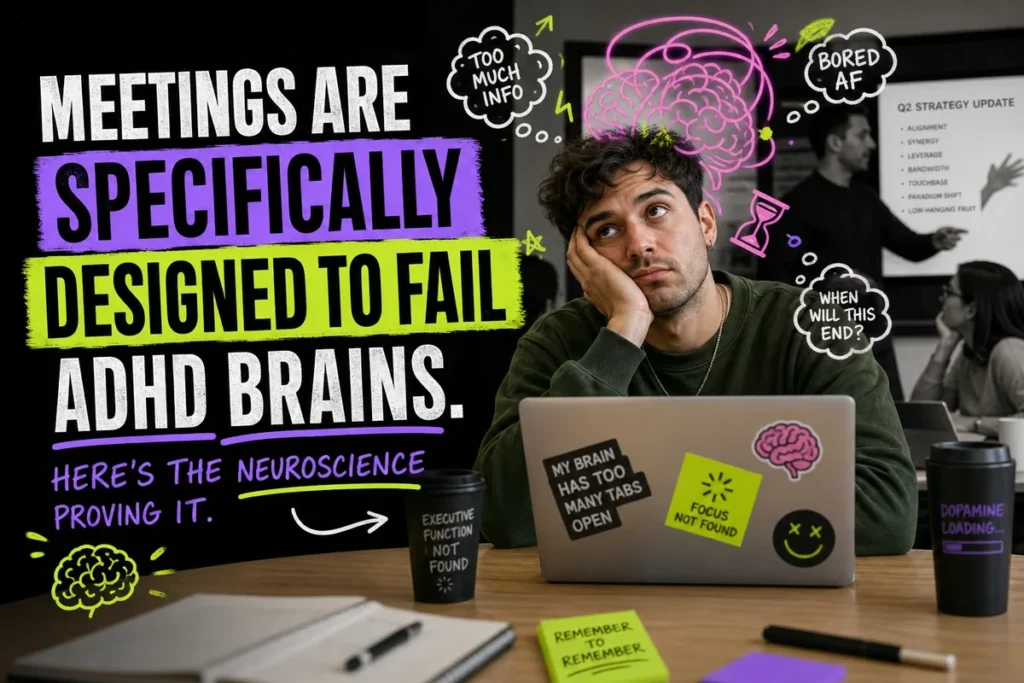
The standard workplace meeting asks your brain to do something it is neurologically very bad at: sustain attention to information that is non-urgent, non-novel, and largely passive, while sitting still, staying quiet, tracking multiple people speaking in sequence, and holding earlier points in working memory long enough to respond to them usefully. For most ADHD brains, that is not a difficult situation. It is an impossible one. Not because of laziness, poor professionalism, or a lack of caring about the job. Because the ADHD brain runs on a fundamentally different attentional architecture, and meetings violate almost every condition that architecture requires to function.
Why Your Brain Checks Out: The Interest-Based Nervous System
ADHD is not a deficit of attention in any simple sense. Research and clinical observation have consistently shown that people with ADHD can sustain extraordinary focus when the content is novel, personally interesting, competitive, or carries immediate consequences. The problem is not attention capacity. It is attention regulation, specifically the inability to direct and sustain attention on demand when the brain’s internal motivational system has not been activated.
Russell Barkley, one of the most cited researchers in ADHD, has described this through the lens of an interest-based nervous system: ADHD brains are effectively governed by what is interesting rather than what is important. This is not a preference. It is a structural feature of how the dopamine reward pathway functions. Research published in Molecular Psychiatry found decreased function in the dopamine reward pathway in adults with ADHD, with reduced dopamine D2/D3 receptor availability in the nucleus accumbens and midbrain, specifically correlated with lower motivation scores (Volkow et al., 2011). When the reward pathway does not fire for a task, the prefrontal cortex, which governs sustained effort and working memory, does not receive the signal it needs to stay online.
Symptoms of ADHD typically worsen in situations that require sustained attention or mental effort that lack intrinsic appeal or novelty, such as listening to lengthy materials or working on monotonous, repetitive tasks. Signs of the disorder may be minimal or absent when a person is engaged in especially interesting activities or in one-to-one situations. Symptoms are more likely to occur in group situations.
That quote is not from a community forum. It is from the DSM-5 clinical description of ADHD. The meeting room is, in precise clinical language, the ideal environment for ADHD traits to peak.
What Is Actually Happening When You Zone Out
Zoning out in meetings is not a choice. When the dopamine signal required to keep the prefrontal cortex engaged is absent, the brain defaults to default mode network activity: internal thought, mind-wandering, and loosely associated thinking. This is not the brain being idle. It is the brain doing what it does in the absence of sufficient external stimulation. For the ADHD brain, which already has lower baseline dopamine availability, the threshold for this shift is crossed much earlier than it is for neurotypical brains.
Working memory compounds the problem significantly. Working memory is the cognitive function that holds recent information active in mind long enough to use it. Research consistently identifies working memory impairment as one of the most reliable markers of ADHD, with studies confirming the close relationship between working memory capacity, inhibitory control, and ADHD traits across the general population (Rahmati and Jarrold, 2026, PLOS One). In a meeting, this matters because conversations are inherently sequential. If you zone out for 40 seconds midway through a five-minute discussion, you have lost the thread connecting everything said before to everything said after. The deficit is not just in the moment of inattention. It cascades forward through the rest of the meeting.
The compounding effect: One brief attention gap in a meeting is not recoverable the way it would be in a written document. You cannot scroll back. The ADHD brain, already managing high cognitive load from the effort of staying engaged, loses contextual threading each time it drifts, and for many people with ADHD, that drift is not under voluntary control.
There is also the inhibition dimension. Executive function research shows that ADHD often involves deficits in response inhibition, specifically the ability to suppress attention to competing stimuli. In a meeting, those competing stimuli are everywhere: the sound of the air conditioning, a notification on someone else’s laptop, an interesting tangent the brain just generated from something the speaker said three minutes ago. Neurotypical attendees filter these passively. Many ADHD brains have a significantly less efficient filter, which means each distractor costs more cognitive effort to override, and eventually the system stops overriding them at all.
Six Specific Ways Meetings Are Built Against ADHD Brains
Understanding the general neuroscience matters, but it is worth being precise about which meeting features are most problematic, because they are not equally damaging and the strategies that help are specific to each.
No movement: Physical movement is one of the most reliably documented ways ADHD brains self-regulate. It increases dopamine and norepinephrine availability in the prefrontal cortex. Meetings demand stillness, removing the primary self-regulation mechanism many people with ADHD rely on unconsciously throughout their workday.
Passive reception: The brain’s dopamine system responds to active engagement, novelty, and challenge. Sitting and listening to someone else speak is among the lowest-stimulation cognitive modes available. When there is no task to complete, no decision to make, no problem to solve in real time, there is no dopamine-generating hook to keep attention anchored.
No clear urgency: The ADHD brain tends to generate attention reliably under time pressure and immediate consequence. A meeting without a clear, felt deadline for individual contribution gives the brain no urgency signal to work with. The meeting matters in the abstract. But the brain is not convinced in the way it needs to be.
Social monitoring overhead: Many adults with ADHD spend significant cognitive energy managing how they appear in social and professional settings. Qualitative research on ADHD in the workplace highlights how chronic self-monitoring and the effort of appearing engaged consume working memory and attention resources that could otherwise go toward actually following the content. In a meeting, this overhead runs constantly, and it is invisible to everyone in the room except the person carrying it.
Long time horizon with no visible progress: ADHD brains are strongly affected by delay discounting: the tendency to dramatically reduce the perceived value of rewards separated by time. A meeting with a stated goal achieved only at the end of a 60-minute session offers no visible progress markers, no completion moments, and no intermediate rewards. Research on ADHD motivational deficits frames this as a steep temporal discounting slope, where future outcomes become effectively invisible (Sagvolden et al., 2005, as cited in Volkow et al., 2011, Molecular Psychiatry).
Transition cost on either side: Neurodivergent individuals tend to take longer to transition between cognitive states. Research on neurodivergent employees found that scattered meetings throughout the day had a particularly detrimental impact on focus and productivity, because each meeting requires disengaging from one cognitive mode and re-engaging in another at a cost substantially higher for ADHD brains than for neurotypical ones (Lauder, 2024, Journal of Organizational Psychology).
The Masking Cost Nobody Mentions
Here is the part that most workplace guides skip entirely: surviving a meeting while having ADHD is not just hard during the meeting. It costs you something after it.
A significant body of qualitative research on ADHD in professional settings documents the use of compensatory masking strategies, including pretending to pay attention, nodding at appropriate intervals, taking performative notes, and maintaining eye contact regardless of comprehension. These strategies are effective enough to go undetected by most managers and colleagues. They are also exhausting and, critically, they do not improve comprehension. You can look like you are engaged while retaining almost nothing.
Pretending to pay attention seemed an effective masking approach, but it was considered effortful and did not help participants pay attention. Masking and compensation were harder when participants had less energy, and some found it more difficult as they grew older.
The energy spent maintaining this appearance comes out of your executive function budget. Research on ADHD and job burnout found that executive function deficits, specifically in self-management to time and self-organisation, mediated the relationship between ADHD and job burnout (Turjeman-Levi, Itzchakov, and Engel-Yeger, 2024, AIMS Public Health). In environments that require heavy masking, that burnout pathway accelerates. You are not just attending meetings. You are performing attending meetings, which is a fundamentally different and far more draining activity.
This is one reason why many people with ADHD describe post-meeting fatigue that their neurotypical colleagues do not share, and why back-to-back meeting days can feel like cognitive emergencies rather than just busy schedules. The ADHD career landscape is full of these invisible taxes, and meeting fatigue is one of the least discussed.
From the community: “I’m sure we all deal with things like zoning out during conversations… What are some other, more insidious behaviors related to ADHD that bother you, which aren’t usually mentioned as symptoms of ADHD?”, r/ADHD thread
Should You Disclose Your ADHD at Work?
Disclosure is one of the most consequential decisions a person with ADHD faces professionally, and nobody can make it for you because the calculus is genuinely different in every workplace and relationship. What is worth being clear about is what disclosure can and cannot accomplish in the specific context of meetings.
The gap between declared organizational support for neurodiversity and lived experience is well documented. Research on workplace neurodiversity found that a significant proportion of neurodivergent employees were unlikely to disclose their condition, citing apprehension about how it would be received, even in workplaces where managers reported having support policies in place (Neurodiversity in Workplace, 2023). HR reporting from late 2025 indicated that a large majority of adults with ADHD describe feeling unsupported at work despite formal policies existing. Stated commitment to neurodiversity and actual day-to-day accommodation are frequently not the same thing.
The practical upside of disclosure in meeting contexts is specific. You may be able to request agendas in advance, ask that minutes or recordings be made available, negotiate to attend by video rather than in person, or reduce overall meeting load when your calendar is already fragmented. These are reasonable accommodations that align with the broader principle that neurodivergent workers asking for adjustments are asking for equivalent access, not advantage.
The practical risk also varies enormously by industry, manager, and organizational culture. A useful decision framework: identify the specific accommodation that would make the actual difference, then ask whether you can request it without naming the diagnosis. In many cases you can. Requesting meeting agendas 24 hours in advance is a request any professional can make on professional grounds. Requesting to attend by video in a hybrid workplace is increasingly standard. You do not always need to name ADHD to ask for what you need.
Strategies That Actually Work (And Why They Work)
Most meeting advice given to people with ADHD falls into two categories: generic productivity tips that were never designed for ADHD brains, and novelty gimmicks that address one variable in isolation. The strategies below are grounded in what the research shows about how ADHD attention actually functions.
Create an interest hook before the meeting starts. Your brain needs a reason to care, and “this is important for work” is not sufficient to activate the dopamine pathway. Write down one specific question you need answered in this meeting, before it begins. A specific question creates a mini-goal. A mini-goal generates the forward-anticipation signal that the ADHD brain’s dopamine system can actually use. This is applied neuroscience: the ADHD brain responds to immediate, concrete goals far more reliably than to abstract importance.
Make the meeting active, not passive. Active note-taking, even fragmentary and imperfect, converts a passive-reception task into an active one. This matters neurologically because active engagement increases prefrontal activation and provides a physical movement component. Type everything: half-sentences, tangents, questions, side observations. The goal is not a perfect record. The goal is keeping the brain in an engaged state by giving it something to produce rather than just receive. Many people with ADHD find this single shift, from observer to active processor, is the most reliable way to stay present through a long meeting.
Use strategic sensory stimulation. Low-level physical input increases catecholamine availability, which supports prefrontal engagement. A discreet foot movement, gripping something under the table, or cold water to sip during a meeting are not distractions. They are self-regulation tools that provide the background stimulation the brain is missing in a low-novelty environment. Research on ADHD and sensory regulation supports proprioceptive input as a method for maintaining prefrontal engagement during otherwise understimulating tasks.
Request agendas in advance. The ADHD brain handles transitions significantly better when they are anticipated. Reading the agenda the night before primes working memory, creates context anchors, and reduces the cognitive load of orienting during the meeting itself. That freed-up working memory can then go toward actually tracking the content rather than figuring out where the conversation is.
Reduce meeting density deliberately. Meeting fatigue compounds across a day of back-to-back sessions. Where you have control over your calendar, protect transition time between meetings. Even 10 minutes between sessions provides enough space for the prefrontal cortex to reset from social monitoring mode to task engagement mode before the next meeting begins. Research on neurodivergent employees consistently identifies scattered, frequent meetings as disproportionately damaging to ADHD focus and productivity (Lauder, 2024, Journal of Organizational Psychology).
Immediately debrief after important meetings. Working memory is brief and degrades quickly under task-switching pressure. For many people with ADHD, information from a meeting starts becoming inaccessible the moment another application is opened or a different conversation begins. A 90-second debrief, three bullet points covering what was decided, what you need to do, and what is still unclear, written before anything else, captures information at its most accessible and converts passive attendance into a usable record.
On virtual meetings: Research on hybrid and remote work found that virtual meetings are generally less anxiety-inducing for neurodivergent individuals than in-person ones, with reduced pressure around social performance and self-presentation (Lauder, 2024). Attending by video from your own space often allows for more natural movement, less sensory overwhelm, and more environmental control, all of which support ADHD attentional regulation in ways the in-person meeting room rarely does.
What About Medication Timing?
If you take medication for ADHD, the timing of that medication relative to your meeting-heavy periods is worth examining closely. Stimulant medication improves prefrontal cortex activation and increases dopamine and norepinephrine availability, directly addressing the attentional regulation challenges that make meetings so difficult. If your medication tends to peak during solo focused work in the morning and has worn off by the time an afternoon all-hands meeting begins, that is a pharmacological scheduling problem worth discussing with your prescribing clinician. Framing it as a specific, time-linked challenge gives your clinician something concrete to work with rather than a vague sense that things are not quite right.
Non-stimulant options function differently and may offer more stable coverage across a full workday for some people. The specifics of timing and dosing are a clinical conversation, but the meeting context is a useful one to bring explicitly because it captures the sustained, low-novelty attention demand more precisely than general descriptions of focus difficulty.
This Is Not a You Problem
The traditional meeting format was not designed with ADHD in mind. It was designed for an average neurotypical brain that can sustain passive attention to spoken content reasonably well, tolerate low-novelty environments without significant performance degradation, and hold conversational context without working memory difficulties. The meeting is, structurally, a neurotypical artifact.
ADHD exerts a pervasive and multifaceted impact on occupational functioning, mediated primarily by executive and emotional dysregulation. Effective long-term management requires targeted support for planning, organization, and self-regulation, ideally within occupational and educational settings.
That is not a statement about inadequacy. It is a statement about environment. The same ADHD brain that struggles to track a 45-minute status meeting can hyperfocus for hours on a genuinely compelling problem, generate solutions before a neurotypical colleague has finished reading the brief, and notice connections across domains that sequential thinkers miss entirely. The issue is not the brain. The issue is a mismatch between the brain’s operating conditions and the format being imposed on it.
Building work systems that align with your attentional architecture rather than fighting it is the core of sustainable ADHD performance at work. That applies inside meetings, and it applies to everything structured around them: your calendar design, your preparation habits, your recovery time, and your willingness to advocate for environments where your brain can do its best work. If you want a framework that extends beyond individual meeting tactics and into how your whole work system is structured, the ADHD Systems pillar covers what low-friction, ADHD-compatible design actually looks like in practice.
The meeting was not built for your brain. But your brain is not broken. It is operating exactly as its neurology predicts, in an environment specifically calibrated to trigger its most significant failure modes. Understanding that distinction does not dissolve the meeting problem, but it is the correct starting point for actually addressing it.
Quick Dopamine Hits:
- Before the next meeting, write one specific question you want answered by the end of it. Put it on a sticky note in front of you. Your brain now has a concrete interest hook that gives it a reason to stay engaged.
- During the meeting, keep a notes document open and type fragments as they come: half-sentences, questions, tangential thoughts. This keeps your hands moving and converts passive reception into an active task your brain can hold onto.
- Within 90 seconds of the meeting ending, write three bullet points: what was decided, what you need to do next, and what is still unclear. Do this before opening any other tab, the working memory window closes fast.
Rate this article
Was this a useful hit?