You Have Seventeen Subscriptions. You Use Four. Your Brain Knows This and Cannot Make Itself Care.

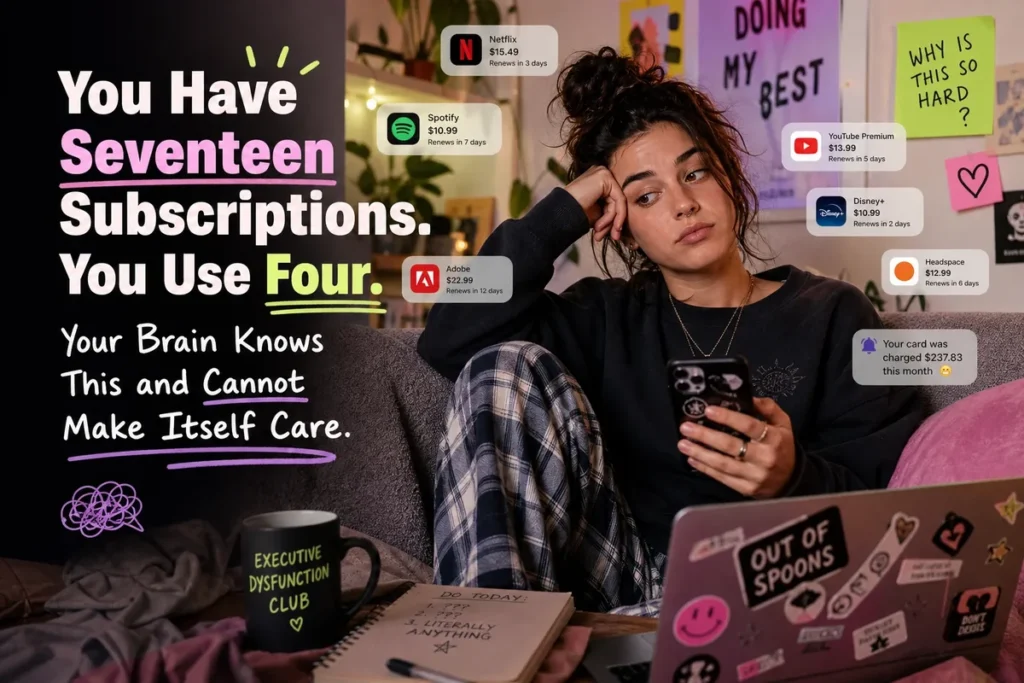
Somewhere in your bank statement, right now, there is a charge for something you signed up for during a particularly enthusiastic Tuesday afternoon and have not thought about since. Probably more than one. Research on subscription spending suggests that the average consumer significantly underestimates how many active subscriptions they hold, but for adults with ADHD, the gap between what you’re paying for and what you’re actually using tends to be substantially wider, and the psychology behind it is specific enough to deserve its own explanation.
This is not a carelessness problem. It is not a willpower problem. It is the intersection of three well-documented ADHD neurological features operating at exactly the wrong moment, in exactly the wrong sequence. Understanding the mechanism doesn’t automatically fix your bank account, but it does stop you blaming your personality for something your neurobiology is driving.
Why Your Brain Finds Subscribing Genuinely Thrilling
The sign-up moment is where the ADHD subscription trap begins, and it deserves to be understood on its own terms rather than dismissed as impulsiveness. When you discover something new, a streaming platform, a productivity app, a meditation service, an online course, a meal kit delivery, your brain doesn’t just register mild interest. For a dopamine-dysregulated system, novelty arrives as a genuine neurological event.
Research using positron emission tomography (PET) scanning has demonstrated that adults with ADHD show reduced availability of D2/D3 dopamine receptors in the nucleus accumbens and midbrain, the core structures of the brain’s reward circuit (Volkow et al., 2011, Molecular Psychiatry). Lower receptor availability in these structures correlates directly with lower trait motivation scores. The ADHD brain, running chronically undersupplied on reward signal, responds to genuine novelty with disproportionate intensity. What a neurotypical brain registers as interesting, an ADHD brain can register as urgent.
The subscription model is perfectly engineered to catch this exact moment. A free trial lowers the friction to almost nothing. The novelty hit is immediate. The future cost is abstract, distant, and small in absolute terms. Research consistently documents that people with ADHD display steeper delay discounting curves than controls, meaning future rewards (or future costs) are perceived as significantly smaller than present ones (Scheres et al., 2008, Marco et al., 2009). A $12.99 monthly charge landing in six weeks registers with roughly the same psychological weight as a rounding error. The enthusiasm you’re feeling right now is real, the cost is hypothetical, and your brain’s accounting system is structurally biased toward the present. Of course you click subscribe.
The subscription business model relies on exactly this: Companies offering free trials count on the fact that most people will forget to cancel before the billing date. For ADHD brains, the forgetting is not a quirk. It is a predictable consequence of working memory deficits and time blindness. Subscription businesses also design their cancellation flows to be as inconvenient as possible, precisely because friction at the exit works. For brains with impaired working memory and avoidance tendencies, that friction can easily become insurmountable.
The Forgetting Is Not Random. It Is Structural.
Most financial advice about subscriptions treats forgetting as a simple oversight: set a reminder, check your statement, stay on top of it. This framing misunderstands what ADHD forgetting actually is. It is not the same as a neurotypical person forgetting to write something down. It is a specific failure of working memory and prospective memory that is both well-documented and largely involuntary.
Working memory, the ability to hold information actively in mind while using it, is one of the most consistently impaired cognitive functions in ADHD (Barkley, 1997, Brown, 2005). The free trial end date is not just forgotten because you didn’t write it down. It disappears because working memory in ADHD tends to have a shorter and less reliable hold on information that isn’t immediately salient. A charge that won’t hit for three weeks is not salient. It simply isn’t present as a felt reality.
Time blindness compounds this directly. Russell Barkley identifies one of the core deficits in ADHD as an impaired sense of time: the inability to feel time passing or to project yourself meaningfully into the future. This reflects a genuine difference in how prefrontal cortex circuits handle temporal self-projection, not a personality quirk or a failure of planning effort. The trial end date doesn’t feel like it’s approaching because, neurologically, it isn’t yet real. It becomes real the moment the charge appears on your statement, and by then it is already too late.
“It makes me sick to think of all the money I’ve wasted from pure disorganization and procrastination. Things like late fees from missed bills… free trials or old subscriptions I forget to cancel… not returning those clothes that don’t fit before the refund deadline.”
This account, shared in an r/ADHD discussion of the ADHD tax, is not describing a personal failing. It is an accurate description of what happens when working memory deficits, time blindness, and a reward system that structurally devalues future costs all operate on the same financial decision point simultaneously.
Why Your Brain Also Avoids Checking
The subscription trap has a third phase that almost never gets discussed: the avoidance of discovering what you’re already paying for. Once enough subscriptions have accumulated without being reviewed, the prospect of going through your bank statement starts to feel like a punishment. Not slightly unpleasant, genuinely aversive. And many ADHD brains are well-equipped to avoid aversive tasks indefinitely.
Task overwhelm in ADHD isn’t simply not wanting to do something boring. Research on ADHD and emotional regulation documents how the anticipated difficulty or emotional discomfort of a task can be experienced as a genuine threat, triggering freeze or avoidance responses that persist for weeks or months. An audit of your own subscriptions carries embedded shame: how many are there, what do they add up to, how long has this been going on. That anticipated shame is often enough to make the task genuinely inaccessible.
The pattern follows a structure that ADHD finances tend to repeat across categories. The embarrassment of having signed up without thinking, the guilt of still not having cancelled, and the avoidance of looking because looking will confirm what you already suspect. Each month the direct debit hits, the shame registers briefly, and then the brain moves on because engaging with it feels worse than ignoring it. This is the same loop described in the research on ADHD financial avoidance more broadly, playing out at smaller, recurring scale.
From the community: “I constantly feel like I’m forgetting something really important… even when I’ve kept track of and finished things such as appointments, paying bills, cleaning up, replying to email/messages, etc, I still feel like I’m forgetting something. It never goes away.”, r/ADHD thread
What Does ADHD Subscription Spending Actually Cost?
Putting a number on this is harder than it sounds, and honest accounting with ADHD tends to reveal figures that are higher than expected. The categories accumulate fast. Streaming services for platforms you tried during a hyperfocus period on a specific show. Fitness apps downloaded during an enthusiastic gym phase. News sites you read intensively for two weeks after signing up. Software tools purchased for a project that stalled. Meal kit services started with good intentions and abandoned after the second delivery. Online course platforms bought with a genuine plan to finally learn something, now sitting untouched.
Research submitted to the Australian Senate Inquiry on ADHD found that the cumulative financial costs of ADHD for individuals are substantial and consistently underestimated, driven not by large single expenditures but by the compounding of many small recurring costs that slip beneath the threshold of deliberate attention. Subscriptions are a precise example of this mechanism: individually affordable, collectively significant, and structurally invisible to the working memory limitations that characterise ADHD in adults.
Chachar and Shaikh (2024, Frontiers in Neuroscience) synthesised the neuroeconomic evidence on ADHD and financial decision-making, finding that people with ADHD tend toward suboptimal choices across economic contexts, selecting options with lower expected value even when better alternatives are available. In the subscription context, this plays out specifically as: the better option (cancel the unused service) requires executive function resources that are often unavailable at the moment the charge arrives, while the default option (doing nothing) requires no cognitive effort and charges automatically. The system rewards inertia, and ADHD can make inertia the path of least resistance.
The ADHD subscription trap is not one bad decision. It is the default setting of a reward system that fires hard at sign-up and goes completely silent at renewal.
The Part Where Novelty Also Works Against You After Sign-Up
There is a specific feature of the ADHD relationship with novelty that makes subscriptions particularly sticky at the beginning and particularly invisible a month later. The dopamine response to novelty is not sustained. Research on dopaminergic reward processing describes how midbrain dopamine neurons initially activate strongly in response to unexpected rewards, but this response is meant to transfer to anticipatory cues over repeated exposures. In ADHD brains, this transfer is often impaired (Tripp and Wickens, 2024, Personality Neuroscience). The first time you open the new app, it is exciting. By the third week, the novelty signal has faded. By week six, you have not opened it in twelve days and the subscription continues silently.
This is why the “I’ll cancel if I don’t use it” plan, made at the moment of sign-up with complete sincerity, so often fails to execute. It relies on your brain sending a signal when engagement drops off. But the mechanism that would generate that signal, sustained monitoring of your own behaviour over time, is exactly what executive dysfunction disrupts. The plan was real. The follow-through infrastructure was never built.
ADDitude Magazine has documented this cycle in the context of novelty-seeking and behavioural addiction vulnerability in ADHD: the lower baseline dopamine that drives sensation-seeking also means that the drop-off when novelty fades tends to be faster and more complete than in neurotypical brains. You are not simply distracted from the subscription. You have neurologically moved on, while the billing cycle has not.
How a Subscription Audit Works When Your Brain Fights It
Standard advice says: go through your bank statements, list all your subscriptions, cancel what you don’t need. This is correct as a goal, but it fails as an instruction because it treats the audit as a single neutral task rather than a multi-step, emotionally loaded process that requires specific scaffolding for ADHD brains. Broken down correctly, it becomes manageable. Approached as one comprehensive review session, it tends to trigger the overwhelm-avoidance spiral it was meant to resolve.
The ADHD-compatible version works in three distinct phases, each requiring minimal sustained attention. The first phase is collection only: open your bank statement or app, scroll back around 35 days, and screenshot every charge whose name you don’t immediately recognise. Don’t evaluate, don’t cancel, don’t add up. Just collect. This phase takes about five minutes and carries minimal emotional weight because you are not making any decisions yet. The 35-day window matters because most subscriptions bill monthly, and looking back slightly further than 30 days catches any charges that fell just outside a standard calendar month.
The second phase is sorting: take your screenshot list and categorise each item with a single letter. U means you use it at least weekly. S means sometimes. N means you haven’t used it in a month or genuinely can’t remember what it is. This is the entire task for this phase. No cancellations yet, no totalling the damage, no shame accounting. Just U, S, or N. Keeping the working memory load low at this stage is deliberate, it avoids triggering the emotional response that shuts down financial tasks for many ADHD brains before they’re finished.
The third phase is action, but limited action: cancel only the N items, right now, before you close the app or tab. Not the S items. Not a full optimisation exercise. Just the clear ones. This framing matters because trying to evaluate every subscription in a single session is exactly the kind of open-ended task that many ADHD brains abandon halfway through. Finishing the N cancellations completely, and stopping there, builds the follow-through loop that makes the next audit easier rather than harder.
The three-phase split is not fussiness, it is working with ADHD cognitive limits: Each phase has a clear start and a clear end, requires a different type of thinking, and can be stopped and resumed. Collection requires no decisions. Sorting requires no action. Action is scoped to only the obvious cuts. Any one phase can be completed in under ten minutes, which makes it a task ADHD brains can actually initiate.
Building a System So You Don’t Start from Zero Every Time
A one-time audit addresses today’s problem. The longer-term challenge is building a low-friction structure that prevents the same accumulation from happening again, without relying on memory, willpower, or sustained motivation. None of those are reliable indefinitely in ADHD, and a system that depends on them will eventually fail.
The most effective structural intervention is removing the memory requirement from the equation entirely. Two tools do this consistently. The first is a virtual card number, available through some banks and financial apps, used exclusively for free trials. When the trial period ends, the virtual card number can be deleted before the first real charge, making it structurally impossible for the subscription to continue without a deliberate second decision. This reverses the default from “continues unless cancelled” to “stops unless reactivated,” working with ADHD inertia rather than against it.
The second tool is a dedicated subscription note in whatever app you actually open regularly, not a new app created specifically for this purpose. A single note in an existing, already-used app: phone notes, a calendar description, a pinned message to yourself. The goal is not a perfect spreadsheet. It is a visible list that exists somewhere you will occasionally encounter it without going looking for it.
Monthly calendar entries with a specific, minimal scope also work well for ADHD brains. Not “review finances”, that framing is too large and too vague for reliable task initiation. Something like “10-minute subscriptions: find one to cancel” gives the task a scope the brain can actually complete and stop. The ADHD systems pillar covers the broader architecture of low-friction routines built for executive dysfunction, including why small, scoped tasks tend to outperform comprehensive review systems for brains that struggle with sustained initiation.
The goal is not perfect subscription hygiene. It is a system that makes the default outcome approximately correct without requiring your full executive function resources every single month.
The Shame That Keeps the Problem Hidden
People with ADHD frequently describe the financial consequences of their traits with significant shame, and forgotten subscriptions are no exception. The pattern of signing up impulsively, forgetting, avoiding, and then discovering the accumulated cost tends to generate a specific internal narrative: that this is evidence of being fundamentally irresponsible, bad with money, or incapable of managing adult life.
That narrative is both inaccurate and functionally harmful. It is inaccurate because the behaviour has a well-documented neurological basis across impulsivity, working memory deficits, time blindness, and avoidance driven by emotional dysregulation. None of those are character flaws. The narrative is harmful because shame activates the same avoidance response that created the problem: if looking at your finances confirms you are bad with money, the brain has every incentive not to look.
Separating the audit from the self-verdict is the operational key. Reviewing your subscriptions is not an assessment of what kind of person you are. It is a mechanical task with a financial output: change what leaves your bank account next month. Those are genuinely different things, and only the mechanical one requires opening the app. The broader context of how ADHD-specific financial patterns accumulate and interact is covered in the ADHD money pillar, which is worth reading if you’re trying to build systems that hold across multiple financial habits, not just subscriptions.
So How Do You Actually Stop This Happening Again?
Subscription accumulation is one of the few ADHD financial problems with a genuinely structural solution. Unlike impulse spending, which requires real-time decision-making at moments of high dopamine activation, subscription management can largely be handled in advance, during a calm moment, using structural tools rather than willpower or memory.
The interventions that work consistently share a common feature: they remove decisions from future-you and front-load them into a single present moment when executive function is available. Using a virtual card for free trials means future-you never has to remember to cancel. A monthly calendar event with one concrete output means future-you never has to define the task from scratch. A simple three-letter categorisation system means the emotional weight of financial review is distributed across short, completable steps rather than concentrated into one overwhelming session.
None of this requires a complete financial overhaul, a new budgeting application, or a sustained behaviour change programme. It requires a short, focused setup session and a recurring ten-minute prompt. For brains that tend to hyperfocus on the appeal of a new system and then disengage when the novelty fades, the design principle is to keep the system simple enough that it doesn’t need novelty to work. A monthly reminder to cancel one subscription, followed through with reasonable consistency across most months of the year, will recover more money than a perfect audit done once and never revisited.
The Thread tool is designed for exactly this kind of commitment: recurring, low-friction, valuable through repetition rather than intensity, and built to function on the days when executive function is running low rather than only on the days when everything feels manageable.
Quick Dopamine Hits:
- Open your bank app right now and scroll back exactly 35 days. Screenshot every charge you don’t immediately recognise by name. Do nothing else yet, just collect the list.
- Take your screenshot list and mark each item with one of three letters: U (use weekly), S (sometimes), N (never used or can’t remember what it is). Anything marked N gets cancelled today, before you close the app.
- Set a recurring calendar event for the first of every month titled ‘Subscription 10’. The only rule: spend 10 minutes opening your bank statement and finding one subscription to cancel or downgrade. One. Then stop.
Rate this article
Was this a useful hit?