Your Partner Doesn’t Recognize You Since You Started Meds. That’s Not a Coincidence.

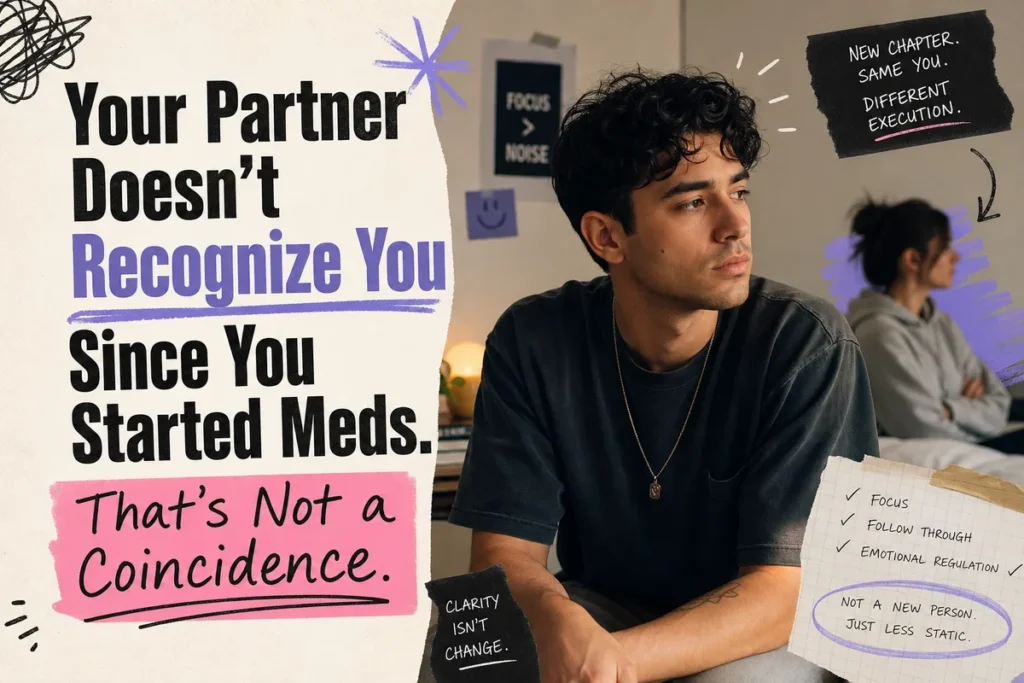
You finally started the medication. The chaos in your head got quieter. You remembered things. You finished tasks. You felt, for the first time in years, like maybe you could actually function like a regular adult. And then your partner sat down next to you one evening and said, carefully, that they were glad things were going better, but they were worried because you seemed different. Quieter. Less there. Like something had been turned down. You did not know what to say, because you had noticed it too, but you thought you were supposed to feel relieved. What nobody told you before you filled that prescription is that ADHD meds and relationships have a more complicated relationship than “medication helps, therefore everything gets better.” The medication can reduce traits and reshape emotional texture in ways that create a secondary rift, sometimes right at the moment you thought the worst was over.
The Zombie Complaint Is Not Just an Adjustment Phase
The “medicated zombie” experience has a name in clinical literature, even if prescribers rarely volunteer it during a ten-minute appointment. Emotional blunting, sometimes called affective flattening, describes a reduction in emotional range and spontaneity that some people experience on stimulant medications. It is dose-dependent, meaning higher doses are more likely to produce it, and it is more commonly associated with long-acting formulations where plasma levels stay elevated throughout the day. It is also routinely underreported, partly because many people assume it is simply what “calm” feels like and they have no prior baseline for comparison.
What clinical evidence shows is more nuanced than “stimulants make you flat.” Posner, Kass, and Hulvershorn reviewed the evidence on stimulants and emotional processing, finding that methylphenidate can meaningfully improve emotional lability in ADHD, but also that in a minority of cases it induces or worsens irritability, and that as serum levels decline in the afternoon, a rebound effect can trigger increased emotional volatility. In other words, the medication’s effect on your emotional life is not a straight line. It varies by time of day, by dose, by whether you are under stress, and by your individual neurobiology. Research published in 2026 found that pharmacological response in ADHD is moderated by context, including sustained stress exposure and comorbid affective traits, with core ADHD trait improvements remaining robust while emotion-linked outcomes showed “smaller and more variable” effects (Central Stimulants in a Stressed Brain, 2026). Your emotional life on medication is not a single simple fact. It is a moving variable that most prescribers are not actively tracking between appointments.
Stimulants consistently improve core ADHD traits. Benefits for emotion- and stress-linked outcomes are smaller and more variable, particularly when psychosocial demands are high.
What this means practically is that your partner may be noticing something real. Not imagined, not an overreaction, not a failure to appreciate that you are finally “better.” The version of you that shows up on a particular dose, at a particular time of day, in a particular season of life, genuinely is different from the version they knew before. Whether that difference is entirely negative, neutral, or a mixed bag depends on variables that have never been sat down and mapped with you.
What Gets Quieted Along With the Chaos
ADHD traits and ADHD personality are not the same thing, but they are built from the same neurological architecture. The dopaminergic systems that drive impulsivity and distractibility also drive enthusiasm, spontaneity, the ability to hyperfocus on something that matters to you, and the kind of emotional intensity that makes certain people magnetic to be around. When medication reduces the noise, it can sometimes reduce the signal too.
Creativity, verbal spontaneity, the tendency to say the unexpected thing that makes a room erupt, the way you used to hyper-engage with whatever your partner was passionate about at midnight on a Tuesday: these are partly expressions of an ADHD nervous system running hot. Stimulants can quiet them. Not always, not in everyone, and not permanently or inevitably. But research on personality pathology and medication outcomes found that stimulant medication primarily targets attentional and behavioral dysregulation, with limited and inconsistent gains in adaptive functioning and interpersonal warmth (Personality Pathology and Functional Outcomes During Pharmacological Treatment of Adult ADHD, 2026). Core trait relief and “better to be around” are not guaranteed to arrive as the same outcome, and prescribers tend to measure the first without asking about the second.
Your partner fell in love with a particular configuration of your brain, the whole configuration, including the parts that were sometimes exhausting. Now they are living with a recalibrated version and trying to figure out whether to be grateful or grieving. Often they feel both and tell neither of you that.
The afternoon wear-off window: Many partners report that the most difficult relational moments happen between 4 and 7 PM, which maps directly onto the wear-off period for most long-acting stimulants. Irritability, emotional volatility, and withdrawal are all documented rebound effects as medication serum levels decline. If your evenings are consistently harder than your mornings, this is a pharmacological variable worth raising with your prescriber, not a relationship failure.
Why Partners Grieve the Pre-Medicated Version
There is a particular kind of relational loss that nobody warns partners about: the grief of watching the person they loved become more functional and less present simultaneously. It sounds ungrateful to name it. It feels like they should simply be happy that things are better. But grief does not operate on logic, and this one is legitimate.
Qualitative research on romantic relationships in adults with ADHD consistently finds that partners report lower intimacy and relationship satisfaction compared to those in neurotypical partnerships, and that emotional disconnection is among the most painful contributors to that gap. What that research rarely captures is that some of this disconnection emerges not from ADHD traits themselves but from the treatment period, when the chaos is being managed but the warmth has not yet been recalibrated. A partner who spent years adapting to high-energy unpredictability and learned to find connection inside that texture is now adapting to something structurally different, and nobody framed this as a transition that would require its own adjustment.
Some partners also carry a complicated private shame about this grief. They wanted the medication to help. They advocated for it, drove to appointments, managed the paperwork. Now they feel strangely robbed and do not know how to say that without sounding awful. So they say nothing, or they say “you seem different lately” and watch it land badly, and the gap between them quietly widens.
The person with ADHD is trying to become more functional. Their partner is trying to find the person they knew inside the newly functional version. Both searches are happening in the same house, in near-total silence.
The Identity Question Medication Forces Open
Starting ADHD medication in adulthood, particularly following a late discovery, activates a deeper question that the zombie experience makes impossible to ignore: which parts of you are ADHD, and which parts are you? This is not a trivial philosophical puzzle. It is a question with real relational stakes.
A systematic review published in 2026 examined identity reconstruction in late-discovered neurodivergent adults and found that receiving an ADHD diagnosis is “a complex relational process that can be both validating and destabilizing,” with significant variation in how it affects individuals’ relationships with themselves and others. When medication follows quickly on diagnosis, that destabilization is compressed. You are asked to chemically alter a neurological system you only just learned was the reason you are the way you are, before you have had time to separate what you want to keep from what has been making life harder.
This is the invisible tax that this article’s title points toward: not just the financial and logistical cost of managing ADHD, which is substantial and documented. It is the identity tax of not knowing, in any given moment on medication, whether the quieter version of yourself is the real you finally emerging or a pharmacologically imposed constraint. And because your partner is also tracking this question, often without either of you naming it, it becomes a shared uncertainty that sits between you like static.
Understanding your relationship to ADHD identity, who you actually are beneath the masking and beneath the traits, becomes not just personally important but relationally urgent when medication reshapes the presentation. If you have not done that work, medication makes it more pressing, not less.
Does Your Partner Dislike the Medicated You, or Are They Adjusting?
This question is worth asking clearly, because the answer changes what you need to do. There is a meaningful difference between a partner who is experiencing a genuine grief response to a transition and one who is communicating that something specific has been lost and they want help naming it. The first usually resolves as both of you adjust. The second is a signal that a deliberate conversation is overdue.
ADDitude magazine’s survey of 2,500 readers in ADHD-affected relationships found that even in the happiest couples, the impact of ADHD on relationship quality was rated below the midpoint of a ten-point scale. The three attributes that distinguished the happiest couples from the rest were communication, compassion, and curiosity, particularly curiosity about each other’s internal experience rather than assumption. The partners who fared best were not the ones where traits disappeared. They were the ones where both people stayed genuinely interested in understanding what was happening inside the other person.
Medication changes the relational landscape. It does not change whether curiosity is available to you as a tool. If your partner is asking “are you okay?” what they are usually asking is “are you still in here with me?” That question deserves more than a reassurance. It deserves an honest investigation of what the medication is and is not doing to your emotional availability.
From the community: “How undiagnosed ADHD Destroyed My 12-Year Relationship Before I Even Understood It”, r/ADHD thread
The Wear-Off Window and Evening Relationship Damage
One of the most clinically underappreciated contributors to post-medication relationship friction is the pharmacokinetic reality of stimulant wear-off. Most long-acting formulations deliver peak plasma levels through the mid-afternoon and then taper. The period from roughly 4 PM onward is when stimulant serum levels drop, dopamine and norepinephrine signaling returns toward baseline, and rebound effects including irritability, emotional volatility, social withdrawal, and dysphoria can emerge.
This is not a personal failing. It is pharmacology. But from the outside, what a partner observes is a person who was calm and engaged during the day and is now snappy, checked out, or emotionally unavailable precisely during the hours when the couple shares the same space. Evenings, weekends, and unscheduled time, the exact contexts where relationships live and breathe, are often when the medication is least present and the nervous system is returning to its baseline or rebounding past it.
Research on stimulant effects in stressed contexts found that afternoon wear-off and affective lability were among the most frequently reported clinical concerns in routine care (Central Stimulants in a Stressed Brain, 2026). Partners often build a mental map of “when you are impossible to talk to” that they never connect to pharmacokinetics, because nobody told them to. That single conversation, explaining that the 6 PM version of you is not a choice but a timing issue with a potential pharmacological solution, can meaningfully reduce the relational damage the wear-off window creates over months and years.
What Useful Communication Actually Looks Like Here
The existing pillar on ADHD and relationships covers the general architecture of neurodivergent communication challenges. This situation requires something more specific: a conversation about the medication itself as a shared relational variable, not just a private medical decision.
Most couples do not have this conversation. The person with ADHD goes to their prescriber, manages the titration process, and reports back outcomes in clinical shorthand: focus is better, sleep is affected or not, appetite has changed. The relational texture of life on medication, the emotional availability, the spontaneity, the creative energy, the bedtime humor, rarely enters the clinical conversation because it is not on the standard checklist. And because it is not on the checklist, it never gets communicated to the partner either.
Couples who navigate this most successfully tend to do one thing differently: they treat the medication adjustment period as a shared project rather than one person’s medical situation. The partner with ADHD brings observations from inside. The partner without ADHD contributes observations from outside. Both sets of data are relevant to optimizing a prescription that will affect not just one person’s focus but two people’s relational life. This is not overstepping. It is accurate. The medication affects the relationship, and the relationship is therefore legitimate input into whether and how the medication is working.
Treating medication titration as a shared project, where both people contribute observations, produces more useful clinical data than one person managing it alone in appointment-length windows.
When the Zombie Feeling Is a Signal About Dose or Formulation
Emotional blunting on ADHD medication is not a fixed outcome. It is frequently dose-dependent. Research consistently finds that the emotional effects of stimulants are nonlinear: low-to-moderate doses tend to improve emotional regulation and reduce impulsive emotional reactivity, while higher doses or formulations that maintain elevated plasma levels throughout the day are more associated with emotional dampening and the flat, withdrawn quality that partners describe as zombie-like (Posner et al., Current Psychiatry Reports).
This matters because it means the zombie experience is often a calibration problem, not a fundamental incompatibility with medication. A dose reduction, a different formulation, a switch between amphetamine-based stimulants and methylphenidate, a non-stimulant option like atomoxetine for people where emotional flattening is severe, or adjusting the timing of doses to preserve emotional availability during evening hours: these are all clinical levers that exist and are routinely not pulled because the person taking the medication has not brought “my partner doesn’t recognize me” as a presenting complaint to their prescriber.
The language barrier is real. If you are trying to describe a qualitative shift in your emotional texture to a prescriber you see for ten minutes, in a system that is measuring functional outputs rather than relational warmth, the words are hard to find. The DopamineDriven article Something Feels Off With Your Meds and You Can’t Find the Words addresses why adults who came to diagnosis late often struggle most with this, and what to actually say when you get the appointment. The short version: lead with the relational impact. Say that the person you live with has noticed a change in your emotional availability and you want to understand whether it is dose-related. That is language a prescriber can act on.
Formulation differences matter: Amphetamine salts and methylphenidate have different emotional profiles for different people. Non-stimulant options such as atomoxetine or guanfacine may preserve more emotional range for individuals where stimulant-related blunting is significant. If emotional flatness is affecting your relationship, that is a legitimate clinical reason to revisit formulation, not just dose. Blunting is not a mandatory price of better focus.
Rebuilding Recognition When the Landscape Has Changed
The goal is not to return to the pre-medicated version of your relationship. In many cases, that would mean returning to patterns that were genuinely unsustainable: forgotten commitments, impulsive arguments, the chaos that was exhausting for both of you even when it was also vivid and alive. The goal is to build a post-medicated version of the relationship that preserves what mattered while incorporating what has changed.
That requires deliberately reintroducing the things that made your particular relationship recognizable. The shared jokes. The interests you could spend hours exploring together. The way you used to notice things about the world and say them out loud before the medication made you quieter. These are not traits to be managed. They are connection points to be reinstated with intention rather than left to chance. Medication changes the baseline. It does not determine what is worth recovering.
Research on ADHD identity following late discovery found that self-understanding and re-contextualizing traits as neurological rather than personal failures produced meaningful relief and greater relational stability. Crucially, qualitative research found that adults with ADHD reported the strongest relationship satisfaction when their partner also understood ADHD as a neurological condition rather than a character problem, with one participant noting: “It’s the first time I’ve felt I don’t have to pretend my way through the day” (O’Brien et al., 2026, Irish Journal of Psychological Medicine). Shared understanding of the medication’s effects, the straightforward improvements, the complicated trade-offs, and the pharmacokinetic timing, extends that same principle. When both people understand what is actually happening neurologically, the zombie question becomes a solvable calibration problem rather than an identity crisis wearing a relationship’s face.
The recognition your partner is looking for, the sense that the person they chose is still in there, does not depend on the medication going away. It depends on you remaining curious about your own emotional life even when the medication makes that harder, and on being willing to bring that curiosity into the room with them. That is the work medication cannot do. It has to come from you.
Quick Dopamine Hits:
- Tonight, name one thing that felt emotionally muted today and text it to your partner or write it down, not to fix it, just to put language on it.
- At your next prescriber appointment, say exactly this: ‘I want to talk about emotional tone, not just symptom reduction.’ If you get five minutes, use them.
- Pick one ritual from before medication that you’ve stopped doing, a hobby, a joke, a habit, and deliberately reintroduce it this week, even briefly. Reconnection starts with micro-moments.
Rate this article
Was this a useful hit?