You’re Rejecting Yourself Before Anyone Else Gets the Chance. That’s What RSD Actually Does.

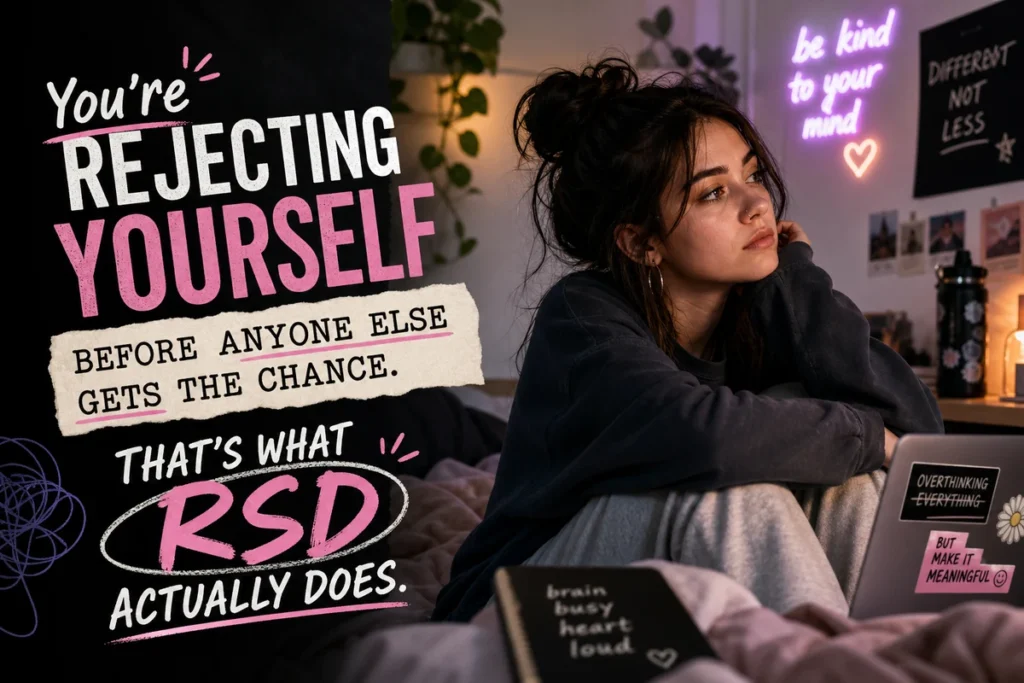
Rejection sensitive dysphoria does its most damaging work before anything actually goes wrong. Before the message is sent, before the application is submitted, before the conversation is started. The moment the possibility of rejection enters your awareness, the neurological alarm fires, and the most efficient way to silence it is to never put yourself in the position where rejection is possible. So you don’t send the message. You talk yourself out of the application. You assume the silence means you’ve already done something wrong. The rejection never happens, and you feel briefly safer, and your world gets a little smaller. This is not a personality trait or a pattern of self-sabotage. It is a documented neurological pain response, and it is quietly reshaping the architecture of your life.
What Rejection Sensitive Dysphoria Actually Is (and What It Is Not)
Rejection sensitive dysphoria, or RSD, is the intense, sudden emotional pain that people with ADHD experience in response to perceived or actual criticism, rejection, failure, or social disapproval. The emphasis belongs on the word “perceived.” RSD does not require a real rejection. It does not require any rejection at all. It requires only the possibility of one.
The word “dysphoria” is clinically precise, borrowed from the Greek for “difficult to bear.” This is not poetic license. Research consistently describes the experience as exceeding ordinary disappointment by a categorical margin. A 2026 qualitative study led by Rowney-Smith, Sutton, Quadt, and Eccles at Brighton Sussex Medical School, published in PLOS One, found that adults with ADHD described rejection sensitivity as “a painful and overwhelming experience which often lasts a significant amount of time, between hours and weeks, and can resurface many years later.” Not an afternoon. Hours to weeks, and then again years later when a different trigger calls the same memory back.
What RSD is not: a character flaw, an indicator of low self-esteem, a sign that you are “too sensitive,” or evidence of an anxious attachment style. These framings are not just wrong. They are actively harmful, because they locate the problem inside the person’s personality when the problem is inside the brain’s emotional regulation circuitry.
The DSM-5 gap: RSD does not appear as a formal diagnostic criterion in the DSM-5, despite being one of the most impairing features of ADHD in adulthood. Faraone et al. (2019, Journal of Child Psychology and Psychiatry) described emotional dysregulation as a primary feature of adult ADHD with significant clinical relevance, compounding impairment across virtually every major life domain. The absence from diagnostic criteria means millions of adults are carrying a major symptom cluster without either they or their clinicians having been trained to recognize it.
Why This Is Neurological: The Brain Circuitry Behind RSD
The mechanism is not mysterious, even if it is underreported. The prefrontal cortex, the brain’s regulatory moderator, is supposed to receive the emotional signal generated by the limbic system and apply inhibitory control: the capacity to pause between feeling and reacting. In ADHD, this inhibitory function is reliably compromised. Barkley (2010) described the unique contribution of emotional impulsiveness to impairment in major life activities in adults who had been hyperactive children, identifying it as a distinct and severely undertreated component of the condition.
Neuroimaging research sharpens this picture further. A 2025 study examining functional connectivity in children with ADHD and emotional dysregulation, published in Frontiers in Psychiatry, found significant abnormalities in resting-state functional connectivity between the dorsolateral prefrontal cortex and the orbitofrontal cortex. The dorsolateral PFC is responsible for cognitive regulation and executive modulation of emotional responses. The orbitofrontal cortex processes social threat signals and reward valuation. When the connection between these regions is disrupted, the brain cannot apply the brake between perceiving a potential social threat and experiencing the full emotional consequence of it. The signal floods through without moderation.
Three neurotransmitters are implicated: dopamine, norepinephrine, and to a lesser degree serotonin. Stimulant medications raise dopamine and norepinephrine levels, which is why some people with ADHD report that their RSD improves on medication, even though the medication is not targeting RSD specifically. When the prefrontal cortex has adequate neurotransmitter support, it can do its regulatory job more effectively, and the gap between emotional signal and emotional reaction widens enough to be workable. As Gregory Mattingly, M.D., of Washington University School of Medicine, has noted in clinical discussions of ADHD brain chemistry, the condition is not about any single chemical deficit but about how these neurotransmitters interact with each other across interconnected circuits.
“The pain is real. But the source of that pain isn’t always what it looks like in the moment.”, Alex Partridge, ADHD Chatter, on learning to name his RSD triggers rather than act on them immediately.
The Pre-Rejection Phenomenon: Shrinking Your Life to Stay Safe
This is the dimension of RSD that gets the least attention, and it is arguably the most consequential. The Rowney-Smith et al. (2026) study found a striking result in its withdrawal theme: participants explained that the expectation of rejection caused more distress than actual rejection itself. The anticipation was more painful than the event. This finding is not incidental. It explains why RSD operates so powerfully as a life-limiting force even in the absence of real rejection.
If anticipated rejection is more painful than actual rejection, then the rational response, from the perspective of a brain trying to manage unbearable pain, is to eliminate the conditions that produce anticipation. You do not apply for the promotion because then you cannot be waiting anxiously to hear. You do not tell the friend you care about them because then you cannot be dreading that they do not feel the same. You do not raise your hand in the meeting because then you cannot be scanning everyone’s faces for signs that your contribution was unwelcome. The pain management strategy is avoidance, and avoidance works, in the very short term, in exactly the way it promises to.
Research on the romantic experience of people with ADHD, published in a large qualitative study examining relationships, found a consistent pattern of pre-emptive distancing: participants described having “a string of casual flings, preferring to keep things from getting any closer to avoid rejection.” Others described a tendency to “push them away because I never felt good enough.” This is not emotional immaturity or fear of commitment in the ordinary sense. It is a neurologically-driven avoidance strategy that runs on the calculation that if you control the ending, it will hurt less than waiting for someone else to deliver it.
The Masking Trap: When Your Coping Strategy Makes Things Worse
The second major coping response identified in the research is masking. Participants in the Rowney-Smith et al. study described adopting “a mask of toughness” to hide rejection sensitivity and appear unaffected. On the surface, this seems like a reasonable strategy: appear invulnerable, and you signal to others that their criticism cannot reach you, which reduces the social invitation for more of it.
The problem is that masking creates a vicious circle the research describes explicitly. When people around you believe rejection does not affect you, they deliver more of it. They give you harder feedback, more bluntly, because you appear to handle it well. The actual experience of RSD intensifies because the trigger frequency increases. In response, you mask more aggressively. The gap between your internal experience and your external presentation widens, and the isolation deepens, because no one around you understands what you are actually feeling. Several participants in the same study disclosed that the sustained effort of masking had caused them to feel dissociated from themselves, with one requiring therapy to re-identify their authentic self after years of presenting as unbothered.
From the community: “I found out last week I had ADHD. I told my brother that I don’t remember us being close as kids, he looked at me shocked, recalling all the memories I barely remembered, claiming that we were best friends. That fucking hurt him and hurt me as well.”, r/ADHD thread
This is why RSD is so poorly understood by the people around those who have it. The external presentation actively misleads them. The person who shrugs off criticism publicly is the same person who is replaying the exchange at 2 a.m., searching for evidence of what they did wrong, wondering if the friendship is over. The mask is so convincing that even close relationships cannot see what is happening, which means they are also unable to offer the understanding or reassurance that might actually help.
The Bodily Reality: Why This Feels Like Physical Pain
One of the most important and underreported findings from qualitative research on RSD is that the experience is not primarily cognitive or emotional. It is somatic. It lives in the body.
Participants in the 2026 Brighton Sussex Medical School study described physical responses that were immediate and overwhelming. One described the sensation as “a pinch in your heart, like a very swift, brief… your heart or like your throat closing up… feels like your heart kind of drops maybe a bit.” Another described feeling as if “a chair had been taken out from beneath you.” A third used a heat metaphor: “you know the hand warmers, when you click, it becomes solid and warm… getting warmer inside me… everything inside.” These are not metaphors for sadness. They are descriptions of an autonomic nervous system response: the body reacting to social threat the way it would react to physical danger.
The distinction matters clinically and personally. If RSD is a bodily experience, not only a cognitive one, then cognitive reframing alone will often be insufficient. The body has already registered the event before the thinking brain has time to evaluate it.
This is consistent with what the neuroimaging research shows about the DLPFC-amygdala circuit in ADHD. The amygdala, which generates threat responses, is operating faster than the prefrontal moderator can respond. By the time your reasoning mind says “this isn’t actually dangerous,” your nervous system has already flooded the body with the signal that something threatening has happened. You cannot think your way out of a physiological response that has already fired.
What RSD Is Costing You Beyond the Moments It Hurts
The immediate pain of an RSD episode is visible, at least to the person experiencing it. What is harder to see are the compound costs: the decisions that were made, the paths that were foreclosed, the opportunities that were never pursued because the avoidance strategy was running quietly in the background, rejecting things on your behalf before you even had to face them.
The Rowney-Smith et al. study documented this specifically. Participants described withdrawing from university assignments, avoiding job opportunities, and limiting their social circles to other neurodivergent people because prior rejection from neurotypical individuals had made the anticipatory pain of trying again too high a cost. The research notes that these effects are “far-reaching” and potentially long-term: people who withdraw from relationships may find themselves without support networks, with difficulty forming lasting connections, and with compounding loneliness. ADHD is already associated with elevated loneliness compared to the general population. RSD is a significant, underappreciated driver of this.
This is the part that cannot be addressed by telling someone to “not take things personally.” Telling someone with RSD to develop thicker skin is like telling someone with a fractured leg to walk it off. The structural issue is real, and the advice bypasses it entirely. Understanding that RSD is neurological does not make the pain disappear, but it does change the framing from “I am weak” to “my brain’s regulatory system is working differently.” That distinction matters enormously for what comes next.
The structural issue is real. Understanding that RSD is neurological does not make the pain disappear, it changes the framing from “I am weak” to “my brain’s regulatory system is working differently.”
What Actually Helps: Beyond Cognitive Reframing
Because RSD operates at a neurological and somatic level, the most effective interventions address those levels directly. Cognitive-behavioral therapy has demonstrated efficacy in multiple randomized controlled trials for ADHD-related emotional dysregulation, with some protocols specifically targeting anger management, frustration tolerance, and relationship communication skills (Safren et al., 2010, Solanto et al., 2010). These are useful, but they work best when paired with approaches that address the body’s role in the response.
Pharmacologically, stimulant medications improve emotional regulation in many people with ADHD as a secondary effect of improving prefrontal function. Atomoxetine has also shown clinically meaningful effect sizes on emotion dysregulation scales (Reimherr et al., 2005), and methylphenidate demonstrated similar effects in structured clinical research (Reimherr et al., 2007). Medication does not cure RSD, but for many people it creates enough of a window between trigger and response to make behavioral strategies workable. Without that window, the flood arrives too fast for any technique to be applied.
The naming practice that Alex Partridge, founder of the ADHD Chatter podcast and author of “Why Does Everybody Hate Me?”, describes in his recent work is worth taking seriously: he names his RSD response “Dave the Dragon.” The practice is not about dismissing the pain. It is about externalizing the process enough to create a small separation between the experience and the identity. “The pain is real, but the source of that pain isn’t” is the insight he is working with. When the response has a name that is separate from your self-concept, the signal stops functioning as a verdict and starts functioning as information about your nervous system’s state.
For the anticipatory dimension specifically, where RSD rewrites decisions before rejection even occurs, the most important intervention is pattern recognition. If you can learn to identify the moments when you are about to pre-reject yourself, when you are about to not send the message or not apply for the role, you create at least a brief pause in which the actual decision can be made. The goal is not to override the feeling. It is to prevent the feeling from being mistaken for information about the external world when it is actually information about the internal one. What feels like a signal that the opportunity is too risky is often a signal that your nervous system is in a state of elevated threat sensitivity. These are different things, and noticing the difference is where the work lives.
RSD and ADHD burnout: The sustained effort of managing RSD, particularly through masking, is one of the underrecognized contributors to ADHD burnout. Chronic hypervigilance around social threat is metabolically expensive. If you are exhausted in ways that go beyond task demands, RSD-driven emotional labor is worth examining as a factor.
The Language You Did Not Have
One of the most consistent findings in ADHD late-diagnosis research is the relief people describe when they finally have a framework for experiences they have been carrying without language for years, sometimes decades. RSD falls squarely in this category. The people who grew up hearing they were “too sensitive,” “too intense,” “too much to handle,” or “exhausting” often had no other frame than to internalize those labels as personality verdicts.
Having the language does not rewrite the past. It does not undo the career decisions made in anticipatory avoidance, the relationships that contracted under the weight of unmanaged RSD, the years of self-narration that described an emotional vulnerability as a character defect. But language changes what is possible going forward. It changes what you say to yourself in the moment when the pain fires. It changes what you can say to a partner, a friend, a manager, a therapist. It changes whether you seek support or conclude that the problem is simply who you are.
If the experience described in this article is familiar, if you recognize the pre-emptive self-rejection, the bodily sensation, the hours-long or days-long aftermath that can be triggered by something most people would describe as minor, you are not looking at a character flaw. You are looking at a neurological pattern with a name, a mechanism, a research base, and pathways toward management that actually address what is happening. The further reading available on the full RSD resource guide covers the clinical picture in more depth, and the connection between RSD and the broader pattern of ADHD-related avoidance is worth understanding as a system, not just as individual episodes.
The experience has been real this entire time. It has also been neurological this entire time. Neither of those things cancels the other out. Both are true, and both matter for what you do next.
Quick Dopamine Hits:
- When you notice the urge to pull back or not send the message, name it aloud: ‘This is RSD pre-empting. I’m not in danger.’ Pause for 90 seconds before acting on the impulse.
- After an RSD episode, write exactly one sentence describing what actually happened, not what it felt like, but what the objective event was. This trains your brain to distinguish signal from noise.
- If a past rejection keeps resurfacing days or weeks later, schedule a specific five-minute ‘processing window’ for it, then close it. This gives the rumination a container instead of letting it run the whole day.
Rate this article
Was this a useful hit?