ADHD Paralysis vs Laziness: What the Difference Actually Looks Like From the Inside

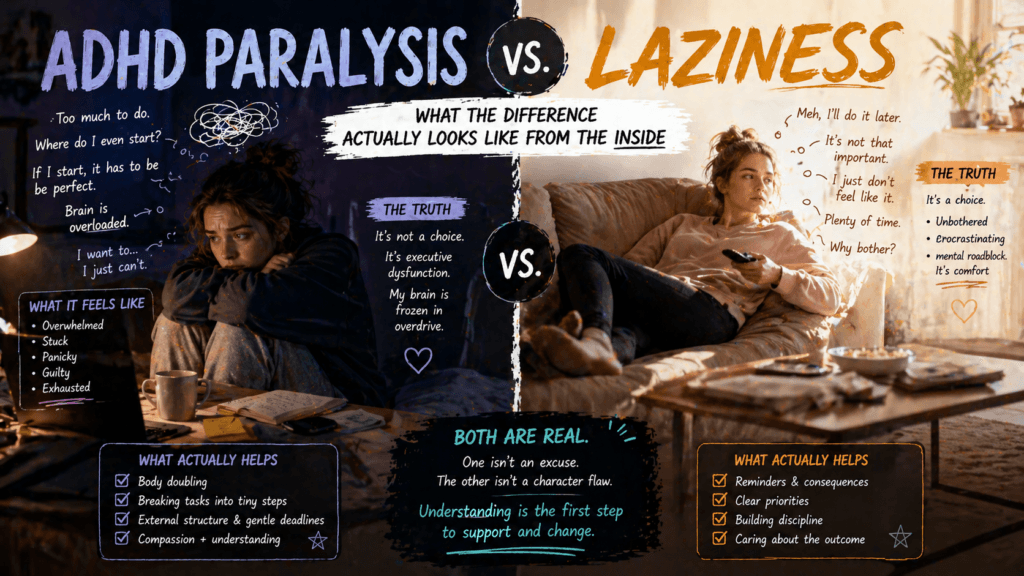
If you have ADHD, someone has probably called you lazy. Maybe a parent, a teacher, a manager, or the quiet voice inside your own head that keeps a running tally of everything you failed to start today. The word sticks because from the outside, ADHD paralysis and laziness look identical: a person not doing the thing they’re supposed to do. But from the inside, they are categorically different experiences, and the failure to distinguish between them has caused real harm to real people for decades. This article is a direct examination of what ADHD paralysis actually is, what laziness actually is, why the two get conflated, and what you can do when you’re sitting frozen in front of a task that matters to you.
Defining Laziness Properly, Without the Moral Baggage
Laziness, used precisely, describes a disposition toward avoiding effort when effort is possible and the person has consciously weighed the cost. It implies a functioning motivation system that has simply selected the easier option. A lazy person could start. They have access to the initiation mechanism. They are choosing, in some meaningful sense of that word, not to use it.
That is not a moral judgment. Humans conserve energy by default. The brain is an expensive organ metabolically, and avoiding unnecessary effort is a deeply normal feature of mammalian cognition. The problem isn’t laziness in some abstract ethical sense. The problem is when people apply that label to behavior that has nothing to do with a conscious choice about effort conservation.
Laziness requires a working accelerator pedal. You press it or you don’t. ADHD paralysis is what happens when the accelerator pedal is present but the signal from your brain to your foot is intermittent, delayed, or missing entirely.
What ADHD Paralysis Is, Neurologically Speaking
ADHD is fundamentally a disorder of executive function, not attention in the colloquial sense. Research has consistently linked ADHD to dysregulation in dopaminergic and noradrenergic circuits, particularly in the prefrontal cortex, which governs task initiation, working memory, and the ability to shift from intention to action (MacDonald et al., 2024, Frontiers in Psychiatry). The prefrontal cortex is the part of the brain that bridges “I need to do this” with “I am now doing this.” In ADHD, that bridge has structural and functional differences that are not a matter of willpower.
Dopamine specifically plays a central role. It is involved not just in reward and pleasure, but in the signaling of salience: what matters enough to act on right now. When dopamine signaling is inefficient, the brain genuinely struggles to treat an important but unstimulating task as worth mobilizing toward (MacDonald et al., 2024, Frontiers in Psychiatry). The task doesn’t register with sufficient urgency, even when you consciously know it’s urgent. This is why a person with ADHD can be acutely aware that they need to file their taxes, can feel genuine distress about not doing it, can sit at a desk with the form open, and still not move. The conscious mind and the initiation system are operating in different registers.
The initiation gap: Executive function research describes task initiation as a discrete cognitive process separate from motivation and awareness. You can know a task matters, want to complete it, and still experience a neurological block on beginning it. This is the hallmark of ADHD paralysis, not moral failure.
Ramos-Galarza et al. (2024, Journal of Clinical Medicine) conducted a systematic review of executive function stimulation methods in the ADHD population and confirmed that deficits in initiation, working memory, and cognitive flexibility are core and measurable features of ADHD, not secondary symptoms. These are not soft, subjective complaints. They are observable on neuropsychological testing.
The “Choice” Illusion and Why It’s So Convincing
Here is where the laziness accusation gets its traction. From a behavioral standpoint, a person with ADHD paralysis appears to be making a choice. They are sitting there. They are not doing the thing. Sometimes they are doing something else, something obviously more enjoyable. The inference that they could do the important thing but are choosing not to is completely logical given only that behavioral data.
The inference is also wrong.
The ADHD brain doesn’t struggle to do hard things because they’re hard. It struggles to do hard things because the neurological signal that converts intention into action is unreliable, and no amount of wanting to start compensates for a system that isn’t firing correctly.
The trap is that people with ADHD can sometimes initiate tasks. They can hyperfocus on something interesting for six hours without stopping. They completed a project last week under a deadline that created genuine adrenaline. So observers conclude the capacity is there, the effort is optional, and non-performance on a given task reflects a choice. What this misses is that ADHD initiation is heavily state-dependent and novelty-dependent. The same person who cannot start a routine report may be able to start a crisis project immediately, not because they chose differently but because their neurological state was different. Urgency, novelty, interest, and fear are not moral tools. They are dopamine triggers. They create the conditions under which initiation becomes possible.
This is also why the standard advice “just set your mind to it” is not only unhelpful but genuinely insulting. You cannot set a mind to something when the mechanism doing the setting is the problem.
What ADHD Paralysis Actually Feels Like
Most content on this topic describes ADHD paralysis from the outside. Let’s be specific about the internal experience, because that specificity is what distinguishes it from laziness and from ordinary procrastination.
You are aware the task exists. You are aware of the deadline, the importance, the consequences. You may feel genuine urgency or anxiety about it. You open the document, or you sit at the desk, or you pull up the email. And then nothing happens. There is no decision point where you consciously elect to do something else. There is simply an absence of forward movement. It feels less like choosing not to go and more like standing at a door that won’t open regardless of how hard you push.
Sometimes it comes with a physical heaviness, a sense that your body is made of material denser than it should be. Sometimes it comes with a rapid, almost desperate mental cycling through the task, breaking it apart, reassembling it, imagining starting it, without any of that activity translating into physical action. Sometimes it comes with a surge of avoidant behavior, suddenly the kitchen needs cleaning, there’s an urgent desire to reorganize a drawer, you find yourself on your phone without having decided to pick it up.
The avoidance behavior isn’t laziness seeking comfort. It’s a dysregulated nervous system seeking any dopamine input that can generate enough signal to feel like functioning. The brain isn’t choosing leisure over work. It’s seeking any available stimulation because the important task isn’t generating enough neurological traction to initiate.
This is a critical point. The activities that replace the stuck task aren’t usually pleasurable in the normal sense. They’re compulsive. People with ADHD paralysis often describe doing those alternative activities with a sense of despair running underneath them, knowing they’re avoiding, unable to stop, feeling worse by the minute. That is not the phenomenology of laziness. Laziness, done well, feels fine. Paralysis does not feel fine.
The Shame Spiral That Makes Everything Worse
What turns a single episode of ADHD paralysis into a multi-day collapse is almost always shame. You didn’t start the task. You feel bad about not starting the task. Feeling bad reduces your available cognitive and emotional resources. With fewer resources available, initiation becomes harder. The harder initiation gets, the more evidence accumulates that you are, in fact, the lazy, broken, undisciplined person the accusation said you were. The more you believe that, the less point there is in trying. The more you don’t try, the more the pile grows.
Turjeman-Levi et al. (2024, AIMS Public Health) found that executive function deficits in employees with ADHD mediated the relationship between ADHD symptoms and job burnout. This is important: it wasn’t just the ADHD itself driving burnout, it was the ongoing failure experience created by executive function gaps, compounded by self-perception and stress. Shame isn’t a side effect of ADHD paralysis. It’s an accelerant.
Shame as a cognitive tax: Research on self-criticism and cognitive load suggests that shame actively consumes working memory resources needed for task initiation. For someone with ADHD, whose working memory is already compromised, shame isn’t just emotionally painful. It functionally makes the paralysis worse.
The shame spiral also has a social dimension. Adults with ADHD are typically not believed when they explain that they couldn’t start. “You just need to be more disciplined” is the response. “Everyone procrastinates sometimes.” “If it was really important to you, you’d do it.” Each of these phrases treats the experience as a motivational problem solvable by wanting harder. None of them are accurate. All of them add weight to the shame that’s already making the paralysis worse.
Why This Gets Mistaken Even by People With ADHD
Here is something that doesn’t get said enough: many people with ADHD also call themselves lazy. They have internalized the external narrative so completely that they don’t question it. They know they couldn’t start, they know they wanted to start, and they still conclude that the problem is a character flaw rather than a neurological one. This self-diagnosis of laziness is a product of decades of being told a particular story about yourself, and it deserves to be challenged with the same directness you’d offer to an external critic.
The distinction matters because the intervention changes depending on which problem you’re actually solving. If you’re lazy, motivation is the lever. If you’re experiencing ADHD paralysis, the intervention needs to target task initiation specifically. Trying to motivate yourself harder when the problem is initiation failure is like turning up the volume on a speaker when the issue is a broken audio cable. The mechanism is wrong.
Solanto (2025, World Psychiatry) reviewed the efficacy of cognitive-behavioral therapy for adults with ADHD and noted that effective treatment requires targeting the specific executive function deficits involved, not just general motivation or self-esteem. The specificity of the intervention matters. Vague encouragement doesn’t touch the initiation system.
How to Actually Tell Them Apart in the Moment
There are a few questions that can help you identify what you’re actually dealing with when you’re stuck. They won’t solve the paralysis, but they can reframe it correctly and that reframing matters for what you do next.
First: do you care about the outcome? If the answer is yes and you’re still not moving, that’s not laziness. Laziness involves some degree of indifference to the consequence or a genuine preference for the alternative. Caring about a task and being unable to start it points clearly toward a failure of initiation, not motivation.
Second: does the thought of starting produce anything other than simple reluctance? If there’s a wall feeling, a kind of blankness, an inability to locate the entry point despite knowing the task well, that’s initiation failure. Reluctance about an unpleasant task is human. An inability to generate the first movement despite full intention is neurological.
Third: does external pressure or novelty suddenly unlock you? If a friend calls and offers to work alongside you, if a deadline gets real enough to generate adrenaline, if you’re suddenly able to start the task you couldn’t touch for four days, that’s the dopamine trigger effect. The capacity was there. The neurological state wasn’t. That asymmetry is diagnostic.
Laziness is consistent. If you’re genuinely lazy about a task, low stakes won’t bother you and high stakes won’t suddenly unlock you. ADHD paralysis is state-dependent. It fluctuates based on neurochemical conditions, not moral choices.
What Actually Helps When You’re Paralyzed
This section is not about fixing ADHD. It’s about working with the actual mechanism rather than against a fictional one. The goal is to create the neurological conditions under which initiation becomes possible, not to willpower your way through a broken system.
The most consistently effective technique in the research and in clinical practice is reducing the task to its smallest possible first action, not the first step, the first physical movement. Mette (2023, International Journal of Environmental Research and Public Health) reviewed a decade of findings on time perception and task engagement in adult ADHD and noted that future-oriented tasks have poor salience in the ADHD brain partly because time perception itself is disrupted. The brain struggles to feel the relevance of something thirty minutes away, let alone two weeks away. Making the task immediate and micro-sized shifts it from abstract to concrete, which is a salience shift, not a motivation shift.
Body doubling, working alongside another person even without interaction, consistently lowers the initiation threshold for people with ADHD. The presence of another person provides external regulation that partially substitutes for the internal regulation that’s impaired. This isn’t a workaround for laziness. There is no mechanism by which a lazy person is specifically helped by having someone sit nearby. It only helps if the underlying problem is regulatory rather than motivational.
Time pressure, manufactured through timers or commitments, works for similar reasons. It creates the urgency signal that the ADHD brain needs to mobilize dopamine. Setting a five-minute timer and committing only to work until it goes off lowers the cost of initiation to a level the brain can process.
Try Spark: Spark is built specifically for the moment before you can start. It helps you locate the smallest possible entry point into a task and creates just enough structure to shift from frozen to moving. It works on the initiation mechanism, not the motivation narrative.
Reframing Is Not Excusing
Calling ADHD paralysis what it actually is does not mean all non-performance by people with ADHD is explained and forgiven. There are tasks that ADHD makes harder to complete and whose non-completion has real consequences for real people. The reframe isn’t “nothing is my responsibility because my brain works differently.” The reframe is: if you want to actually improve, you need to know what you’re improving against.
Treating paralysis as laziness produces the wrong interventions: more self-criticism, more willpower demands, more shame. Those don’t help. They make it worse. Treating paralysis as a neurological initiation deficit produces the right interventions: environmental scaffolding, dopamine-adjacent triggers, task structure, external regulation tools. Those help. Not perfectly, and not always immediately, but they address the actual problem rather than compounding the shame that’s already making it harder to function.
You are not lazy. You are dealing with a brain that requires specific conditions to initiate, and those conditions are not always present by default. Knowing that doesn’t end the problem. But it stops you from spending your limited cognitive resources on shame and self-attack that actively consume the working memory you need to start.
The Label Does Real Damage
It’s worth being direct about this: the laziness label has caused measurable harm to adults with ADHD. It has delayed diagnosis, because people who believe they are lazy don’t seek evaluation for a neurological condition. It has undermined treatment, because people who believe their problem is a moral failing don’t consistently use tools that address a cognitive one. It has driven depression and anxiety in a population already at elevated risk for both. And it has cost people jobs, relationships, and decades of believing they were fundamentally deficient in character.
The science is not ambiguous here. ADHD involves real, measurable differences in brain structure and function, in dopamine signaling pathways, in prefrontal cortex activity during tasks requiring initiation and sustained attention (MacDonald et al., 2024, Frontiers in Psychiatry; Ramos-Galarza et al., 2024, Journal of Clinical Medicine). The behavioral output of those differences sometimes looks like laziness. The underlying mechanism has nothing to do with it.
Understanding that distinction clearly is not a comfort prize. It is the prerequisite for getting better at navigating a brain that works differently from the one the default world was built for.
Quick Dopamine Hits:
- Set a 90-second timer and write one sentence describing only the very first physical action required to start your stuck task. Not the goal. The first hand movement.
- Text one person right now with: ‘I’m starting [task] in 5 minutes.’ You don’t need them to respond. The act of declaring it externally shifts activation state.
- Stand up, walk to a different room, and return. This brief environment shift can interrupt the freeze signal. Sit back down and open the task document before you sit fully.
Rate this article
Was this a useful hit?