Rejection Sensitive Dysphoria: The Science Behind Feelings That Feel Too Big

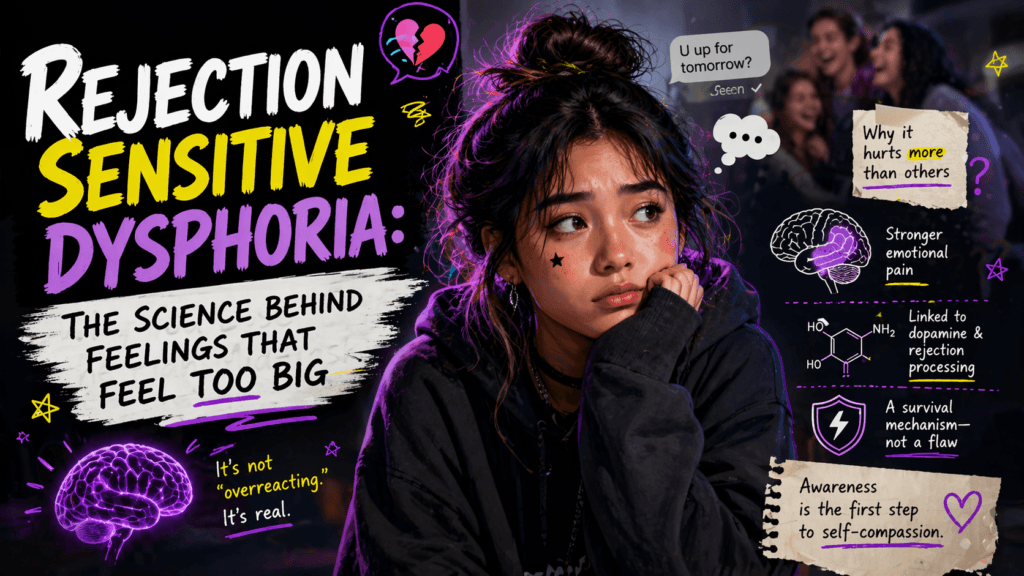
You get an email from your manager that says "Can we chat later?" No context. No tone. And within thirty seconds you are certain you are being fired, that you have done something wrong, that everything is about to collapse. The physical sensation is real: chest tight, stomach dropped, hands not quite steady. It is not an overreaction. It is Rejection Sensitive Dysphoria firing on an ambiguous signal.
RSD is one of the least discussed and most debilitating aspects of ADHD. Most people have never heard the term. Many clinicians are not trained to recognize it. And the people experiencing it have often been told their whole lives that they are too sensitive, too dramatic, too much.
They are not too much. They are dealing with a neurological response that is faster, stronger, and more difficult to regulate than the emotional responses most people experience. Understanding what it actually is, and why it works the way it does, is the starting point for managing it.
What Rejection Sensitive Dysphoria Actually Is
The term was coined by William Dodson, a psychiatrist who has specialized in adult ADHD for decades. Dodson uses the word "dysphoria" deliberately: it means an intense, profound state of emotional suffering, the opposite of euphoria. Not sadness. Not disappointment. Suffering.
RSD refers specifically to an extreme emotional response triggered by the perception of rejection, criticism, failure, or the sense of falling short of a standard, particularly a standard held by someone whose opinion matters to the person experiencing it. The trigger does not have to be actual rejection. It often fires on perceived or anticipated rejection. A facial expression. A pause in a text reply. A missed invitation. The absence of praise when praise was expected.
The response is typically sudden, intense, and feels completely real regardless of whether the triggering event was objectively significant. It can range from rage (outward) to shame and withdrawal (inward), and it can shift between those poles rapidly.
Dodson estimates that approximately 99 percent of adults with ADHD experience RSD to some degree. This is not a cited figure from a peer-reviewed study; it comes from his extensive clinical experience. The formal research on RSD is still thin because it is not a recognized DSM diagnosis and has historically been underresearched. But the clinical observation is strong enough that most ADHD practitioners working with adult populations recognize it immediately.
The Neurological Basis
RSD is not well-explained by traditional models of emotional dysregulation. Cognitive behavioral therapy frameworks, for instance, focus on cognitive appraisal: you have a thought, the thought creates a feeling, you can intervene at the thought level. RSD often does not work this way. The emotional response can arrive faster than conscious thought processes can intercept it.
The leading neurological explanation involves norepinephrine and dopamine, the two neurotransmitters most implicated in ADHD generally. The prefrontal cortex, which regulates emotional responses and inhibits impulsive reactions, requires adequate norepinephrine and dopamine signaling to function at full capacity. In ADHD, this system runs differently, meaning emotional responses that would normally be modulated by prefrontal inhibition can arrive at full strength without the usual attenuation.
This is consistent with clinical observation: RSD often responds well to medications that affect norepinephrine signaling, particularly alpha-2 agonists like guanfacine, and to stimulant medication that improves prefrontal function generally. The pharmacological response pattern is consistent with a neurological origin rather than purely a learned or psychological one.
Research by Shaw and colleagues published in the American Journal of Psychiatry has documented that emotional dysregulation in ADHD involves structural and functional differences in the prefrontal cortex, anterior cingulate cortex, and amygdala, the brain regions involved in evaluating social threat and regulating emotional responses. The amygdala appears to respond more strongly and the prefrontal brake appears to engage more slowly in ADHD populations.
RSD is not emotional immaturity. It is a faster, stronger emotional signal arriving in a system with a slower, weaker regulatory brake. The problem is the system architecture, not a lack of self-control or willingness to regulate.
The Three Faces of RSD
RSD does not have a single presentation. Clinicians observe three main patterns, and individuals often cycle through all three or show different patterns in different contexts.
Outward: the anger response. The perceived rejection triggers immediate rage. This can manifest as snapping, a harsh reply, withdrawal with contempt, or a confrontation. The person often knows, even as it happens, that the response is disproportionate. That knowledge does not stop it. Later, there is often significant shame about the anger itself, which can trigger another RSD episode.
Inward: the shame and collapse response. Rather than externalizing, the person internalizes the perceived rejection as confirmation of a core fear: that they are fundamentally inadequate, unworthy, too difficult to be around. This response often looks like depression, withdrawal, and an inability to function. It can last hours or days and is sometimes misdiagnosed as a depressive episode.
Preemptive: the avoidance response. To prevent the pain of rejection, the person avoids situations where rejection might occur. They do not submit the creative work. They do not apply for the role. They decline the invitation. They pull back in relationships before the other person can pull back first. This pattern can significantly limit a person's life over time while remaining almost invisible: nothing happened, they just did not try.
RSD and Relationships
RSD is one of the most damaging features of ADHD for interpersonal relationships, largely because the people on the receiving end often cannot understand what is happening. A partner who says "I'm a bit tired tonight, can we catch up tomorrow?" is met with an immediate withdrawal that feels inexplicable. A friend who does not reply to a message within a few hours is assumed to be angry. A colleague who gives brief rather than warm feedback in a meeting is read as hostile.
People with RSD often develop sophisticated detection systems for potential rejection. They become attuned to micro-expressions, tone shifts, changes in communication frequency, and any deviation from an established warm baseline. This vigilance is exhausting and often produces false positives. The cost is a constant low-level alert state in relationships and a tendency to either pull back preemptively or seek repeated reassurance.
Reassurance-seeking is a common pattern. If the emotional pain is relieved by confirmation that the rejection is not real, asking for that confirmation becomes a reliable short-term strategy. The problem is that it can strain the relationship if the other person does not understand why the reassurance is needed and why it needs to be so explicit and frequent.
Dodson notes that RSD is often the primary driver of relationship difficulties in ADHD adults, outweighing the organizational and executive function challenges that are more commonly discussed. Many adults with ADHD who have learned to manage their task-based symptoms still find that RSD is the piece that most damages their quality of life and their closest relationships.
RSD at Work
The professional context creates specific RSD challenges. Feedback, by definition, contains the risk of criticism. Performance reviews are a concentrated dose of evaluation by someone whose opinion carries significant weight. Presentations put performance on display for an audience. Competitive dynamics create constant low-level comparison and the possibility of being found lacking.
A common pattern is the feedback spiral: someone gives constructive criticism, RSD fires, the response is withdrawal or defensive anger, the professional relationship is damaged, which creates more insecurity about standing, which increases RSD sensitivity to future feedback. The content of the original criticism may have been entirely reasonable. The emotional architecture made it impossible to receive.
People with RSD at work often become extreme people-pleasers, overcommitting, over-delivering, and refusing to set limits with colleagues, because saying no carries the perceived risk of rejection. This produces burnout. Others go the opposite direction and disengage preemptively from environments where criticism feels inevitable.
What Management Actually Looks Like
There is no cure for RSD, but there is a range of approaches that reduce its frequency and intensity and improve the ability to function during episodes.
Medication. As noted, stimulant medication improves prefrontal regulation generally, which can reduce the speed and intensity of RSD spikes. Alpha-2 agonists (guanfacine, clonidine) have shown particular utility for emotional dysregulation in ADHD. Any medication discussion should be with a prescribing clinician who understands ADHD and its emotional dimensions.
Naming the episode. One of the most effective immediate interventions is labeling: recognizing in the moment that what is happening is an RSD spike, not an accurate read of reality. "This is RSD" is not the same as "this is fine." It is a framing that creates enough distance to pause before acting. Even a few seconds of pause between the spike and the response can prevent the most damaging consequences.
Body-first regulation. Because the RSD response arrives faster than cognition can intercept it, cognitive interventions often arrive too late. Body-based approaches are more effective at the acute phase: cold water on the face or wrists, deep pressure, slow diaphragmatic breathing. These activate the parasympathetic nervous system and can reduce the intensity of the spike enough for cognitive processing to come online.
Checking perceived against confirmed. Most RSD fires on ambiguous signals. Building a habit of distinguishing "I perceived rejection" from "rejection has been confirmed" creates a useful pause. The question is simple: "Do I have actual evidence, or am I interpreting?" This does not eliminate the feeling, but it can prevent the most extreme behavioral responses.
Therapy that understands RSD. Traditional CBT may be insufficient for RSD on its own because the response often precedes cognitive processing. Dialectical Behavior Therapy (DBT), which focuses on emotion regulation, distress tolerance, and interpersonal effectiveness, has a better fit with the RSD profile. EMDR has also shown clinical utility for the shame content that often underlies chronic RSD.
The Distinction That Changes Everything
Most people with RSD spend years believing that their emotional responses are character defects. They are too sensitive. They cannot handle criticism. They overreact. They are exhausting to be around. These beliefs are painful and, importantly, they are wrong.
RSD is not a character defect. It is a neurological response pattern that arises from the same brain differences that produce ADHD. The emotional system is not broken. It is wired for a faster, higher-amplitude response that the regulatory system struggles to attenuate in time. That is a description of a neurological architecture, not a personality flaw.
This reframe matters practically. Shame about emotional responses increases the likelihood of suppression rather than regulation. Suppression delays the response, stores the charge, and often produces a larger eventual discharge. Regulation, by contrast, requires acknowledgment first: this is what is happening in me right now. That acknowledgment is easier when the thing happening is understood as a feature of a brain condition rather than evidence of personal inadequacy.
Understanding RSD does not make it stop. But it changes the relationship with it, and that change is where management begins.
Rate this article
Was this a useful hit?