ADHD Perfectionism: Why the Brain That Cannot Finish Anything Demands It Be Perfect

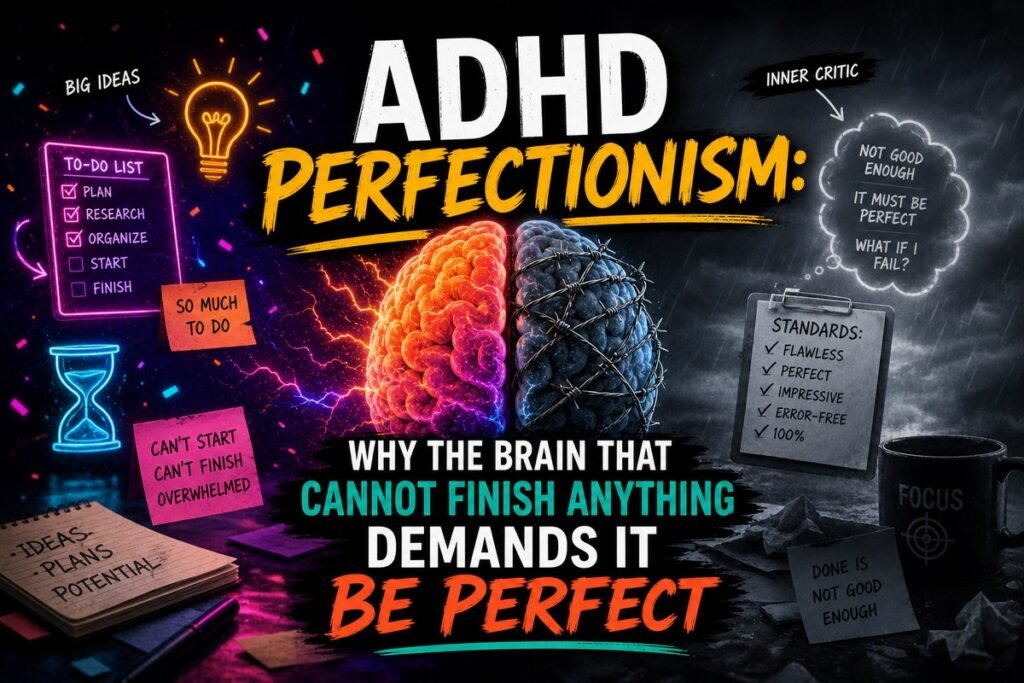
There is a specific kind of suffering that comes from being the person who cannot start the email, cannot submit the assignment, cannot send the text, because none of it is good enough yet. And there is a particular cruelty in the fact that this suffering happens most often in people whose brains are also genuinely bad at sustained focus, follow-through, and finishing things. ADHD perfectionism looks like a contradiction from the outside. It is not. It is one system misfiring in two directions at once, and understanding that system is the difference between spending another year on a project that never ships and actually getting something done.
The Paradox: One System, Two Symptoms
The standard narrative about ADHD is that it produces chaos: missed deadlines, half-finished projects, abandoned hobbies. The standard narrative about perfectionism is that it produces the opposite: meticulous, exacting, nothing-leaves-the-desk-until-it-is-flawless behavior. Put them together and you get a person who is paralyzed by the gap between what they have produced and what they believe they should have produced, while simultaneously struggling to produce anything at all.
This is not a paradox. Both symptoms emerge from the same underlying deficits in executive function and emotional regulation. The ADHD brain does not have a problem with wanting things to be good. It has a problem with regulating the emotional weight attached to evaluation. When that emotional weight is high enough, the task stops being a task and becomes a threat. And threats are not started. They are avoided.
Perfectionism in ADHD is not a personality trait. It is a defensive posture. The standard is not the point. Avoiding the feeling that comes with falling short of the standard is the point.
Rejection Sensitivity: The Engine Under the Hood
To understand why ADHD perfectionism feels so compulsive and so emotionally loaded, you need to understand rejection sensitive dysphoria. RSD is the extreme emotional pain triggered by the perception of failure, criticism, or rejection, and research is increasingly clear that it is one of the most functionally impairing features of adult ADHD. A qualitative study published in PLOS One exploring the lived experience of rejection sensitivity in ADHD found that perceived rejection and criticism could evoke extreme dysphoria in people with ADHD, and that emotional dysregulation is a highly impactful but underrecognized feature of the condition (PLOS One, 10.1371/journal.pone.0345112).
Here is how RSD becomes perfectionism. The person with ADHD has learned, usually through a lifetime of being corrected, criticized, and told they are not living up to their potential, that evaluation is dangerous. Their nervous system does not experience the prospect of someone reading their work and finding it mediocre as a minor professional setback. It experiences it as an acute threat. Perfectionism becomes the armor. If the thing is perfect, there is nothing to criticize. If there is nothing to criticize, there is no pain. The logic is airtight, until it produces a situation where nothing is ever submitted because nothing is ever good enough to be safe.
RSD and perfectionism form a closed loop: The fear of criticism raises the perfection threshold. The raised threshold makes completion impossible. Incompletion invites the very criticism that was feared. The loop then tightens.
Perfectionism as Procrastination’s Better-Dressed Cousin
Ask someone why they have not submitted the report, and “I want to make sure it is right” sounds responsible. It sounds conscientious. It sounds like the opposite of the lazy, disorganized ADHD narrative. This is why perfectionism is such an effective avoidance mechanism for people with ADHD: it is socially legible as diligence. Nobody questions it. Nobody pushes back. The person with ADHD does not even question it in themselves, because it genuinely feels like commitment rather than fear.
But the functional outcome is identical to procrastination. Nothing gets finished. The difference is that perfectionism avoidance carries a moral self-story: “I am not avoiding this, I just have standards.” That story is harder to dismantle than ordinary procrastination because it has self-worth woven into it. Admitting the perfectionism is avoidance requires admitting that the standard is not really about quality, it is about protecting yourself from evaluation. That is a difficult thing to see clearly when your nervous system is loudly insisting otherwise.
From the community: “I have a folder on my desktop called ‘finished’ and it has been empty for three years. Everything in my ‘drafts’ folder is actually done. I just can’t move it over.”, r/ADHD thread
Initiation Paralysis: When the Standard Kills the Starting Line
The mechanics of ADHD perfectionism get even more destructive at the moment of initiation. Before a single word is written or a single line of code is typed, the perfectionist demand is already active. The person is not thinking about what they will do first. They are thinking about what the finished product needs to look like, and measuring the distance between where they are now and where it needs to end up. That distance is enormous. The task has not started, and it is already failing.
This connects directly to how reward and activation work in the ADHD brain. Research on the nucleus accumbens, a key structure in the brain’s reward circuitry, has shown that functional connectivity deficits in this region predict clinical course in adult ADHD, and that the nucleus accumbens plays a crucial role in impaired delay of gratification and altered reinforcement sensitivity (Functional connectivity of the nucleus accumbens predicts clinical course in medication adherent and non-adherent adult ADHD). When the bar is set at perfection, the dopaminergic reward system has no meaningful signal to generate. There is no intermediate milestone, no near-term reinforcement available, no graduated sense of progress. The activation energy required to begin the task exceeds what the system can produce, and the person does not start.
This is not laziness. It is a mismatch between the standard being demanded and the neurological capacity to generate motivation toward a target that feels infinitely far away. Lowering the bar is not giving up. It is engineering the reward system correctly.
The perfectionist threshold is not a quality metric. It is an activation threshold. And when it is set too high, the brain’s starter motor cannot turn over.
ADHD Perfectionism vs. OCD Perfectionism: A Critical Distinction
It matters to distinguish ADHD perfectionism from the perfectionism that can accompany obsessive-compulsive disorder, because the mechanisms are different and the interventions are different. Getting this wrong can mean spending years on the wrong treatment approach.
In OCD, perfectionism is typically driven by intrusive thoughts and the need to perform compulsive behaviors to reduce anxiety. The person feels that something bad will happen, or that an internal rule will be violated, if the task is not done exactly right. The compulsion is anxiety-driven and the anxiety reduces temporarily after the compulsion is performed. The perfectionism has a rigid, ritualistic quality tied to specific content or themes.
In ADHD, perfectionism is driven by emotion regulation failure and threat avoidance tied to self-worth, not intrusive content. The fear is not that something bad will happen in the world. The fear is that the person will be seen as inadequate, stupid, or not enough. Research on emotional dysregulation in ADHD describes it as excessive emotional reactivity and an inability to control high-intensity emotional responses, often disproportionate to the trigger (Associations between adult ADHD core symptoms, cognitive flexibility, and emotional eating, 2026). The perfectionism in ADHD is not ritualistic. It is fluid, shifting from project to project wherever the self-worth threat is most active. It is also heavily intertwined with avoidance and inertia, where OCD perfectionism often produces repetitive checking and redoing rather than complete non-initiation.
The practical implication is that ADHD perfectionism responds to strategies that address emotional regulation, threat perception, and activation, not compulsion-disruption approaches. Exposure and response prevention, the gold standard for OCD, may do very little for an ADHD perfectionist whose core problem is that they cannot access the motivation to start, not that they cannot stop checking.
The All-or-Nothing Brain: Cognitive Rigidity Meets Emotional Dysregulation
ADHD perfectionism does not just create high standards. It creates binary standards: the thing is either good or it is worthless, either done or it is nothing, either excellent or it is evidence that you are a failure. There is no middle ground, no spectrum of acceptable outputs, no acknowledgment that something can be useful without being polished. This all-or-nothing cognitive pattern is not a personality defect. It is the predictable output of two overlapping neurological deficits interacting with each other.
The first deficit is impaired cognitive flexibility. Research has documented that adult ADHD is associated with significant reductions in cognitive flexibility, the ability to shift perspective, tolerate ambiguity, and adapt evaluation criteria depending on context (Associations between adult ADHD core symptoms, cognitive flexibility, and emotional eating: a case-control study, 2026). Without flexible thinking, the brain defaults to the most rigid available categories: good or bad, done or broken.
The second deficit is emotional dysregulation. Research consistently identifies excessive emotional reactivity as a core feature of adult ADHD, with individuals experiencing rapid mood changes and high-intensity emotions that are disproportionate to the actual trigger (PLOS One, 10.1371/journal.pone.0345112). When cognitive rigidity and emotional hyperreactivity operate simultaneously, nuanced evaluation becomes neurologically inaccessible. The brain cannot hold the thought “this is pretty good and could be better.” It can only hold “this is not good enough” and feel the full emotional weight of that judgment as though it were a final verdict.
Cognitive flexibility is not just about thinking differently. It is the neurological prerequisite for tolerating imperfection. Without it, “good enough” is not a lower bar. It is a foreign language the brain cannot speak.
The Dopamine Timing Problem: Why Perfectionism Makes the Brain Starve
There is one more layer to the neuroscience that explains why ADHD perfectionism is so self-defeating at a biological level. The ADHD brain already has impaired delay of gratification. The nucleus accumbens dysfunction documented in ADHD research means that rewards feel significantly less motivating when they are temporally distant. The brain operates on a steep discount curve: a reward next week feels almost meaningless compared to a reward in the next five minutes.
Perfectionism extends the gap between action and reward to its absolute maximum. If you cannot submit until it is perfect, and perfection is a moving target, then the completion reward is perpetually out of reach. The brain is working for a payoff it cannot see, cannot feel, and cannot use to fuel the next hour of effort. Meanwhile, the ADHD brain’s reward system is sensitive to any immediately available alternative: checking notifications, switching to a different task that feels fresher, doing literally anything that generates a more proximal signal.
The result is that perfectionism does not just delay reward. It eliminates it. The person never finishes, never submits, never gets the completion signal that would reinforce future behavior. The neurological training effect of perfectionism is: starting things is unrewarding. Over enough years, that training builds a body-level reluctance to begin that feels indistinguishable from laziness, depression, or simply not caring anymore.
The dopamine math: Impaired delay of gratification plus a perfection-only completion standard equals a task where the reward is always just out of reach. The brain stops trying not because it is broken, but because it is rational about an environment that has been engineered to withhold reinforcement.
Lowering the Bar: Permission Structures That Actually Work
Telling someone with ADHD perfectionism to “just lower your standards” is about as useful as telling someone with a broken leg to walk it off. The problem is not the conscious standard. It is the emotional and neurological system enforcing it. Practically dismantling ADHD perfectionism requires working with the brain’s architecture, not against it.
The most consistently effective reframe is the draft identity shift. When a task is labeled a draft, the brain’s evaluation system does not activate at full intensity. A draft is not being judged yet. It cannot fail yet. Calling something a draft is not self-deception. It is accurate: the first version of anything is a draft. But the linguistic label changes the emotional valence of the work, lowers the perceived stakes, and makes initiation neurologically accessible. This is why writers have long talked about giving themselves permission to write a terrible first draft. It is not false modesty. It is threat-reduction engineering.
The second practical structure is time-boxing over quality gates. Instead of working until the output meets a standard, work until a timer runs out. The metric of completion becomes time elapsed, not quality achieved. This decouples the completion signal from the perfectionist threshold and gives the brain a concrete, near-term reward: the relief of stopping. It also produces actual output, which perfectionism without time limits almost never does.
The third structure involves external deadlines with social accountability. The ADHD brain responds to external time pressure in a way it does not respond to internal time pressure, partly because external deadlines carry the perceived social evaluation threat that activates the nervous system in the direction of action rather than avoidance. Research on compensatory strategies in adult ADHD notes that external structuring systems are among the most consistently effective adaptive tools available (ADHD in Adulthood: Clinical Presentation, Comorbidities, and Treatment Perspectives). Sending a message to someone that says “I am going to send you the draft by 3pm” is not just a productivity trick. It is redirecting the social threat that was previously aimed at the output toward the deadline itself.
The fourth structure is shame-neutral completion language. This means explicitly telling yourself, and where possible others, that the goal is submission, not quality. “This is not my best work but I am sending it” is a complete and valid sentence. For many ADHD perfectionists, the ability to preemptively narrate their own imperfection is the difference between the thing going out and the thing staying in the drafts folder for another eighteen months. You are not lowering your standards. You are decoupling your self-worth from the output, which is something the standards were never supposed to be measuring in the first place.
When Done Becomes the Goal: Building a New Default
The deepest shift available to someone with ADHD perfectionism is not a productivity technique. It is a reassignment of what counts as success. The perfectionist brain has been trained, often from childhood, to treat quality of output as a proxy for personal worth. Every project that falls short is not just a mediocre piece of work. It is evidence about who you are. Disconnecting those two things is not quick and it is not easy, but it is the actual work.
In practical terms, this means building explicit celebration of completion as completion, regardless of output quality. Submitting something gets the same internal acknowledgment as submitting something excellent. The brain needs enough repetitions of “done feels good” to begin to compete with the entrenched “not good enough” signal. Research on treatment targets in adult ADHD suggests that self-esteem and emotional reactivity are clinically significant treatment targets alongside core ADHD symptoms (ADHD symptoms in non-treatment seeking young adults, Cognition, Gambling and Inhibition). This is not an accident. The self-worth dimension of ADHD perfectionism is not a side issue. It is a primary driver.
The goal is not a world where the ADHD perfectionist stops caring about quality. Quality matters. The goal is a world where the cost of caring about quality is no longer an empty drafts folder, a stalled career, and the quiet devastation of watching years go by on projects that never leave the desktop. ADHD perfectionism thrives in silence and isolation, in the story that the thing is almost ready, in the belief that this time the standard will finally be met. It weakens in the presence of external structure, time limits, draft permission, and the radical, neurologically grounded decision to treat finished as the finish line.
The brain that cannot finish anything does not need higher standards. It needs a different definition of done.
Quick Dopamine Hits:
- Label your next task a ‘draft’ out loud before you begin. Literally say or type the words ‘this is a draft.’ It lowers the psychological activation threshold enough to get the first sentence, line of code, or brushstroke started.
- Set a 12-minute timer and commit to working only until it goes off. Tell yourself explicitly: the quality of the output is irrelevant. When the timer ends, you are done whether or not it feels finished.
- After completing any task, send it or submit it within two minutes of finishing. Do not re-read it first. The re-read is where perfectionism re-enters and locks the exit door.
Rate this article
Was this a useful hit?