Your Brain Has a Bouncer Who Hates You: The ADHD Reticular Activating System Explained

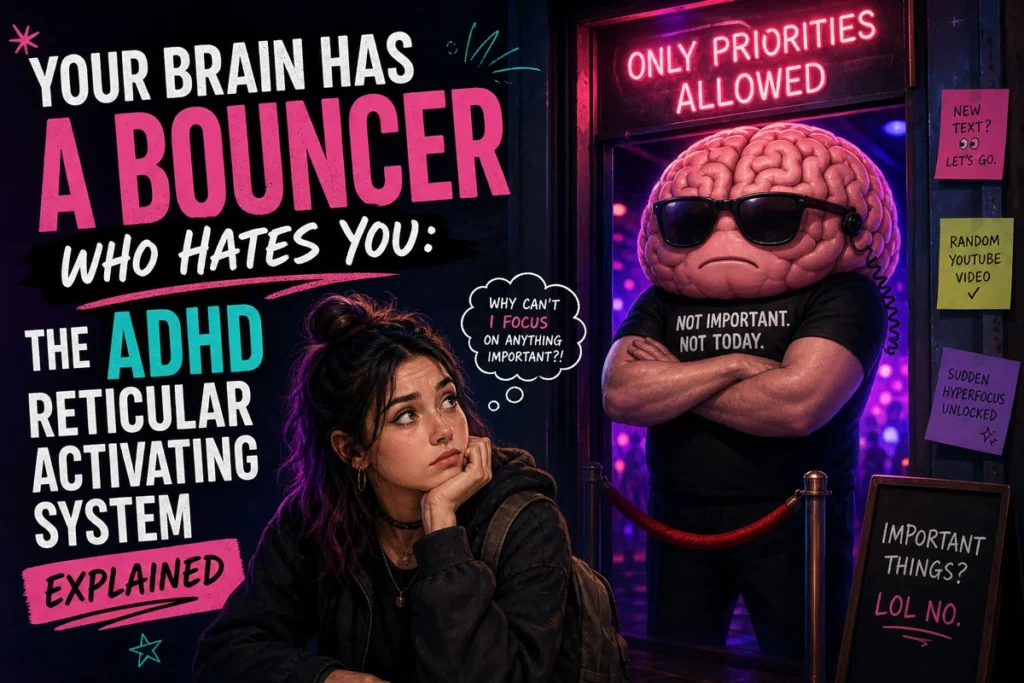
You sit down to work on the thing that genuinely matters. The deadline is real. The stakes are high. You know exactly why it’s important. And your brain produces: nothing. It skips directly to your phone, a tangential thought about something you said three years ago, or an inexplicable urge to reorganize your bookshelf. Meanwhile, a completely irrelevant notification pulls your full attention with the force of a tractor beam. This is not a willpower problem and it is not purely a dopamine problem. It is, at its root, a filtering problem, and the filter lives in a part of your brain that most ADHD content never mentions.
What the Reticular Activating System Actually Does
The reticular activating system, or RAS, is a network of neurons running through your brainstem and into your thalamus. Its job is to act as the brain’s gatekeeper: scanning the enormous flood of sensory and cognitive information arriving every second, deciding what gets amplified into conscious awareness and what gets suppressed. It governs arousal, alertness, and the baseline signal that determines whether your cortex wakes up and pays attention to something at all.
Think of it as the club bouncer for your conscious mind. Everything trying to get into the VIP section of your prefrontal cortex has to get past the RAS first. The bouncer is checking one question constantly: is this signal strong enough, new enough, or important enough to let through? For most brains, a task labeled “important” generates enough of a signal that it clears the threshold. The bouncer waves it in. Work begins.
For the ADHD brain, the bouncer’s threshold calibration is off. Not broken, exactly, but set differently. What registers as a strong-enough signal is not the same as what registers for a neurotypical brain. The result is that genuinely important, objectively high-stakes information can sit outside the door while a sudden noise, a fleeting curiosity, or the smell of someone’s lunch three desks away walks straight in like a celebrity.
The ADHD attention problem is not that the brain cannot focus. It is that the upstream system deciding what to focus on is filtering by the wrong criteria.
The Three Attention Networks and Where ADHD Disrupts Them
Neuroscience does not treat attention as a single faculty. Research using the Attention Network Test has identified three distinct networks that together produce what we experience as “paying attention.” Understanding which ones are affected in ADHD tells you a great deal about why the filter is broken in the specific way it is.
The first network is the alerting network, which sets and maintains your baseline level of arousal and readiness. It is driven primarily by norepinephrine, with tonic levels of alertness produced by noradrenergic input from the locus coeruleus, a small cluster of neurons in the brainstem that is, notably, a core component of the reticular activating system (Posner and Peterson, 1990). When the alerting network is working well, it keeps you in a state of readiness that allows new signals to get through cleanly. When it is underactive, the signal-to-noise ratio degrades, important information looks like background noise, and your brain cannot reliably discriminate between them.
The second network is the orienting network, which selectively allocates attention toward potentially relevant stimuli. This one is relatively intact in ADHD, which explains why people with ADHD can orient to things, they just orient involuntarily, to whatever is loudest or most novel rather than whatever was planned. The third network is the executive attention network, linked to the anterior cingulate cortex and prefrontal cortex, and modulated by dopamine. This is the one that resolves conflicts between competing inputs and keeps goal-directed attention on track. Research using the Attention Network Test found that adults with ADHD show lower vigilance and higher intra-individual variability than controls, with alerting network function partly explaining that gap (Lundervold et al., 2011, Behavioral and Brain Functions).
The cascade goes like this: a poorly regulated alerting network means your baseline arousal is chronically low. Low arousal means the RAS cannot distinguish between signal and noise. The orienting network then picks up whatever is most salient in the environment, which is usually not the thing you planned to work on. And the executive attention network, already working with degraded input, cannot override the competition.
The three-network breakdown: ADHD primarily disrupts the alerting network (norepinephrine, brainstem arousal) and the executive attention network (dopamine, prefrontal cortex). The orienting network remains relatively intact, which is why ADHD is characterized not by an inability to attend, but by attending to the wrong things, involuntarily and consistently.
Why Urgency and Novelty Bypass the Broken Filter
If the RAS is the bouncer and its calibration is off, you might wonder how people with ADHD ever focus at all. The answer is that certain categories of input are strong enough to override the filter, regardless of its miscalibration. Urgency and novelty are the two most reliable ones, and understanding why explains a great deal about the ADHD experience of attention.
Urgency works because a genuine deadline or perceived threat activates the brain’s stress response, flooding the system with norepinephrine. Norepinephrine is precisely the neurotransmitter that drives the alerting network. When it spikes, the signal-to-noise ratio improves substantially, the important signal suddenly clears the threshold that it couldn’t clear an hour ago when the stakes were theoretically the same but no adrenaline was involved. This is why the ADHD pattern of panic productivity is so consistent and so frustrating. It is not a personality quirk. It is a neurochemical workaround for a filter that requires a strong enough jolt to wake up.
Novelty works through a different but parallel mechanism. New stimuli generate phasic dopamine responses, sudden spikes in dopamine signaling that temporarily sharpen the executive attention network and amplify the signal arriving at the RAS. Research has consistently shown that the ADHD dopamine system tends to struggle with tonic, slow-burn baseline signaling while responding more normally to phasic, spike-type signals. A brand-new task activates the phasic dopamine system. The same task, three weeks later, often does not, which is the neurological basis of why motivation in ADHD can collapse once the novelty wears off.
Other signals that can clear the filter include genuine passion, interpersonal urgency like someone waiting on you right now, competitive pressure, or creative challenge. These all share a common feature: they generate a strong enough internal arousal state that the RAS lets the associated content through. This is why the ADHD experience of motivation can feel so binary. The filter is either open or closed. There is often no reliable middle ground of “modest effort applied to a moderately important task.”
What Does “Importance” Actually Signal to the ADHD Brain?
Here is where the RAS angle gets genuinely uncomfortable: importance, as a cognitive concept, is not a strong-enough input to reliably activate the ADHD alerting system. Knowing something is important is a prefrontal cortex function, it involves abstract reasoning, future projection, and value assignment. But the RAS sits upstream of the prefrontal cortex, in the brainstem. It does not process abstract importance. It processes arousal signals: Is this loud? Is this new? Is this threatening? Is this exciting?
This is the critical mismatch. A neurotypical brain can translate “this report is due Friday and my job depends on it” into sufficient arousal to move the signal through the RAS and into sustained attention. The cognitive importance generates enough of an internal signal to clear the filter. In the ADHD brain, that translation is unreliable. Research on dopamine function in ADHD has shown that reduced dopamine D2/D3 receptor availability in the midbrain and nucleus accumbens is positively correlated with lower motivation scores in adults with ADHD, suggesting that for many people with ADHD, the internal signal saying “this matters, get moving” is genuinely quieter at a neurochemical level (Volkow et al., 2011, Molecular Psychiatry).
The practical implications of this are significant. When you know something is important but cannot make yourself engage with it, you are not experiencing a failure of values or discipline. You are experiencing a failure of signal translation. The importance is real. The cognitive recognition is there. But between that recognition and the activation of sustained attention sits a gatekeeper that is waiting for a different kind of input, one that importance alone often cannot provide.
The gap between “knowing it matters” and “being able to act” is not a gap in motivation. It is a gap in neurological signal strength, and filling it requires understanding what the RAS actually responds to.
The Underarousal Problem: Why Boredom Feels Physically Unbearable
One of the most consistent findings in ADHD neuroscience is that the ADHD brain operates at chronically lower baseline arousal than neurotypical brains. This is sometimes called the underarousal hypothesis, and it has substantial support from research on vigilance, cortical activation, and the alerting network. Research on the auditory noise phenomenon in ADHD demonstrated that ADHD brains appear to benefit from external ambient noise through a mechanism called stochastic resonance: a certain level of background stimulation can actually improve cognitive performance in brains with low baseline arousal by pushing the system closer to its optimal operating threshold (Söderlund et al., 2016, Frontiers in Psychology). In neurotypical brains, that same ambient noise tends to degrade performance, because their system was already at the right level.
This explains something that many people with ADHD describe as one of their most disabling traits: the quality of boredom that feels genuinely intolerable rather than merely unpleasant. When baseline arousal is low and a task provides no urgency, novelty, or challenge, the RAS is not just failing to amplify the task signal, it is actively in a state of under-stimulation that produces real discomfort. Hyperactivity traits in ADHD are, in part, the motor system’s attempt to self-stimulate: to generate enough sensory input to raise the arousal level and make the filter work better. Leg-jiggling, fidgeting, excessive talking, seeking out stimulating environments, these are not personality traits. They are the brain trying to fix its own signal-to-noise problem from the bottom up.
People with ADHD and predominantly inattentive presentation often do not show these external behaviors, but the same internal dynamic is frequently present. Instead of seeking external stimulation, the mind wanders inward, generating its own internal noise in the form of daydreaming, rumination, or elaborate chains of thought, all of which are more neurologically activating than the task at hand. The internal wandering is not laziness. It is the brain’s substitute for the arousal stimulation the task is failing to provide.
How Stimulant Medication Actually Works on the Filter
Understanding the RAS and arousal system makes the mechanism of stimulant medication considerably clearer. Methylphenidate and amphetamine-based medications work primarily by blocking the reuptake of dopamine and norepinephrine, increasing their availability at the synapse. Methylphenidate specifically has been shown to amplify weak dopamine signals and increase the signal-to-noise ratio in the brain, enhancing the salience of target tasks (Volkow et al., 2001, as cited in Söderlund et al., 2016, Frontiers in Psychology). Amphetamines also trigger presynaptic release of catecholamines, producing a more potent effect on the same pathways.
The norepinephrine component is particularly relevant to the RAS picture. By increasing norepinephrine availability in the prefrontal cortex and related circuits, stimulants are essentially turning up the volume on the alerting network, the very network that sets baseline arousal and determines whether the RAS filter is calibrated correctly. This is why stimulants feel, to many people with ADHD, less like “speeding up” and more like “things finally feel the right amount of important.” The signal translation problem is being addressed at the neurochemical level.
Non-stimulant medications like atomoxetine work more selectively on the norepinephrine system, which accounts for their particular impact on attention and vigilance while carrying a different profile on impulsivity. Neither category of medication is “fixing” a broken brain, they are adjusting the arousal calibration of the filter so that importance signals can get through more reliably. If you have ever wondered why medication helps you attend to things you already knew mattered, this is the mechanism. The filter’s threshold is temporarily normalized.
It is also worth noting that this model explains why medication effects can be variable across contexts. When external stress is very high, the norepinephrine system can become flooded, pushing arousal past the optimal point and actually degrading performance. The alerting network has an inverted U-shaped response to norepinephrine: too little and the filter fails to discriminate, too much and it becomes hyperactive and indiscriminate. Research on stimulants in high-stress contexts has noted this variability, which is part of why ADHD medication can seem less effective during periods of burnout or sustained pressure.
Why medication doesn’t always work equally: Stimulants improve the alerting network’s signal-to-noise ratio, but only within a range. Very high stress floods norepinephrine past the optimal point, which can reduce medication effectiveness rather than enhance it. This is part of why ADHD medication may seem to stop working during burnout or sustained periods of high pressure.
What the RAS Explains About Hyperfocus
The RAS filter model also reframes hyperfocus in a way that the standard dopamine explanation alone does not fully capture. Hyperfocus is typically described as what happens when an ADHD brain finds a sufficiently dopamine-rich activity. But the upstream story is more specific: when a task generates sufficient arousal to fully open the RAS filter, the executive attention network can engage without competition. The filter is not just cracked open a little, it swings wide, and the default mode network, which is responsible for mind-wandering and is often overactive in ADHD, gets suppressed. The result is the kind of locked-in, time-dissolving focus that can run for hours.
The problem is not that hyperfocus exists. The problem is that the conditions required to trigger it, genuine novelty, intense interest, high urgency, real-time challenge or competition, are not the conditions under which most important tasks exist. A tax return is not novel. An inbox is not exciting after the first three months of a job. The project that matters most to your career is, by month four, neurologically indistinguishable from background noise to a brain whose filter is waiting for a strong signal.
This is the central tension the RAS model illuminates. The ADHD brain is capable of extraordinary concentration. The bouncer is not incapable of letting things in. The bouncer just requires a particular kind of pass, and the passes that reliably work are novelty, urgency, passion, and challenge, not importance, obligation, or good intentions. Understanding this is not an excuse for inaction. It is the correct design specification for a life that actually functions.
You are not waiting to feel motivated. You are waiting for the right signal to clear the filter. The practical question is: how do you generate that signal deliberately, rather than by accident or crisis?
Practical Implications: Designing Around the Filter
If the ADHD reticular activating system filters on arousal rather than importance, then productivity systems built around importance-ranking, priority lists, and “just decide it matters more” are structurally incompatible with how ADHD attention actually works. This is why those systems tend to collapse, not because of any failure of discipline, but because the architecture does not match the brain’s actual operating conditions. What you need instead are systems that generate the right kind of signal to clear the filter on purpose, before the crisis does it for you.
The most reliable lever is manufactured urgency. Urgency can be created deliberately: time-boxing with a visible, ticking countdown, committing to deliver something to another person at a specific time, or treating a self-imposed deadline as genuine rather than negotiable. These are not tricks to fool yourself, they are tools for generating the norepinephrine spike that the alerting network needs to raise its threshold and let the task through. The neuroscience here connects directly to what the ADHD paralysis explainer covers in detail: the inability to start is rarely about the task itself, and almost always about a missing activation signal upstream of intention.
The second lever is novelty injection. This means rotating tasks before the novelty wears off, reframing familiar tasks with genuinely new angles, introducing competitive or game-like elements, or changing the physical environment when the existing context stops generating enough signal. Even small changes in location, background noise level, or tools used can produce meaningful shifts in arousal state, which is the mechanism behind why so many people with ADHD find they work better in coffee shops, libraries, or anywhere other than the desk they “should” work at. The environment is not the distraction. The environment is generating the arousal level the brain needs to filter correctly.
The third lever is body-based arousal regulation. Physical movement raises both norepinephrine and dopamine, improving signal-to-noise ratios in the same networks that are underactive in ADHD. This is not metaphor, exercise produces measurable effects on the neurotransmitter systems that regulate the alerting network. Even five to ten minutes of brisk movement before a difficult task can shift baseline arousal enough to make the filter more responsive to the importance signals you are already trying to send it. The connection between physical state and cognitive filtering is direct and underused as a practical strategy.
Understanding time blindness is also directly relevant here: the ADHD brain often does not experience future deadlines as present threats until they become genuinely imminent, because the RAS filter does not let abstract future urgency through as a strong arousal signal. Our time blindness explainer covers the temporal perception side of this in depth, but the filter model adds a layer: it is not only that time feels different, it is that the urgency of future events often does not generate enough arousal to clear the filter until “the future” becomes “right now.” Building external time anchors is, in this frame, less about time management and more about manufacturing the arousal that proximity to a deadline naturally creates.
A Different Relationship With Your Own Brain
The RAS model does something that pure dopamine explanations of ADHD do not fully accomplish. It explains the specificity of the problem: why it is not that you cannot focus, but that your focus lands precisely where the arousal is, not where the importance is. It explains why the same person can become absorbed in something trivial for hours and sit motionless before something critical for just as long. It explains why shame, willpower, and caring deeply about outcomes all tend to fail as activation strategies, because none of them generate the right kind of upstream signal to shift what the filter lets through.
It also explains something about the emotional weight of living with ADHD that rarely gets framed this way. When important things consistently fail to clear your brain’s filter despite genuine effort, and when minor things consistently hijack your attention despite genuine preference, the experience over time is one of being deeply at odds with your own cognition. The filter that is supposed to serve you seems to be working against you. The bouncer who should be letting in the things you care about is letting in everything except those things.
That is not a character flaw. It is a miscalibrated gatekeeper. And gatekeepers, unlike character flaws, can be understood, worked with, and, with the right design, reliably outsmarted.
Quick Dopamine Hits:
- Pick one task you’ve been avoiding and assign it a fake, imminent deadline: tell yourself it must be submitted to someone in 45 minutes. Set a visible timer and treat it as real. Urgency is a neurological trigger, not a feeling, manufacture it.
- Before starting a task that keeps sliding, find one genuinely interesting angle inside it. Write one sentence about what makes it even slightly curious or novel. This is not motivation journaling, it is priming your alerting system with a real signal before you sit down.
- If you’re stuck and can’t generate urgency or interest, change your sensory environment first: move rooms, put on background noise at moderate volume, or stand instead of sit. Arousal level is upstream of focus, raise it physically before expecting the brain to filter in the right things.
Rate this article
Was this a useful hit?