ADHD Time Blindness: Why Your Brain Genuinely Cannot Feel Time Passing

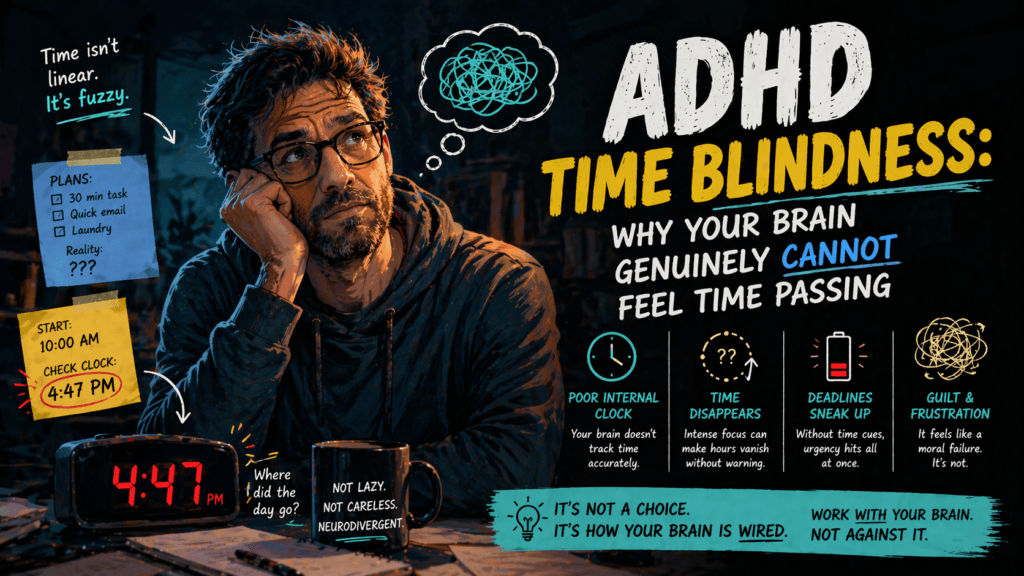
You have been called lazy, inconsiderate, and disrespectful more times than you can count. Every apology for lateness feels hollow because you genuinely intended to be on time. You left the house with what seemed like plenty of buffer, yet somehow arrived twenty minutes late. Again. The frustration on other people's faces mirrors your own internal confusion because you truly cannot explain what happened to that time. This is not a moral failure. This is ADHD time blindness, and it represents a fundamental difference in how your brain processes temporal information.
The Neuroscience of Time Perception in ADHD
Time blindness describes the impaired ability to perceive, estimate, and feel the passage of time. For adults with ADHD, this is not a metaphor or an excuse. It is a measurable neurological difference that researchers have documented across dozens of studies spanning three decades. The term itself has gained traction in clinical circles because it accurately frames time perception problems as a sensory deficit rather than a behavioral choice.
Dr. Russell Barkley, one of the foremost ADHD researchers, has argued that time blindness may be the most impairing aspect of the condition that receives the least attention. In his work on executive function, Barkley positions the ability to sense and manage time as fundamental to self-regulation. Without accurate time perception, planning, prioritizing, and following through on intentions becomes extraordinarily difficult. The prefrontal cortex, which handles executive functions including temporal processing, shows consistent differences in activation patterns in ADHD brains during time estimation tasks.
Research published in the journal Neuropsychology by Toplak and colleagues found that individuals with ADHD consistently demonstrate deficits in time reproduction, time estimation, and time discrimination tasks. When asked to indicate when a specific interval has passed, participants with ADHD showed significant variability and inaccuracy compared to neurotypical controls. This finding has been replicated across age groups and ADHD presentations, suggesting a core deficit rather than a secondary symptom.
Time blindness is not about not caring enough to be on time. It is about lacking the internal clock calibration that most people take for granted as a basic human sense.
Two Time Zones: Now and Not Now
One of the most useful frameworks for understanding ADHD time perception comes from the concept of two time zones. For neurotypical individuals, time exists on a gradient. There is now, soon, later, and eventually, with emotional weight distributed somewhat proportionally across these categories. An assignment due in two weeks feels less urgent than one due tomorrow, but it still registers as something requiring attention and planning.
For the ADHD brain, time often collapses into two categories: now and not now. Everything in the not now category feels equally distant, whether it is happening in two hours, two days, or two months. This is why someone with ADHD can intellectually know a deadline is approaching while feeling zero urgency until the moment it crashes into now. The emotional salience simply is not there until the deadline becomes immediate.
This two-zone model explains behaviors that seem baffling from the outside. Why would someone wait until the night before to start a major project? Because until that night, the project existed in the undifferentiated not now space, carrying no more emotional weight than something due next year. The person with ADHD is not procrastinating in the traditional sense of avoiding discomfort. They genuinely cannot feel the approaching deadline the way others can.
The Not Now Problem: Research by Sonuga-Barke and colleagues on delay aversion in ADHD suggests that the not now zone creates a motivational void where future consequences fail to influence present behavior, regardless of their objective importance.
Time Production Versus Time Estimation
Understanding time blindness requires distinguishing between different temporal tasks. Time production involves creating a specific interval, like waiting exactly five minutes. Time estimation involves judging how much time has passed, like estimating that a meeting lasted thirty minutes. Time reproduction involves recreating an interval you just experienced. ADHD affects all three, but not always in the same ways.
Studies consistently show that individuals with ADHD tend to overestimate short intervals and underestimate long ones. Ask someone with ADHD to indicate when two minutes have passed, and they may respond after ninety seconds. Ask them to estimate how long they spent on a task that took two hours, and they might guess forty-five minutes. This creates a perverse situation where short waits feel interminable while long periods vanish without a trace.
The practical implications are significant. Overestimating short intervals leads to impatience and difficulty with tasks requiring sustained waiting. Underestimating long intervals leads to chronic lateness, missed deadlines, and the bewildering experience of losing entire afternoons to activities that felt like they took twenty minutes. Both patterns stem from the same underlying deficit in temporal processing, but they manifest in opposite directions depending on the time scale involved.
The Dopamine Connection to Time Perception
The link between ADHD and time blindness becomes clearer when we examine the role of dopamine in temporal processing. The basal ganglia, a brain region heavily dependent on dopamine signaling, plays a crucial role in interval timing. ADHD is characterized by dysregulated dopamine transmission, particularly in pathways connecting the prefrontal cortex and basal ganglia. This suggests a direct neurochemical basis for time perception differences.
Research by Noreika and colleagues published in Neuroscience and Biobehavioral Reviews examined the neural substrates of time perception in ADHD and found consistent evidence of altered activity in dopamine-rich brain regions during timing tasks. When dopamine signaling is atypical, the internal clock that marks intervals and tracks duration functions differently. This is not a matter of paying attention to time or caring about punctuality. It is a matter of neurochemistry.
You would never tell someone with color blindness to just try harder to see red. Time blindness deserves the same recognition as a genuine perceptual difference rather than a character defect.
Stimulant medications, which increase dopamine availability, have been shown to improve time estimation accuracy in some studies. This pharmacological evidence supports the dopamine hypothesis of time blindness. When dopamine signaling is enhanced, the internal clock appears to function more reliably. However, medication effects on time perception are variable, and many adults with ADHD continue to experience significant time blindness even with optimized medication regimens.
Why Traditional Time Management Fails
Most time management advice assumes you have an accurate internal sense of time that simply needs better organization. Buy a planner. Set reminders. Break tasks into smaller pieces. These strategies address the behavioral output of time management without addressing the perceptual input. For someone with time blindness, this is like giving someone with poor vision a map and telling them to navigate without offering glasses.
The fundamental problem is that traditional time management requires you to feel time in order to manage it effectively. You need to sense that fifteen minutes have passed to know it is time to wrap up a task. You need to feel the approach of a deadline to motivate yourself appropriately. You need to perceive the length of a task accurately to schedule your day realistically. When the underlying time perception is unreliable, all of these abilities are compromised at the foundation level.
This explains why many adults with ADHD have drawers full of unused planners and phones cluttered with ignored reminders. The tools assume a temporal awareness that does not exist. Setting a reminder for thirty minutes before an appointment assumes you will use those thirty minutes to prepare and transition. If you cannot feel thirty minutes passing, you might glance at the reminder, think you have plenty of time, and look up forty-five minutes later wondering where the time went.
The Planner Graveyard: The failure of traditional time management tools is not evidence of laziness or lack of commitment. It is evidence that these tools were designed for brains with reliable internal clocks, making them inadequate for ADHD time blindness.
Externalizing Time as a Sensory Strategy
If time blindness is a perceptual deficit analogous to other sensory impairments, the solution involves providing external time cues that bypass the faulty internal system. Just as someone with hearing loss uses visual cues and amplification devices, someone with time blindness can use environmental modifications to make time visible and tangible.
Analog clocks with moving second hands provide continuous visual feedback about time passing. Unlike digital clocks that display static numbers, the physical movement of clock hands creates a perceptible sense of motion through time. Placing analog clocks in multiple locations throughout your environment keeps time in your peripheral awareness rather than requiring you to remember to check.
Visual timers, particularly those that show time as a shrinking colored segment rather than changing numbers, leverage visual processing to compensate for impaired temporal processing. The Time Timer brand and similar products display elapsed time as a decreasing red segment, providing an at-a-glance sense of how much time remains. This external representation of duration substitutes for the internal sense that time blindness impairs.
Body-based strategies can also help. Setting interval timers that require physical response, like standing up every thirty minutes, creates time landmarks through physical experience. Some adults with ADHD find that wearing a watch that vibrates at regular intervals provides a gentle external rhythm that substitutes for the missing internal sense of time passing. The key is creating external signals that do not require you to remember to check time, because remembering itself depends on time awareness.
Time Estimation Calibration Exercises
While time blindness cannot be cured, time estimation can be improved through deliberate practice. The goal is not to develop a normal internal clock but to recognize and correct for consistent errors in your perception. If you know you always underestimate task duration by half, you can explicitly double your estimates as a compensatory strategy.
One effective calibration exercise involves estimating, recording, and comparing. Before starting any task, speak your estimate out loud or write it down. After completing the task, record the actual duration. Over time, patterns emerge. You might discover you consistently underestimate creative tasks by seventy percent but estimate routine tasks fairly accurately. You might find that your estimates are worse in the afternoon or that certain types of tasks are black holes for your time perception.
This data collection serves two purposes. First, it creates an external record that bypasses the unreliable internal time sense when planning. Instead of asking how long something feels like it will take, you can consult your historical data on how long similar tasks actually took. Second, the practice itself may improve estimation accuracy over time by creating repeated feedback loops between estimate and reality.
The goal of calibration is not to fix your time perception but to develop workarounds that acknowledge its limitations while producing more accurate planning outcomes.
Time Anchoring and Transition Rituals
One of the most challenging aspects of time blindness is transitioning between activities. Getting absorbed in a task and losing track of time is a near-universal ADHD experience. The problem is not hyperfocus itself but the inability to perceive when it is time to stop one thing and start another. External anchors and transition rituals can help with this specific challenge.
Time anchoring involves attaching internal tasks to external events that happen at predictable times. Instead of planning to leave for an appointment at a certain time, you might plan to leave when a particular podcast ends or when a specific television program starts. These external events provide hard stops that do not depend on your ability to track time internally. The podcast will end whether or not you were paying attention to the clock.
Transition rituals add friction that slows down the absorption process enough to create decision points. Before starting any potentially absorbing task, you might set an alarm and place a physical object, like a sticky note, where you will see it when the alarm goes off. The alarm alone might be dismissed in the hyperfocus state, but the physical reminder prompts a conscious decision about whether to continue or transition. This is not foolproof, but it increases the odds of successfully disengaging.
Communicating Time Blindness to Others
One of the most painful aspects of time blindness is the social impact. Chronic lateness damages relationships and professional reputation. The perception that you do not respect other people's time creates conflict and resentment. Explaining time blindness to others is complicated by the fact that most neurotypical people cannot imagine what it feels like to genuinely not perceive time passing.
Framing time blindness as a sensory difference rather than a behavioral choice can help some people understand. Analogies to other perceptual differences, like color blindness or tone deafness, may create a bridge to understanding. You are not choosing to ignore time any more than someone with color blindness is choosing to confuse colors. The difference is neurological, not moral.
However, explanation is not enough. Accepting that your time perception is unreliable means taking responsibility for creating systems that compensate for it. Telling someone you have time blindness while making no effort to arrive on time is using a diagnosis as an excuse. Telling someone you have time blindness while showing them the extensive systems you use to manage it demonstrates that you take the impact on others seriously even if you cannot fix the underlying issue.
Trust and Repair: When time blindness causes you to be late or miss commitments, acknowledging the impact on the other person matters more than explaining the cause. Lead with impact, follow with explanation, close with the specific strategy you will try next time.
The Emotional Weight of Lost Time
Beyond the practical consequences of time blindness lies an emotional burden that rarely gets discussed. The experience of consistently losing time, of feeling like days and weeks slip away without your consent, creates a particular kind of grief. You look up and realize months have passed. Projects you intended to complete remain untouched. Life feels like it is happening to you rather than being something you actively shape.
This is not melodrama. Research on ADHD and emotional regulation shows that the condition affects not just behavior but the felt experience of living. Time blindness contributes to the sense of being out of control, of watching your life from outside while unable to effectively steer it. Understanding that this experience has a neurological basis does not eliminate the grief, but it does shift the interpretation from personal failure to neurological difference.
Many adults with ADHD carry shame about lost time that compounds over years. The gap between what they intended to accomplish and what they actually did creates a persistent sense of underachievement. Recognizing time blindness as a real phenomenon can begin to dissolve some of that shame, not by excusing outcomes but by accurately attributing causes. You did not waste that decade through laziness or lack of ambition. Your brain processes time differently, and nobody taught you how to compensate for that difference.
Building a Time-Aware Life With ADHD
Living well with time blindness requires accepting two seemingly contradictory truths. First, your time perception is genuinely impaired and will likely remain so regardless of effort or intention. Second, you are still responsible for managing the consequences of that impairment on yourself and others. This is not a contradiction but a mature acknowledgment of reality. Many conditions involve differences that cannot be eliminated but must be accommodated.
The path forward involves externalizing time wherever possible, calibrating estimates through deliberate practice, building systems that do not depend on time awareness, and communicating honestly with others about your challenges and strategies. None of this is easy. ADHD itself makes building and maintaining systems difficult. But understanding the neuroscience of time blindness provides a foundation for realistic strategy rather than repeated attempts at approaches designed for different brains.
Your relationship with time will probably never feel natural or effortless. The neurological basis for time blindness does not disappear with insight or effort. But it can become managed, accommodated, and worked around in ways that reduce its impact on your life and relationships. The first step is believing that time blindness is real, that your experience of genuinely not feeling time is valid, and that you are not fundamentally flawed for having a brain that processes temporal information differently than most.
Time blindness is one of the most impairing and least recognized aspects of ADHD. Naming it, understanding its basis, and building systems around it transforms an invisible struggle into a solvable problem.
Rate this article
Was this a useful hit?