ADHD in Relationships: What Your Partner Sees That You Cannot

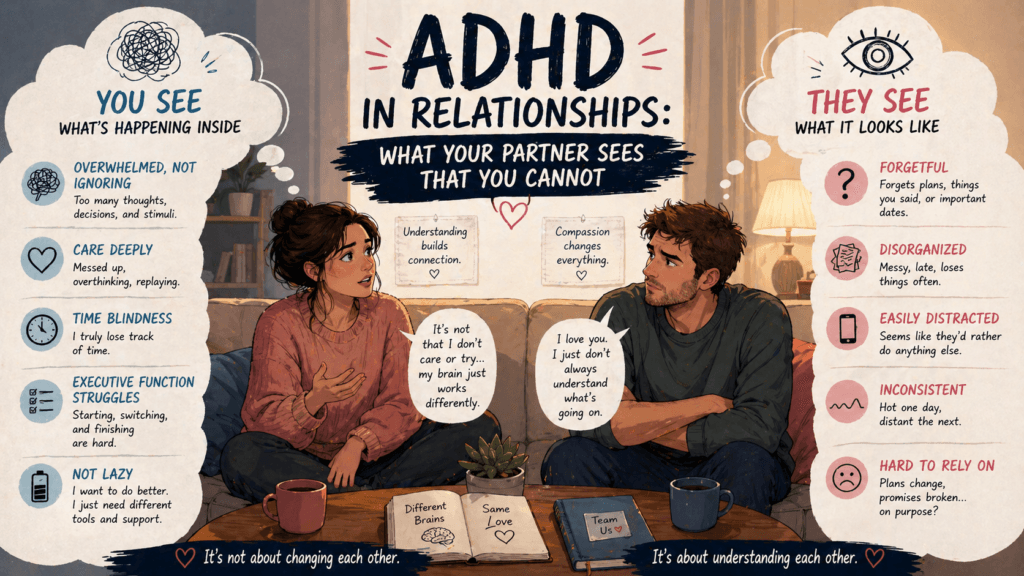
If you have ADHD and you are in a long-term relationship, there is a good chance your partner has a completely different account of your relationship than you do. Not a distorted one, not an unfair one. A different one. They are watching a pattern you genuinely cannot see from inside your own nervous system. They are tracking the accumulation of missed dinners, forgotten conversations, and derailed plans. You are living inside a single moment, convinced that this time was a one-off, that you meant well, that you were about to do it. This gap, between what your partner observes across months and years and what you experience in any given moment, is one of the most corrosive forces in ADHD relationships. Understanding the mechanism is not about assigning blame. It is about finally seeing what they are seeing.
The Credibility Gap Is a Pattern Problem, Not an Intent Problem
Here is the core mismatch: your partner has a long memory. You have an intense present. Every missed commitment you make feels, from the inside, like an isolated incident with a reasonable explanation. You were hyperfocused. Something came up. You genuinely forgot. But from outside, your partner is watching a trend line. The commitment was missed. It happened before. It will probably happen again. This is not them being uncharitable. This is them doing exactly what any reasonable person does when they experience repeated disappointment: they update their expectations downward.
Research captures this pattern directly. A qualitative study exploring romantic relationships in adults with ADHD found that participants themselves recognized the toll their inconsistency took, with one noting, “I can become so engrossed in what I am doing that I will not do something that I said I would do, like make dinner” (Rudden et al., “I Felt Like a Burden,” 2025, Irish Journal of Psychological Medicine). Another described how “time-blindness can make it easy to drift away from people.” These are not confessions of carelessness. They are descriptions of an executive functioning system that simply does not fire the same way as a neurotypical one.
The problem is not that you keep lying. The problem is that your brain keeps making promises your nervous system cannot keep, and your partner has stopped believing the difference matters.
The credibility gap compounds over time. Each explanation you offer, even an accurate one, reads as another excuse layered on top of the last excuse. Your partner is not wrong to feel that way. They have heard the explanation before. What they have not heard is a system change. The distinction between “I understand why I do this” and “I have built something that prevents it from happening” is everything to a partner who has been waiting for things to get better.
What Your Brain Is Actually Doing During Conflict
ADHD is not just an attention problem. It is a regulation problem. The same brain that cannot hold a grocery list in working memory also struggles to stay regulated under emotional pressure. During conflict, this becomes visible in a specific and damaging way: emotional flooding happens faster, runs hotter, and lasts longer than it does in neurotypical adults.
When your partner raises a concern, perhaps calmly, perhaps not, your nervous system registers it as a threat. Rejection sensitivity dysphoria, documented as a distinct feature of ADHD, means that criticism and perceived disappointment can trigger a shame response so intense that it effectively shuts down the prefrontal cortex. You stop being able to listen. You start defending, deflecting, or shutting down entirely. From your partner’s side, they raised a reasonable concern and watched you react as though they had attacked your entire character.
Research from Ben-Naim et al. (2017), cited across multiple ADHD relationship studies, found that partners of individuals with ADHD report significantly lower intimacy and marital satisfaction compared to couples where neither partner has ADHD. Part of that dissatisfaction is logistical. A large part of it is emotional: the experience of trying to have a conversation with someone who floods, escalates, or disappears every time the topic gets difficult.
The flooding loop: Partner raises concern, ADHD brain registers threat, shame floods the system, rational processing drops offline, response becomes defensive or shut down, partner feels unheard and escalates, ADHD brain floods further. This cycle is biological before it is relational.
Understanding this mechanism matters because it changes the intervention. You cannot think your way out of a flooded nervous system. No amount of good intentions or intellectual commitment to “communicating better” will override a stress response that is happening subcortically. The regulation has to happen before the conversation, not during it.
Rejection Sensitivity and the Armor That Breaks Intimacy
Rejection sensitivity dysphoria is one of the least discussed and most destructive features of adult ADHD in relationships. It is not simply feeling hurt when criticized. It is an almost instantaneous, physiologically intense reaction to the perception of criticism, failure, or disappointment that can be completely disproportionate to what actually happened.
Beaton et al. (2022), referenced in the “I Felt Like a Burden” study (Rudden et al., 2025), found that adults with ADHD are intensely fearful of criticism and that repeated experiences of rejection had negatively altered their sense of self. In relationships, this creates a painful loop: fear of rejection leads to hypervigilance for signs of disapproval. Hypervigilance leads to overreactions when those signs appear. Overreactions confirm the partner’s concern that something is wrong. That confirmation triggers more shame, more defensiveness, more flooding.
Some adults with ADHD handle rejection sensitivity by becoming intensely people-pleasing, overcompensating to the point of burnout. Others develop an emotional armor that looks, from the outside, like indifference or stonewalling. Neither response helps the relationship. The people-pleasing exhausts both people. The armor leaves the partner feeling locked out and eventually alone inside a relationship that still technically exists.
Your partner is not trying to hurt you when they bring something up. But your nervous system is treating every difficult conversation like a verdict on your worth as a person. That is not a relationship problem. That is a neurology problem that is showing up inside the relationship.
The Parent-Child Dynamic: How It Forms and Why It Feels Inevitable
Ask any couple therapist who works with ADHD relationships what the single most common complaint is, and the answer is almost always some version of this: one partner feels like a parent, the other feels like a child being managed. Both people hate it. Neither person chose it. And yet it forms anyway, incrementally, through a series of individually reasonable decisions.
It starts with compensation. The non-ADHD partner picks up a dropped task. Then another. They remind, they organize, they follow up. Not because they want to control the relationship but because things need to get done and someone has to do them. Over time, this compensation becomes the default architecture of the relationship. The ADHD partner stops initiating household management because their partner will handle it. The non-ADHD partner escalates their oversight because they have learned, empirically, that things fall through otherwise.
The “I Felt Like a Burden” study (Rudden et al., 2025, Irish Journal of Psychological Medicine) documented this progression precisely. One participant described how “partner scaffolding progressed to toxic codependency.” Another noted the feeling of having “no trust or confidence in myself to maintain standards required to maintain a successful romantic relationship.” The research framed this as a potential outcome of well-intentioned support: when the non-ADHD partner takes over executive functioning for the relationship, the ADHD partner can lose independent skill in decision-making and problem-solving, deepening the imbalance rather than correcting it.
Why the dynamic is so sticky: The non-ADHD partner takes over because things get done faster and better that way in the short term. The ADHD partner accepts it because trying and failing feels worse than not trying. Both responses are individually rational. Together they build a structure neither person wants to live in.
What makes this dynamic particularly damaging is that it erodes attraction. Romantic partnerships require a degree of perceived equality, of two adults navigating the world together. When one person is functionally managing the other, the erotic charge disappears, resentment accumulates on both sides, and what started as love starts to feel like a job. The non-ADHD partner did not sign up to be a project manager. The ADHD partner did not sign up to feel perpetually incapable. Both are right. And yet here they are.
What Your Partner Has Stopped Saying Out Loud
Partners of adults with ADHD often go through a specific sequence. Early in the relationship, they raise concerns directly. They get explanations, promises, genuine effort. Things improve briefly and then regress. After several cycles of this, many partners stop raising the concern. Not because it is resolved. Because they have learned that raising it costs emotional energy they do not have and produces change that does not last.
What happens to the unexpressed concern is important: it does not dissolve. It becomes a layer of quiet resentment, a low hum of hopelessness about whether things will ever be different. Your partner may seem fine. They may have stopped fighting about the thing that used to cause arguments. That silence is not resolution. It is often withdrawal, which is the relationship’s immune system starting to shut down.
Research on depressive symptoms and relationship stress is relevant here. Doyle et al. (2021), cited in the “I Felt Like a Burden” study, identified an association between depressive symptoms and reduced relationship satisfaction and increased relationship stress. This matters because ADHD partners frequently carry co-occurring depression and anxiety, conditions that reduce their capacity to initiate repair. Meanwhile, the non-ADHD partner is managing both the practical gap and their own emotional depletion. The system is exhausted on both ends, and the most likely coping mechanism on both sides is withdrawal.
The Attention Asymmetry Problem
There is a painful irony at the center of many ADHD relationships. The person with ADHD can hyperfocus on a new hobby for six hours but cannot sustain attention on a conversation with their partner for ten minutes. This is not a preference. It is not evidence that they care more about the hobby than the person. It is the mechanics of a dopamine system that runs on novelty and urgency, not on sustained conscious effort.
But try explaining that to someone who has watched you spend three hours engrossed in a video game and then zone out during the one conversation they needed to have. The experience, from their side, is indistinguishable from being deprioritized. The “I Felt Like a Burden” study documented this directly: one participant described how “issues staying focused while being intimate caused their partner to query if I was even interested or thinking of someone else.” Another described forgetting to return calls or answer texts and not being able to remember things their partner had told them.
Hyperfocus on a new interest is not evidence that you can sustain attention when you want to. It is evidence that your dopamine system responds to novelty. Your partner is not new anymore. That is a neurological problem, not a statement about their value to you.
This is one of the hardest things to communicate to a non-ADHD partner, because it runs counter to everything they have been taught about how humans prioritize. If you can do something for six hours when you enjoy it, the conclusion feels obvious: you just do not want to do the other thing enough. Psychoeducation about ADHD neurology is not a get-out-of-jail-free card, but it is genuinely necessary context. Without it, partners are building their models of the relationship on a framework that does not apply.
The Diagnosis That Changes the Story (and the One That Does Not)
Getting an ADHD diagnosis as an adult, or finally understanding that the diagnosis you have had since childhood explains relational patterns you never connected, can be genuinely transformative. The “I Felt Like a Burden” study found that participants who came to understand their behavior through the lens of ADHD reported significant relief: not as an excuse, but as a reframing that allowed for self-compassion and directed effort rather than undifferentiated shame.
One participant described the shift: “I’m with someone for 8 months now and he also has ADHD (diagnosed). He understands the way I think and I’m very happy with him, it’s the first time I’ve felt I don’t have to pretend my way through the day.” Another described the relief of realizing a partner’s tolerance for their traits was because the partner “probably had some sort of neurodiversity” themselves. Self-understanding, and having a partner who shares that understanding, appears to be one of the strongest protective factors for relationship satisfaction in this population.
But the diagnosis has to be followed by actual change, or it becomes another explanation that fails to produce repair. Understanding why you forget does not make the forgetting less frequent unless that understanding is attached to a concrete system. Understanding why you flood during conflict does not help your partner unless you have a regulation strategy that actually works before a conversation escalates. The insight has to become infrastructure.
Insight without infrastructure: Knowing that your ADHD causes the pattern is step one. Building an external system that compensates for what your brain does not do automatically is step two. Most ADHD adults stop at step one and wonder why their relationships do not improve.
What Actually Helps: Mechanisms, Not Mantras
Advice like “communicate more openly” or “be more present” is functionally useless for an ADHD brain. It is the equivalent of telling someone with a broken leg to just walk normally. What works is structural: external systems that reduce the load on working memory, regulation tools that intercept flooding before it derails a conversation, and explicit agreements that remove ambiguity from expectations.
On the practical side, this means offloading commitment-tracking entirely to external systems. A shared calendar with reminders is not optional infrastructure for an ADHD relationship. It is the difference between repeated disappointment and baseline functional reliability. The non-ADHD partner should not have to be the reminder system. That role corrodes the relationship. An app, a calendar, a whiteboard, anything outside the ADHD brain that holds the commitment reliably, is what the brain is not currently doing.
On the emotional regulation side, the single most evidence-consistent intervention is the planned pause. Not walking away from conflict in anger. A pre-agreed signal between both partners that means “my nervous system is flooded and I need five to ten minutes before I can engage productively.” This requires negotiating the agreement during a calm moment, not during a fight. It requires the non-ADHD partner to trust that the pause is not abandonment. It requires the ADHD partner to actually return and re-engage rather than letting the pause become avoidance.
On the parent-child dynamic, the intervention is deliberate redistribution of ownership, not tasks. The ADHD partner taking over complete ownership of a specific domain, even an imperfect one, matters more than doing more tasks that the partner assigns. Ownership of a domain, however narrow, rebuilds the sense of mutual adult partnership that the imbalance erodes. It also gives the ADHD partner somewhere to succeed on their own terms rather than perpetually falling short against someone else’s standard.
The Relationship Is Not the Problem. The Missing Framework Is.
Most ADHD couples who end up in crisis are not in crisis because they chose the wrong person. They are in crisis because they have been trying to run a neurotypical relationship model with a brain that requires a different one. The neurotypical model assumes roughly equivalent working memory, roughly equivalent emotional regulation capacity, and roughly equivalent ability to translate intention into consistent action. When one partner does not have those capacities, the model breaks down and both people blame each other for the failure.
The non-ADHD partner is not wrong that things are harder than they should be. The ADHD partner is not wrong that they are trying. Both of those things are true simultaneously, and no amount of trying harder within the broken model will fix the model. What fixes it is replacing the assumption of neurotypical symmetry with something that actually accounts for how the ADHD brain works, not as an excuse for every failure, but as the honest starting point for building something that actually functions.
You are not a bad partner who keeps failing. You are someone trying to run a system your brain was not built to run, without the modifications that would make it work. The goal is not to try harder. The goal is to build differently.
Couples therapy specifically oriented toward ADHD, not generic communication skills training, makes a measurable difference when both partners understand the neurological framework going in. Psychoeducation for the non-ADHD partner is as important as treatment for the ADHD partner. A partner who understands that emotional flooding is biological, that time-blindness is not disrespect, and that hyperfocus on other things is not evidence of prioritization, can engage with the relationship from a completely different position. That shift in understanding does not remove the hard work required. But it removes the layer of moral judgment that makes the hard work feel pointless.
If you are the partner with ADHD reading this, the ask is not to feel worse about what has happened. It is to stop explaining the pattern and start changing the architecture around it. Your partner has been watching the pattern long enough. What they are waiting to see is something different.
Quick Dopamine Hits:
- Before any difficult conversation, set a two-minute timer and write down the one thing you actually need your partner to understand. Read it aloud to yourself before speaking.
- After you miss a commitment, resist the urge to explain immediately. Say ‘I know I dropped that, and I want to understand why it keeps happening’ before offering any reason.
- When you feel a conflict escalating in your body (chest tight, thoughts racing), say the word ‘pause’ out loud and physically move to a different room for five minutes before continuing.
Rate this article
Was this a useful hit?