Your Anger Isn’t a Temper Problem. It’s RSD You Were Never Taught to Recognize.

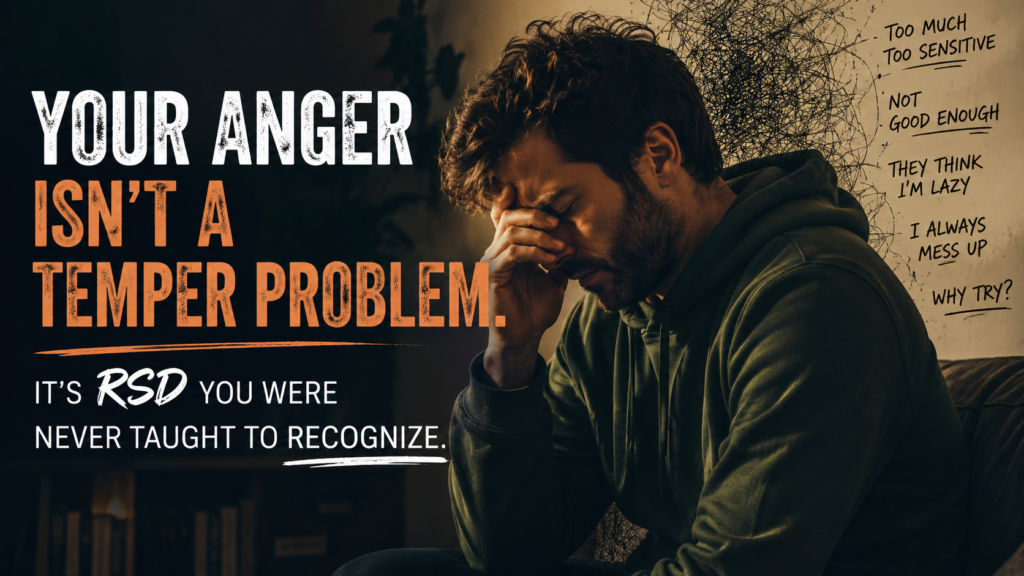
If you are a man with ADHD and you have ever erupted at something that, ten minutes later, felt completely disproportionate, you already know this feeling. The sharp email from your manager that sent you into a spiral of cold fury. The offhand joke from a friend that you replayed for three days. The way your partner’s tone of voice in one sentence made your chest feel like it was caving in, and how that somehow came out as a slammed door. What you have almost certainly never been told is that this is not a temper problem. It is rejection sensitive dysphoria, and in men with ADHD, it almost always looks like anger first.
Why RSD Presents Differently in Men
Rejection sensitive dysphoria is the term used to describe the intense, sudden emotional pain that people with ADHD experience in response to perceived or actual criticism, rejection, or failure. The word “dysphoria” is precise: this is not mild disappointment or normal social discomfort. It is a neurological flood. Research on the lived experience of rejection sensitivity in ADHD describes it as “a painful and overwhelming experience, which often lasts a significant amount of time, between hours and weeks, and can resurface many years later” (Rowney-Smith et al., 2026, PLOS One).
Here is the problem: almost every account of RSD in popular ADHD content describes the same presentation. You become quiet. You withdraw. You cry in the car. You catastrophize internally. You over-apologize. This is a real and valid presentation, and it is the one most commonly described by women with ADHD. But it is not the only presentation, and in men it is frequently not the primary one. Instead, the neurological flood exits through a different channel. It comes out as irritability, hostility, a disproportionate argument, cold shutdown, or a sudden explosion that clears the room before the person even fully understands what they are reacting to.
The world sees your frustration as aggression rather than neurological overload. Add ADHD to the mix, and what is actually pain reads to everyone else as a problem with your character.
This distinction matters because it determines whether RSD gets recognized and addressed, or whether it gets relabeled as something else entirely: a bad temper, aggression, immaturity, or in more clinical settings, oppositional defiant disorder. Many men with undiagnosed or undertreated ADHD spent their childhoods collecting these labels instead of getting help. The labels followed them into adulthood, hardened into self-concept, and made every subsequent emotional eruption feel like further confirmation that they were simply difficult people.
The Neuroscience of Emotional Explosions in ADHD
The biology here is not complicated to understand, though it is often absent from public-facing conversations about ADHD. Emotional dysregulation is now recognized by researchers as a core component of ADHD, even though it remains absent from the DSM-5 diagnostic criteria. Prevalence estimates for emotional dysregulation in adults with ADHD range from 30 to 70 percent, based on multiple studies reviewed by Corbisiero et al. (2013, ADHD and Attention Deficit and Hyperactivity Disorders).
The mechanism involves the prefrontal cortex and its relationship with the limbic system. The prefrontal cortex is responsible for what researchers call inhibitory control: the capacity to pause between feeling an emotion and acting on it. In ADHD, this inhibitory function is structurally and functionally compromised. Barkley (2010) described adults with ADHD as less likely to inhibit emotions pertaining specifically to frustration, impatience, and anger, as a result of deficient cortical regulation. This is not a personality flaw. The brake system is genuinely impaired.
Neuroimaging research has found that ADHD with emotional dysregulation is associated with altered functional connectivity between the dorsolateral prefrontal cortex and the orbitofrontal cortex, regions critical to both emotional appraisal and impulse control. When the appraisal of a social threat (real or perceived rejection) occurs, the limbic alarm fires at full intensity, and the prefrontal brake is often too slow or too weak to intercept it. What emerges is emotional impulsivity: an immediate, high-intensity behavioral response driven by affect rather than reasoning.
Emotional impulsivity vs. emotional dysregulation: Research distinguishes these as related but separate. Emotional impulsivity refers to acting on an intense emotion without delay (the explosion). Emotional dysregulation refers to the broader difficulty regulating the emotion once it has started (the inability to calm down afterward). Men with ADHD often experience both simultaneously during an RSD episode, which is why the event can feel catastrophically out of proportion and then take hours or days to fully resolve.
Research on emotion dysregulation and emotional impulsivity in adults with ADHD found that emotion dysregulation scores fully mediated the relationship between core ADHD traits and emotional impulsivity: the pathway from ADHD to explosive behavior runs directly through impaired emotion regulation, not through any separate aggression trait. The anger is downstream of the dysregulation. The dysregulation is downstream of the neurology.
Does RSD Make Men Hypersensitive to Angry Voices?
Research on neural responses to vocal anger in ADHD offers a direct answer: yes, for many people with ADHD. A study examining event-related brain potentials in ADHD found atypical neural activity during the early perceptual stages of vocal anger processing, suggesting pre-attentive hyper-vigilance to expressions of hostility in others. The researchers proposed that this heightened alertness to vocal anger may act as a trigger for negative emotional outbursts in ADHD. The brain is already scanning for threat signals in the social environment. When a tone of voice, a phrasing pattern, or a silence gets picked up by this hyper-alert system and flagged as rejection or criticism, the response can arrive before conscious awareness has time to reframe it.
This explains a pattern many men with ADHD describe: reacting to something they cannot fully articulate. A partner asks “are you okay?” in a slightly flat tone, and a visceral defensive response activates almost immediately. A colleague does not respond to a message for two hours, and a low-grade hostile mood starts building. The threat detection system has already fired. The cortex is left trying to reverse-engineer a justification for a response that was never rational in the first place.
How Social Conditioning Buries the Real Signal
Boys are told, in direct and indirect ways from very early on, that emotional pain is unacceptable as a public experience. “Toughen up” is the template. Crying is weakness. Vulnerability is something to be concealed. What is permitted, and what often receives a kind of cultural reinforcement, is anger. Anger in men reads as strength, assertiveness, even dominance. It does not require the same level of social courage as saying “that really hurt me.”
For a boy with ADHD who is experiencing RSD but has no framework for understanding it, the path of least resistance is to route every episode of emotional pain through the anger channel. This happens repeatedly, across childhood and adolescence, until it becomes automatic. The neural pathway from “perceived rejection” to “anger response” gets progressively more efficient. By adulthood, the intermediate step, where the pain actually lives, is essentially invisible, even to the person experiencing it.
One account from a man who received his ADHD diagnosis at 34 captured this precisely: “Growing up, I was told to be strong. Translation: Keep your emotions hidden.” The result was that his emotional pain was consistently misread as aggression rather than neurological overload.
The qualitative research on RSD in ADHD found that participants consistently adopted what the authors described as “a mask of toughness” to hide rejection sensitivity and appear unaffected. But consistent masking carries a real cost: dissociation from one’s actual emotional state. Participants in the University of Sussex study reported needing therapy specifically to re-identify their true self after years of masking (Rowney-Smith et al., 2026, PLOS One). For men, this mask is not a choice made in adulthood. It is a social requirement installed in childhood, long before there was any language for what it was covering.
The vicious circle of masking: Research found that when people with ADHD adopt a nonchalant mask, others often assume that rejection and criticism do not affect them. As a result, rejections and critiques increase, the person withdraws further from social situations, and the mask becomes even more entrenched. For men who route RSD through anger rather than visible pain, the mask looks like toughness from the outside. The cost on the inside accumulates over years.
The Misdiagnosis Pipeline: From RSD to “Problem Behavior”
The consequences of this mislabeling go well beyond the personal. Research shows that boys, particularly Black boys, with ADHD are disproportionately diagnosed with oppositional defiant disorder or conduct disorder instead of ADHD, precisely because emotional and behavioral externalizing presentations are interpreted as willful defiance rather than neurological dysregulation. One account published by ADDitude Magazine described this directly: young Black males are significantly less likely to be diagnosed with ADHD than white boys presenting with comparable ADHD traits, due to implicit bias and the tendency to interpret emotional dysregulation as conduct problems. The emotional impulsivity that characterizes untreated ADHD is read as aggression. The aggression gets punished. The punishment increases the frequency of RSD episodes. The cycle accelerates, and the actual underlying condition recedes further from view.
Even for men who eventually receive an ADHD diagnosis in adulthood, the RSD component is rarely addressed specifically. The core DSM-5 criteria do not include emotional dysregulation, which means a clinician who follows the diagnostic criteria closely may identify inattention and hyperactivity-impulsivity without ever naming the emotional flooding that has been driving the most damaging behavior for decades. Corbisiero and colleagues (2013, ADHD and Attention Deficit and Hyperactivity Disorders) argued explicitly that the clinical picture of ADHD in adulthood is more complex than the three classical domains suggest, and that emotional dysregulation requires separate clinical attention, including specific attention to temper control, affective lability, and emotional overreactivity.
Without that specific naming, men with ADHD continue operating with a partial map. They may understand their attention and impulse control challenges. They almost certainly do not understand that the anger that has cost them jobs, relationships, and years of self-respect is the same condition expressing itself through a different channel.
What an RSD Anger Episode Actually Looks Like
It helps to see this pattern described precisely, because when you are inside it, it rarely feels like RSD. It feels like legitimate grievance. The typical architecture of an RSD anger episode in men tends to follow a specific sequence.
First, there is a trigger: something that registers, consciously or not, as rejection, criticism, or being found inadequate. This can be dramatic (explicit rejection, public criticism) or extremely subtle (a delayed text reply, a partner using a certain tone of voice, a colleague who did not include you in a meeting). Second, the neurological flood activates within seconds. Chest tightens. Jaw sets. Cognition narrows. Third, the anger emerges as the primary output: defensiveness, hostility, withdrawal, or an actual verbal or behavioral explosion. Fourth, the episode begins to resolve, often relatively quickly, leaving behind a residue of shame, confusion, and frequently a relationship casualty that now has to be managed. The person on the other end may be completely baffled. They made a fairly ordinary comment and something disproportionate happened.
What distinguishes this from ordinary anger is the speed, the intensity relative to the trigger, the strong bodily component, and the difficulty modulating the response once it has started. Research participants in the RSD qualitative study described the physical experience of rejection sensitivity as visceral: “it’s like a pinch in your heart,” “a chair being taken out from beneath you,” a flooding warmth spreading through the body (Rowney-Smith et al., 2026, PLOS One). The physical sensation precedes the cognitive interpretation. By the time the brain is trying to make sense of what is happening, the body is already in emergency mode.
Recognition: The Step That Has to Come First
Before any behavioral strategy is useful, recognition has to happen. Recognition has two components: knowing what RSD is, and being able to identify it in real time as it is occurring, rather than only in retrospect.
The first component is the work of reading and understanding. RSD is well-documented in the ADHD research literature even if it remains underrepresented in clinical settings. Understanding that your anger is frequently the outward form of internal emotional pain that your nervous system cannot otherwise express is not a small reframe. It is a structural reorientation. It changes the question from “why am I so angry?” to “what did my nervous system just interpret as rejection, and is that interpretation accurate?”
The second component is harder. Real-time recognition of RSD in men is difficult precisely because the externalizing presentation is so fast and so convincing. The anger feels justified from the inside. One practical leverage point is to notice the physiological signature before the behavioral response: the tightening in the chest, the narrowing of attention, the shift in breathing. These physical signals often precede the full emotional flood and give a small window for interruption. Research on executive function and emotional regulation in ADHD suggests that even brief cognitive labeling of an emotional state can increase prefrontal engagement and reduce the intensity of the impulsive response. It does not eliminate the neurological flood, but it can reduce the amplitude.
De-escalation Strategies That Are Built for This Presentation
The strategies most commonly recommended for RSD are designed around internalizing presentations: journaling, talking about feelings with trusted people, leaning into vulnerability. These are valid, and men with ADHD should not permanently exclude them. But they are not the right entry point when someone is in the middle of an externalizing anger episode, or for men who have spent decades routing emotional pain through anger channels and have no established vocabulary for the internal experience.
A more effective entry point is the time buffer. Because emotional impulsivity in ADHD is characterized specifically by the failure to pause between feeling and acting, any strategy that artificially creates that pause has neurological leverage. The 20-minute rule is one form of this: no response to the triggering event for 20 minutes. RSD episodes in ADHD tend to be intense but time-limited. The neurological flood activates fast, peaks fast, and drops relatively fast compared to, say, a major depressive episode or chronic anxiety. The problem is that the most damaging responses almost always happen inside the first ten minutes. Creating a mandatory buffer between the trigger and the response does not require understanding or resolving the underlying emotion. It simply prevents the behavioral output from occurring while the intensity is at its highest.
The second strategy is cognitive labeling. This is not about being asked to feel your feelings in a way that feels foreign or performative. It is about giving the brain a secondary processing task that partially engages the prefrontal cortex. Naming the emotion specifically (not just “angry” but “humiliated,” “dismissed,” “inadequate”) activates language-processing regions and slightly reduces the intensity of the initial emotional response, an effect documented in affective neuroscience research. For men with ADHD who have almost exclusively processed emotional pain as anger, this naming will initially feel artificial. That is expected. It is a new neural pathway being formed, not an existing one being used.
The third strategy involves pre-commitment before high-stakes situations. If you know that a certain type of interaction reliably triggers RSD, prepare a cognitive anchor in advance. Write one sentence before the conversation that separates criticism of your work from rejection of your identity. Executive function research consistently shows that the ADHD brain tends to be far more effective at using regulatory strategies when they are set up in advance, during a calm state, than when they are attempted in real time during an emotional flood. The executive function system does not perform reliably under emotional load. Front-loading the regulation work is not a workaround: it is using the system correctly.
The goal is not to stop feeling things intensely. The goal is to stop the feeling from becoming a behavior before you have had three seconds to decide whether that behavior is what you actually want.
What Addressing This Actually Changes
The relational cost of unrecognized RSD in men with ADHD is significant and well-documented. Research on ADHD and romantic relationships found that RSD frequently placed serious strain on partnerships, with participants describing how their jealousy and need for reassurance put partners through considerable difficulty. That dynamic tends to be worse when the RSD presents as anger rather than vulnerability, because anger is much harder for partners to receive as evidence of pain. It reads as threat or contempt. The underlying message, which is “I am terrified of losing you or being rejected by you,” is completely invisible behind it.
Men who begin to recognize RSD in their anger presentation frequently report a significant shift in self-understanding. Not because the emotional experiences stop being intense, but because they finally have an accurate map. The anger stops feeling like evidence that they are broken or dangerous and starts being legible as a signal: the nervous system has just registered a threat, real or perceived, and needs support rather than suppression or punishment. That shift in self-concept is not trivial. It is often the thing that makes treatment actually land.
Research confirms that emotional dysregulation traits in ADHD are responsive to treatment. Both methylphenidate and atomoxetine have shown clinician-rated improvements in emotional dysregulation (Reimherr et al., 2005; 2010, referenced in Corbisiero et al., 2013). Cognitive-behavioral approaches that specifically target emotion regulation are also supported by randomized controlled evidence. None of that changes anything until the problem is correctly named. For men with ADHD, RSD presenting as anger has been incorrectly named for most of their lives. Calling it by its real name is, in the most literal sense, where the work begins.
Quick Dopamine Hits:
- Next time you feel a sudden surge of anger after a perceived slight, pause and name the underlying emotion before you respond: write down ‘I feel ___’ using a feeling word other than ‘angry’ (try ‘humiliated’, ‘dismissed’, ‘worthless’). The naming alone interrupts the automatic externalizing response.
- Set a 20-minute timer after any emotionally charged interaction (a sharp email, a terse reply from your partner, a sarcastic comment from a colleague). Do not respond to the trigger during those 20 minutes. RSD peaks and then drops fast once the initial neurological flood passes.
- Before any high-stakes conversation where criticism is likely (a performance review, a relationship conflict), write one sentence in your notes app: ‘This person criticizing my work is not the same as them rejecting who I am.’ Read it before you walk in. This is a pre-emptive cognitive label that gives your prefrontal cortex something to hold onto when the flood starts.
Rate this article
Was this a useful hit?