What Is Executive Function Dysfunction? An Honest Explainer for ADHD Adults

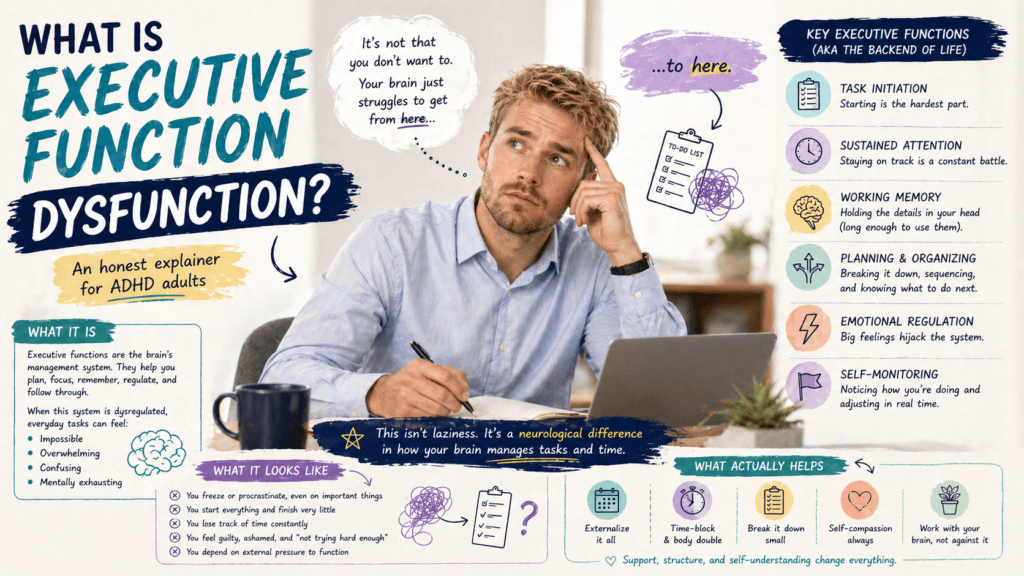
Executive function dysfunction is the reason you can explain a complex project to your team with total clarity and still be unable to start a simple email for three hours. It’s why you know exactly what you need to do, feel genuinely motivated to do it, and then watch yourself open Reddit instead. For adults with ADHD, executive function dysfunction isn’t a character flaw living inside a capable brain. It is the primary mechanism through which ADHD disrupts daily life, and understanding it honestly changes how you interpret nearly every frustrating pattern you’ve developed.
Most explanations of executive function stop at the textbook definition. You get a list of cognitive skills, a diagram of the prefrontal cortex, and a vague suggestion to use a planner. This article goes further. It explains what executive function actually is at the neural level, why the dysfunction in ADHD is fundamentally different from regular difficulty, which specific domains are implicated and how, and what that means for the strategies most likely to help you versus the ones most likely to fail.
The Prefrontal Cortex Is Not the Whole Story
Executive function refers to a suite of higher-order cognitive processes that allow humans to regulate their own behavior in service of goals. Historically, researchers linked these processes almost entirely to the prefrontal cortex following observations of patients with frontal lobe damage who showed dramatic changes in planning, impulse control, and decision-making while retaining language and memory. That framing stuck around longer than the evidence supported.
Contemporary neuroscience is more precise. Executive functions depend on distributed neural circuits that include the prefrontal cortex, yes, but also the basal ganglia, anterior cingulate cortex, and their dopaminergic and noradrenergic projection pathways. In ADHD, the disruption is not a structural hole in the brain. It’s a signaling problem. Dopamine and norepinephrine systems that modulate how strongly the prefrontal cortex can recruit and sustain these circuits are underperforming in specific contexts, particularly contexts involving low immediate reward, ambiguous deadlines, or high cognitive load (Arnsten, 2006, American Journal of Psychiatry).
This is why ADHD executive dysfunction has an inconsistency to it that confuses everyone, including the person experiencing it. The circuits work under certain conditions. Put an ADHD adult in a high-stakes, immediately rewarding, externally structured environment and executive function can appear completely intact. Remove those conditions and the same person can be functionally paralyzed. This isn’t selective effort. It is neurochemistry responding to context.
The Six Domains Where Things Actually Break Down
Researchers have proposed various taxonomies for carving executive function into distinct components. For clinical purposes and for lived experience, the most useful framework distinguishes six domains where ADHD adults commonly experience measurable impairment.
Inhibitory control is the ability to suppress a prepotent response, the thing your brain wants to do automatically, in favor of what the situation actually calls for. In ADHD, the suppression signal is weaker and slower. You interrupt conversations not because you’re rude but because the competing thought will be gone by the time there’s a pause. You click away from the document not because the work is boring but because a notification hit the inhibition pathway before the suppression could fire.
Working memory is your brain’s scratch pad, the capacity to hold information actively in mind while manipulating it. Adults with ADHD consistently show reduced working memory capacity compared to neurotypical peers (Rapport et al., 2008, Journal of Abnormal Psychology). You lose the thread of a sentence you’re writing because by the time you’ve typed the first clause, the second clause has faded. You walk into rooms and forget why. You read a paragraph and realize you processed the words but retained none of the meaning.
Cognitive flexibility is the capacity to shift attention and strategy when circumstances change. Paradoxically, ADHD involves both deficient flexibility (getting stuck in patterns, struggling with transitions) and excessive flexibility in the wrong direction (attention pulled involuntarily toward novelty). The basal ganglia’s role in gating attention shifts explains both: the gating system is dysregulated, not simply weak.
Planning and organization require holding a goal in mind, decomposing it into ordered steps, estimating the time and resources each step requires, and sequencing actions accordingly. Every part of this depends on working memory and inhibitory control functioning together. When both are impaired, planning produces incomplete or unrealistic outputs, and tasks feel undifferentiated regardless of their actual complexity or urgency.
Emotional regulation is increasingly recognized as a core executive function rather than a secondary ADHD symptom. Carvalho (2026, Frontiers in Human Neuroscience) proposes a distinction between “cool” executive processes involving cognitive control and working memory and “hot” executive processes encompassing emotion regulation and motivational control, arguing both represent disrupted pathways in ADHD and related conditions. The rejection sensitivity and emotional intensity many ADHD adults experience are not personality quirks. They are failures of the regulatory systems that should dampen and contextualize emotional signals before they drive behavior.
Time perception is less commonly included in classic executive function taxonomies but is arguably the most disabling component for adults. Research by Barkley (2011, Journal of Attention Disorders) identifies ADHD as fundamentally a disorder of self-regulation across time, with impairments in prospective memory, time estimation, and the subjective sense of time passing. This explains why deadlines feel abstract until they are immediate, why an hour of highly engaging activity feels like ten minutes while an hour of low-stimulation work feels like four hours, and why people with ADHD chronically underestimate how long tasks will take.
ADHD is not a failure to know what to do. It is a failure of the brain’s systems for doing what you know, when knowing alone provides insufficient motivational signal to activate the relevant circuitry.
Why “Just Try Harder” Is Neurologically Incoherent Advice
Effort is not a separate resource you can pour into an executive function system to compensate for its dysfunction. Effort is itself mediated by the same dopaminergic circuits that are impaired. When clinicians and coaches tell ADHD adults to simply apply more willpower, they are describing a mechanism that requires the very neurotransmitter systems that are misfiring. It is approximately as useful as telling someone with a broken thermostat to just feel warmer.
This is not a framing designed to remove personal responsibility. It’s a framing designed to direct effort toward interventions that actually have leverage. The ADHD brain is not effort-insensitive. It is highly sensitive to specific kinds of motivational signals: novelty, urgency, challenge, competition, and personal interest. These are not cheats or workarounds. They are the legitimate levers through which dopaminergic systems can be engaged when baseline activation is insufficient.
The engagement paradox: ADHD adults often perform at or above neurotypical levels when intrinsic interest or external urgency is high enough. This is not evidence that the dysfunction isn’t real. It is evidence that the deficit is in activating executive circuits, not in the circuits themselves. The goal of any good intervention is to make activation more reliable, not to question whether activation problems exist.
Executive Dysfunction as a Transdiagnostic Condition
One reason ADHD adults frequently go undiagnosed or misdiagnosed for years is that executive function dysfunction is not unique to ADHD. Carvalho (2026, Frontiers in Human Neuroscience) presents a comprehensive framework arguing that executive dysfunction represents a transdiagnostic mechanism of psychopathology, a shared neurocognitive vulnerability that cuts across depression, anxiety, OCD, bipolar disorder, and PTSD, among other conditions. This helps explain why ADHD so frequently co-occurs with these conditions and why the same person can be legitimately diagnosed with multiple disorders that each have executive function impairment as a core feature.
For ADHD adults navigating a mental health system, this creates a specific problem. When you present to a clinician with difficulty concentrating, emotional dysregulation, poor follow-through, and low motivation, you may receive a depression diagnosis, an anxiety diagnosis, or both. Treatment for those conditions may partially help, particularly if emotional regulation improves. But if the underlying executive function architecture of ADHD is not addressed directly, functional recovery remains incomplete. Carvalho (2026) notes explicitly that when executive limitations are not directly addressed, functional recovery may stall even when primary symptom clusters respond to treatment.
This is not an argument for self-diagnosis. It is an argument for pushing for comprehensive neuropsychological evaluation if standard treatment is not producing functional improvement in your day-to-day capacity to plan, initiate, and follow through.
Treating depression and anxiety without addressing executive dysfunction is like fixing the smoke alarm without finding the fire. Symptom relief and functional recovery are related but not the same thing.
The Working Memory Problem Is Worse Than You Think
Of all the executive function domains impaired in ADHD, working memory deficits may produce the widest range of downstream consequences because working memory is foundational to almost every other cognitive operation. Rapport et al. (2008, Journal of Abnormal Psychology) found significant working memory impairments in adults with ADHD compared to controls across verbal and visuospatial domains, with effect sizes that were clinically meaningful rather than statistically marginal.
Consider what working memory underwrites on any given Tuesday: holding the steps of a task in mind while executing the first step, tracking where you are in a conversation, remembering why you opened a browser tab, maintaining the thread of your own argument while typing it, mentally simulating the consequences of a decision before making it, and keeping track of multiple competing priorities simultaneously. Every one of these breaks down when working memory capacity is reduced or unstable.
The practical implication is that working memory cannot simply be strengthened through effort alone. External scaffolding is not a crutch. It is the functional equivalent of the scratch pad your working memory is failing to provide. Written task lists, verbal self-narration, external timers, and structured environment design are not accommodations for laziness. They are prosthetic cognitive tools filling a genuine functional gap.
On working memory training apps: Multiple meta-analyses have found that working memory training programs produce improvements on training tasks but limited transfer to real-world executive function outcomes. Don’t spend months training your working memory in isolation. Spend that time building external systems that reduce working memory demands in the environments where you actually live and work.
Emotional Dysregulation Is Not a Separate Problem
Many ADHD adults spend years in treatment for anxiety, mood instability, or interpersonal sensitivity without anyone connecting these experiences to executive function. The connection is direct and well-supported. Hot executive processes, particularly emotional decision-making and motivational control, are disrupted in ADHD through the same prefrontal-subcortical circuits implicated in cool cognitive control (Carvalho, 2026, Frontiers in Human Neuroscience).
What this looks like in practice: you receive a mildly critical email and your body responds as if it is a serious threat. The prefrontal regulatory circuits that should modulate that signal and contextualize it are not firing quickly or strongly enough. The amygdala-driven response runs to completion before downregulation occurs. You send a reactive reply you regret, or you spend the next two hours unable to work because the emotional signal is still activating your threat system at full intensity. This is rejection sensitive dysphoria territory, and it is not separate from executive dysfunction. It is one of its expressions.
The clinical takeaway is that emotional regulation strategies need to be built into any ADHD management approach from the start, not added later as a secondary concern. Medication that improves cognitive executive function often partially improves emotional regulation too, because both run on overlapping dopaminergic and noradrenergic pathways. Therapy specifically targeting emotional regulation, particularly dialectical behavior therapy or cognitive-behavioral approaches adapted for ADHD, adds to that foundation.
Why Most Standard Productivity Advice Fails ADHD Brains
The productivity industry is built almost entirely on the assumption that the person using the system has functional access to planning, time perception, and working memory. Most productivity frameworks require you to hold multiple priorities in mind simultaneously, accurately estimate task durations, sustain motivation through low-interest phases, and reliably return to interrupted tasks. These are exactly the capacities most impaired by executive function dysfunction in ADHD.
The result is a predictable pattern. An ADHD adult discovers a promising system, implements it with enthusiasm during a high-dopamine novelty window, and then watches it collapse when the novelty fades and the actual executive load of maintaining the system exceeds available capacity. The system gets blamed. The person blames themselves. Neither is the primary problem. The problem is a mismatch between what the system requires and what the brain reliably provides.
Effective systems for ADHD adults share specific structural properties: they reduce working memory load rather than adding to it, they use external triggers rather than relying on internal memory, they build in very short feedback loops rather than delayed gratification, they accommodate inconsistency by design rather than requiring perfect adherence, and they leverage interest and novelty deliberately rather than expecting intrinsic motivation to materialize. The Pomodoro technique works better for many ADHD adults than time blocking not because it is objectively superior but because its short intervals match the brain’s natural engagement rhythm and provide frequent completion signals that feed the dopamine system.
The best ADHD productivity system is not the one that’s most comprehensive. It’s the one that requires the least executive function to maintain while producing the most external structure to compensate for what’s missing internally.
Task Initiation: The Most Misunderstood Symptom
Of all the downstream effects of executive function dysfunction, task initiation failure is perhaps the most stigmatized and the least accurately understood. When an ADHD adult spends four hours unable to begin a report that will take forty-five minutes to write, the outside observer sees avoidance. The inside experience is frequently something more paralytic: a genuine absence of the internal signal that should trigger beginning.
Neurologically, task initiation in the ADHD brain requires sufficient motivational activation to engage the anterior cingulate cortex and basal ganglia in starting a new action sequence. When the task lacks novelty, urgency, competitive stakes, or intrinsic interest, that activation signal may simply not reach threshold. This is not the same as choosing not to start. It is closer to a car whose ignition won’t engage, regardless of how badly the driver needs to get somewhere.
This is why external structure is so disproportionately powerful for ADHD initiation problems. Body doubling, the practice of working in the presence of another person, activates social engagement circuits that substitute for missing intrinsic motivational signals. Hard deadlines imposed by external parties work better than self-imposed ones because they carry genuine social and practical consequences that raise urgency to threshold. Committing to start a task in a specific physical location at a specific time converts an abstract intention into a contextual cue that can trigger initiation more reliably than willpower alone.
On “just start” advice: Telling an ADHD adult with task initiation dysfunction to just start is like telling someone with a pain disorder to just ignore it. The advice is not technically wrong in every circumstance, but it addresses the wrong variable. Lowering the entry cost of starting, by making the first action trivially small, physically preparing the workspace in advance, or using an external trigger, is what actually moves the needle.
What Honest Progress Actually Looks Like
Managing executive function dysfunction in ADHD is not a project with a completion date. The neurodevelopmental differences in dopamine signaling and prefrontal regulation that underlie ADHD are stable features of the brain’s architecture, not deficits that disappear with enough therapy or enough habit-building. What changes over time is the scaffolding, the external systems, the environmental design, the medications if applicable, and the self-awareness that allows you to recognize when a specific executive function is failing and respond with a targeted intervention rather than shame.
This matters because the goal is not to become neurotypical. It is to build a life that functions reliably given the brain you actually have. That means accepting that you will need more external structure than most, that your performance will be more context-dependent than most, and that certain approaches that work for neurotypical colleagues will not work for you through no failure of effort or character.
Research supports a combined approach for most ADHD adults: medication where indicated, behavioral strategies that specifically target executive function domains rather than general productivity, environmental modification that reduces cognitive load, and support structures that provide external accountability and feedback. Saxena et al. (2024, cited in Carvalho, 2026) found across a transdiagnostic sample that executive dysfunction was closely associated with functional impairment, reinforcing that addressing it directly, rather than treating it as a secondary concern, is where functional gains are most consistently found.
If you’ve spent years wondering why your brain works the way it does, why the gap between knowing and doing is so relentlessly wide, why you can be brilliant in one context and completely dysfunctional in another, the honest answer is that executive function dysfunction in ADHD is a real, measurable, neurobiological phenomenon. It is not a reflection of your potential. It is a description of the specific cognitive architecture you are working with. And that description, uncomfortable as it sometimes is, is where useful work begins.
Quick Dopamine Hits:
- Pick one task you’ve been avoiding and write down only the very first physical action required to start it, then set a two-minute timer and do only that action.
- Set three alarms on your phone right now labeled ‘Where are you with time?’ spaced two hours apart during your workday to interrupt time blindness before it compounds.
- Before your next complex task, say out loud or write: ‘The goal is X, the first step is Y, I’ll know I’m done when Z.’ This externalizes the working memory load your brain is struggling to hold.
Rate this article
Was this a useful hit?