The AuDHD Double Bind: When Your Autism Masks Your ADHD and Your ADHD Blows Your Autism Mask

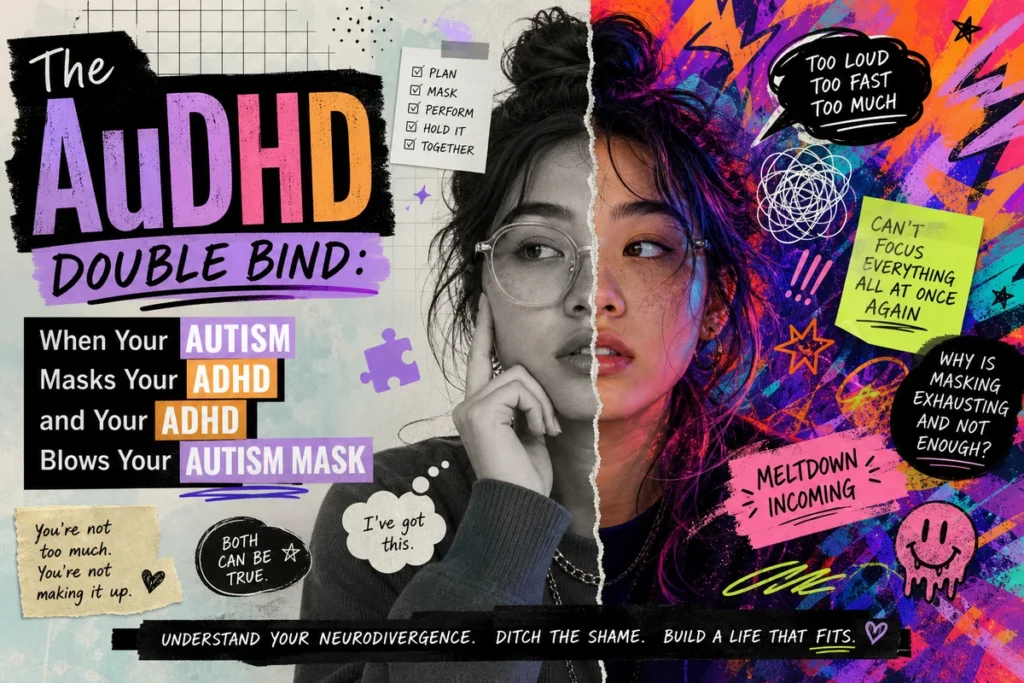
There is a specific kind of exhaustion that comes from being told, repeatedly, that you are contradictory. You crave routine but you catastrophically blow up your own routines. You need predictability but novelty is the only thing that pulls you out of inertia. You mask socially with impressive precision but then some impulsive, unfiltered thing comes out of your mouth at exactly the wrong moment and destroys the whole carefully constructed performance. If that sounds familiar, you are probably not contradictory. You are almost certainly AuDHD, and what you are living inside is a genuine neurological double bind: two conditions that do not just co-exist but actively sabotage each other’s core coping mechanisms. This is the thing almost no content about AuDHD masking actually addresses, and it is the thing that matters most.
The Mutual Sabotage: How ADHD and Autism Undo Each Other’s Coping Mechanisms
Start with the basics of what each neurology actually requires to function. Autistic nervous systems are organized around predictability. They benefit from sameness, from knowing what comes next, from routines that reduce the cognitive cost of a world that never quite makes sense socially or sensorially. ADHD nervous systems, by contrast, are driven by novelty, urgency, and dopamine-seeking. They cannot sustain engagement with anything that has stopped being new or interesting, regardless of how important it is. These are not personality differences. They are distinct neurological profiles with documented differences in dopaminergic regulation, sensory gating, and executive function architecture.
When you are AuDHD, you do not get to pick which neurology is in charge. Your autistic brain builds a routine. Your ADHD brain finds it intolerable after three days and blows it up. Your ADHD brain locks onto a hyperfocus. Your autistic brain cannot disengage from it, long past the point where your body needs food or rest. You stim to regulate sensory overload. Your ADHD restlessness interrupts the stim before it completes its regulatory function. Every tool one condition uses for survival becomes material for the other condition to dismantle. This is not metaphor. This is the specific lived architecture that researchers and AuDHD community members have begun documenting, and naming it changes what you do about it.
The combination isn’t just the sum of its parts. It creates something distinct, with its own rhythms, challenges, and strengths. Autistic need for structure can temper ADHD impulses, while ADHD energy can break out of Autistic ruts. But many AuDHD people live inside the tension between structure and novelty, quiet solitude and colorful impulsivity, deep focus and overwhelm from pingy thoughts.
Masking Autism While ADHD Screams: The Energy Paradox Nobody Names
Masking is the process of suppressing or camouflaging autistic traits to appear neurotypical, and it is metabolically expensive in ways that are only beginning to be quantified. It requires sustained conscious monitoring of your own behavior, real-time comparison against neurotypical social scripts, active suppression of stimming, forced eye contact, modulated vocal tone, and performed emotional expression. Every one of those processes draws on working memory and executive function. That is not incidental. That is the specific mechanism that makes AuDHD masking uniquely destructive.
Because ADHD already compromises executive function at baseline, the additional executive load of masking autistic traits drains a resource that was already running on deficit. Research on autistic masking, including work by Lai et al. (2017, Autism) and Hull et al. (2017, Journal of Autism and Developmental Disorders), has documented significant associations between higher masking and worse mental health outcomes, greater burnout, and reduced quality of life. In AuDHD adults, this depletion is not just additive: the ADHD executive deficit means there is less executive resource available before masking even begins. You are overspending from an already-empty account.
The feedback loop this creates is specific and brutal. You mask through the workday, depleting executive function. ADHD regulation, which was already unstable, collapses further. Impulsivity increases precisely because the suppression-and-monitoring system has run out of fuel. The autism mask blows. You say the unfiltered thing. You visibly stim. You lose the social thread entirely. And then the self-recrimination begins, which costs more executive function, which depletes you further. This is not a character failure. It is a neurological resource-depletion cycle operating exactly as the biology predicts it would.
The masking tax is real: Hull et al. (2017, Journal of Autism and Developmental Disorders) found that autistic adults who masked more heavily reported significantly higher levels of depression, anxiety, and autistic burnout. In AuDHD people, this cost compounds because ADHD already depletes the executive function masking requires to function.
The Diagnostic Overshadowing Trap: Why One Condition Erased the Other Until Now
Before 2013, the DSM explicitly prohibited diagnosing both autism and ADHD in the same person. Clinicians were required to choose one. This was not a minor administrative quirk. It shaped an entire generation of diagnostic outcomes, and many of the adults now identifying as AuDHD spent decades in that gap. When ADHD’s external, visible restlessness was present, clinicians saw it and stopped looking. The subtler, inward, rigidity-and-pattern traits of autism remained unrecognized, explained away as anxiety, giftedness, introversion, or being “too sensitive.”
The reverse occurred equally. When an autistic presentation was more prominent, the inattentive ADHD profile, which is quiet and internal, was absorbed into the autism diagnosis as a symptom of poor executive function, as if there were no separate neurological mechanism driving it. In a large survey conducted as part of the AuDHD Unlocked research project, the majority of AuDHD respondents reported receiving one or both diagnoses in adulthood, often after years of misdiagnosis or being told they were “just anxious” or “too sensitive.” The phrase “half-right” recurred as a description of how diagnostic spaces felt: ADHD communities felt close but incomplete, autistic communities felt close but incomplete, and neither community quite contained the full experience.
Diagnostic overshadowing is not merely historical. Clinicians who see obvious ADHD presentations today may still dismiss the quieter autistic features as ADHD traits, particularly in women and people assigned female at birth, where both conditions are already systematically underdiagnosed. Research including Hiller et al. (2014, Research in Developmental Disabilities) has documented that co-occurring conditions are frequently missed when a primary presenting diagnosis draws clinical attention. The pipeline problem begins at the first appointment and echoes for decades.
From the community: “Just as the title, i would love to know from the ppl who got diagnosed with both adhd and autism, what the key difference for u were. I got adhd and my therapist also mentioned clear symptoms of autism, but since both can overlap or interferr it is not always easy to identify.”, r/AuDHD thread
When Your Autistic Brain Locks Into Hyperfocus But Can’t Release, and ADHD Won’t Let You Rest
One of the most specific and least-documented AuDHD experiences is the hyperfocus trap. ADHD initiates the hyperfocus, pulling you into a task or special interest with the intensity that comes from finally, finally having enough dopamine to sustain engagement. But autistic inertia, the neurological difficulty in transitioning out of a current state, means the hyperfocus does not release when it should. You are locked in, not because the task is rewarding anymore, but because the autistic brain cannot execute the switch. Hours pass. Your body is exhausted. The task has become aversive. But you cannot stop.
Meanwhile, the ADHD understimulation panic begins building underneath the locked-in state. The task has gone stale but you cannot leave it. Your nervous system is simultaneously screaming for a change of input and unable to execute any transition. This is not laziness. It is not poor time management. It is two neurological systems pulling in opposite directions simultaneously, with no mechanism available to break the deadlock. The result is often what looks to outsiders, and feels to the person themselves, like frozen unproductivity. Nothing is getting done. Nothing feels possible. And the longer it persists, the more the self-blame accumulates on top of the neurological gridlock, creating a shame spiral that is its own separate problem to address.
You might find yourself unable to start anything while simultaneously feeling desperate for stimulation. Or you might get locked into a hyperfocus loop that the ADHD part of your brain initiated and the Autistic part cannot release, long past the point of enjoyment.
Residual Category, Fluid Identity: Why AuDHD People Keep Renegotiating What They Are
One of the more quietly destabilizing aspects of being AuDHD is that the diagnostic categories themselves were built to exclude the combination. Before 2013, the DSM treated autism and ADHD as mutually exclusive. Even now that the prohibition has been lifted, the two diagnoses exist as separate entries with separate criteria, separate research literatures, and separate clinical communities. There is no formal container for the interaction between them. AuDHD occupies what researchers have called a residual diagnostic category, meaning it falls between two classificatory systems in a way neither system was designed to accommodate.
Research by Craddock (2024, in work exploring the lived experiences of women diagnosed with both autism and ADHD in adulthood) found that participants struggled to articulate cohesive identities incorporating both conditions. Instead, they described the two as separate, opposing parts of their brain, with each condition experienced as an internally autonomous agent pulling in different directions. Significantly, this was not a stable perception. Participants periodically described the two conditions as complementary rather than contradictory, then shifted back. Some described their understanding as still changing years after diagnosis. One participant noted: “I’m still so early into this journey that I do still think of them as separate.” Another reflected: “I thought my quirks were me, but they are me influenced by neurodiversity. I am proud of them.”
What this research makes clear is that the ongoing renegotiation is not a sign of insufficient self-knowledge. It is a structurally predictable response to inhabiting a diagnostic position that existing systems were not designed to hold. There is no linear route from diagnosis to integrated understanding. The fluidity is the point, not a problem to be resolved.
The Inertia Spiral: When Structure Bores You and Novelty Overwhelms You at the Same Time
There is a specific type of paralysis that AuDHD people describe that fits neither a purely autistic nor a purely ADHD presentation: the state where everything feels simultaneously too boring to start and too overwhelming to approach. Standard ADHD activation strategies, novelty, urgency, interest, challenge, do not work because the autistic nervous system responds to too much novelty with shutdown. Standard autism-supportive strategies, sameness, predictability, reduced sensory load, do not work because the ADHD nervous system responds to too much sameness with a collapse of dopamine-driven engagement. The two failure modes overlap perfectly, leaving a gap where neither coping toolkit functions.
A 2026 study on inertia in AuDHD adults explicitly documented this interaction, noting that AuDHD participants described ADHD novelty-seeking and autistic need for predictability as directly clashing in their experience of inertia. This is not a metaphor the community invented. It is a measurable feature of the combined neurology, observed in formal research. The inertia cycle for AuDHD people is self-reinforcing: predictability triggers ADHD boredom, novelty triggers autistic overwhelm, and the paralysis that results is misread by everyone, including often the person themselves, as laziness, avoidance, or lack of motivation. None of those attributions are accurate. The behavior is a predictable output of two opposing neurological drives creating a deadlock.
The inertia paradox is AuDHD-specific: A 2026 study on AuDHD burnout recovery found that the interaction between autism and ADHD was a direct exacerbating factor in inertia, with participants explicitly describing the clash between ADHD novelty-seeking and autistic need for predictability as the mechanism of their stuckness, not low motivation, not laziness.
What Recovery Actually Requires: Rhythm Over Rest, Novelty-Safe Structure Over Either/Or
Standard advice for burnout is rest. Standard advice for ADHD underactivation is novelty and stimulation. For AuDHD people, both of these recommendations fail in isolation, and applying them without understanding the interaction can actually make things worse. Unstructured rest deepens autistic inertia. Pure novelty overwhelms an already-depleted autistic nervous system. The recovery strategy that actually works for AuDHD burnout is neither of these: it is the deliberate pairing of enough predictability to soothe the autistic nervous system with enough gentle novelty to engage the ADHD one.
Research adapting behavioral activation specifically for autistic adults has highlighted why standard behavioral activation for depression, which recommends scheduling pleasurable activities to interrupt withdrawal, needs modification for this population. Activities need to be chosen with sensory load and social demand in mind. Autistic-affirming versions emphasize sensory-friendly activities, special interests, and structure that does not increase time in depleting environments. For AuDHD people, the specific adaptation is adding novelty inside a predictable container: the same morning structure every day, but with a rotating sensory element, a different playlist, a new texture, a changed walk route, that provides enough stimulation variation to prevent ADHD boredom without disrupting the autistic brain’s need for a recognizable rhythm.
This is not a hack or a workaround. It is a neurologically accurate response to a neurologically specific problem. The goal is not to fix one condition at the expense of the other. The goal is to build an environment in which both conditions can co-exist at a functional baseline, which requires taking both seriously at the same time rather than alternating between them.
Recovery for AuDHD burnout often means cultivating rhythms that offer enough novelty to engage the ADHD brain, and enough predictability to soothe the Autistic nervous system. Gentle routines and structure can help with inertia, and gentle pleasure gives the nervous system something to organize around other than threat or depletion.
The Identity Piece: Naming the Paradox Instead of Choosing One
One of the most consistent findings in qualitative research on AuDHD adults is that the attempt to resolve the internal contradiction between the two conditions causes more harm than the contradiction itself. Participants who tried to identify more strongly with one diagnosis, to become more “ADHD” or more “autistic” in their self-concept, reported greater confusion and self-doubt over time, not less. The two conditions do not reduce to a single coherent identity. Forcing that reduction is itself a form of diagnostic violence, a demand that a person fit into a category that was not built to contain them.
What actually shifts the experience is naming the paradox without requiring it to resolve. Not “I am contradictory” but “I am AuDHD, which means I hold two opposing neurological needs simultaneously, and both of them are real.” This is not a reframe in the motivational-poster sense. It is an accurate description of a documented neurological reality. When the autistic need for predictability and the ADHD need for novelty conflict in a given moment, neither need is wrong, neither is a problem to be managed out of existence, and the conflict between them is not a character flaw. It is information about what your specific nervous system requires.
Craddock’s (2024) research found that participants’ understanding of their AuDHD identity was genuinely dynamic and non-linear, with fluidity between framing the two conditions as separate or integrated depending on context and life stage. This is not a failure to achieve coherence. It is coherence, of the kind that accurately maps onto a genuinely complex neurological reality. Some days the conditions feel like separate agents in opposition. Some days they feel like two parts of the same whole. Both experiences are valid, and neither requires the other to be wrong.
The practical consequence of this shift is significant. When you stop trying to be more one thing or less another, and start mapping what both neurologies actually need in a given situation, you gain information you can act on. The question stops being “what is wrong with me” and starts being “which neurology is louder right now, and what does it actually need.” That question has answers. The former one never did.
Quick Dopamine Hits:
- Pick one sensory activity you genuinely enjoy (a specific texture, a warm drink, a short walk somewhere quiet) and schedule it as a 10-minute block after any high-masking situation today, not as a reward, as neurological maintenance.
- When you notice the inertia spiral starting, name which pull is louder right now: ‘too boring’ or ‘too overwhelming.’ Say it out loud or write it down. Naming the specific direction of the freeze interrupts the self-blame loop before it compounds.
- Choose one predictable anchor for tomorrow, same wake time, same first task, same sensory environment, and pair it with one small novelty: a new playlist, a different seat, an unusual snack. Give your ADHD brain the new thing inside the autistic brain’s safe container.
Rate this article
Was this a useful hit?