Your Brain Wants to Shut Down AND Speed Up at the Same Time — That’s AuDHD

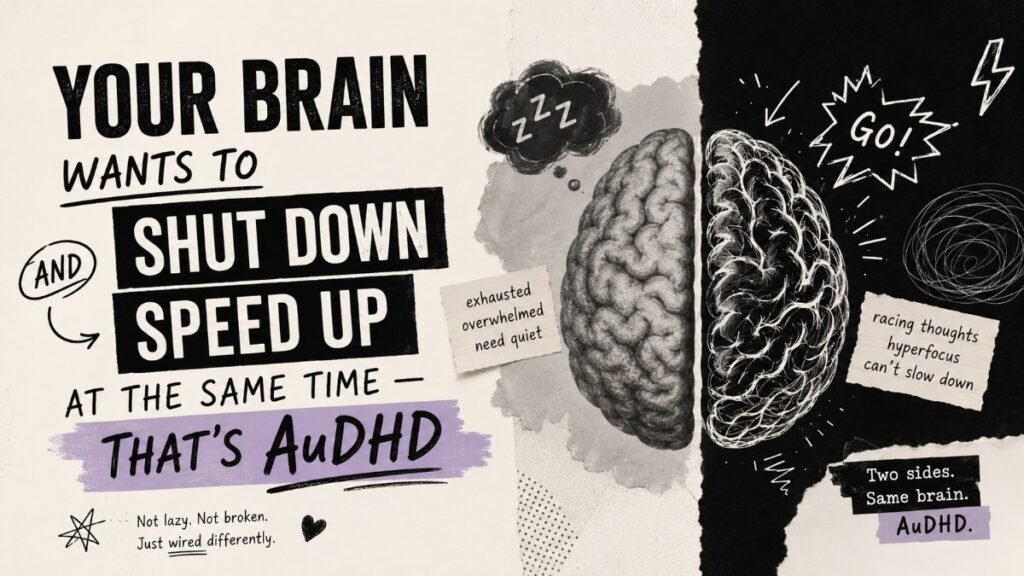
If you have both autism and ADHD, you already know the feeling: you are simultaneously desperate to escape the boredom and desperate to escape the noise. You need routine but cannot maintain it. You crave deep focus but cannot access it on demand. You want to rest but resting feels unbearable. This is not a failure of self-discipline or a quirk of personality. It is the result of two neurological operating systems with fundamentally opposing needs running inside the same brain. The term for this is AuDHD, and its core difficulty is not simply “having two conditions.” It is that those two conditions spend most of the day actively working against each other.
Why AuDHD Is More Than the Sum of Its Parts
Before the DSM-5 was updated in 2013, clinicians were not permitted to diagnose autism and ADHD in the same person. The assumption was that the two conditions were mutually exclusive: that if you had one, it explained away the other. That assumption turned out to be wrong in a clinically significant way. Research now estimates that between 50 and 70 percent of autistic people are likely also to have ADHD, making co-occurrence the rule rather than the exception.1
What the diagnostic history obscured was not just a prevalence statistic. It obscured the lived reality that many people were experiencing: a brain that did not fit cleanly inside either description. ADHD information felt close but incomplete. Autism descriptions resonated in patches. Neither framework accounted for the specific contradictions that made daily life so exhausting. AuDHD is not a simple addition of traits from column A and column B. It is a third neurological profile that arises from the interaction between the two, and that interaction is where the real difficulty lives.
The co-occurrence rate matters: Research across multiple studies estimates that 50, 70% of autistic people also meet criteria for ADHD. For many adults, receiving only one diagnosis leaves the other half of their neurological reality unnamed and unaddressed for years.
The shared genetic and neurobiological underpinnings of the two conditions go some way toward explaining the overlap. Both autism and ADHD involve atypical development in brain regions governing attention, executive function, social cognition, and emotional processing. Research has even identified the DRD4 gene variant, a dopamine receptor gene, as implicated in both conditions, with the 7-repeat allele associated with elevated risk for ADHD traits in autistic individuals and with poor emotional regulation across development (Chang, 2024, Berkeley Scientific Journal).2 The conditions share neurological real estate. What they do not share is direction of drive.
What Does the AuDHD Brain Actually Want?
The clearest way to understand why AuDHD feels like internal warfare is to look at what each set of neurological needs is actually demanding. Autism, broadly, orients the nervous system toward predictability, sameness, and lower-stimulus environments. Autistic traits include craving familiarity, finding comfort in routine and repetitive behavior, a need for sensory conditions to be consistent, and deep reliance on knowing what comes next. This is not a preference in the casual sense. The autistic nervous system actively uses predictability as a regulatory tool: when the environment is known, the sensory and cognitive load drops, and the system can function without being constantly on guard.
ADHD operates from a fundamentally different set of demands. The ADHD brain tends toward underarousal in its dopamine systems, and it responds to that underarousal by seeking novelty, stimulation, and change. Research on ADHD dopamine pathways consistently shows that the ADHD nervous system often does not reliably generate the neurochemical activation needed for engagement from routine or predictable tasks alone: it tends to require something new, urgent, challenging, or emotionally salient to trigger sufficient dopamine release for sustained focus. Left understimulated, the ADHD brain can produce intolerable restlessness. It needs to move, seek, and change.
Autism says: keep everything the same, predictable, manageable. ADHD says: this is too slow, too familiar, too quiet, find something new right now. The AuDHD brain receives both signals simultaneously, at full volume, every day.
Put those two operating systems together and you get a brain that is simultaneously trying to shut down and speed up. Not metaphorically. Neurologically. The autistic system tends to register novelty as threat. The ADHD system tends to register routine as insufferable. Every moment the brain must somehow arbitrate between two competing regulatory responses, with no clean mechanism for resolution. This is what many AuDHD adults describe when they say they feel permanently at war with themselves.
The Routine Trap: Why You Keep Starting Habits You Cannot Maintain
One of the most recognizable expressions of this conflict shows up in the relationship with routine. Autistic brains are genuinely soothed by structure. Routine reduces the cognitive and sensory overhead of navigating a world that is otherwise unpredictable and overwhelming. When things happen in the same order, at the same time, with the same sensory texture, the nervous system does not have to expend energy anticipating what comes next. Routine is not just helpful for autistic people: it is regulatory. It functions the way external scaffolding functions, lowering the arousal level of a system that is otherwise running too hot.
The ADHD brain, however, tends to become hostile to routine over time. What is novel and stimulating on day one becomes predictable and deadening by week three. The dopamine signal that once made the new habit feel manageable begins to fade as the task becomes familiar. Without novelty, the ADHD system starts searching for an exit, through distraction, avoidance, impulsivity, or simply losing the thread entirely. Research on ADHD reinforcement learning shows that ADHD brains tend to switch away from rewarded options significantly more than controls, particularly as novelty decays (Frank et al., 2007).3
For AuDHD adults, this creates a painful cycle. The autistic system builds a routine because routine is regulating. The ADHD system then dismantles it from the inside because it has become too familiar to sustain engagement. Research participants described this dynamic directly in a qualitative study of women with late-discovery AuDHD diagnoses: “I am forever starting routines and habits [autism] but I can never stick to them because I lose motivation and get bored [ADHD]” (Craddock, 2025, Health, London).4
“My autism creates a need for order, formality, structure, routines, repetition, solitude, and intense interests, all of which are disrupted by my ADHD’s chaotic impulse towards newness, variety, inconsistency, and inattention.”, Research participant, Craddock (2025)
This is not weak willpower. It is structural incompatibility between two genuine neurological needs, and recognizing it as such is the first practical step toward working with it rather than repeatedly blaming yourself for the collapse.
Autistic Inertia Meets ADHD Understimulation: The Frozen-but-Frantic State
Perhaps the most disabling expression of the AuDHD contradiction is what happens when autistic inertia and ADHD understimulation collide at the same moment. Autistic inertia is the neurological difficulty of transitioning between states: starting something new, stopping something underway, or switching from rest to action. It operates something like Newton’s first law applied to the nervous system. A brain at rest tends to stay at rest, a brain in motion tends to stay in motion. Both states can feel involuntary, and both can be functionally disabling.
ADHD understimulation is the state where the dopamine-starved nervous system is not getting enough input to feel tolerable. In this state, rest itself becomes aversive. Sitting quietly can feel like a kind of deprivation. The system urgently needs something to engage with, but nothing available feels engaging enough to break through the inertia threshold. What you get is a person who cannot start anything and also cannot comfortably tolerate not starting. Unable to move forward, unable to comfortably stay still: this is the state many AuDHD adults describe as being frozen in place while their nervous system screams.
Research on AuDHD inertia found that this push-pull between understimulation and inertia is cyclical, fatiguing, and deeply tangled with the specific interaction between autism and ADHD, it is not simply a more severe version of either condition alone. When the ADHD system finally initiates something, a project, a conversation, a hyperfocus episode, the autistic system can then lock onto it and refuse to release it long past the point where the activity is still rewarding. The result is a hyperfocus that has stopped feeling good but cannot be stopped, because the autistic system is now using it as a predictability anchor. Both locked in and wanting out, simultaneously.5
Sensory Experience: The Contradiction You Live in Your Body
The shutdown-versus-speedup conflict does not stay abstract. It is viscerally physical, particularly when it comes to sensory processing. Autism commonly involves heightened sensory sensitivity: sounds, textures, lights, and smells that neurotypical people filter effortlessly can be genuinely painful or disorganizing for autistic nervous systems. The autistic drive, accordingly, tends toward sensory quiet. Less input, less unpredictability, fewer demands on a processing system that is already working at capacity.
ADHD, meanwhile, is often associated with sensory seeking. The understimulated ADHD nervous system frequently craves sensory input as a form of stimulation: loud music, movement, busy environments, physical sensation. This is partly why many ADHD adults find it easier to work in a coffee shop than a silent room: the ambient sensory input provides enough stimulation to keep the ADHD system from hunting for distraction.
For AuDHD adults, these needs are not negotiable preferences. They are regulatory requirements from two different systems. A noisy environment can provide what the ADHD system needs while overwhelming what the autistic system can handle. A quiet environment soothes the autistic system while starving the ADHD one. Few sensory environments satisfy both simultaneously, which means the AuDHD person is often managing a deficit in at least one direction. This is exhausting in a way that is frequently invisible to others, because the person is rarely showing distress openly: they are mostly spending enormous energy compensating.
The sensory bind: AuDHD adults are not being difficult about their environment. They are managing two regulatory systems with incompatible requirements, one that needs quiet to function and one that needs stimulation to stay engaged. Neither need is optional, and compromising on both simultaneously is what drives the chronic low-grade exhaustion many describe.
Emotional Dysregulation: When Two Systems Amplify Each Other
Both autism and ADHD independently involve difficulty regulating emotions. ADHD contributes impulsivity, heightened emotional reactivity, and poor inhibition of emotional responses. Autistic nervous systems bring difficulty reading social and emotional cues, communication challenges, cognitive rigidity, and heightened susceptibility to emotional overwhelm. Neither is a simple deficit in “knowing your feelings.” Both involve structural differences in how the prefrontal cortex and limbic system communicate under stress.
When both operate together, the research suggests the effect is not simply additive. A large real-world study found that adults and children with AuDHD showed substantially higher odds of co-occurring psychiatric conditions compared to those with either diagnosis alone, suggesting that co-occurring autism and ADHD may synergistically increase vulnerability to additional mental health challenges rather than simply stacking the risks linearly.6 For emotional regulation specifically, this means AuDHD adults are often contending with the ADHD tendency toward explosive emotional intensity combined with the autistic tendency toward shutdown and withdrawal, and the combination can produce an oscillation between the two that is deeply confusing both to the person experiencing it and to everyone around them.
This is also where rejection sensitive dysphoria intersects with AuDHD in particularly painful ways. RSD, the intense emotional response to perceived criticism or rejection common in ADHD, can be amplified when autistic social processing differences mean that ambiguous social feedback is already more likely to be misread as rejection. The ADHD system generates the intensity of the response, the autistic system increases the likelihood of perceiving the trigger as real.
Why Medication Gets More Complicated in AuDHD
One of the most practically relevant aspects of AuDHD that rarely appears in mainstream content is what happens with medication. Stimulant medications, primarily methylphenidate and amphetamines, are the first-line pharmacological treatment for ADHD. They work by increasing dopamine and norepinephrine availability, particularly in the prefrontal cortex. For people with ADHD alone, they are among the most effective interventions available.
In AuDHD, the picture is more complicated. Research indicates that stimulant effects can be paradoxical in individuals who also have autism: the medication may address core ADHD traits while simultaneously producing side effects less commonly seen in ADHD-only individuals, including increased irritability, social withdrawal, and emotional flatness (Chang, 2024, Berkeley Scientific Journal).2 The hypothesis is that dopamine modulation in the autistic brain interacts differently with the striatal and prefrontal circuits involved in repetitive behavior and sensory sensitivity, producing effects that are not straightforward improvements across the board.
This does not mean stimulants do not work for AuDHD adults, many people find them highly effective with careful dose calibration. It means that “ADHD medication is not working the way I expected” is a clinically meaningful observation, not a sign that something is being done wrong. Working with a prescriber who understands the AuDHD overlap matters, because the standard titration protocol is designed around a population without concurrent autistic neurology. Dosing that addresses ADHD understimulation without overwhelming an already-sensitive autistic sensory system may require more nuanced adjustment than general guidance suggests.
The Masking Tax: Why AuDHD Adults Are So Depleted
Masking, the suppression of visible signs of neurodivergence to appear more neurotypical, depletes energy reserves that are already being heavily taxed by the internal conflict of AuDHD. Autistic masking involves monitoring and modifying social behavior constantly: making eye contact that does not come naturally, suppressing stimming, maintaining conversation scripts, keeping sensory distress invisible. ADHD masking involves managing impulsivity, manufacturing the appearance of focus, and compensating for executive function challenges through elaborate workarounds that others never see.
For AuDHD adults, both forms of masking are operating simultaneously, often in every social and professional context. Research on autistic burnout describes extreme physical, mental, and emotional exhaustion as a direct result of sustained masking to meet societal expectations, often culminating in a period of functional collapse where the person can no longer maintain the performance (Ali et al., 2025, Clinical Psychology Review).7 AuDHD adults face this burnout risk with an added layer: the ADHD executive function load means the masking itself is harder to maintain, because the system managing the performance is itself impaired.
Late discovery compounds all of this. For adults who received one diagnosis years before the other, or who received both only in adulthood, there is often a painful period of retrospective reinterpretation. Not just “why did I struggle so much?” but “which parts of my experience were which condition, and how do they interact?” That untangling is not just intellectually useful. For many people, it is the first time their internal experience has had an accurate map, and the relief of having a name for the specific contradiction they have been living is itself significant (Craddock, 2025, Health, London).4
Working With the Contradiction Rather Than Against It
The goal is not to make the AuDHD conflict disappear. It cannot be eliminated, because both sets of needs are real and both require genuine accommodation. What can change is how deliberately you structure your environment and expectations around the collision points, rather than continuing to treat the conflict as a personal failing.
The most useful reframe is that the two sets of needs are both legitimate, and both require accommodation simultaneously rather than alternately. AuDHD adults who try to fully satisfy their autistic need for routine first and then address their ADHD need for novelty tend to oscillate between the two states without settling in either. What tends to work better is finding the zone where both needs are partially met at the same time: routines that have built-in variation, environments that are sensory-predictable but cognitively stimulating, focus structures that use the ADHD interest-based system within containers that the autistic system finds safe.
Practically, this often looks like keeping the sensory environment consistent, the same workspace, the same physical setup, a controlled noise level, while varying the cognitive content of work within that environment. Or using a predictable rhythmic activity to soothe the autistic nervous system enough that the ADHD system can engage without the anxiety of sensory unpredictability pushing it toward avoidance. The aim is not balance in the abstract sense. It is deliberate partial satisfaction of both needs, consistently enough that neither system goes into full emergency mode.
Naming the conflict is not the same as resolving it. But it is the difference between fighting yourself and understanding your own neurological terrain, and that distinction changes which strategies are even worth trying.
This is genuinely difficult work, and it is not the same as standard ADHD productivity advice or standard autism self-regulation guidance. Both of those frameworks assume a single neurological profile. AuDHD requires a different design brief entirely: one that treats internal contradiction as the central constraint rather than a problem to be solved by picking a side. Understanding that you are not broken, lazy, or uniquely bad at being either autistic or ADHD, that you are instead managing two real and conflicting neurological systems in one body, is the starting point. Not the whole answer, but the only honest place to begin.
Quick Dopamine Hits:
- When you feel frozen between rest and stimulation, give yourself a ‘novelty anchor’: pick one familiar, repetitive task (like a known playlist or a podcast you have heard before) that delivers mild ADHD stimulation without unpredictability, this threads both needs at once.
- Map your conflict points this week: every time you feel the shutdown-vs-speedup war, write one sentence about what your autistic system wanted and one about what your ADHD system wanted. After three days, the patterns will show you your real triggers.
- Before starting a demanding task, spend 90 seconds doing something rhythmic and predictable, tapping, rocking, stirring a drink, to bring autistic nervous system arousal down to a baseline where the ADHD brain can engage rather than scatter.
Rate this article
Was this a useful hit?